
Views: 298 Author: Miluo Smart Home Publish Time: 2026-09-21 Origin: Site


Content Menu
● How We Selected These Manufacturers
● Top 10 Manufacturers at a Glance
● 1. Jiaxing Miluo Smart Home Co., Ltd.
>> Why buyers may shortlist Miluo
>> Questions to ask Miluo during RFQ
● 2. SSWW
● 7. HEGII
● 8. Oulin
● 9. Foshan-Based Acrylic and Bathroom Product Specialists
● 10. Zhejiang Transparent Resin and Solid-Surface Specialists
● Transparent Bathtub Materials: What Buyers Must Specify
>> 3. Solid surface and resin stone
>> 4. Glass or glass-panel designs
● The Most Common Sourcing Risks
● An Industry "Inside" Tip: Inspect the Drain Area First
● Buyer's Verification Checklist
>> Before requesting a quotation
>> During factory verification
>> For certification verification
● MOQ, Samples, and Production Planning
● Shipping and Packaging Considerations
>> Packaging requirements to include in your purchase order
● FAQ
>> 1. How can I verify whether an ISO certificate is still valid?
>> 2. How do I distinguish transparent resin from low-grade acrylic or a coated opaque bathtub?
>> 3. What should be included in a transparent bathtub golden sample agreement?
>> 4. Is CE required for a transparent bathtub sold in Europe?
>> 5. What defect rate should I allow for transparent bathtub production?
China is an important sourcing base for transparent bathtubs, acrylic tubs, resin-stone tubs, solid-surface bathtubs, and integrated bathroom collections. For professional buyers, the opportunity is not simply lower factory pricing: it is the ability to combine custom dimensions, transparent color development, private-label packaging, mixed bathroom-product sourcing, and export-oriented production.
However, a transparent bathtub is not a conventional white acrylic tub. Its appearance makes material purity, mold quality, thickness consistency, polishing, UV resistance, structural reinforcement, and packaging defects immediately visible. A minor yellowing issue, internal bubble, stress crack, or uneven gloss that may be less noticeable on an opaque bathtub can become a serious customer complaint on a clear or tinted transparent model.
China's sanitary ware ecosystem is supported by several production clusters. Foshan and Chaozhou are widely associated with ceramics, bathroom fittings, and complete sanitary ware supply chains; Zhejiang has strong export-manufacturing and logistics links; while Guangdong, Jiangsu, and other coastal provinces provide broad access to acrylic, resin, molding, hardware, packaging, and export services. China's sanitary ware exports reached 2.17 million tonnes in 2024, up 19.7% from 2023, according to Ceramic World Web's trade analysis—a useful indicator of the country's continuing role in global sanitary ware supply.
This article focuses on manufacturers and sourcing options relevant to buyers seeking transparent bathtubs, especially transparent resin bathtubs, crystal-look bathtubs, clear freestanding bathtubs, colored transparent tubs, and customized premium bathroom collections.
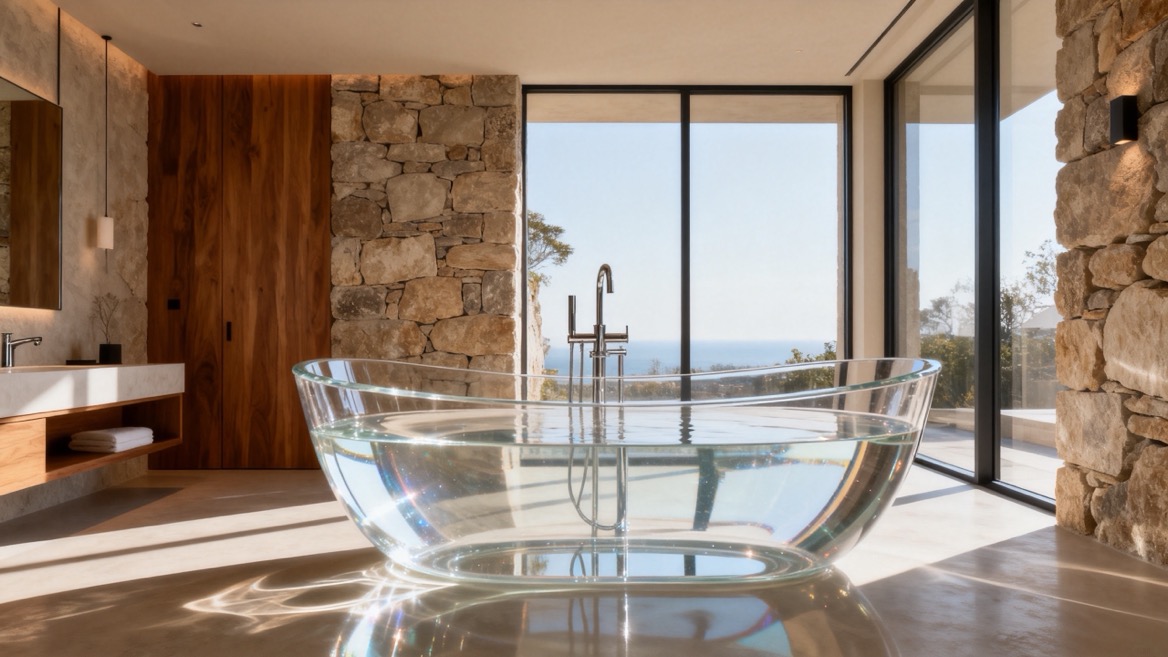
This list is designed for procurement managers, brand owners, wholesalers, hospitality-project buyers, and manufacturers looking for long-term OEM or ODM partners. The companies below are not ranked solely by size. Instead, they are reviewed according to the practical capabilities that matter when sourcing a high-visibility bathroom product.
- Product relevance: Ability to supply freestanding bathtubs, transparent resin tubs, acrylic tubs, solid-surface tubs, basins, vanities, or coordinated bathroom collections.
- Manufacturing capability: Evidence of product development, molding, finishing, production organization, and quality control.
- Customization depth: Support for dimensions, colors, surface finish, drainage position, overflow configuration, accessories, private labeling, packaging, and model development.
- Export orientation: Experience serving overseas markets, communication capability, shipping support, and familiarity with market-specific compliance requirements.
- Quality transparency: Willingness to provide material declarations, inspection records, sample approval procedures, product drawings, and batch traceability.
- Commercial fit: Suitability for different buyer types—from established brands with container-level demand to smaller premium brands testing a new transparent bathtub collection.
- Logistics practicality: Access to major export ports, packaging competency, and ability to manage fragile or scratch-sensitive products.
A credible supplier should not simply state that its products are "high quality." It should be able to answer specific questions: What resin system is used? What is the nominal and minimum finished wall thickness? Is the surface polished manually, mechanically, or both? What is the acceptable bubble standard? How are units inspected under direct light? How is each tub protected from abrasion during inland transport and ocean freight?
For broader market context, Statista notes that the North American bathroom hardware market generated more than USD 20 billion in 2024, with further growth expected in subsequent years. This demand environment helps explain why brands increasingly seek differentiated products, including colored, sculptural, freestanding, and transparent-look bathtubs.
The table below is a buyer-oriented comparison. Capacity and MOQ should be treated as quotation-stage items, because they vary materially by design complexity, mold availability, color, material system, reinforcement requirements, and packaging specification.
| Manufacturer / Supplier | Main Focus | Suitable Buyer Profile | Typical OEM/ODM Scope | Practical MOQ Expectation | Certificates / Compliance to Request |
|---|---|---|---|---|---|
| Jiaxing Miluo Smart Home Co., Ltd. | Transparent resin, solid-surface, resin-stone tubs, basins, vanities | Small-to-mid-sized premium brands, distributors, design-led projects | Custom colors, dimensions, coordinated bathroom collections, branding, packaging | Discuss by model; lower-volume custom development may be more practical than at high-volume factories | Factory certificates, material data, market-specific test reports |
| Oulin / Ningbo Oulin Kitchenware | Kitchen and bathroom systems | Established distributors and project buyers | Product integration, branded bathroom solutions | Generally project or volume-oriented | ISO documentation, product-specific compliance files |
| SSWW | Bathtubs, shower enclosures, sanitary ware | Large wholesalers, retail programs, project buyers | Branded and project-oriented bathroom supply | Usually higher for standard production programs | ISO, CE-related product documents where applicable |
| FAENZA | Bathroom ceramics and integrated sanitary ware | Retail, distributor, and developer channels | Complete bathroom collections and market adaptations | Typically volume-based | Product-category certification and export documentation |
| APPOLLO | Massage tubs, shower rooms, wellness products | Wellness, hotel, and higher-specification buyers | Functional bathtub configurations and project solutions | Depends on model and system requirements | Electrical and safety documents for powered products |
| Huida | Broad sanitary ware portfolio | National distributors, developers, project procurement | Integrated product supply and private-label discussions | Usually higher-volume | ISO and product-category compliance documents |
| Arrow Home Group | Bathroom collections and smart-bathroom products | Large-scale retail and project accounts | Collection planning and integrated supply | Often volume-oriented | Product-specific reports and regional compliance documents |
| HEGII | Bathroom fixtures and smart sanitary ware | Mid-to-large distributors and projects | Coordinated bathroom products, some customization | Generally program-based | Certification files by product category |
| MONDIAL / Foshan-area suppliers | Acrylic tubs, shower products, sanitary ware | Wholesalers seeking broad selection | Dimensions, colors, packaging, accessory options | Depends on existing molds | Material declarations and export compliance documentation |
| Zhejiang regional acrylic/resin specialists | Freestanding tubs, solid surface, resin products | Brands seeking niche design development | Deep customization, lower-volume development potential | Varies widely; must verify model-by-model | Material safety, REACH/RoHS if required, factory audit records |
The companies with broad ceramic and full-bathroom portfolios may be a better fit when you need toilets, basins, shower enclosures, faucets, cabinets, and bathtubs in one procurement program. Specialist resin and solid-surface manufacturers can be more suitable when your product strategy centers on design differentiation, transparent effects, special colors, smaller launch quantities, or complex OEM development.
Do not assume that a large sanitary ware group is automatically the strongest transparent bathtub partner. Large factories often excel in standardized mass production, while a specialist manufacturer may be more responsive on prototype iterations, niche materials, color matching, custom reinforcement, and lower-volume product development.
Location: Jiaxing, Zhejiang, China
Established: 1999; the Miluo brand was launched in 2005
Core products: Transparent resin bathtubs, solid-surface bathtubs, resin-stone bathtubs, acrylic bathtubs, basins, vanities, shower bases, and mirrors
Main markets: North America, the United Kingdom, Canada, Australia, the Middle East, and other overseas markets
Best fit: Brands, wholesalers, design studios, and project buyers seeking flexible OEM/ODM development and coordinated modern bathroom collections
Jiaxing Miluo Smart Home Co., Ltd. is a relevant option for buyers whose transparent bathtub sourcing strategy requires more than an off-the-shelf product. The company positions itself around customized contemporary bathroom products and solutions, covering transparent resin, solid-surface, resin-stone, acrylic, basin, vanity, shower-base, and mirror categories. It is located in Jiaxing, Zhejiang, with logistical access to both Shanghai Port and Ningbo Port.
For a procurement manager, the practical value lies in the company's potential flexibility. Rather than limiting sourcing discussions to a single freestanding bathtub SKU, buyers can explore a coordinated product program: transparent bathtub plus matching transparent basin, solid-surface basin, vanity, shower base, LED mirror, private-label packaging, and market-specific accessory selection.
Miluo states that it has focused on sanitary ware research, development, production, and export for more than a decade. Its company profile also identifies the United States, United Kingdom, Canada, Australia, and Middle East as established market areas. This makes the company particularly relevant for small and medium-sized overseas brands that need timely English communication, design coordination, and an OEM partner willing to work through product details before mass production.
- Product coverage includes transparent resin and complementary bathroom products, which can reduce supplier fragmentation.
- The company supports customized high-end bathroom concepts rather than only standard commodity tubs.
- Its location near Shanghai and Ningbo can support practical export planning for containerized shipments.
- The business emphasizes project communication from concept development through delivery and feedback.
- It may be a particularly suitable candidate for buyers that need prototypes, color options, branded packaging, and flexible development support before committing to larger recurring orders.
- Can you provide the exact resin formulation category and technical data sheet for the transparent bathtub?
- What is the nominal and minimum wall thickness in the rim, sidewall, base, and drain area?
- Can you provide a signed golden sample and color-transmission reference standard?
- What are the available transparent colors, tint tolerances, and UV-stability options?
- Can the company provide matching transparent basins or related solid-surface collections?
- What are the MOQ, tooling cost, sample lead time, mass-production lead time, and packaging specification for the selected model?
Location: Foshan, Guangdong, China
Core products: Bathtubs, shower rooms, toilets, basins, bathroom cabinets, and bathroom accessories
Best fit: Buyers seeking an established, broad-category supplier for retail programs, distributors, and project packages
SSWW is known in the Chinese bathroom sector for offering an integrated sanitary ware portfolio that includes bathtubs and shower products. Its scale and broad collection approach can be attractive to buyers seeking a unified supplier for multiple bathroom categories rather than a single transparent bathtub item.
For transparent-bathtub procurement, buyers should determine whether the desired transparent construction is a standard offering, a custom development project, or a special material request. Larger integrated suppliers may have stronger systems for standardized quality management and export documentation, while customization lead times and MOQ requirements can be more demanding.
Use SSWW when your purchasing program requires a broad bathroom range and your transparent bathtub model can align with the supplier's development priorities, tooling capabilities, and production schedule. Request physical material samples under natural light, warm indoor lighting, and direct LED lighting before approval.
Location: Foshan, Guangdong, China
Core products: Bathroom ceramics, bathtubs, basins, cabinets, shower products, and coordinated bathroom systems
Best fit: Retailers, distributors, developers, and buyers seeking a design-coordinated bathroom collection
FAENZA operates in the broader bathroom furnishing and sanitary ware space, offering a collection-driven approach. This can be useful when a buyer's product assortment must maintain consistent visual language across bathtub, basin, vanity, and other bathroom components.
For transparent bathtub inquiries, buyers should distinguish between a visually transparent material, a transparent decorative component, and a fully transparent structural bathtub. The structural and technical implications are very different. A clear decorative panel can have lower mechanical demands than a bathtub shell designed to carry a filled-water load and repeated human use.
Ask for engineering confirmation of the load-bearing structure, drain-area reinforcement, base support, and long-term color stability. Do not approve transparent material based on studio images alone.
Location: Guangdong, China
Core products: Massage bathtubs, whirlpool tubs, shower rooms, steam cabins, and wellness-oriented bathroom products
Best fit: Hotel, spa, premium residential, and wellness buyers requiring functional bathtub systems
APPOLLO is more relevant to buyers seeking a wellness or hydrotherapy angle. If a transparent bathtub concept includes air jets, water jets, chromotherapy, LED lighting, heating, or control systems, a supplier experienced with functional tubs can be valuable.
The sourcing risk rises significantly once electrical and water systems are integrated. Transparent material makes internal pipe routing, bonding quality, and structural concealment more visible. Buyers should request wiring diagrams, component-brand lists, water-pressure testing procedures, electrical safety documentation, spare-parts terms, and post-sale support commitments.
For powered tubs, request product-specific compliance documentation for the destination market. CE marking alone is not a universal quality guarantee; the buyer must confirm that the relevant directives, standards, technical file, declaration, and test scope match the actual product configuration and target market.
Location: Tangshan, Hebei, China
Core products: Toilets, basins, bathtubs, cabinets, shower products, fittings, and integrated bathroom solutions
Best fit: Large distributors, developers, and procurement groups needing broad category coverage
Huida is associated with broad sanitary ware manufacturing and is especially relevant where a buyer needs an integrated bathroom sourcing strategy. Tangshan is a well-known ceramic sanitary ware production area, supported by long-established industrial infrastructure and supply-chain resources.
For transparent bathtub buyers, Huida may be more relevant as part of a complete bathroom procurement program than as a specialist transparent-resin source. Its value proposition may be broader product coordination, supplier consolidation, and category coverage.
Confirm whether the transparent bathtub is produced in-house, co-developed with a specialist division, or sourced from a partner. This distinction affects control over mold changes, defect handling, lead times, and long-term spare-parts availability.
Location: Foshan, Guangdong, China
Core products: Toilets, bathroom furniture, shower products, bathtubs, faucets, and smart bathroom products
Best fit: Larger retail accounts, branded bathroom programs, and commercial projects
Arrow Home Group is a major name in China's integrated bathroom industry. Buyers considering a collection-based purchasing program may find value in its broad product coverage, category integration, and established market presence.
Transparent bathtub development with a major group should be approached as a formal product-development project. The buyer should be prepared to supply clear CAD drawings, surface requirements, intended retail price, target markets, expected annual quantities, packaging requirements, and compliance needs.
Large suppliers can offer systems and scale, but small custom orders may receive less priority. If your launch quantity is limited, negotiate a phased plan: engineering sample, pilot production, initial market batch, then annual-volume expansion.
Location: Guangdong, China
Core products: Sanitary ware, bathroom furniture, shower systems, and smart bathroom products
Best fit: Buyers seeking modern bathroom collections and project-oriented supply
HEGII is another major Chinese bathroom brand with product categories spanning traditional sanitary ware and more contemporary bathroom systems. It can be relevant to buyers sourcing a full bathroom concept, especially where design coordination and distribution support matter.
The key question is whether the transparent bathtub is a true strategic category for the factory or a custom request outside its standard production process. A supplier can technically agree to develop a product without having the mature process discipline required for consistent transparent resin production.
Ask to inspect previous transparent, colored-resin, high-gloss composite, or similar high-appearance-quality products. Past experience with opaque tubs is useful but does not automatically prove competence in producing crystal-clear or tinted transparent shells.
Location: Ningbo, Zhejiang, China
Core products: Kitchen and bathroom products, sinks, cabinets, sanitary ware, and integrated home solutions
Best fit: Distributors and project buyers seeking product-system integration and export logistics advantages
Oulin's Zhejiang location places it in a region with strong export infrastructure and proximity to Ningbo-Zhoushan Port, one of China's major shipping gateways. For buyers managing multi-category kitchen-and-bathroom programs, this can be commercially useful.
A transparent bathtub buyer should assess whether the supplier's primary strengths match the desired product. Companies with strong sink, cabinet, or kitchen systems may be capable of coordinating a bathroom collection, but the transparent bathtub itself may require a dedicated resin, acrylic, or composite production partner.
Request a factory-map explanation: Which components are made internally, which are outsourced, who owns the molds, and who carries warranty responsibility if a transparent shell cracks or discolors after installation?
Location: Foshan, Guangdong, China
Core products: Acrylic tubs, shower enclosures, shower trays, bathroom cabinets, faucets, and sanitary ware
Best fit: Buyers wanting access to a dense bathroom-product supply chain and a wide range of existing models
Foshan remains one of China's strongest bathroom and building-material sourcing hubs. The practical advantage is supply-chain density: buyers can source bathtub shells, metal frames, overflow kits, drains, faucets, shower screens, vanities, mirrors, lighting, and packaging services within the wider regional ecosystem.
For transparent bathtub programs, Foshan suppliers can be highly competitive when the buyer needs several design options quickly. But the concentration of suppliers also makes verification more important. A showroom may display a product that was manufactured by another factory, while the quoted company may act as a trading organization or project integrator.
Do not rely only on a showroom visit. Ask to see:
- The molding or casting area
- Raw-material storage and batch identification
- Cutting, sanding, polishing, and reinforcement stations
- Water-testing area
- Final inspection under controlled lighting
- Export-packing process
- Traceability labels or batch records
Location: Zhejiang, China
Core products: Transparent resin tubs, resin-stone tubs, solid-surface tubs, basins, shower trays, and custom bathroom surfaces
Best fit: Design-led brands, boutique hospitality buyers, and companies needing color, shape, or low-to-medium-volume customization
Zhejiang has a strong manufacturing culture, developed export logistics, and access to Shanghai and Ningbo shipping routes. It is also home to many specialist factories that can be more responsive than large national brands when buyers need custom molds, colored resin development, special dimensions, matching basins, or private-label programs.
This group includes companies that may not be as internationally famous as large sanitary ware brands but can be strong technical partners for a transparent bathtub program. Their suitability depends on factory discipline, material sourcing, polishing quality, reinforcement design, and the depth of their export process.
A smaller specialist factory can be the better option when your product depends on fast technical communication and customization. However, buyers should conduct stronger due diligence: on-site audit, sample inspection, documented quality plan, production-capacity verification, and third-party pre-shipment inspection.
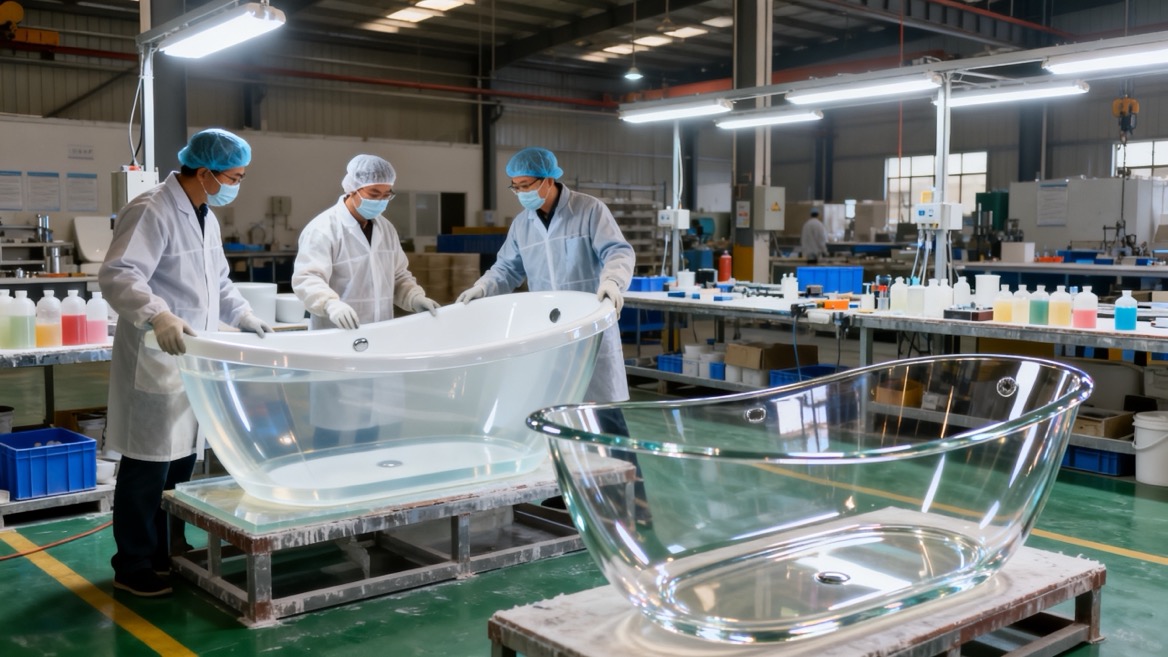
Transparent bathtubs are often described with inconsistent terms. A buyer should never approve the phrase "transparent acrylic bathtub" or "crystal bathtub" without a detailed specification sheet.
Cast acrylic is commonly used in conventional bathtubs because it can offer a glossy surface, moderate weight, and thermoforming flexibility. However, a clear acrylic construction may require careful thickness control, reinforcement, edge treatment, and scratch protection.
Ask for:
- Acrylic sheet grade and supplier
- Virgin-material confirmation
- Sheet thickness before forming
- Minimum thickness after thermoforming
- Reinforcement materials and application method
- Surface scratch resistance
- UV-stability information
- Cleaning-agent restrictions
Transparent resin systems can create highly sculptural, glass-like, colored, or artistic effects. Their quality depends heavily on resin chemistry, curing discipline, mold release, pigment compatibility, degassing, polishing, and post-curing.
Ask for:
- Resin type and technical data sheet
- Yellowing-resistance performance
- UV exposure data, where available
- Cure schedule and post-cure process
- Bubble, flow-line, inclusion, and haze acceptance criteria
- Surface repair procedure
- Chemical-resistance information
- Material traceability by production batch
Solid surface and resin stone are generally opaque or lightly translucent rather than fully transparent. They may be better suited to buyers prioritizing durability, repairability, matte finishes, and color consistency over glass-like clarity.
These materials can work well for matching basins, shower bases, vanity tops, and coordinated bathroom collections. For a transparent bathtub collection, a brand may combine a transparent tub with solid-surface accessories to balance visual impact and product practicality.
A true glass bathtub or a tub with large structural glass panels has different engineering and safety requirements from transparent resin or acrylic. It may involve laminated safety glass, metal framing, specialized seals, and a more complex shipping-risk profile.
Do not compare its pricing directly with transparent resin tubs. The materials, liability profile, manufacturing process, and freight-damage risk are not equivalent.
Transparent bathtubs expose defects that opaque products can hide. Below are the most common problems buyers should anticipate.
| Risk | What It Looks Like | Why It Happens | How to Prevent It |
|---|---|---|---|
| Yellowing | Clear material becomes warm, amber, or unevenly tinted | Low-grade resin, weak UV stabilizers, poor curing, unsuitable pigments | Request material data, aging tests where available, and retain approved control samples |
| Internal bubbles | Small bubbles or voids visible inside the transparent body | Insufficient degassing, moisture contamination, poor pouring process | Define acceptable bubble size and count; inspect samples under direct light |
| Haze or cloudiness | Loss of clarity, milky appearance, uneven transparency | Resin mixing errors, humidity, poor polishing, contamination | Approve transparency standard using physical samples, not only photos |
| Stress cracking | Fine cracks near drains, rims, corners, or base | Weak reinforcement, insufficient thickness, improper handling, thermal stress | Require drawings, reinforcement plan, load testing, and drain-area inspection |
| Scratches | Fine lines visible after shipment or installation | Inadequate protective film, poor packing, rough handling | Specify protective layers, corner protection, crate design, and abrasion testing |
| Color inconsistency | Different units vary in tint or transparency | Uncontrolled pigment dosage, resin-batch variation, inconsistent curing | Use master color chips and signed golden samples |
| Unstable base | Tub rocks, twists, or drains poorly | Inaccurate mold, weak frame, poor leveling design | Inspect base flatness, support design, water drainage, and installation instructions |
| Hidden outsourcing | Factory cannot control quality or lead times | Trader or partial assembler presents another factory’s product | Audit the actual production site and verify mold ownership |
One rarely discussed but highly practical inspection method is to examine the drain opening and surrounding underside before focusing on the overall appearance.
Why? The drain zone is where several manufacturing weaknesses often become visible first:
- Material thickness may be reduced after drilling or finishing.
- Resin flow lines, internal bubbles, incomplete curing, or reinforcement transitions can appear around the opening.
- Stress concentration is higher when the tub is filled with water.
- Poor bonding between the visible shell and structural reinforcement may be hidden elsewhere but exposed near the drain.
- An overly aggressive polishing or drilling process can create micro-cracks that later grow during transportation or installation.
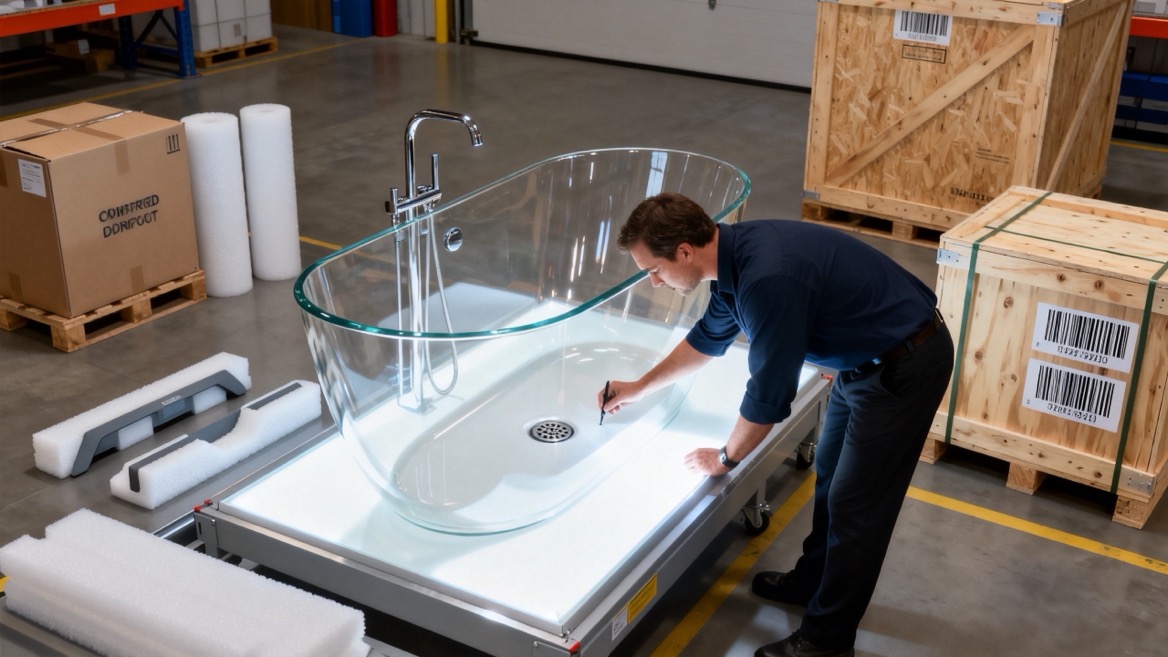
During sample approval, ask the supplier to provide close-up photographs and videos of the drain hole, overflow area, lower shell, base joints, and underside reinforcement. For high-value orders, have an independent inspector use a bright side light and magnification to check these areas.
A beautiful showroom image is not proof of long-term structural reliability. The underside, drain area, overflow opening, and base-frame connection are often more informative than the tub's most photogenic angle.
Prepare a clear request for quotation with the following information:
- Product type: transparent resin, acrylic, glass-panel, or composite bathtub
- Target dimensions and tolerances
- Desired capacity and waterline
- Transparent color: clear, smoky grey, amber, green, blue, or custom tint
- Surface finish: high gloss, satin, matte, polished, or textured
- Freestanding, wall-adjacent, alcove, or drop-in installation
- Drain and overflow configuration
- Required accessories: waste, overflow, pop-up drain, frame, faucet deck, headrest, LED lighting, jets, or heating
- Target destination country
- Required certifications or test reports
- First-order quantity and estimated annual volume
- Packaging requirement
- Private label, barcode, manual, and carton-marking requirements
- Required Incoterm: EXW, FOB, CIF, DDP, or another agreed term
A serious supplier evaluation should include:
1. Business registration review
Confirm the legal entity name, address, registered scope, export status, and bank-account consistency.
2. Factory audit
Verify the actual location of molding, finishing, assembly, water testing, inspection, warehousing, and packing.
3. Material verification
Request invoices, technical data sheets, or supplier declarations for acrylic sheets, resin systems, pigments, reinforcement materials, and hardware.
4. Sample approval
Approve a physical golden sample, including color, transparency, finish, drain configuration, logo position, and packaging.
5. Quality plan
Require a documented inspection plan covering incoming materials, in-process inspection, water testing, cosmetic inspection, final packaging, and batch traceability.
6. Pre-shipment inspection
Use a third-party inspection agency or your own quality team to conduct random sampling before final payment or shipment release.
Do not accept a PDF certificate at face value. Ask for:
- Certificate number
- Issuing body
- Scope of certification
- Factory legal name and address
- Issue date and expiry date
- Audit report or audit summary where appropriate
- Direct verification through the issuing certification body's official database
- Confirmation that the certificate applies to the actual manufacturing site
For products intended for Europe, buyers may request CE-related documentation where relevant. However, CE applicability depends on the product configuration. A non-powered freestanding bathtub, a whirlpool tub, and an electronically controlled tub do not necessarily fall under the same conformity-assessment requirements. If your product includes electrical parts, consult a qualified compliance specialist for the destination market.
RoHS is generally more relevant to electrical and electronic components than to a standard non-powered bathtub body. It may become relevant for LED modules, control panels, wiring systems, powered pumps, or other electrical accessories. Buyers should avoid asking for generic "CE/RoHS certificates" without specifying the actual product and applicable regulatory scope.
MOQ is often misunderstood in transparent bathtub sourcing. There are usually three separate commercial thresholds:
| Commercial Item | What It Covers | Buyer Question |
|---|---|---|
| Sample MOQ | Prototype or approval sample cost | Is the sample refundable against a future production order? |
| Color MOQ | Minimum quantity for a custom transparent tint or pigment batch | Can the color be repeated using a documented formula and master chip? |
| Mold MOQ | Volume needed to justify a new mold or modified mold | Who owns the mold after payment, and can it be transferred? |
| Production MOQ | Minimum order quantity for routine manufacturing | Can multiple colors or sizes be mixed in one container? |
| Packaging MOQ | Minimum quantity for custom cartons, foam, manuals, or labels | Can neutral packaging be used for the first order? |
For a first transparent bathtub order, a phased approach is often safer:
1. Confirm the technical drawing and material specification.
2. Produce a prototype or pre-production sample.
3. Inspect the sample in person or through a third party.
4. Approve a golden sample and written acceptance criteria.
5. Start a limited pilot order.
6. Conduct pre-shipment inspection.
7. Review market feedback before scaling the model.
This method may cost more initially than placing a large order immediately, but it reduces the risk of receiving inventory with inconsistent transparency, poor reinforcement, incorrect drainage, or unsuitable packaging.
Transparent bathtubs require more careful logistics planning than standard opaque sanitary ware.
- Protective film on visible surfaces
- Non-abrasive protective wrapping
- Foam or molded support at contact points
- Reinforced edge and corner protectors
- Individual carton, pallet, plywood crate, or customized crate design
- Clear "fragile," "do not stack," and orientation marks
- Moisture-protection plan for sea freight
- Photo documentation before container loading
- Container-loading plan that prevents movement and stacking pressure
- Confirm the cubic-meter volume per model before comparing FOB and CIF pricing.
- Ask whether tubs can nest safely; many transparent tubs cannot be nested without scratch or pressure risk.
- Consider mixed-container loading with vanities, basins, shower bases, or mirrors only if the load plan prevents contact damage.
- Request spare drainage parts, touch-up kits if technically suitable, and replacement-unit policy before shipping.
- For project orders, align production completion with installation schedules, not only port departure dates.
Jiaxing-based suppliers such as Jiaxing Miluo Smart Home Co., Ltd. can offer practical access to Shanghai and Ningbo export routes, which can be useful when managing international shipments and comparing freight options.
The right transparent bathtub manufacturer is not necessarily the largest company, the lowest-priced quotation, or the supplier with the most polished catalog. The right partner is the one that can document its material system, show real production capability, maintain repeatable transparency and finish, communicate clearly during development, and support your brand after the container leaves the factory.
For large standardized programs, integrated sanitary ware groups may offer broad category support and scalable supply. For premium, design-led, or custom transparent bathtub projects, specialist resin and solid-surface manufacturers can offer more flexibility—provided they pass a serious factory, sample, and quality-control review.
Jiaxing Miluo Smart Home Co., Ltd. is worth considering for buyers looking for a flexible partner in transparent resin bathtubs and coordinated high-end bathroom collections. Its product range includes transparent resin, solid-surface, resin-stone, acrylic bathtub, basin, vanity, shower-base, and mirror categories, while its Jiaxing location supports access to Shanghai and Ningbo export logistics. The company's stated focus on customized bathroom solutions and ongoing client communication makes it particularly relevant for small and mid-sized brands that need OEM development support rather than a purely standardized catalog transaction.
Before proceeding, request a product specification package, technical drawings, material declarations, certification files relevant to your market, current MOQ guidance, a sample quotation, and an inspection plan. The most reliable sourcing decision is made after comparing physical samples, factory evidence, written specifications, and final landed cost—not after comparing unit prices alone.
Start by checking the certificate number, legal entity name, factory address, scope, issue date, expiry date, and issuing certification body. Then verify it through the certification body's official database or directly by email. Also confirm that the certificate covers the factory actually producing your bathtub—not a trading company, a head office, or a different production location.
An ISO 9001 certificate can indicate that a quality-management system has been audited, but it does not prove that every transparent bathtub meets your material, appearance, or durability requirements. You still need sample approval, inspection standards, and batch-level quality control.
Ask for a cross-section sample, material technical data sheet, product-construction drawing, and close-up photos of the drain area and cut edges. Transparent resin and acrylic can look similar in polished photographs, but their processing, thickness behavior, reinforcement method, repairability, and long-term color stability may differ.
A reliable supplier should explain the material structure clearly rather than use vague terms such as "crystal material" or "premium transparent material."
The agreement should include product code, dimensions, transparency standard, approved color chip, surface gloss or finish, visible-defect standard, bubble tolerance, scratch standard, drain and overflow location, base configuration, logo position, packaging method, accessory list, installation manual, and acceptance photographs.
It should also specify that mass-production units must match the approved sample within agreed tolerances.
It depends on the bathtub configuration and applicable European legislation. A basic non-powered bathtub is different from a whirlpool bathtub with pumps, LED lights, controls, heating, or other electrical components. Buyers should determine the applicable requirements for the exact model and obtain documentation specific to that configuration.
Do not accept a generic CE logo as sufficient evidence. Request the Declaration of Conformity, applicable standards, test reports where required, and evidence that the documents correspond to the actual product.
There is no universal percentage that replaces a written appearance standard. Transparent products are visually sensitive, so cosmetic acceptance criteria should be more detailed than for opaque tubs. Define inspection distance, lighting conditions, bubble size and quantity, scratch limits, haze tolerance, color variation, edge quality, water leakage, base stability, and packaging damage criteria.
For high-end retail models, many buyers require near-zero tolerance for visible defects on primary viewing surfaces. A supplier should identify how defects are classified and how rejected units are segregated before shipment.
- [Ceramic World Web: World Sanitaryware Imports and Exports (2024)] — Reports China's 2024 sanitary ware export volume at 2.17 million tonnes, an increase of 19.7% year on year. [ceramicworldweb]
- [Statista: Bathroom Market in the United States] — Provides market context for North American bathroom hardware and renovation demand. [statista]
- [Miluo Bath: Company Profile] — Company information, product categories, export-market references, and Jiaxing location details. [china-miluo]


