
Views: 220 Author: Miluo Smart Home Publish Time: 2026-09-15 Origin: Site


Content Menu
● Why Minimalist Bathrooms Need Better Basin Design
● Seamless Pedestal Basin vs. Traditional Pedestal Basin
● What Makes a Pedestal Basin "Seamless"?
>> Material Choices Shape the Result
● Why Seamless Designs Work in Minimalist Bathrooms
>> It Creates a Clear Visual Hierarchy
>> It Makes Floor Space Feel More Open
>> It Supports Easier Visual Cleaning
● The Practical Trade-Off: Style vs. Storage
● Product Development Checklist for Brands and Buyers
>> 1. Define the Intended Bathroom Segment
>> 2. Confirm Dimensions and Ergonomics
>> 3. Select Faucet Compatibility Early
>> 4. Engineer Installation and Service Access
● Customization Opportunities for OEM and ODM Projects
● A Sourcing Framework for Importers
● Choosing the Right Basin for Each Project
● FAQ
>> 1. What is a seamless pedestal basin?
>> 2. Are seamless pedestal basins suitable for small bathrooms?
>> 3. Do pedestal basins provide storage?
>> 4. Which material is best for a seamless pedestal basin?
>> 5. Can seamless pedestal basins be customized for private-label brands?
>> 6. What should buyers check before ordering pedestal basins in bulk?
>> 7. Are seamless pedestal basins suitable for hotels?
Seamless pedestal basins are reshaping minimalist bathrooms by combining a clean monolithic appearance with practical everyday performance. For international bathroom brands, wholesalers, project developers, and manufacturers, the shift is not simply from a traditional pedestal basin to a newer silhouette—it is a move toward more intentional product design, easier visual coordination, and higher perceived product value.
A conventional pedestal basin typically uses a separate washbasin and pedestal or shroud. A seamless pedestal basin, by contrast, presents the bowl and base as one continuous sculptural form. This difference has major implications for product development, material selection, installation planning, maintenance, branding, and customer appeal.
For a supplier offering custom modern bathroom collections, such as Jiaxing Miluo Smart Home Co., Ltd., seamless pedestal basins create meaningful OEM and ODM opportunities. The category enables brands to develop distinctive basin collections through customized dimensions, finishes, colors, tap-hole positions, drainage configurations, logos, and packaging—without relying on generic designs that are difficult to differentiate in competitive export markets.
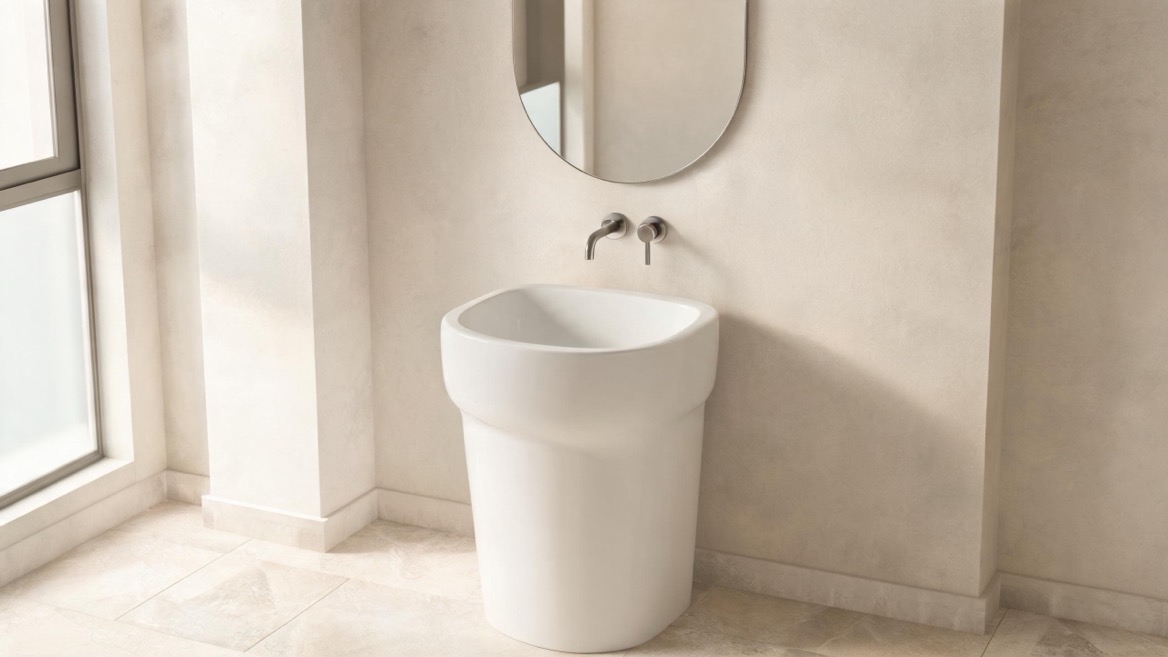
Minimalism in bathroom design does not mean creating an empty room. It means removing unnecessary visual noise and giving each functional object a clear purpose.
In a minimalist bathroom, the basin is often one of the first elements people notice. It sits at eye level, interacts with faucets and mirrors, and influences how spacious, calm, and premium the room feels. A basin with too many joints, exposed pipes, bulky cabinetry, or mismatched surfaces can interrupt the intended design language.
A seamless pedestal basin supports minimalist interiors because it offers:
- A continuous visual profile from basin rim to floor.
- Fewer visible transitions between individual components.
- Concealed plumbing, depending on the installation system.
- A freestanding focal point without the bulk of a vanity cabinet.
- More visible floor area than many full-width bathroom cabinets.
- A premium, architectural appearance suitable for residential and commercial projects.
Traditional pedestal basins remain useful and commercially important. However, the market increasingly values products that look intentional from every viewing angle. This is particularly relevant in boutique hotels, premium apartments, show homes, villas, hospitality washrooms, spa environments, and high-end renovation projects.
Contemporary bathroom trends are moving beyond cold, purely white minimalism toward warmer spaces with tactile materials, sculptural fixtures, and refined finishes. Pedestal basins continue to be a relevant format within this direction, especially when they are redesigned with slimmer proportions, softer geometry, and a more integrated appearance.
The difference between these two basin types is more than visual. Buyers should assess them across design, manufacturing, installation, maintenance, and market positioning.
| Comparison Factor | Seamless Pedestal Basin | Traditional Pedestal Basin |
|---|---|---|
| Overall appearance | Integrated, monolithic, and sculptural | Basin and pedestal appear as separate components |
| Visual impact | Strong focal point for premium interiors | Familiar and versatile, but often more conventional |
| Surface transitions | Minimal visible joints | May include seams between basin, pedestal, and wall |
| Product differentiation | High potential for exclusive shapes and finishes | More likely to compete in standardised designs |
| Plumbing concealment | Often designed to hide pipework elegantly | Usually conceals pipework through a pedestal or shroud |
| Storage space | No built-in cabinet storage | No built-in cabinet storage |
| Cleaning experience | Smooth external form can reduce dirt-catching edges | Accessible, but seams and rear areas may require attention |
| Installation requirements | Requires precise site planning and fixing details | Often simpler for standard replacement projects |
| Target market | Luxury residential, hospitality, designer projects | Residential renovation, compact bathrooms, mainstream retail |
| Brand positioning | Design-led and premium | Practical, classic, and value-oriented |
A standard pedestal basin is generally wall-mounted, while the pedestal conceals the trap and water supply lines. This format preserves floor visibility and can be effective in smaller bathrooms. Typical pedestal basin widths are commonly around 450–600 mm, with standard rim heights often planned around 800–850 mm from the finished floor.
The seamless version takes the concept further. Instead of presenting the pedestal as a supporting accessory, it turns the entire basin into a single design object.
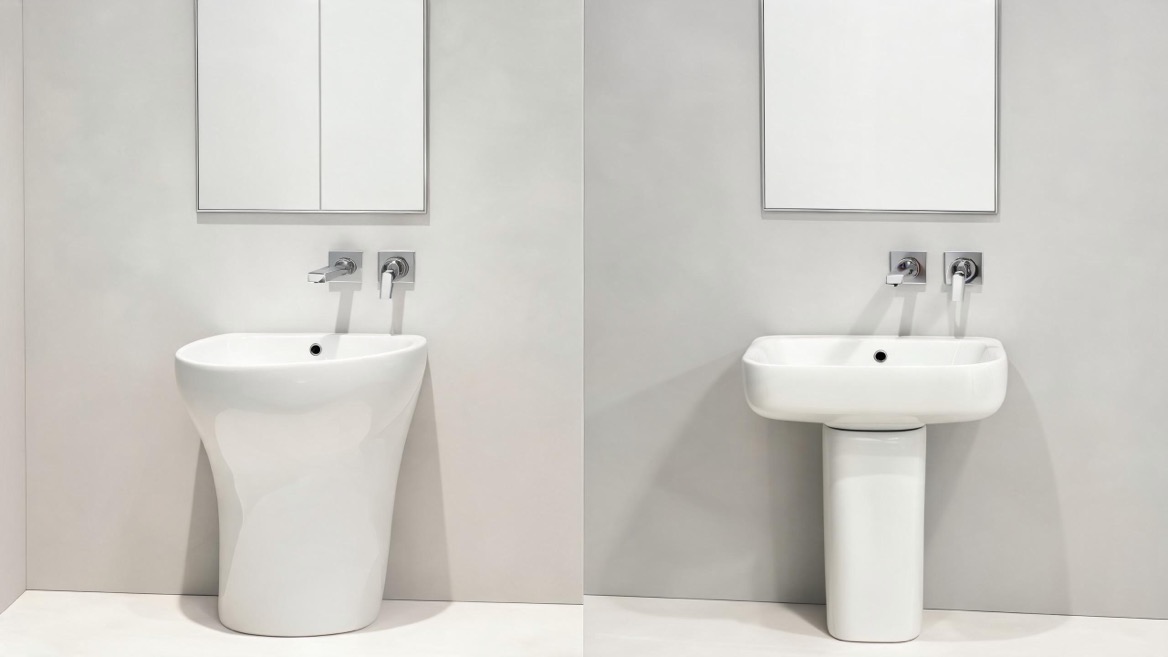
The word "seamless" can mean different things in product marketing. For procurement teams and product developers, it is essential to define it accurately.
A seamless pedestal basin may refer to:
- A one-piece freestanding basin produced as a continuous form.
- A basin with carefully integrated bowl and pedestal geometry.
- A product with no visually disruptive external joints.
- A basin made from solid surface, composite resin, engineered stone, ceramic, or other mouldable materials.
- A design where any required assembly points are concealed after installation.
It does not necessarily mean that every internal component is permanently fused or inaccessible. Drainage systems, wall fixings, supply connections, overflow channels, and service areas still require practical engineering.
The goal is visual continuity without sacrificing installation access or long-term maintainability.
Material is central to the appearance, feel, weight, durability, and production method of a seamless pedestal basin.
| Material | Strengths | Considerations | Best-Fit Positioning |
|---|---|---|---|
| Solid surface | Smooth touch, repairable surface, flexible color options | Requires controlled fabrication and quality consistency | Premium homes, hotels, designer collections |
| Composite resin | Seamless molding potential, modern forms, moisture resistance | Formula, curing, and finish quality strongly affect performance | Contemporary luxury and ODM projects |
| Ceramic | Familiar material, durable glaze, established buyer trust | Complex large-form production and firing control | Mainstream premium sanitaryware |
| Artificial stone | Heavy, tactile, high perceived value | Logistics and installation planning are critical | Luxury residential and hospitality |
| Natural stone | Unique veining and exclusivity | Higher variation, sealing needs, and raw-material cost | Boutique, bespoke, and ultra-premium projects |
Composite resin pedestal basins are often selected for their ability to achieve smooth, joint-free surfaces and complex freestanding forms. Manufacturers position these products for high-end residential, hotel, resort, office, and spa applications because they can combine a clean appearance with stain and moisture resistance.
Minimalist bathrooms depend heavily on proportion. A room can feel crowded even when it contains only a few fixtures if those fixtures have too many visual breaks.
A seamless pedestal basin helps solve this problem in several ways.
A freestanding basin can become the hero piece in a bathroom. Rather than adding decorative elements, designers can use the basin's silhouette, texture, and finish as the visual statement.
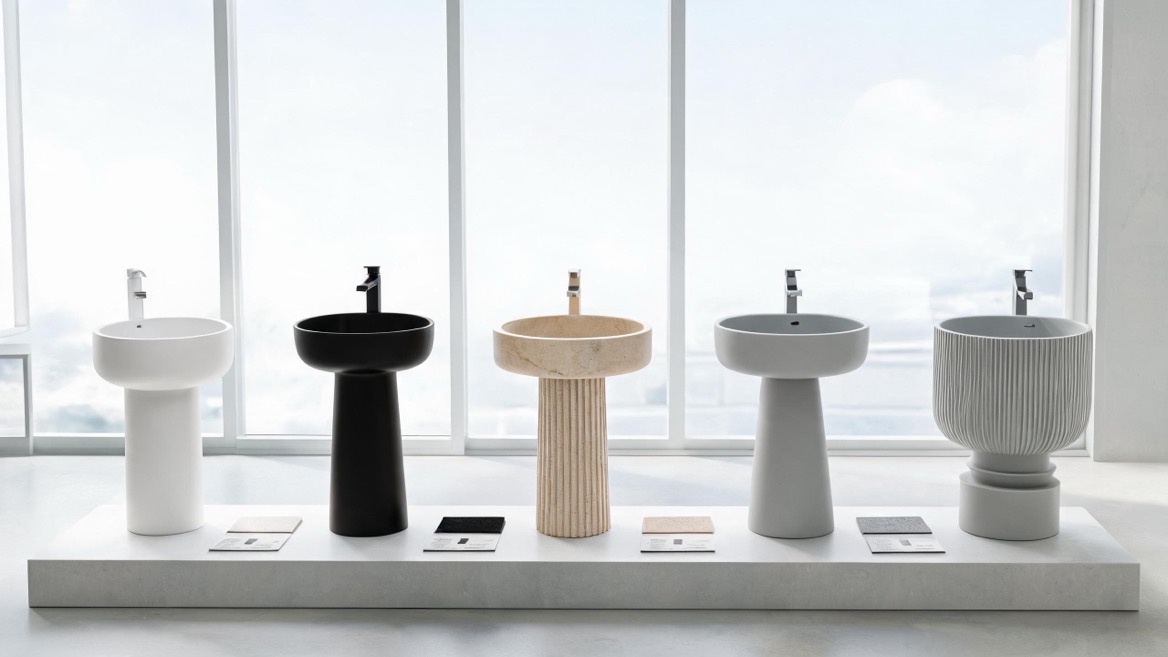
For example, a soft oval white basin paired with a wall-mounted brushed brass faucet can create a warm, refined mood. A matte black cylindrical basin can create a more dramatic architectural look. A fluted or ribbed pedestal can add texture while keeping the overall form simple.
The key principle is controlled contrast. Minimalist interiors do not require every surface to look identical. They work best when a small number of materials and shapes are deliberately coordinated.
Bathroom cabinets are practical, but they add volume. In powder rooms, guest bathrooms, hotel suites, and compact apartment bathrooms, a pedestal basin can reveal more wall and floor surface.
Visible floor area can make a room appear less enclosed. This does not increase the physical size of the room, but it can improve the feeling of openness.
Pedestal basins are especially suitable for small to medium-sized bathrooms when circulation, visual lightness, and accessible plumbing layouts matter.
A smooth external pedestal surface has fewer visual interruptions than a basin combined with a cabinet, drawer handles, countertop seams, and open shelving.
This matters in hospitality settings. Housekeeping teams often value surfaces that can be wiped quickly and inspected easily. For residential users, a simplified exterior can reduce the sense of cleaning complexity.
However, buyers should avoid assuming that a seamless exterior automatically guarantees effortless maintenance. The real performance depends on:
- Surface porosity.
- Stain resistance.
- Scratch resistance.
- Chemical resistance.
- Drainage slope.
- Basin depth.
- Splash control.
- Access to hidden plumbing components.
The biggest limitation of a seamless pedestal basin is simple: it does not replace a vanity cabinet.
For a primary family bathroom, users may need storage for towels, skincare products, cleaning supplies, hair tools, and toiletries. A pedestal basin alone may not be the best solution unless storage is provided elsewhere.
This is why the product is particularly effective in:
- Guest bathrooms.
- Powder rooms.
- Hotel bathrooms.
- Spa changing rooms.
- Luxury apartment show units.
- Public-facing washrooms.
- Bathrooms with recessed wall storage.
- Bathrooms with a separate linen or storage cabinet.
A strong bathroom collection can solve this issue through coordinated accessories. Brands may pair a seamless pedestal basin with a tall cabinet, mirrored cabinet, recessed niche, open metal shelf, or matching wall-mounted storage module.
The best solution is not always the basin with the most features. It is the basin that fits the room's real usage pattern.
For OEM and ODM projects, design should be tested early—not only in digital renderings, but also through physical samples and installation reviews.
Before selecting a shape, identify the target use case:
- Compact residential bathroom.
- High-end villa project.
- Boutique hotel room.
- Commercial washroom.
- Retail showroom collection.
- Senior-living or accessible bathroom.
- Designer-led renovation market.
A narrow pedestal basin may suit a compact powder room. A larger sculptural pedestal basin may suit a hotel lobby washroom or premium master suite.
The rim height, bowl depth, projection, faucet reach, and clearance around the basin must work together.
As a general planning reference, pedestal basins are often installed with a rim height around 800–850 mm. Common basin sizes fall in the 450–600 mm width range, although custom projects may require more compact or more generous dimensions.
Important questions include:
- Will the bowl cause splashing with the selected faucet?
- Is there enough handwashing space?
- Can users stand comfortably in front of the basin?
- Does the basin projection obstruct a door or circulation path?
- Does the faucet spout align with the drainage outlet?
- Is the overflow system compatible with the intended waste fitting?
Faucet selection is not a finishing detail. It shapes basin geometry.
A seamless pedestal basin may be designed for:
- Deck-mounted single-hole faucets.
- Three-hole widespread faucets.
- Wall-mounted faucets.
- Tall vessel faucets.
- Sensor faucets for commercial applications.
- No tap hole, where a wall-mounted faucet is specified.
The faucet should not overpower the basin. Its spout length, height, water angle, and flow pattern should be tested with the bowl shape to control splashing. Modern pedestal sink guidance also emphasizes balancing faucet scale with basin size and using water-saving aerators where suitable.
A beautifully designed basin can fail commercially if installers find it difficult to fit or service.
A professional product specification should clarify:
- Net weight and packed weight.
- Recommended wall fixing method.
- Floor fixing requirements, if applicable.
- Pipe entry positions.
- Drain outlet size.
- Overflow configuration.
- Trap clearance.
- Access panel details.
- Compatible mounting hardware.
- Installation tolerance.
- Cleaning and care instructions.
Wall structure is especially important for wall-supported designs. Appropriate reinforcement or a suitable mounting frame may be required to safely support the load.
Seamless pedestal basins offer strong potential for private-label bathroom collections because the product can be customized in highly visible ways.
- Round, oval, rectangular, tapered, or asymmetrical basin shapes.
- Cylindrical, conical, fluted, ribbed, faceted, or curved pedestals.
- Compact, standard, or oversized basin dimensions.
- Deep bowls for improved splash containment.
- Integrated overflow or no-overflow options.
- One, two, three, or zero tap holes.
- Matte white.
- Gloss white.
- Matte black.
- Stone-inspired gray.
- Sand, beige, clay, and warm neutral finishes.
- Marble-effect surfaces.
- Custom color matching for brand collections.
- Textured or fluted outer surfaces.
- Laser-etched or moulded brand logos.
- Customized carton artwork.
- Protective export packaging.
- Installation manuals in local languages.
- Sample development for buyer approval.
- Coordinated faucet, mirror, cabinet, and accessory collections.
- Market-specific drainage and certification preparation.
For brands, the commercial value lies in developing a coherent collection rather than selling a single basin. A matching basin, mirror, faucet, shower system, and storage unit can create a stronger showroom story and increase order value.
Choosing a seamless pedestal basin supplier should involve more than reviewing catalog images.
Use this five-step evaluation process:
1. Review the material system. Ask what the basin is made from, how it is moulded or formed, how surface consistency is controlled, and whether the material can be repaired if damaged.
2. Request dimensional drawings. Confirm width, depth, height, waste location, tap-hole position, wall-clearance needs, and floor connection details.
3. Inspect a physical sample. Check surface smoothness, color consistency, edge finishing, bowl drainage, stability, weight, packaging, and visible imperfections.
4. Test the complete water path. Pair the basin with the intended faucet and waste set. Observe splash behavior, drainage speed, overflow performance, and ease of cleaning.
5. Assess production reliability. Discuss minimum order quantity, lead time, quality inspection procedures, sample approval standards, spare parts, packaging tests, and after-sales support.
A supplier should be able to explain not only how the basin looks, but also how it is produced, packed, installed, cleaned, and serviced.
A seamless pedestal basin is not automatically the right choice for every bathroom. The product should be selected according to space, budget, user habits, and visual goals.
Choose a seamless pedestal basin when:
- The bathroom needs a sculptural focal point.
- The project targets a premium or design-led market.
- Concealed plumbing and a clean silhouette are priorities.
- Storage is available elsewhere.
- The brand wants a distinctive product family.
- The customer values modern luxury and visual simplicity.
Choose a traditional pedestal basin when:
- The project needs a familiar, economical solution.
- Replacement compatibility is the main priority.
- The market prefers classic sanitaryware formats.
- Product cost needs to remain highly competitive.
- The design does not require a strong statement piece.
Choose a vanity basin when:
- Storage is essential.
- Multiple family members use the bathroom daily.
- Counter space is needed for toiletries.
- The project is focused on practical primary bathrooms.
The rise of seamless pedestal basins reflects a broader change in bathroom design. Buyers increasingly want products that provide both utility and identity. They do not want a basin that merely performs a task. They want a fixture that makes the bathroom feel more considered, spacious, modern, and valuable.
For overseas brands, distributors, and project buyers, the opportunity is to create basin collections that balance sculptural design with real installation requirements. The strongest products will not be defined only by a seamless outer surface. They will be defined by thoughtful proportions, durable materials, controlled drainage, compatible faucets, reliable packaging, and consistent manufacturing quality.
Looking to develop a customized seamless pedestal basin collection? Jiaxing Miluo Smart Home Co., Ltd. can support OEM and ODM bathroom projects with tailored basin designs, color and finish development, brand customization, coordinated bathroom products, export-oriented packaging, and production solutions aligned with your target market.
A seamless pedestal basin is a freestanding washbasin designed to look like one continuous unit from the bowl to the base. It usually minimizes visible joints and creates a clean, sculptural appearance for modern bathrooms.
Yes. They can work well in small bathrooms because they avoid the visual bulk of a large vanity cabinet and leave more floor area visible. The basin width, depth, and door-clearance space should still be checked carefully before installation.
No. Most pedestal basins do not include integrated storage. They are better suited to powder rooms, guest bathrooms, hotel rooms, and bathrooms where wall cabinets, niches, or separate storage units are available.
The best material depends on the target market and performance requirements. Solid surface and composite resin are popular for seamless modern forms, while ceramic remains a trusted option for traditional sanitaryware durability and buyer familiarity.
Yes. OEM and ODM customization can include basin size, shape, color, surface finish, tap-hole configuration, overflow design, logo placement, packaging, installation guides, and coordinated bathroom collections.
Buyers should confirm dimensions, material specifications, wall and floor fixing requirements, faucet compatibility, drainage performance, packaging protection, sample approval procedures, production lead times, quality control standards, and after-sales service arrangements.
Yes. They are well suited to boutique hotels, premium resorts, serviced apartments, and luxury guest bathrooms where a distinctive visual experience matters. Hotels should prioritize durable surfaces, easy-clean finishes, reliable drainage, spare-part access, and installation consistency across rooms.
1. [Bathroom Mountain — Pedestal Basin Buying Guide: Sizes, Types, Installation and Benefits]
2. [Vintage Tub & Bath — Bathroom Design Trends for 2026]
3. [Aquacubic — Top Modern Wash Basin Designs for Contemporary Bathrooms and Hotels]
4. [Casa Bezier — Resin Pedestal Basin Manufacturer]
5. [Pioneer Industries — Choosing the Right Faucet for Pedestal Sinks]
6. [Enterprise Green Communities — Water Criteria and Certification]
7. [Modern Bathroom — Pedestal Sink or Vanity: The Great Debate]


