
Views: 257 Author: Miluo Smart Home Publish Time: 2026-09-16 Origin: Site


Content Menu
● What Makes a Vessel Sink Worth Buying?
● The 10 Best Vessel Sink Styles for Today's Bathroom Projects
>> 1. Low-Profile Oval Vessel Sink
>> 4. Matte White Solid-Surface Vessel Sink
>> 5. Black Vessel Sink for Statement Bathrooms
>> 6. Stone-Effect Vessel Basin
>> 7. Fluted or Textured Vessel Sink
>> 8. Asymmetrical Sculptural Vessel Sink
>> 9. Semi-Recessed Vessel Sink
● How to Choose the Right Vessel Sink Material
● Three Details That Prevent Expensive Installation Problems
>> Verify Faucet Reach Before Ordering
>> Match the Drain to the Basin Design
>> Plan for Countertop Strength and Flatness
● A Smarter Buying Checklist for Brands and Wholesale Buyers
● Care Tips That Protect the Finish
● Build a Vessel Sink Collection That Customers Remember
>> Are vessel sinks practical for everyday bathrooms?
>> What is the best material for a vessel sink?
>> Do vessel sinks splash more than regular sinks?
>> Does a vessel sink require a special faucet?
>> Can a vessel sink be installed on any vanity top?
>> Do vessel sinks need an overflow drain?
>> Are matte black vessel sinks hard to maintain?
>> What should OEM buyers ask a vessel sink supplier?
A well-chosen vessel sink can turn an ordinary vanity into the visual focal point of a bathroom. For homeowners, designers, hospitality buyers, and private-label bathroom brands, the best vessel sink balances sculptural presence with everyday usability, reliable drainage, compatible faucet geometry, durable materials, and a countertop system designed to support the complete installation.
Unlike an undermount or drop-in basin, a vessel sink sits partly or fully above the countertop. That elevated profile creates an immediate premium effect, but it also introduces important buying considerations: finished rim height, splash control, countertop strength, faucet reach, drain compatibility, cleaning access, packaging safety, and long-term consistency across production batches.
For brands and wholesale buyers developing a modern bathroom collection, the right approach is not simply selecting a beautiful bowl. It is creating a coordinated product solution—from basin material and shape to logo application, color matching, packaging, and technical documentation.

The best vessel sinks are not defined by appearance alone. A basin can look impressive in a catalog but create frustration if the faucet is too short, the vanity becomes too high, the drainage is slow, or the rim shape causes excessive splashing.
A strong vessel sink specification should consider five essentials:
- Comfortable finished height after the basin is installed on the vanity
- Correct faucet spout reach and height for controlled water flow
- A stable, level countertop interface with appropriate drain-hole positioning
- A material suited to the intended use, cleaning routine, and price segment
- Consistent quality control across color, glaze, flatness, drainage slope, and surface finish
For most residential projects, a completed sink rim height of approximately 34 to 36 inches from the finished floor is a useful planning target. A tall vessel bowl installed on a standard-height vanity can place the washing surface uncomfortably high, especially for children or shorter users.
This is why experienced bathroom designers often begin with the total system height rather than choosing a basin first. The equation is simple:
Finished rim height=Vanity height+Countertop thickness+Basin height above counter
A shallow countertop vessel sink may be the better choice when the vanity cannot be lowered. Conversely, a deeper round or oval basin can work beautifully on a custom low-height cabinet.
Rather than treating "best" as one fixed product category, it is more useful to match sink styles with real project needs. The following vessel sink types cover the most commercially valuable shapes, materials, and use scenarios for modern bathroom brands and buyers.
A low-profile oval vessel sink is one of the safest choices for broad market appeal. Its softened silhouette works with contemporary, transitional, Scandinavian, and hotel-inspired bathrooms.
Why buyers choose it:
- Comfortable rim height compared with deep countertop bowls
- Easy-to-clean interior with fewer sharp corners
- Broad compatibility with wall-mounted and tall deck-mounted faucets
- Familiar shape that reduces customer hesitation at retail
This style is especially effective for private-label collections because it can be offered in gloss white, matte white, black, gray, sand, or custom colors while maintaining the same core mold platform.
A round vessel basin creates a balanced, architectural look. It works particularly well on narrow vanities, compact powder rooms, boutique hotel suites, and symmetrical double-vanity layouts.
For practical use, look for a bowl with adequate internal depth and a gently sloped base toward the drain. A beautiful but overly flat interior can leave standing water after use, increasing cleaning complaints.
Best application: Small bathrooms where countertop space is limited but the sink needs to feel intentional and premium.
A rectangular vessel sink brings clean visual order to modern bathrooms. Its linear profile pairs naturally with rectangular mirrors, wall-hung vanities, and geometric faucets.
However, shape matters. Extremely sharp inner corners may look minimalist but can collect soap residue and mineral deposits. A design with subtly radiused internal corners often provides a more refined balance between visual precision and maintenance convenience.
For commercial projects, a rectangular basin with a wide internal washing area can provide a more practical experience than a narrow decorative model.
Matte white has become a highly versatile finish for high-end bathroom interiors. It feels softer and more contemporary than traditional glossy ceramic, while working with timber, stone, brushed nickel, chrome, matte black, and warm metallic faucet finishes.
Solid-surface and stone-resin materials are particularly suitable for this finish because they can deliver a smooth, non-porous, stone-like appearance. Resin-based sink materials are widely valued for durability and resistance to staining, scratching, and discoloration.
For manufacturers and brand owners, matte surfaces require strict quality control. Minor mold lines, dust marks, uneven polishing, or inconsistent color tone are more visible than on high-gloss white surfaces.
A black vessel sink creates contrast, depth, and a luxury mood. It is particularly popular in dark-stone bathrooms, industrial interiors, boutique hotels, and design-led powder rooms.
There are several finish directions:
| Finish | Visual Effect | Best Use Case | Buying Consideration |
|---|---|---|---|
| Matte black | Soft, contemporary, understated | Modern homes and hotels | Water spots may be visible in hard-water regions |
| Gloss black | Dramatic and reflective | Luxury powder rooms | Requires careful packaging to prevent surface scratches |
| Black marble effect | Decorative and expressive | Premium residential spaces | Pattern consistency should be controlled |
| Black stone resin | Warm, tactile, architectural | Boutique and high-end projects | Confirm color consistency across batches |
Important: A dark vessel sink should not be specified without considering local water quality. Hard water can leave visible mineral marks, so buyers should provide appropriate care guidance and recommend non-abrasive cleaning products.
Stone-effect vessel sinks deliver the visual character of natural stone while avoiding some of the maintenance demands associated with porous materials. They suit spa-style bathrooms, wellness spaces, resorts, and premium residential projects.
Natural stone can be beautiful and distinctive, but its performance depends heavily on the specific stone type, sealing process, and ongoing care. Stone-like engineered materials can offer a more predictable experience for brands that need repeatable color, texture, dimensions, and packaging outcomes.
A stone-effect basin is a strong option when a collection needs a natural visual language without relying on highly variable quarry material.
Fluted basins add tactile depth and shadow play. They are increasingly used in vanity collections that aim to create a furniture-like bathroom atmosphere rather than a purely utilitarian one.
Textured exteriors can elevate a product's perceived value, but the interior should remain smooth and easy to clean. The strongest designs combine a decorative outside surface with a clean internal bowl.
For OEM and ODM projects, texture can also become a distinctive brand signature when combined with a custom color palette, exclusive mold, or coordinated countertop and cabinet program.
An asymmetrical vessel basin is designed to be noticed. It may feature an off-center drain, angled rim, organic silhouette, or irregular stone-inspired form.
This sink style is best reserved for low-traffic luxury projects, premium showrooms, and statement powder rooms. It is less suitable for buyers who prioritize universal replacement compatibility or need an easy-to-standardize range.
The key technical requirement is drainage. Even a highly artistic basin should guide water efficiently toward the drain without pooling in low areas.
A semi-recessed vessel sink sits partially below the countertop while retaining the distinctive raised profile of a vessel bowl. It offers a useful middle ground between design impact and practical ergonomics.
Why it performs well:
- Reduces total rim height
- Improves stability and visual integration
- Helps contain splash compared with a fully raised bowl
- Allows a deeper internal basin without making the vanity too tall
This option is particularly valuable for apartment developments, family bathrooms, senior-friendly designs, and projects where standard vanity heights cannot be altered.
Double vessel sink installations create a strong luxury impression in primary bathrooms, hospitality suites, and high-end residential developments. However, doubling the basins means doubling the planning requirements.
Before specifying a double setup, verify:
1. The vanity width provides adequate elbow room between users.
2. Each faucet spout reaches close to the drain area without striking the rim.
3. The countertop has enough rear clearance for faucets and backsplash.
4. Drain connections and P-traps fit within the cabinet structure.
5. The mirror, lighting, and accessories remain visually balanced with two raised bowls.
For many double-vanity projects, two moderate-size oval basins are more comfortable than two oversized sculptural bowls.
Material affects appearance, price, weight, maintenance, production consistency, and customer satisfaction. The ideal option depends on the brand position and end-use environment.
| Material | Advantages | Watchouts | Suitable Projects |
|---|---|---|---|
| Ceramic or vitreous china | Familiar, durable, easy to clean, cost-effective | Can chip from severe impact | Residential, wholesale, mainstream retail |
| Solid surface | Smooth, modern, repairable in some cases | Requires controlled finishing quality | Premium homes, hotels, contemporary collections |
| Stone resin | Durable, stone-like, often non-porous | Color and finishing consistency matter | Boutique hotels, luxury residential, project supply |
| Tempered glass | Light-transmitting and decorative | Edge damage and visible water spots require care | Powder rooms, design-led retail |
| Natural stone | Unique veining and premium character | Often needs sealing and ongoing maintenance | Luxury residential and bespoke projects |
| Metal | Distinctive, durable, expressive | May show water marks or patina depending on finish | Boutique hospitality and statement interiors |
Ceramic remains a widely trusted sink material because its surface can resist routine scratches, chips, and impacts in daily use. Meanwhile, engineered stone-like materials can be a compelling option for brands seeking a more contemporary appearance with predictable manufacturing control.
A vessel sink is easy to admire in a product image. It is harder to install well when planning is incomplete. These three checks eliminate many avoidable problems.
The water stream should land near the drain area, not on the rear wall of the bowl or directly on the front rim. A faucet that is too short can cause water to hit the inner wall and splash outward. One that is too long may cause uncomfortable use or make cleaning more difficult.
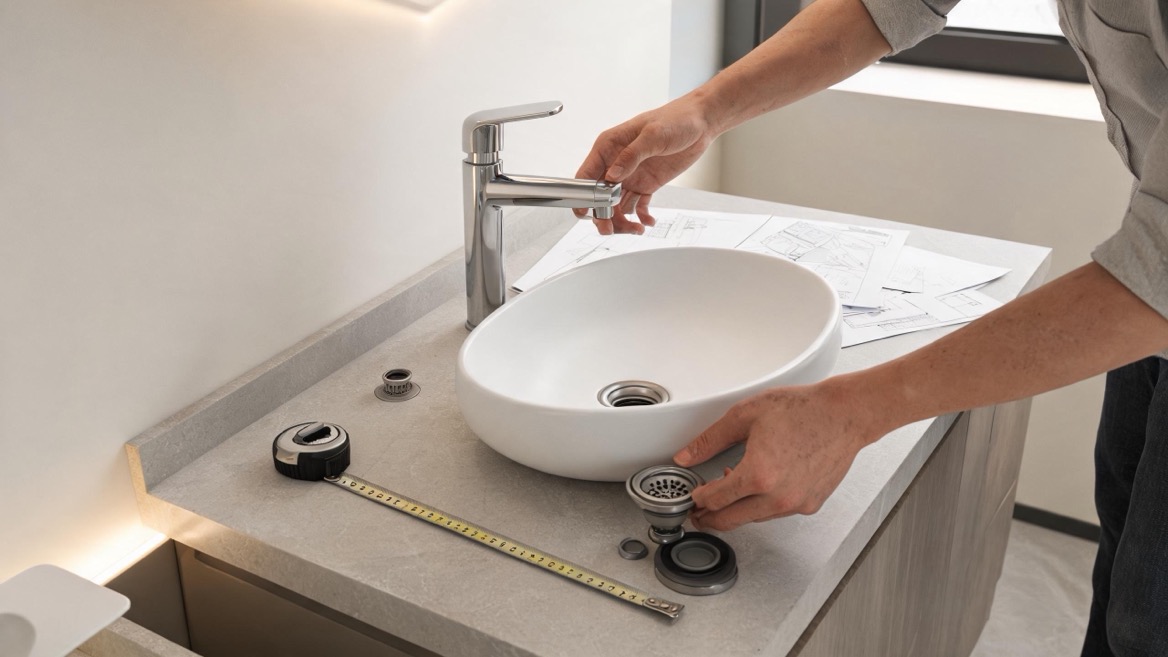
Always dry-fit the basin and faucet together before cutting the countertop. Installation guidance also recommends confirming plumbing and faucet clearances before final placement.
Some basins require a drain with overflow; others do not have an overflow channel and need a compatible non-overflow drain. Using the wrong drain assembly can compromise sealing and drainage performance.
The drain diameter, gasket design, countertop thickness, and tailpiece length should be checked as one system—not as separate purchases.
The countertop needs to support the basin securely and remain level. Uneven stone, timber movement, poorly supported engineered boards, or an incorrectly cut hole can cause rocking, sealant gaps, and long-term leakage risk.
During installation, the basin should be dry-fitted, aligned over the drain, sealed appropriately, and allowed sufficient curing time before regular use. Installation instructions commonly recommend applying sealant at the joint and allowing approximately 24 hours for curing.
For an individual homeowner, a vessel sink purchase may involve one bathroom. For a brand, distributor, developer, or importer, the decision affects product reputation across hundreds or thousands of units.
Use this checklist before approving a supplier or finalizing a vessel sink program:
- Confirm finished dimensions, tolerances, bowl depth, drain opening, and net weight.
- Request samples in all proposed finishes, especially matte black, custom colors, and stone effects.
- Test drainage by filling and emptying the basin repeatedly.
- Check for rocking on a verified flat surface.
- Review interior and exterior surfaces under direct light for pinholes, color inconsistency, scratches, and finishing defects.
- Confirm faucet compatibility guidance and recommended vanity-height range.
- Review packaging drop protection, corner protection, carton compression strength, and pallet loading method.
- Clarify logo placement, laser marking, embossed branding, color box design, manuals, and barcode requirements.
- Establish acceptable quality limits and inspection standards before mass production.
- Confirm spare-part availability for drains, mounting accessories, and replacement units.
Expert insight: The most successful private-label vessel sink collections are built around repeatable systems. Instead of launching too many unrelated shapes, develop a coordinated family of basins with shared finishes, compatible faucet recommendations, and consistent packaging language.
Daily care should be simple enough that customers will actually follow it.
- Wipe the basin with a soft cloth after use, particularly in hard-water areas.
- Use mild, non-abrasive cleaners.
- Avoid steel wool, harsh scouring powders, and highly aggressive chemical products unless the manufacturer specifically approves them.
- Do not place heavy metal objects on thin glass, ceramic, or stone edges.
- Check the drain and silicone joint periodically for signs of movement or leakage.
- For natural stone, follow the supplier's sealing and maintenance instructions.
A clear care guide reduces post-sale complaints and helps protect the appearance of dark, matte, textured, and natural-material finishes.
The best vessel sink is not necessarily the tallest, most decorative, or most expensive option. It is the basin that fits the room, supports comfortable use, drains properly, complements the faucet, and delivers the intended design story year after year.
For bathroom brands, wholesalers, and project buyers, vessel sinks offer an opportunity to create a recognizable collection with strong visual identity. Through OEM and ODM development, Jiaxing Miluo Smart Home Co., Ltd. can support customized modern bathroom basin solutions, including product design development, material and finish selection, custom colors, private-label branding, coordinated packaging, and scalable production planning.
Ready to develop a distinctive vessel sink range for your market? Contact Jiaxing Miluo Smart Home Co., Ltd. to discuss your drawings, target price, finish requirements, packaging standards, and OEM or ODM project goals.

Yes. Vessel sinks can be practical for everyday use when the basin depth, vanity height, faucet reach, and countertop installation are correctly planned. Low-profile and semi-recessed designs are often the most comfortable choices for frequently used bathrooms.
There is no single best material for every project. Ceramic is a dependable mainstream option, while solid surface and stone resin are strong choices for contemporary premium collections. Natural stone and glass are more decorative but may require additional care.
They can, especially when a tall faucet, shallow bowl, or incorrect spout reach sends water against the rim. Selecting a bowl with adequate depth and positioning the water stream near the drain area helps reduce splashing.
Usually, yes. A vessel sink commonly needs either a tall deck-mounted vessel faucet or a wall-mounted faucet. The faucet must have enough height to clear the rim and enough reach to direct water appropriately into the bowl.
Not always. The countertop must be flat, stable, appropriately supported, and compatible with the required drain-hole cutout. The cabinet height should also be evaluated because the basin adds height above the countertop.
It depends on the basin. If the basin has an overflow opening, use a drain designed for overflow sinks. If it does not have an overflow channel, use a compatible non-overflow drain assembly.
Matte black basins are straightforward to clean with mild products and a soft cloth, but water spots and mineral residue can be more visible in hard-water locations. Regular wiping after use helps preserve the finish.
Ask about material composition, dimensions and tolerances, drainage testing, surface-finish standards, color consistency, custom molds, logo options, packaging tests, lead times, quality inspection procedures, and replacement-part support.
- Aquatica, "[10 Best Vessel Sinks of 2023]"
- Lowe's, "[Bathroom Vessel Sink Installation Guide]"
- Sinkology, "[Bathroom Vessel Sink Installation Guide]"
- Signature Hardware, "[Bathroom Sink Material Buying Guide]"
- Kohler Middle East, "[Bathroom Sink Material Guide]"
- Spokesman-Review / Ask the Builder, "[Vessel Sink Planning and Installation]"
- HOROW, "[Bathroom Vessel Sink Installation: Install a Vessel Sink Right]"


