
Views: 238 Author: Miluo Smart Home Publish Time: 2026-09-17 Origin: Site


Content Menu
● What Is a Double-Basin Solution?
● What Is a Trough-Basin Solution?
● Double-Basin vs Trough-Basin at a Glance
>> Double Basins for Predictable, Moderate Use
>> Trough Basins for Peak-Traffic Environments
● Design Flexibility and Brand Positioning
>> Double Basins Deliver Familiar Premium Comfort
>> Trough Basins Create a Stronger Architectural Statement
● Hygiene, Splash Control, and Daily Cleaning
>> Double-Basin Hygiene Advantages
>> Trough-Basin Hygiene Advantages
● Accessibility and Inclusive Design
>> Double-Basin Accessibility Strategy
>> Trough-Basin Accessibility Strategy
● Installation and Plumbing Considerations
● Material Selection for Commercial Basins
● Decision Framework for Buyers
>> 1. Define the Real Traffic Pattern
>> 2. Measure the Entire Wash Zone
>> 3. Select Faucet Technology Early
>> 4. Plan for Maintenance, Not Only Opening Day
● Which Solution Should You Choose?
● Custom Manufacturing Support
● FAQ
>> Is a trough basin better than a double basin for a busy public restroom?
>> How many faucets can a commercial trough basin include?
>> Can a trough basin include an accessible washing position?
>> Which basin material is best for high-traffic public restrooms?
>> Are sensor faucets suitable for double and trough basins?
>> What information should I provide for a custom basin quotation?
Choosing between a double-basin layout and a trough-basin layout can materially affect a public restroom's capacity, cleanliness, accessibility planning, maintenance workload, and visual identity. For architects, restroom fixture distributors, hospitality brands, commercial contractors, and sanitaryware buyers, the best solution is not simply the basin with the lower purchase price—it is the one that supports the project's traffic profile, available wall space, user expectations, and long-term operating model.
At Jiaxing Miluo Smart Home Co., Ltd., we work with overseas brands, wholesalers, and manufacturers that need customized, modern, high-end bathroom products through OEM and ODM cooperation. From a manufacturing and project-specification perspective, the choice between a double-basin public restroom sink and a trough-basin public restroom sink should begin with the actual use case: How many people are likely to wash their hands at one time? What is the desired brand image? Is barrier-free access required? How much flexibility does the project need for faucet positions, materials, colors, overflow systems, and mounting methods?
This guide compares both solutions in depth and explains how buyers can select, customize, and specify the right commercial restroom basin for their market.
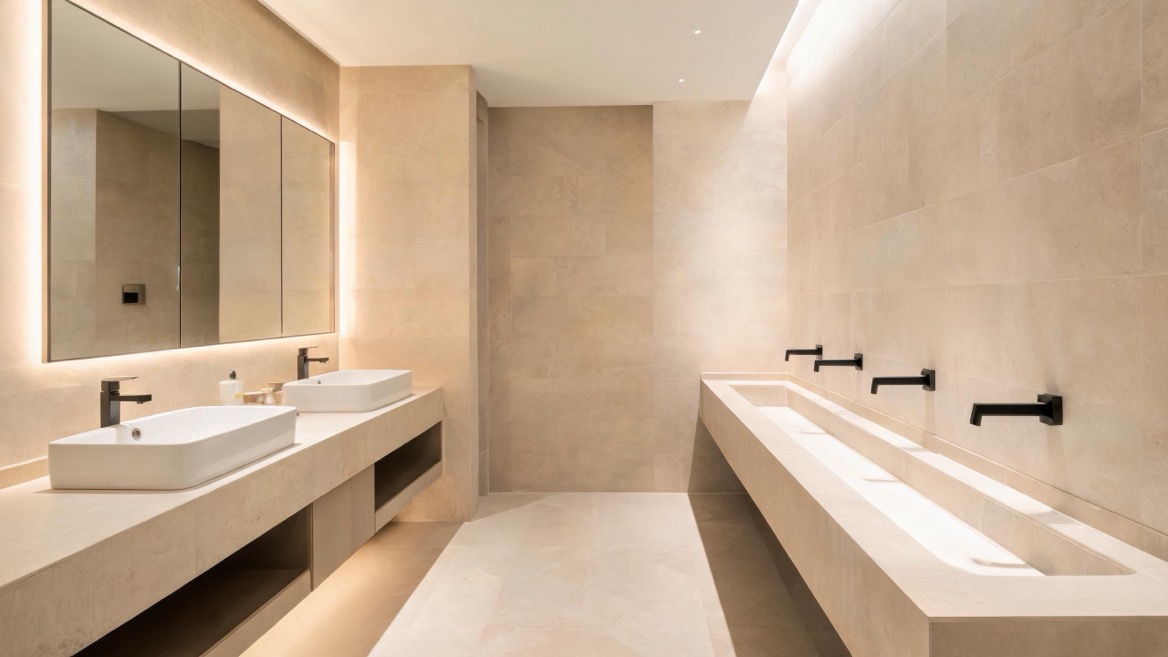
A double-basin solution normally includes two distinct wash bowls installed in a shared countertop, vanity, wall-mounted structure, or freestanding cabinet. Each user has a clearly defined washing position, usually with an individual faucet, drain, and bowl area.
In public restroom applications, double basins are common in:
- Hotels and resorts
- Restaurants and cafés
- Office buildings
- Retail stores
- Boutique gyms and clubs
- Medical clinics
- Educational facilities
- Residential common areas
- Premium commercial washrooms
The main characteristic is separation. Each user receives an individual bowl, which can make the layout intuitive and familiar. Double-basin units can be created with symmetrical ceramic bowls, solid-surface integrated tops, countertop vessels, under-mount sinks, or molded composite vanity systems.
For many mid-traffic commercial spaces, a double-basin design provides a practical balance between user comfort, visual order, and installation flexibility.
A trough-basin solution, also called a linear basin, communal wash basin, or multi-user wash trough, is one long and continuous basin that can support two, three, four, or more users along the same washing surface. It typically uses multiple faucets positioned at intervals above the basin.
Trough basins are especially suitable for:
- Airports and transport hubs
- Shopping malls
- Stadiums and event venues
- Schools and universities
- Factories and industrial facilities
- Large office campuses
- Museums and public attractions
- High-traffic hospitality venues
- Contemporary retail environments
Rather than dividing the washing area into separate bowls, the trough design creates one continuous fixture. This provides a clean architectural line and can allow several users to wash their hands at the same time.
The configuration can be wall-mounted, countertop-mounted, integrated with a vanity, or supplied as a custom fabricated system. Material choices may include sanitary ceramic, solid surface, quartz composite, engineered stone, stainless steel, or other project-specific materials.
| Comparison Area | Double-Basin Solution | Trough-Basin Solution |
|---|---|---|
| User positions | Usually supports two defined users | Can support two to multiple users |
| Visual style | Classic, organized, familiar | Modern, architectural, minimalist |
| Best traffic level | Low to medium traffic | Medium to high traffic |
| Space efficiency | May require more width per user | Can optimize a long wall efficiently |
| Cleaning pattern | Separate bowls and drain areas | One continuous basin channel |
| Custom faucet spacing | Moderate flexibility | Highly customizable |
| Privacy perception | Higher because bowls are divided | Lower because washing is more communal |
| Splash management | Easier to control per bowl | Requires careful depth and faucet design |
| Accessibility planning | One bowl can be made accessible | One usable station must be planned carefully |
| Installation complexity | Often simpler for standard projects | May require more coordination for drainage and support |
| Brand impression | Practical, premium, conventional | Contemporary, high-capacity, design-led |
A trough basin is not automatically better because it is larger, and a double basin is not automatically better because it feels more private. The right answer depends on traffic flow, project positioning, and technical coordination.
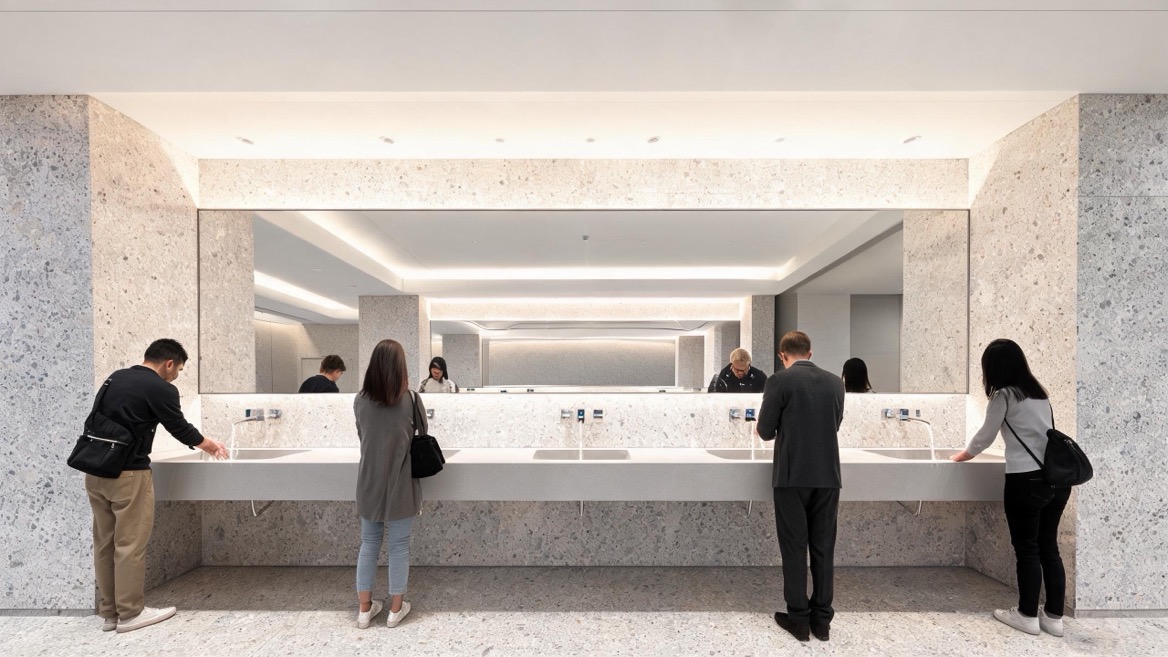
Double basins work well when two people are likely to use the restroom at once, but large queues are not expected. For example, a boutique hotel lobby restroom, executive office washroom, premium restaurant, or small retail store can benefit from two separate basins without creating an oversized fixture wall.
The individual bowl layout helps users understand where to stand. This is useful in environments where personal space and polished appearance are more important than maximum handwashing throughput.
A double-basin configuration is usually a strong choice when:
- The restroom has limited wall width
- User traffic is steady rather than intense
- The interior design is classic, residential-inspired, or hospitality-led
- Separate bowl hygiene is a priority
- The buyer wants more conventional replacement options
- Two individual faucets and drains are preferred
For international brands developing commercial bathroom collections, double basins are also easier to adapt across multiple product families. A manufacturer can retain the same bowl geometry while offering different cabinet finishes, countertop materials, faucet deck options, and mounting structures.
Trough basins become more compelling when several users need handwashing access during short, concentrated periods. Airports, schools, cinemas, shopping centers, sports facilities, and large restaurants can experience sudden handwashing demand after breaks, events, meals, or shift changes.
A long public restroom trough basin can create multiple washing positions without placing several separate bowls side by side. This can reduce visual clutter and make a large wall feel more intentional.
However, capacity depends on more than the number of faucets. Buyers should consider:
- Faucet center-to-center spacing
- Clear standing space in front of the basin
- Mirror layout
- Soap-dispenser positioning
- Hand-dryer or towel-dispenser placement
- Drainage performance
- Queue paths and door circulation
A basin that holds four faucets but gives users insufficient elbow room may look efficient on a drawing while performing poorly in real use. The fixture should support comfortable simultaneous use, not only a high faucet count.
A double-basin vanity can feel more personal, particularly in hotel, retail, restaurant, and office settings. Defined bowl edges can create a sense of order, while separate water zones help maintain a more traditional washroom experience.
For high-end projects, a double-basin solution can be customized through:
- Slim-rim or deep-bowl geometry
- Matte or glossy sanitary ceramic finishes
- Integrated overflow details
- Countertop or under-counter installation
- Wall-hung or cabinet-mounted structures
- Custom basin color options
- Stone-look or solid-surface vanity tops
- Matching mirrors, cabinets, and accessories
- Branded packaging and private-label identification
This makes double basins attractive for OEM customers building coordinated bathroom collections. A buyer can differentiate the product through form, finish, packaging, and cabinet integration without changing the fundamental user experience.
A trough basin is often selected because it becomes a visual centerpiece. Its uninterrupted horizontal form works particularly well with long mirrors, concealed lighting, sensor faucets, backlit signage, and wall-mounted accessories.
For projects seeking a modern public restroom identity, a custom trough basin can offer:
- Custom overall length
- Two to six or more faucet positions
- Integrated backsplashes
- Offset or centered drain layouts
- Concealed drainage design
- Single-slope or dual-slope basin bottoms
- Bracket-mounted or vanity-supported installation
- Solid-color, marble-look, terrazzo-look, or custom finishes
- Open-bottom sections for accessible use
- Customized logo or project identification
From an ODM viewpoint, trough basins offer substantial design potential because dimensions do not need to follow only standard household vanity sizes. The fixture can be engineered around a project's wall length, plumbing points, traffic demand, and brand language.
A public restroom basin must look clean during active use—not only after a cleaning shift. Both basin formats can perform well, but their hygiene outcomes depend heavily on geometry, faucet selection, drainage design, and maintenance procedures.
Separate bowls can help contain water within each user zone. When bowl depth, faucet flow, and spout reach are well matched, users are less likely to direct water into adjacent washing areas.
Advantages include:
- Separate drains can localize debris and maintenance issues
- Defined bowl edges can reduce cross-zone splashing
- Cleaning teams can inspect each bowl quickly
- Individual faucets can be serviced without changing the entire fixture
- Users often perceive separated basins as more personal
The trade-off is that two bowls create more internal corners, edges, drain covers, and joint lines. These details should be designed for easy wiping and resistance to staining.
A trough basin can simplify the visible wash surface by replacing multiple bowls with one continuous channel. In a well-designed model, smooth transitions and minimal seams can make daily cleaning faster.
Trough basins are especially effective when combined with:
- Sensor-operated faucets
- Wall-mounted soap dispensers
- Sloped basin bottoms
- Easy-access drain channels
- Durable non-porous surfaces
- Rounded internal corners
- Splash-resistant basin depth
- Carefully controlled water flow
The key technical issue is water management. If the trough is too shallow, too flat, or paired with a faucet that has excessive flow or incorrect spout projection, water can travel across the basin and onto the countertop or floor.
For this reason, buyers should not specify a trough basin based only on appearance. They should evaluate the whole washing system: basin depth, internal slope, drain capacity, faucet aerator, mounting height, and user standing position.
Accessibility must be integrated early because it affects the basin height, knee clearance, pipe protection, faucet operation, and clear floor space. In the United States, at least one lavatory in an accessible toilet or bathing room must comply with the applicable accessibility requirements. Where a multi-bowl sink is provided, one bowl is generally required to comply, rather than every bowl. The applicable authority and project location should always be confirmed before final production.
For an accessible washing position, project teams commonly need to consider:
- A rim or counter height no higher than 34 inches above the finished floor
- A clear forward approach
- Usable knee and toe clearance below the basin
- Protected or enclosed hot-water and drainage pipes
- Controls operable with one hand
- Controls that do not require tight grasping, pinching, or wrist twisting
- Appropriate reach ranges for soap, hand dryers, paper towels, and related accessories
A double-basin unit can be designed with one accessible bowl and one standard bowl. This may be useful when the project wants to maintain a conventional two-bowl appearance while accommodating different user needs.
A common approach is to provide:
1. One open-bottom basin position with adequate knee and toe clearance.
2. A second position with a cabinet, storage zone, or standard-height structure if local rules permit.
3. Insulated or protected plumbing beneath the accessible bowl.
4. Lever-operated or touchless faucet controls.
5. Accessible placement of soap and drying accessories.
A trough basin requires more careful coordination because the fixture is continuous. One section may be designed to provide the necessary accessible approach and clearance, while other portions support standing users.
This can be achieved by using:
- An open support structure below one faucet position
- A lower accessible segment within a continuous basin design
- Wall-mounted concealed support systems
- Pipe covers that preserve required clearance
- Sensor faucets positioned within usable reach
- A drain arrangement that does not obstruct the accessible station
The advantage is that a trough basin can support a visually unified restroom design while still incorporating a dedicated accessible washing position. The challenge is that customization must be engineered from the beginning rather than added after the basin mold, cabinet, and plumbing layout are finalized.
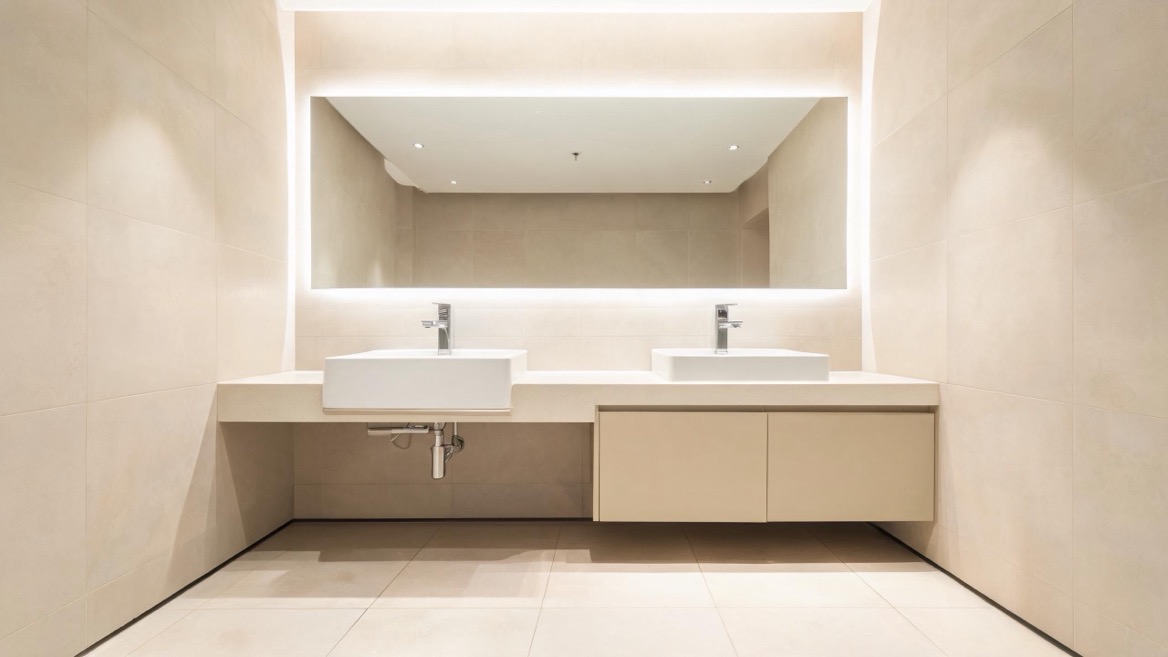
Double-basin units typically use two drain points and two faucet points. For many contractors, this is familiar and straightforward, particularly when the wall rough-in already supports two standard lavatories.
Potential installation benefits include:
- Easier replacement of individual components
- Standardized drain connections
- Flexible cabinet or countertop integration
- Familiar installation process for local contractors
- Clear division between user stations
Potential challenges include keeping both bowls level, aligning drains precisely, and coordinating separate traps, shutoff valves, and faucet supply lines.
Trough basins may use one, two, or more drains depending on the basin length and internal slope. A long basin must be properly supported to avoid deflection, cracking, or drainage problems over time.
Before approving a trough-basin specification, review:
- Finished wall dimensions
- Exact faucet quantity and center spacing
- Drain quantity and position
- Basin slope direction
- Wall reinforcement or bracket requirements
- Cabinet support requirements
- Water supply routing
- Access for future maintenance
- Expansion tolerance for long solid-surface fixtures
- Mirror, backsplash, and lighting coordination
A custom trough basin should always be reviewed with dimensioned drawings before mass production. This is particularly important for overseas procurement, where a small interpretation error in the wall-to-wall measurement, drain centerline, or faucet spacing can affect an entire shipment.
The material should match the project's expected traffic, target appearance, cleaning routine, budget, and installation method.
| Material | Best Use | Main Strengths | Key Considerations |
|---|---|---|---|
| Sanitary ceramic | Hotels, offices, retail, standard public restrooms | Durable, familiar, easy to clean, stable color | Size and shape flexibility may be lower for very long troughs |
| Solid surface | High-end hotels, retail, offices, design-led public spaces | Seamless appearance, custom lengths, repairable surface | Requires professional fabrication and proper support |
| Quartz or engineered stone | Premium vanity projects | Luxury visual effect, strong surface presence | Weight, edge finishing, and maintenance must be considered |
| Stainless steel | Schools, factories, transport facilities, utility areas | Highly durable, hygienic, impact-resistant | May feel more industrial than luxury-oriented |
| Composite materials | Customized commercial projects | Flexible forms, varied finishes, lightweight potential | Quality control and long-term surface performance are essential |
For private-label and OEM programs, ceramic and solid-surface solutions often provide the most balanced path between brand differentiation and scalable manufacturing. Ceramic supports recognized sanitaryware expectations, while solid surface can be shaped into longer, more distinctive trough forms.
Use the following practical process before selecting a double-basin or trough-basin system.
Do not estimate traffic only from the building size. Consider peak periods.
For example:
- A small office restroom may have low, distributed use.
- A school washroom may experience intense demand between classes.
- A restaurant restroom may receive short bursts after meal periods.
- An airport restroom may have continuous, unpredictable use.
If users arrive in groups, a trough basin may provide better flow. If use is more individual and dispersed, double basins may offer a more comfortable experience.
Measure more than the available countertop width. Confirm:
- Wall length
- Door swing and circulation
- Toilet compartment positions
- Mirror coverage
- Electrical locations
- Plumbing rough-ins
- Hand-dryer location
- Cleaning-cart access
- Clear floor space
- Accessible route requirements
A basin that fits the wall can still fail if users cannot comfortably approach it or if the accessory layout creates bottlenecks.
The basin and faucet must be designed together. A sensor faucet with the wrong spout reach can cause splashing; a tall vessel-style faucet may look elegant but perform poorly in a high-traffic commercial setting.
For most public restrooms, buyers should assess:
- Sensor, push-button, or lever control
- Water flow rate
- Spout projection
- Aerator type
- Battery, mains, or hybrid power supply
- Maintenance access
- Compatibility with the chosen basin depth
A strong fixture design makes cleaning and service easier. Ask practical questions:
- Can staff wipe all corners easily?
- Are drain covers removable?
- Can supply valves be accessed?
- Will the surface resist common cleaning chemicals?
- Are replacement faucets and waste components available?
- Does the support structure allow access without removing the full basin?
The lowest initial price can become expensive if the design creates repeated cleaning difficulty, water leaks, or complicated maintenance.
Choose a double-basin public restroom solution when the project needs a familiar layout, controlled individual washing zones, moderate capacity, and flexible integration with cabinets or standard countertops. It is especially suitable for hospitality, offices, restaurants, clinics, boutique retail spaces, and premium commercial interiors.
Choose a trough-basin public restroom solution when the project needs higher simultaneous capacity, a contemporary architectural statement, efficient use of a long wall, and extensive customization of faucet positions, lengths, materials, and support structures. It is especially suitable for airports, schools, malls, public venues, transport facilities, large workplaces, and high-traffic washrooms.
In many projects, the answer may be a hybrid approach: a long custom trough basin for the main public washing zone, paired with a carefully designed accessible station, or a two-bowl vanity in smaller premium restroom areas.
Jiaxing Miluo Smart Home Co., Ltd. supports overseas brands, wholesalers, contractors, and manufacturers seeking customized modern bathroom products and integrated sanitaryware solutions. For double-basin and trough-basin programs, OEM and ODM customization can include basin dimensions, materials, colors, faucet-hole layouts, drain positions, overflow structures, mounting methods, matching vanity units, packaging, labeling, and project-specific drawings.
The most reliable procurement process begins with a clear specification package. Share the target market, application scenario, installation drawings, required quantity, preferred material, desired finish, faucet configuration, and compliance requirements. This allows the product team to develop a solution that is practical for manufacturing, installation, maintenance, and end-user comfort.
Contact Jiaxing Miluo Smart Home Co., Ltd. to discuss a customized double-basin or trough-basin solution for your public restroom project, OEM collection, or private-label sanitaryware program.
Usually, yes. A trough basin can support more simultaneous users when it is designed with appropriate faucet spacing, drainage capacity, and standing room. However, a double basin may still be better for smaller restrooms or projects where user separation and a more traditional premium appearance are priorities.
The quantity depends on the available length, user spacing, basin material, water supply, drainage design, and local requirements. Two- and three-faucet layouts are common for compact commercial washrooms, while larger public spaces may require four or more positions.
Yes. A continuous trough design can include at least one accessible station when the relevant height, knee clearance, pipe protection, clear floor space, and faucet-operability requirements are designed into the product and installation plan.
There is no single answer. Stainless steel is highly durable for industrial or institutional settings. Sanitary ceramic offers a familiar, easy-clean surface for many commercial projects. Solid surface is often preferred for high-end custom trough basins because it can create a seamless, tailored look.
Yes. Sensor faucets can support touch-free operation and a cleaner visual appearance in both configurations. They should be selected together with the basin to ensure the spout reach, water flow, basin depth, and drain location minimize splashing.
Provide the project type, target market, quantity, basin dimensions, drawings or wall measurements, preferred material, color, faucet quantity, drain positions, mounting method, packaging needs, branding requirements, and requested delivery schedule.
1. U.S. Access Board. "[Chapter 6: Lavatories and Sinks]." Accessibility guidance for lavatory height, clear floor space, knee and toe clearance, protected plumbing, and operable controls. [access-board]
2. Sloan. "[Sinks]." Commercial sink solutions and multi-height options for accessibility and public restroom applications. [sloan]
3. Bradley Corporation. "[Commercial Bathroom Sinks]." Overview of commercial basins and sink options for public restroom applications. [bradleycorp]
4. Sophstone. "[How to Choose the Right Commercial Bathroom Sink for Your Project]." Practical considerations for traffic, layout, accessibility, materials, maintenance, and custom sizing. [sophstone]
5. Griffin Products. "[Double Faucet Trough Sinks]." Example of multi-user commercial trough sink construction and high-use applications. [griffinproducts]
6. FontanaShowers. "[Commercial Bathroom Design with Large Sinks]." Commercial sink layout considerations, including user spacing and counter depth guidance. [fontanashowers]


