
Views: 288 Author: Miluo Smart Home Publish Time: 2026-10-15 Origin: Site


Content Menu
● Why Matte Stone Basins and Glossy Backsplashes Work Together
● Specify the Basin Material Before Choosing the Tile
>> Stone Resin and Solid Surface Basins
● How to Choose High-gloss Tile Backsplashes
>> Select a Compatible Color Undertone
>> Coordinate Tile Scale with Basin Shape
>> Decide How Much Wall Should Shine
● Control Reflections with a Lighting Mock-up
● Plan the Basin, Faucet, and Backsplash as One Assembly
>> Check Faucet Reach and Water Delivery
>> Keep the Basin-to-wall Area Accessible
● Detail the Backsplash Junction for Movement and Moisture
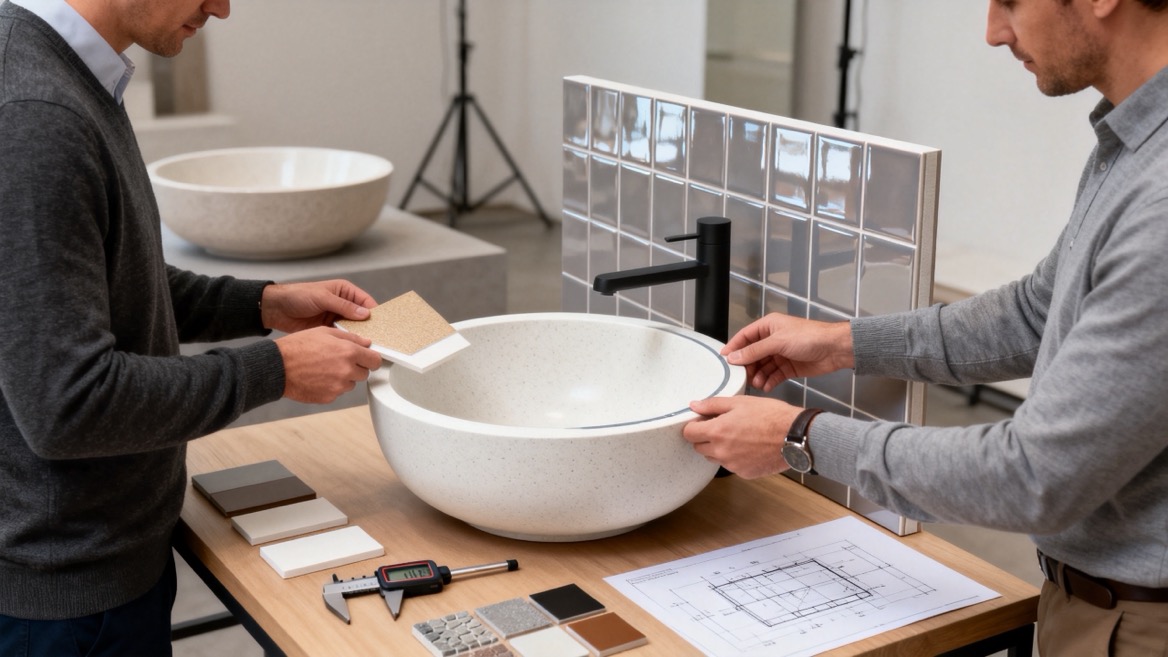
● A Five-step Sample Approval Process
>> Step 1: Build a Complete Material Board
>> Step 2: Review Under Multiple Lighting Conditions
>> Step 3: Test a Working Basin Arrangement
>> Step 4: Evaluate the Proposed Cleaning Routine
>> Step 5: Retain Reference Samples
● Two Design Scenarios to Guide Product Development
>> Compact Residential Bathroom
>> Boutique Hospitality Bathroom
● OEM and ODM Considerations for Bathroom Brands
● Cleaning Matte Basins and Glossy Tile Backsplashes
● Develop a Coordinated Basin Collection
>> Are matte stone basins harder to clean than glossy basins?
>> Can marble basins be paired with glossy ceramic tiles?
>> Which backsplash color works best with a white matte basin?
>> Should backsplash tiles match the basin exactly?
>> Can high-gloss backsplash tiles also be used on the floor?
>> What should a buyer provide for a customized basin project?
Pairing matte stone basins with high-gloss tile backsplashes creates a bathroom defined by contrast: a softly finished basin against a reflective wall surface. The combination can feel architectural, welcoming, and refined without relying on elaborate decoration.
For homeowners, the challenge is choosing colors, proportions, and lighting that work together. For bathroom brands, wholesalers, and manufacturers, the task extends to material specifications, installation details, maintenance instructions, and consistent production.
My starting principle is simple: treat the basin and backsplash as one composition, but specify them as two different materials. A successful pairing needs both visual harmony and clearly defined performance expectations.
This guide explains how to develop that balance—from selecting matte stone bathroom basins to preparing an OEM or ODM product brief.
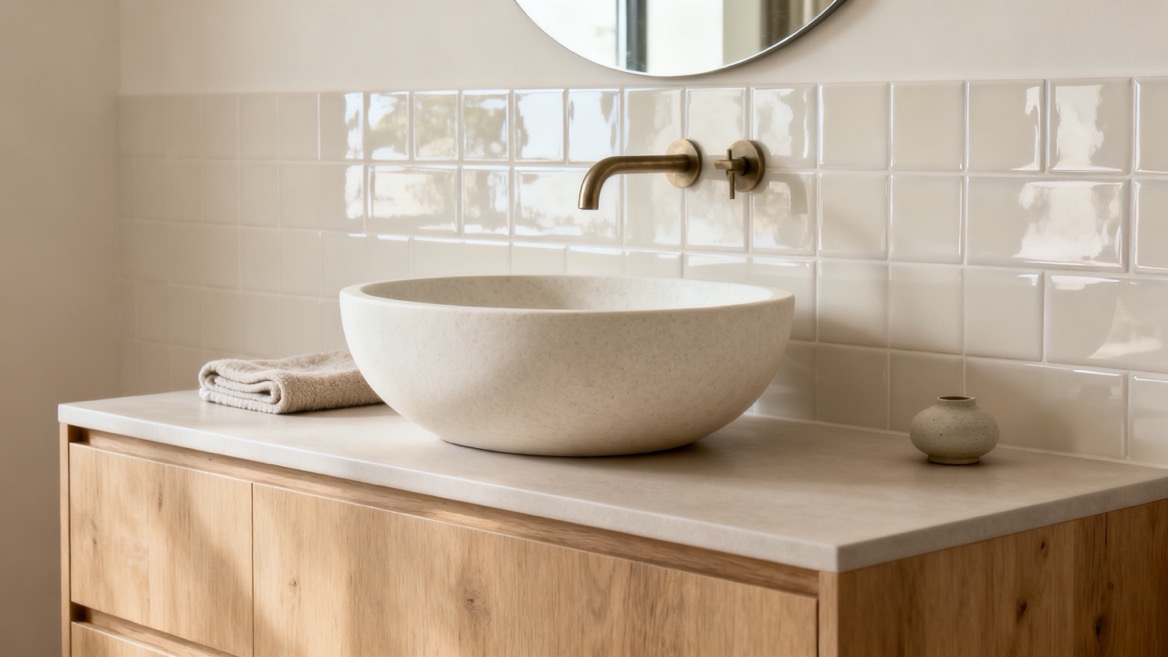
The appeal comes from contrast rather than exact matching.
A matte basin has a restrained surface appearance. A glossy backsplash introduces reflections and highlights. Together, they create a hierarchy: the basin provides a calm focal point, while the wall brings movement to the background.
However, contrast alone does not guarantee a cohesive bathroom.
A heavily textured basin, strongly patterned tiles, reflective metallic fittings, and dramatic lighting can compete for attention. I would usually select one dominant feature and let the other elements support it.
For example:
- A sculptural basin pairs well with simple glossy rectangular tiles.
- A strongly colored backsplash benefits from a neutral basin.
- Handmade-look tiles work best with a basin whose silhouette is relatively restrained.
- A richly veined stone basin may need a quieter wall pattern.
The goal is not to make every surface equally noticeable. It is to give each surface a clear role.
"Matte stone basin" describes an appearance, but it does not identify one standardized material.
Before discussing color or tile layout, establish exactly what the basin is made from.
Natural stone basins may use marble, limestone, granite, or other stones. Their mineral composition affects cleaning requirements, and their appearance can vary between individual pieces.
Marble and limestone contain acid-sensitive minerals. Vinegar, lemon-based cleaners, and some descaling products can etch these surfaces.
A matte or honed finish does not eliminate that vulnerability.
Ask the supplier to identify:
- The stone type.
- Any applied sealer or surface treatment.
- Approved cleaning products.
- Expected variation in color and veining.
- Maintenance and resealing requirements, where applicable.
Stone resin and solid surface products combine mineral components with binders, but formulations and surface constructions differ.
Some products have a coating. Others have a finish developed directly on the underlying material. These distinctions affect cleaning, scratch repair, and long-term appearance.
Do not assume that care instructions for one branded solid surface apply to every mineral-composite basin.
For B2B purchasing, request a written material declaration and product-specific care instructions. Appearance samples alone cannot establish chemical resistance, repairability, or structural performance.
High-gloss tile backsplashes should complement the basin while remaining suitable for the intended wall installation.
Check the tile manufacturer's stated applications, installation instructions, cleaning guidance, and dimensional information before approval.
White is not a single color.
A warm ivory basin beside a cool blue-white tile can look mismatched, even when both products are described as white.
Compare physical samples under the actual bathroom lighting. Include the countertop, grout, and faucet finish in the review.
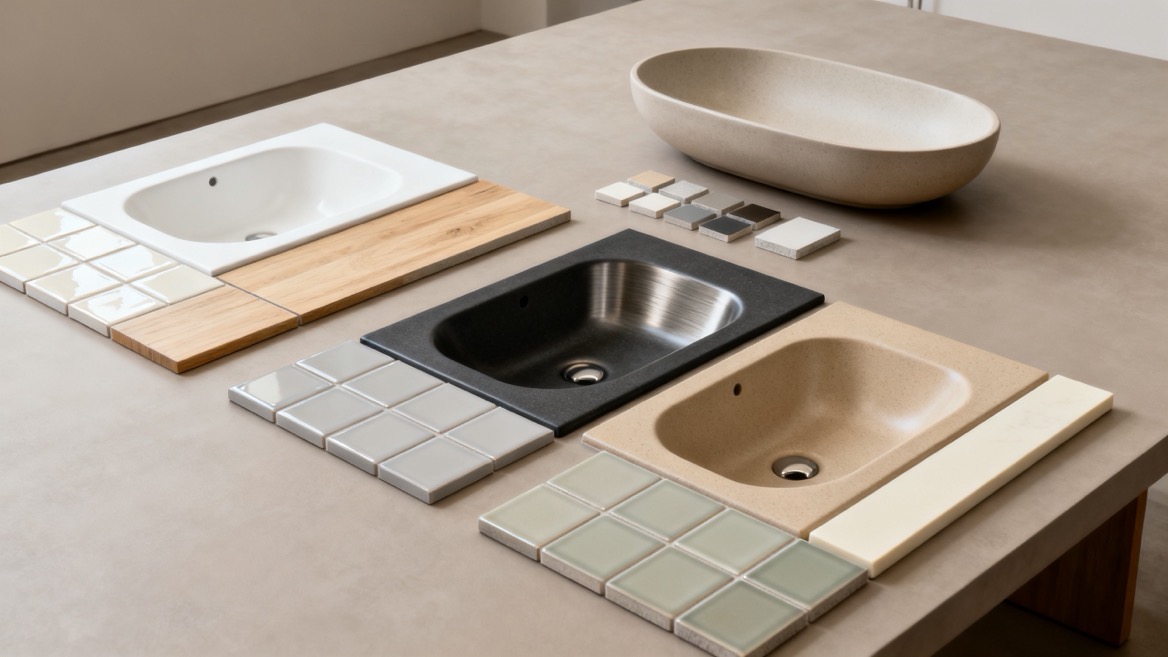
Useful starting combinations include:
| Matte basin finish | High-gloss backsplash | Design direction | Main approval check |
|---|---|---|---|
| Warm white | Ivory or cream | Soft contemporary | Avoid an unintended yellow contrast |
| Cool white | Pale gray or blue-white | Crisp architectural | Check that the room does not feel overly cold |
| Charcoal | White or pale gray | Strong monochrome | Review reflections and visible water residue |
| Sand or beige | Sage or muted green | Natural-inspired | Compare undertones in daylight |
| Light gray | Deep blue | Statement bathroom | Check the palette under evening lighting |
These are design starting points, not guaranteed combinations. Sample approval remains essential.
Small tiles introduce more grout lines. Large tiles create a broader, less interrupted backdrop.
For an oval matte stone vessel basin, a simple tile layout can preserve the softness of the bowl. For a rectangular basin, vertically stacked tiles can introduce a contrasting direction.
Avoid choosing tile dimensions in isolation. Draw the complete vanity elevation, including the mirror, faucet, outlets, and backsplash edges.
A pleasing tile pattern can become awkward when small cuts appear around fittings.
A backsplash does not always need to reach the ceiling.
A compact splash zone can frame the basin discreetly. A taller tiled panel creates a stronger architectural feature. A full-height glossy wall produces a more reflective composition.
Select the height according to splash exposure, mirror placement, cleaning access, and the intended visual emphasis—not a universal decorative rule.
Lighting can make the same basin-and-tile combination look calm in one setting and distracting in another.
Glossy tiles may reflect exposed lamps, windows, and illuminated mirrors. The appearance depends on the light position, viewing angle, and tile surface.
I would review the pairing from three practical positions:
1. Standing at the basin.
2. Entering the bathroom.
3. Viewing the vanity from the adjoining space.
Check whether reflected light competes with the mirror or obscures the tile color.
Diffuse lighting is a useful starting approach, but it should still be tested. Strong light directed across textured glossy tiles can emphasize surface irregularities and grout shadows.
Do not approve the final palette from a digitally rendered image alone. Physical samples reveal reflections, texture, and undertones more reliably than a screen representation.
A bathroom can look coordinated while remaining inconvenient to use.
The most important functional relationship is between the faucet outlet, basin bowl, and surrounding splash surfaces.
Do not select a faucet only because its height looks appropriate beside a vessel basin.
Check:
- Outlet position relative to the bowl.
- Basin depth and internal slope.
- Water stream direction.
- Clearance for washing hands.
- Access to faucet controls.
- Splash behavior under intended operating conditions.
For a wall-mounted faucet, resolve the installation depth before tiling. Later adjustments may require disturbing the finished backsplash.
A working mock-up is particularly valuable when developing a new basin shape or pairing an existing basin with an unfamiliar faucet.
A narrow, inaccessible gap can collect moisture and residue.
Choose either a deliberately accessible clearance or a junction designed for the specific basin and countertop arrangement.
There is no universal gap dimension suitable for every basin. The correct detail depends on the product geometry, installation instructions, and cleaning method.
For wall-hung basins, verify the prescribed structural support and fixing arrangement. Decorative tile should not be treated as the load-bearing support.
The connection between the countertop and backsplash deserves attention before installation.
Different materials can respond differently to temperature and moisture. Rigidly trapping a solid surface component against surrounding materials can conflict with its installation requirements.
For example, Corian fabrication guidance requires movement clearance in specified installations. That guidance illustrates the importance of accommodating movement; its dimensions should not automatically be copied to unrelated basin products.
Follow the instructions for the actual basin, countertop, tile system, and sealant.
The specification should identify:
- Substrate preparation.
- Required moisture protection for the location.
- Adhesive compatibility.
- Movement-joint treatment.
- Sealant compatibility with adjacent materials.
- Access for inspection and future renewal.
Do not assume that a glossy tile face makes the entire wall assembly moisture-proof. Review the joints, penetrations, and underlying construction as part of the installation.
For brands and wholesalers, a structured approval process reduces subjective disagreements between design, purchasing, and production teams.
Include the basin finish, tile, grout, countertop, faucet finish, and proposed sealant color.
A basin sample beside a tile sample is not enough when the surrounding materials materially influence the result.
Compare the samples in daylight and under the planned artificial lighting.
Record which combination was approved and under what conditions. Photographs can document the decision, but they should not replace the approved physical samples.
Where feasible, assemble the basin and faucet.
Observe splashing, drainage, cleaning access, and whether users can comfortably reach the controls.
Use only cleaners approved for the relevant materials.
Assess whether the intended maintenance instructions are understandable and practical. Any formal stain or chemical-resistance claim should be supported by an appropriate test method and documented results.
Keep signed or otherwise clearly identified master samples for production comparison.
Define acceptable variation rather than relying on phrases such as "premium matte finish" or "consistent white."
This process turns a visual preference into an actionable purchasing specification.
The following are illustrative concepts, not completed customer projects.
Pair a warm-white matte basin with ivory glossy tiles and a light wood vanity.
Use a restrained tile layout and review reflections from the mirror lighting. Keep accessories limited so that the basin remains the main feature.
The development priority is usability: adequate bowl space, sensible faucet reach, and accessible cleaning areas.
Pair a charcoal matte basin with pale glossy tiles and a simple countertop.
The contrast creates a stronger visual identity. However, evaluate local water conditions and housekeeping routines before final approval.
The development priority is repeatable maintenance. Cleaning teams need clear instructions for the basin, tile, grout, and metal fittings—not one generic cleaner for every surface.
Jiaxing Miluo Smart Home Co., Ltd. focuses on customized modern bathroom products and solutions for overseas brands, wholesalers, and manufacturers through OEM and ODM services.
For a matte basin collection intended to coordinate with glossy backsplashes, a useful development brief should connect appearance with installation and aftercare.
| Specification area | Information to define |
|---|---|
| Material | Composition, surface construction, and intended application |
| Geometry | Dimensions, rim profile, bowl depth, and installation method |
| Plumbing | Drain interface, overflow configuration, and faucet compatibility |
| Appearance | Color reference, texture, sheen, and acceptable variation |
| Installation | Support requirements, fixing details, and junction treatment |
| Aftercare | Approved cleaners, prohibited chemicals, and repair guidance |
| Packaging | Product protection, labeling, and agreed shipment requirements |
For OEM projects, clarify which design and performance requirements the buyer supplies.
For ODM projects, identify which development decisions require joint approval. Discuss tooling, samples, documentation, and production expectations before committing to a final design.
Do not advertise certification, test performance, or material properties until supporting documentation is available for the specific product.
Begin with the gentlest approved cleaning method.
For natural stone, neutral cleaners or suitable mild detergent solutions are common starting recommendations. Acidic cleaners are unsuitable for acid-sensitive stones.
For engineered materials, follow the exact manufacturer's guidance. Abrasive refinishing methods recommended for one solid surface may damage another product's coating.
A practical routine is to:
1. Remove fresh residue promptly.
2. Clean each material with its approved product.
3. Rinse away cleaner residue.
4. Dry accessible surfaces with a soft cloth.
5. Inspect joints and address deterioration.
Avoid allowing tile cleaners to run onto an incompatible basin. Shared surroundings do not mean shared chemical resistance.
A successful pairing connects appearance, daily use, and manufacturable specifications.
To discuss an OEM or ODM basin project with Jiaxing Miluo Smart Home Co., Ltd., prepare your basin drawings, preferred matte finish, backsplash samples, target market, and estimated order requirements. Request a review of material options, sample development, installation compatibility, and product-specific care documentation before approving production.
Not necessarily. Cleaning depends on material composition, surface treatment, water conditions, and basin geometry. Finish alone does not determine maintenance requirements.
Yes, visually. However, the marble requires suitable care, and tile-cleaning products must not damage it. Approve the complete installation and maintenance approach.
Start with a white of a compatible undertone, then consider pale gray, muted green, or a contrasting dark color. Physical samples are more useful than color names.
No. Coordinated undertones and balanced proportions are usually more useful than an exact match. Deliberate contrast can create a clearer focal point.
Only when the manufacturer declares them suitable for the intended flooring application. Wall suitability does not establish wet-floor suitability.
Provide drawings or dimensions, material expectations, finish references, installation details, plumbing interfaces, target market requirements, and purchasing expectations. Include proposed tile samples if visual coordination matters.
1. Natural Stone Institute — "Care & Cleaning of Natural Stone." Supports the distinctions between calcareous and siliceous stone, neutral-cleaner recommendations, and warnings about acidic cleaning products. [naturalstoneinstitute]
2. Corian — "Corian® Solid Surface Care and Maintenance." Supports the importance of material-specific cleaning and finish-maintenance instructions. Its recommendations apply to Corian products, not automatically to other solid surface or stone resin basins. [corian]
3. Corian — "Corian® Solid Surface Requirements." Supports discussion of movement clearance and the need to follow product-specific fabrication and installation requirements. [corian]
4. Corian — "Corian® Solid Surface Transportation and Installation." Supports trial fitting, installation planning, and accommodating expansion at surrounding walls. [corian]
5. Tile Council of North America — "ANSI Standards." Identifies ANSI A326.3 as a standard addressing the dynamic coefficient of friction of hard surface flooring materials, supporting the distinction between wall-tile selection and flooring suitability. [tcnatile]


