
Views: 237 Author: Miluo Smart Home Publish Time: 2026-10-14 Origin: Site


Content Menu
● What Makes a Walk-In Tub Suitable for Seniors?
● Best Walk-In Tubs for Seniors by Bathing Need
● Essential Walk-In Bathtub Safety Features
>> Low Entry Threshold and Clear Door Access
>> Comfortable Seating and Reachable Support
>> A Dependable Door and Replaceable Seal
>> Temperature Controls That Are Easy to Understand
● Fill and Drain Time: The Overlooked Comfort Factor
● Acrylic, Gelcoat, or Solid Surface: Compare the Finished Product
● Are Massage Jets and Heated Seats Worth Adding?
>> Keep Comfort Claims Separate From Medical Claims
>> Consider the Cleaning Routine
● What Real Users Say About Walk-In Tubs
● A Five-Step Walk-In Tub Installation Checklist
>> 1. Assess the User Before Measuring the Room
>> 2. Measure the Delivery Route and Bathroom
>> 3. Confirm Plumbing, Hot Water, and Electrical Requirements
>> 4. Obtain an Itemized Installed Quote
>> 5. Complete a Documented Handover
● OEM and ODM Walk-In Tub Development for Overseas Buyers
>> Build a Clear Product Requirements Matrix
>> Validate Before Committing to Volume
● Create a Better Senior-Friendly Bathroom Collection
● Frequently Asked Questions About Walk-In Tubs for Seniors
>> What is the best walk-in tub for seniors?
>> Are walk-in tubs completely safe?
>> Can wheelchair users use any walk-in bathtub?
>> How long does a walk-in tub take to drain?
>> Is a walk-in shower a better alternative?
>> What should overseas buyers request from a supplier?
The best walk-in tubs for seniors combine accessible entry, comfortable seating, dependable drainage, and controls that are easy to operate. However, the right bathtub depends on more than its feature list. The user's mobility, bathroom layout, bathing preferences, and installation conditions all influence whether it will work well in everyday life.
My starting point is simple: prioritize usability before luxury extras. A beautiful bath has limited value if its user cannot reach the handle, transfer comfortably, or tolerate the wait before exiting.
For homeowners, this guide provides a practical selection framework. For overseas brands, wholesalers, and manufacturers, it also explains how to turn senior-friendly bathing requirements into a clearer OEM or ODM development brief.
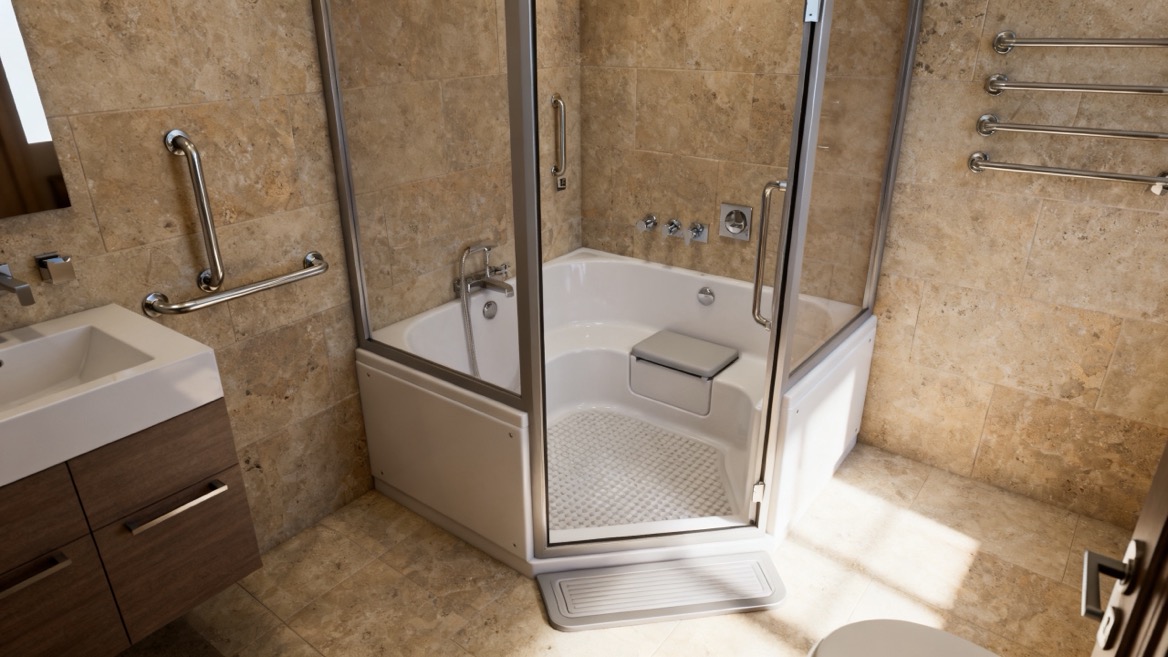
A walk-in bathtub typically includes a watertight door, a low entry threshold, and a built-in seat. Instead of climbing over a conventional tub wall and lowering themselves toward the floor, users enter through the doorway and bathe while seated.
This arrangement can make bathing more manageable for some people with restricted mobility. It does not eliminate fall risk or guarantee independent bathing.
Current public health guidance reports that more than one in four adults aged 65 and older falls each year. These figures cover falls generally, not just bathroom incidents, and they do not establish how much a particular bathtub reduces risk.
A suitable bath therefore belongs within a broader plan that addresses lighting, slippery surfaces, support rails, and the user's balance and strength.
There is no universally best model. Start with how the person enters, sits, bathes, and exits rather than choosing by age alone.
| Bathing need | Configuration to investigate | Main buying question |
|---|---|---|
| Independent seated soaking | Standard walk-in soaking tub | Can the user step in and stand up comfortably? |
| Wheelchair-to-seat transfer | Transfer-accessible model | Does the opening support the actual transfer method? |
| Additional body space | Wider or bariatric model | Are seat dimensions and rated capacity adequate? |
| Optional massage comfort | Air-jet or water-jet model | Are controls and cleaning requirements manageable? |
| Regular caregiver assistance | Accessible bath or alternative shower layout | Is there enough room to assist safely? |
These categories describe different requirements, not interchangeable product labels. Wheelchair-accessible and bariatric versions exist, but their suitability must be checked against the individual model and user.
For progressive mobility conditions, an occupational therapist can help assess whether a walk-in tub will remain appropriate as assistance needs change.
A low threshold reduces the height the user must step over. Nevertheless, it remains an obstacle for someone who cannot lift a foot reliably.
Measure the threshold from the finished bathroom floor. Then check the clear doorway opening, nearby fixtures, and the space needed to approach the seat.
A specification drawing is useful, but a supervised demonstration can reveal difficulties that dimensions alone do not show.
Seat fit should reflect the user's body and transfer method. Ask for seat height, width, depth, and the manufacturer's rated load capacity.
Do not select a wider bathtub solely because it looks spacious. The user also needs to reach the controls and support points without awkward stretching.
Secure grab bars, better lighting, and appropriate slip-resistant bathing surfaces are recognized bathroom safety measures. Decorative rails and towel bars should not be treated as substitutes for properly installed support.
Inward-opening and outward-opening doors require different space and transfer arrangements. Door direction alone does not prove that one bathtub is safer or more leak-resistant than another.
Review the latch, gasket, opening clearance, and maintenance instructions. Ask how a worn seal is replaced and whether replacement parts will remain available.
For procurement, request documented leak checks and operating-cycle information rather than relying on descriptions such as "premium sealing."
Users normally sit inside a conventional walk-in tub while it fills. Water temperature therefore deserves particular attention.
Ask the installer to explain the proposed temperature-limiting protection and demonstrate the controls. Also confirm whether a heater maintains bathwater temperature or performs another function; these capabilities should not be assumed from a package name.
Users with health concerns should obtain individualized advice before prolonged hot-water bathing.
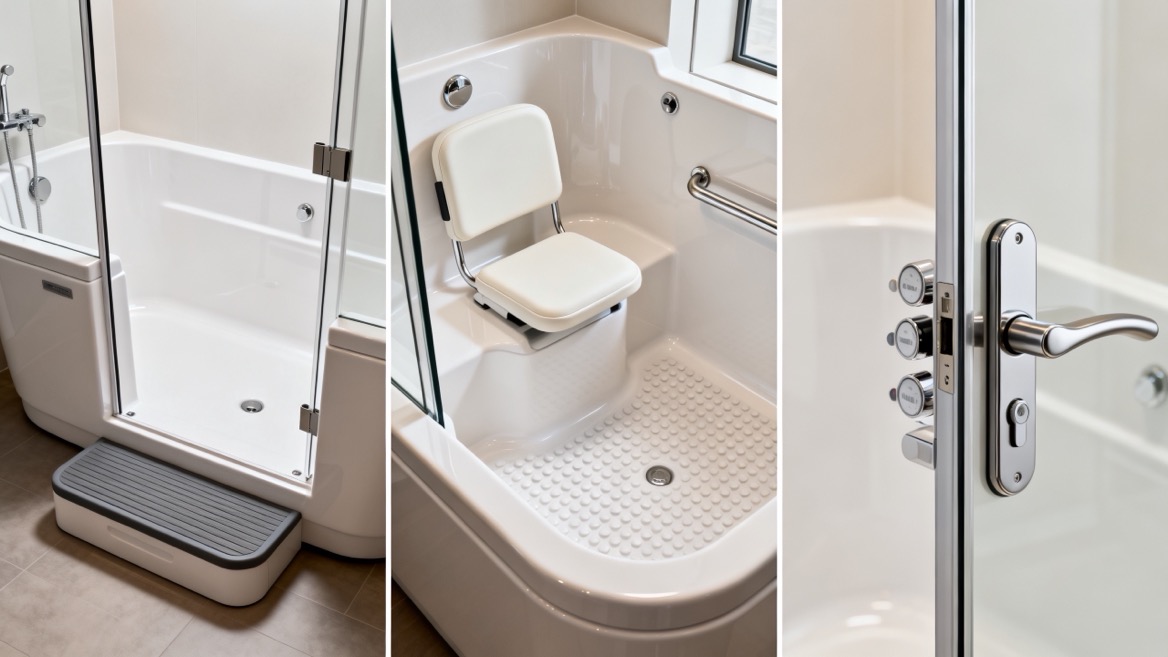
With most conventional walk-in tubs, the user closes the door before filling and waits until the water drains before opening it. Waiting is therefore part of every bath, not a minor technical detail.
Published comparisons report substantial differences between models. One review describes a dual-drain system taking approximately 80–200 seconds, compared with the five-to-fifteen-minute range encountered elsewhere in its research. These are reported results, not guarantees for another model or installation.
Before purchase, ask:
- What water level was used for the advertised drain test?
- What plumbing conditions were required?
- Does accelerated drainage depend on electrical power?
- What is the documented procedure if drainage becomes slow?
- Can performance be demonstrated after installation?
For a user who becomes cold, tired, or anxious while waiting, predictable drainage may matter more than additional massage features.
Include exit planning in the assessment. Ask the supplier and installer how assistance would be provided if the user became unwell before the bath had emptied.
Material names are useful starting points, but they are not complete quality assessments. Available walk-in tubs include different shell materials and finishes, with manufacturers positioning them at different price and design levels.
From a purchasing perspective, I would compare the finished construction rather than accept a blanket claim that one material always lasts longer.
Request information covering:
- Surface care and compatible cleaning products.
- Repair procedures for scratches or chips.
- Structural support and rated user capacity.
- Access to drains, pumps, and door hardware.
- Material-specific warranty exclusions.
For premium bathroom collections, finish consistency and visual coordination also matter. However, attractive styling should not hide inaccessible service panels or difficult-to-replace components.
Claims about heat retention, durability, or scratch resistance should be supported by product-specific evidence, not inferred from the material category.
Air jets, water jets, and heated surfaces can enhance comfort for people who enjoy soaking. They also introduce additional components and maintenance requirements.
The strongest reason to add them is a clearly identified user preference.
A relaxing bathing experience should not be described as a cure for arthritis, circulation problems, or other conditions. User reports of relief are experiences, not proof that every buyer will receive the same benefit.
Likewise, colored lighting should be presented as an optional ambience feature unless a specific health claim has appropriate evidence.
Ask how jet systems are cleaned, what products are permitted, and which components require servicing. Check whether the person using the bath—or their caregiver—can realistically follow that routine.
A simpler soaking model may be the better choice when easy maintenance matters more than a spa-style experience.
Public feedback highlights both increased confidence and practical frustrations.
A recent older-adult mobility survey included users who described easier entry, reduced worry, and greater independence. Its review reports that 86% of respondents who used a walk-in tub described a positive or very positive impact on their lives. This is self-reported feedback, not a clinical measurement of injury reduction.
Caregiver forum discussions provide a more mixed picture. Some contributors described relatives enjoying seated soaking, while others raised concerns about installation problems, waiting during drainage, and changing mobility needs.
Those forum posts are older and unverified, so they should not establish current pricing or product performance. Their value is in identifying questions that remain worth asking.
The practical lesson is to evaluate the complete routine: entering, filling, bathing, draining, exiting, and cleaning.
Document how the person currently bathes and where assistance is needed. Discuss balance, stepping, sitting, standing, and caregiver involvement.
When needs are complex or likely to change, seek an occupational therapist's assessment before committing to a layout.
Check entrance doors, corridors, turning points, and the final installation space. Some tubs arrive fully assembled, making delivery access a decisive consideration.
Include the space needed for door movement, servicing, and caregiver positioning—not just the bathtub footprint.
Ask qualified installers to compare the selected model's requirements with the existing services.
Confirm working fill volume, hot-water demand, drainage arrangements, and any electrical requirements for pumps or heaters. Installation complexity can substantially change the overall project cost.
Separate the bathtub price from removal, plumbing alterations, electrical work, delivery, finishing, and installation labor.
Published retail comparisons show that installation is a significant additional expense. Their figures should be treated as market context, not a quotation for an individual home or wholesale order.
Request a demonstration of the latch, controls, filling, drainage, and cleaning procedure. Record installed fill and drain performance and check for leaks.
Keep manuals, warranty terms, installer details, and replacement-part information together.
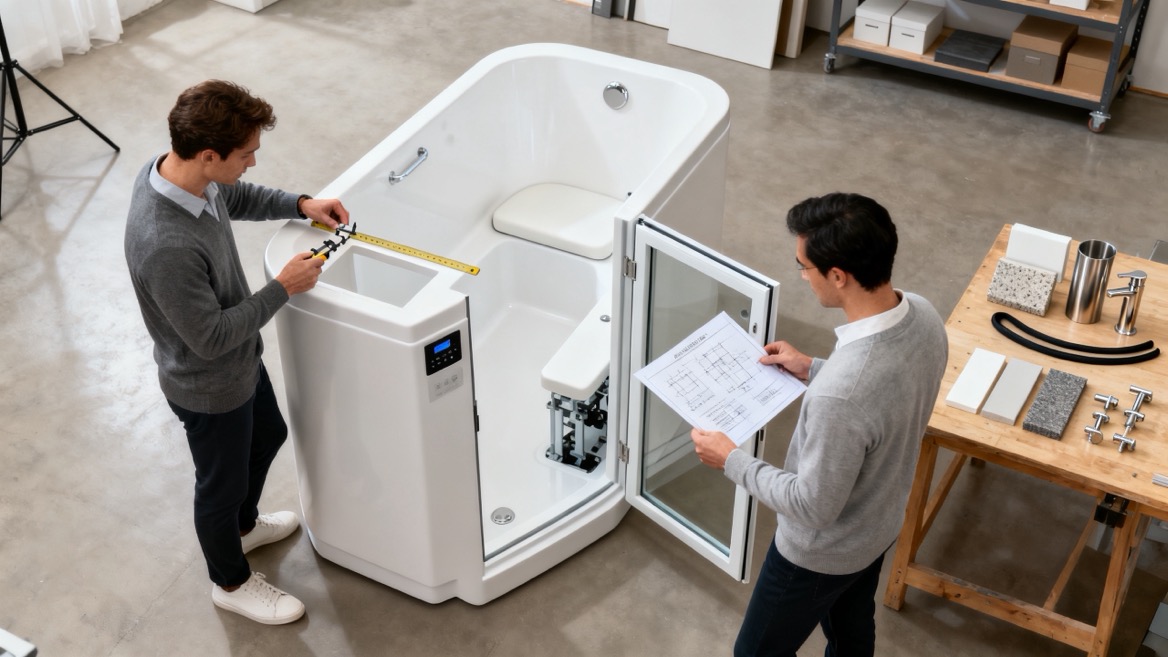
Jiaxing Miluo Smart Home Co., Ltd. focuses on customized modern, high-end bathroom products and solutions for overseas brands, wholesalers, and manufacturers.
For a senior-friendly bathtub project, the development brief should translate lifestyle goals into measurable requirements. "Easy access" is less useful than specified threshold dimensions, door clearance, seat geometry, and handle reach.
A proposed procurement matrix can cover:
| Development area | Information to define or request |
|---|---|
| Intended user | Mobility profile, assistance level, body-size range |
| Accessibility | Entry dimensions, transfer approach, control locations |
| Performance | Working water volume, fill and drain test conditions |
| Construction | Support design, hardware, seals, service access |
| Market readiness | Applicable local requirements and required documentation |
| After-sales support | Spare parts, manuals, warranty responsibilities |
This matrix is a development recommendation, not a claim that a particular product has passed these checks.
Review drawings, inspect samples, and agree on acceptance criteria before approving production. Where practical, involve representative users and qualified accessibility professionals.
Keep accessibility claims model-specific. A low threshold or built-in seat alone should not be used to imply that an entire installation meets every applicable requirement.
A well-chosen walk-in tub balances accessible movement, comfortable bathing, practical maintenance, and dependable installation. Its value comes from how well those elements work together.
For overseas brands, wholesalers, and manufacturers planning a customized bathroom collection, contact Jiaxing Miluo Smart Home Co., Ltd. with your target market, intended users, preferred dimensions, design direction, and expected order volume. Request an OEM or ODM feasibility discussion covering configuration, validation requirements, and project scope before finalizing your purchasing brief.
The best choice matches the user's transfer ability, seating needs, bathroom conditions, and maintenance capacity. A feature-rich model is not automatically preferable to a simpler, easier-to-use soaking tub.
No. They can address difficulties associated with stepping over a high tub wall, but wet surfaces, poor balance, and other hazards remain. Lighting, secure support, and appropriate assistance still matter.
No. A standard walk-in model should not be assumed to support wheelchair transfers. Investigate a specifically designed accessible configuration and assess its opening, seat arrangement, and surrounding space.
Drain times vary by model and installation. Published comparisons include both fast-drain systems and substantially longer waits. Request the test conditions and verify performance after installation.
It can be, especially when soaking is not a priority or the proposed tub does not suit the user's assistance needs. An occupational therapist can help compare bathing options against current and future abilities.
Request drawings, model-specific performance documentation, applicable compliance information, installation instructions, warranty terms, and a spare-parts plan. Agree on sample approval and acceptance criteria before placing a volume order.
1. Aquatica Baths USA. "[Best Walk-In Tubs for Seniors]." Original article reviewed for product positioning, material claims, accessibility features, and content restructuring. [aquaticausa]
2. Centers for Disease Control and Prevention. "[Facts About Older Adult Falls]." Public health information supporting the discussion of annual fall prevalence among adults aged 65 and older and the limitations of bathtub-specific safety claims. [cdc]
3. National Council on Aging. "[Compare the Best Walk-In Tubs 2026]." Comparative information on walk-in bathtub configurations, accessibility, installation costs, drainage performance, and self-reported user experiences. [ncoa]
4. UCLA Health. "[How to Prevent Falls in the Bathroom]." Bathroom safety guidance supporting the recommendations for secure grab bars, improved lighting, and slip-resistant bathing surfaces. [uclahealth]
5. ConsumerAffairs. "[Pros and Cons of Walk-In Tubs]." Consumer guidance on seated bathing, filling and draining delays, installation considerations, and ownership trade-offs. [consumeraffairs]
6. AgingCare. "[Does Anyone Out There Have Experience With Walk-In Tubs?]" Community discussion illustrating caregiver and user concerns about bathing comfort, installation, drainage waits, and changing mobility needs. These comments are anecdotal, not verified product tests or clinical evidence. [agingcare]


