
Views: 258 Author: Miluo Smart Home Publish Time: 2026-10-08 Origin: Site


Content Menu
● What Is Resin Stone, and Why Does Its Composition Matter?
>> Homogeneous Solid Surface Versus Gel-Coated Resin Stone
● Why Public Airport Restrooms Need More Than Attractive Basins
● Resin Stone Versus Other Airport Restroom Basin Materials
>> Resin Stone Versus Ceramic Basins
>> Resin Stone Versus Stainless Steel Basins
>> Resin Stone Versus Natural Stone Basins
● Why Designers Consider Resin Stone for Airport Washrooms
>> Integrated Forms Can Simplify Cleaning
>> Custom Geometry Supports Better Layout Coordination
>> Repeatable Finishes Support a Consistent Interior
>> Repairability May Reduce Replacement Disruption
● Accessibility Should Shape the Basin Before Tooling Begins
>> Check the Complete Installed Assembly
● Industry Case Insight: Airport Washstands Benefit From Modular Planning
● A Practical Validation Plan for Commercial Resin Stone Basins
>> Step 1: Define Operating Conditions
>> Step 2: Test the Actual Finish
>> Step 3: Build a Working Basin Mock-Up
>> Step 4: Verify Repair and Replacement Procedures
● Evaluate Lifecycle Cost, Not Just Basin Price
● OEM and ODM Planning With Jiaxing Miluo Smart Home Co., Ltd.
● Choose a Basin System, Not Just a Surface
>> Is Resin Stone Suitable for High-Traffic Airport Restrooms?
>> Is Resin Stone More Hygienic Than Ceramic?
>> Can Scratches in Resin Stone Basins Be Repaired?
>> Does Resin Stone Require Special Cleaning Products?
>> Are Custom Resin Stone Basins Automatically Accessible?
>> What Should Overseas Buyers Request Before Bulk Ordering?
Resin stone for public airport restrooms offers an appealing balance of design flexibility, cleanable surfaces, and coordinated manufacturing. For architects and commercial buyers, a basin must do more than look impressive. It must support efficient handwashing, accessible layouts, predictable maintenance, and reliable operation during busy travel periods.
From a specification perspective, I would prioritize serviceability over showroom appearance. A beautiful basin becomes a poor investment if cleaners cannot maintain its finish or technicians cannot reach its plumbing.
This article compares resin stone with ceramic, stainless steel, and natural stone basins. The preference described here is a design rationale, not a claim that all airport designers choose resin stone. Its suitability depends on the formulation, installation, and maintenance plan.

"Resin stone" generally describes mineral-filled composites bonded with resin. However, it is not a single standardized material with identical performance across suppliers.
Products sold under this name may include homogeneous solid-surface formulations, mineral-cast composites, or products with a separate gel-coat finish. These differences affect cleaning, scratch resistance, repair methods, and long-term appearance.
A homogeneous solid-surface basin has broadly consistent material through its thickness. Depending on the formulation and finish, trained technicians may remove superficial damage through controlled refinishing.
A gel-coated resin stone basin uses a distinct surface layer over a composite body. That coating determines much of its visible finish and surface performance. Sanding it as though it were homogeneous solid surface can cause permanent damage.
Before specifying commercial resin stone basins, request:
- The resin and mineral composition.
- Confirmation of homogeneous or coated construction.
- Approved cleaning and disinfecting instructions.
- Relevant product test reports.
- Written repair procedures and warranty exclusions.
Never transfer the maintenance claims of one branded solid-surface product to every resin stone basin.
Airport washrooms combine fluctuating passenger demand with cleaning, inspection, and maintenance requirements. The basin area must accommodate travelers carrying luggage, children, wheelchair users, and people unfamiliar with the building.
The central design challenge is coordination. Basin geometry, faucet placement, soap dispensing, drying facilities, and plumbing access should work as one system.
A shallow bowl may look elegant but perform poorly with an unsuitable faucet. A deep countertop may offer storage space while making controls difficult to reach. A continuous vanity may simplify wiping while making replacement disruptive.
These relationships explain why material selection should follow operational planning—not precede it.
No basin material wins every comparison. The following table summarizes practical selection considerations, rather than ranking untested products.
| Selection factor | Resin stone | Ceramic | Stainless steel | Natural stone |
|---|---|---|---|---|
| Design flexibility | Molded shapes and integrated layouts are possible | Often selected from established fixture ranges | Fabricated layouts suit functional schemes | Custom fabrication is possible but stone-dependent |
| Surface maintenance | Depends on formulation and coating | Glazed surfaces generally support straightforward cleaning | Finish and cleaning technique influence appearance | Some stones need sealing and chemical restrictions |
| Damage considerations | Scratching, coating damage, or discoloration require product-specific assessment | Hard glaze resists everyday abrasion, but impact can cause chips | Surface scratches and dents may remain visible | Chipping, staining, and etching vary by stone |
| Repair approach | Some homogeneous products can be refinished | Visible chips can be difficult to restore discreetly | Refinishing depends on finish and damage | Specialist repair may be necessary |
| Strong project fit | Coordinated, contemporary basin installations | Standardized, replaceable fixtures | Utility-led or demanding environments | Premium feature areas with suitable maintenance |
Ceramic remains a credible choice for commercial bathrooms. Standardized fixtures can simplify procurement and replacement, and glazed surfaces are familiar to maintenance teams.
Resin stone becomes attractive when the design needs unusual dimensions, coordinated colors, or integrated basin-and-countertop forms.
However, customization creates obligations. Buyers need replacement drawings, retained specifications, and a clear future supply arrangement. A standard ceramic basin may be easier to replace than a discontinued custom composite design.
Stainless steel deserves consideration where practical robustness and a utilitarian appearance match the project brief.
Resin stone can offer a softer visual character, rounded forms, and finishes suited to premium terminal interiors. That does not make it automatically more durable.
Compare actual products against anticipated impact, scratching, cleaning chemicals, and maintenance methods. Appearance alone is not a performance test.
Natural stone provides distinctive veining and material character. Its maintenance requirements, however, depend on the stone selected.
Some stones are sensitive to acidic cleaners or require sealing. Resin stone may provide greater control over repeated colors and dimensions, but its chemical resistance also needs verification.
The useful comparison is between documented finished products—not broad material labels.
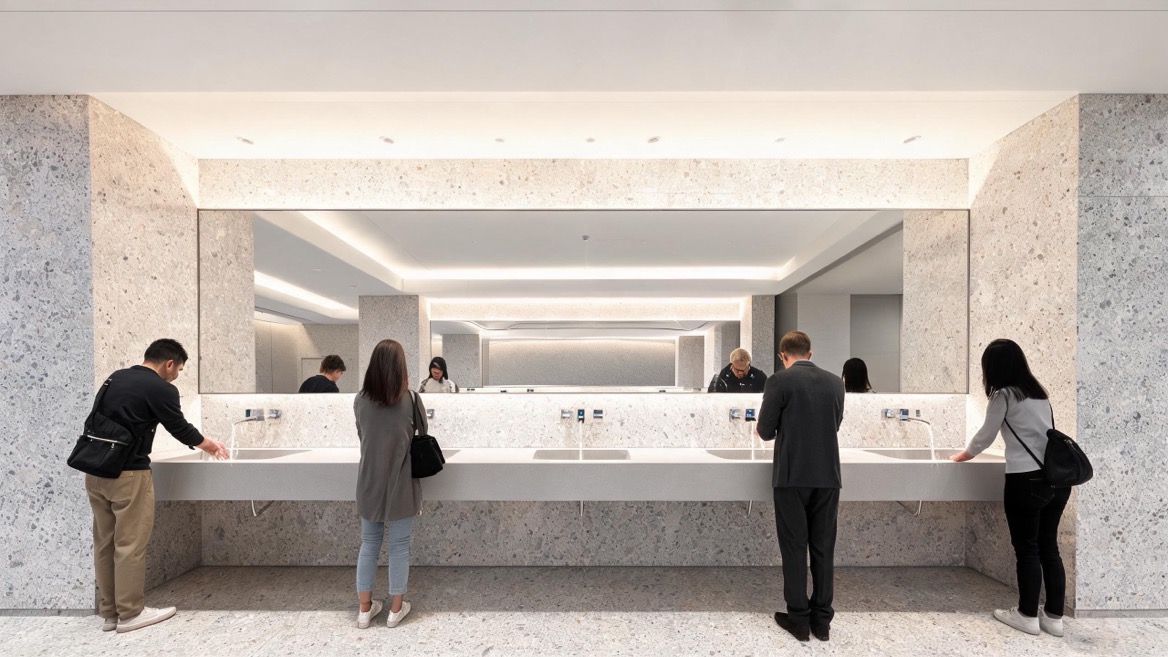
An integrated basin and countertop can reduce interfaces compared with a separate vessel basin mounted on a counter.
Fewer interfaces may simplify wiping and reduce difficult-to-reach edges. Nevertheless, drains, faucet openings, wall junctions, and installation joints remain maintenance points.
Nonporous surfaces are not self-disinfecting. Cleanability depends on both surface condition and an effective cleaning routine.
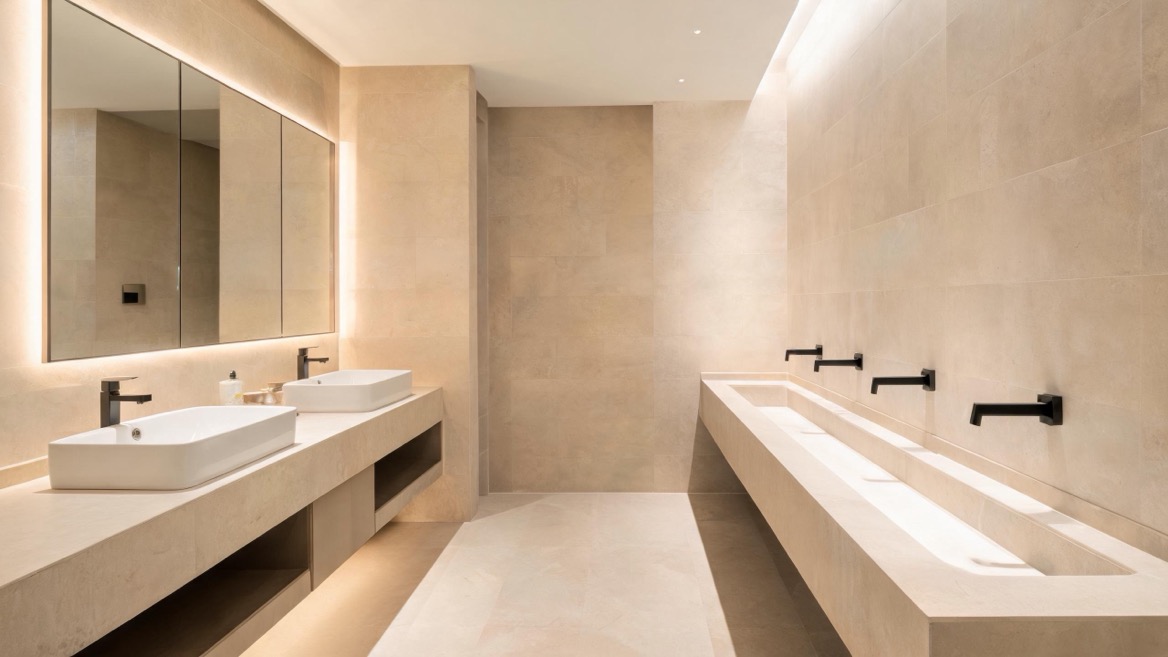
Custom resin stone basins can help designers coordinate bowl dimensions, countertop depth, faucet positions, and splash protection.
This flexibility is particularly useful when a restroom layout does not suit standard fixtures.
The design should still be tested. Changing a bowl's slope or faucet position can affect splashing, drainage, and reach. Attractive renderings cannot establish those outcomes.
A coordinated basin range can help connect washrooms across terminal zones, lounges, and refurbishment phases.
For overseas brands and wholesalers, repeatability also matters commercially. Approved samples, dimensional drawings, and finish tolerances help define what subsequent production batches should deliver.
Even engineered materials require color control. Lighting conditions and adjacent finishes can make small differences more noticeable.
Some homogeneous solid-surface products allow superficial scratches or stains to be removed through approved refinishing.
That can be useful when replacing a large installation would disrupt surrounding finishes or temporarily close handwashing stations.
The limitation is important: repairability depends on material construction, damage depth, finish, and technician competence. Coated resin stone products may require a different repair process.
A customizable material can support accessible design, but it does not make an installation compliant by itself.
For U.S. projects, the accessibility standards require the higher of the lavatory rim or counter surface to be no more than 34 inches above the finished floor. Forward approach space, knee and toe clearance, operable controls, and protected plumbing also matter.
Review accessibility with the basin, countertop, support frame, plumbing, faucet, and dispensers shown together.
A basin may fit the required mounting height while its underside prevents wheelchair approach. A protective plumbing enclosure may create another obstruction.
Before approving tooling, confirm:
1. Finished mounting height.
2. Knee and toe clearance.
3. Reach to faucet and soap controls.
4. Safe treatment of exposed plumbing.
5. Clear approach space and surrounding circulation.
Projects outside the United States should follow applicable local requirements. Avoid describing a basin as universally accessible without checking its installation.
A documented Heathrow Terminal 5 washroom project provides a useful manufacturing lesson.
Wills Watson+Associates reports developing modular washstands for off-site fabrication, with precision alignment and fast installation as primary concerns. The project involved nearly 1,000 modules configured in approximately 75 variations.
This case supports the value of modular planning. It does not establish that all those modules used resin stone or prove superiority over other materials.
For a custom basin program, the practical lesson is to standardize interfaces while allowing controlled variation:
- Common mounting positions.
- Coordinated plumbing connections.
- Defined dimensional tolerances.
- Repeatable service access.
- Clearly identified replacement components.
Customization works best when it produces a managed product family rather than many unrelated designs.
The following workflow is a proposed procurement method, not a report of testing performed by Jiaxing Miluo Smart Home Co., Ltd.
Document the cleaning chemicals, cleaning frequency, water conditions, expected misuse, and maintenance access requirements.
Include the facility operator early. Its cleaning team may identify limitations that are invisible in architectural drawings.
Request production-representative samples with the proposed color and surface finish.
Evaluate approved cleaners at their specified concentrations and contact times. Check for staining, gloss changes, discoloration, and surface damage.
A successful test on one finish should not automatically qualify every finish in the range.
Combine the proposed basin with the actual faucet, soap dispenser, drain, and support arrangement.
Check:
- Splashing at intended water settings.
- Drainage and standing water.
- Comfortable handwashing positions.
- Cleaning access around fittings.
- Technician access to connections.
This test can reveal coordination problems before expensive tooling or bulk production.
Ask the supplier to demonstrate the approved repair method on representative damage.
Then assess replacement logistics. Determine whether one basin, a countertop section, or the entire assembly must be removed.
The easiest surface to repair is not always the easiest installation to service.
An airport basin quotation should be assessed alongside installation, cleaning, repair, and replacement implications.
A useful comparison considers:
> Lifecycle cost = purchase + installation + routine maintenance + repairs + replacement-related disruption.
This is a planning framework, not a guaranteed savings calculation.
Ask competing suppliers to quote against the same scope. Otherwise, one offer may include support frames, fittings, packaging, or spare parts while another excludes them.
Avoid unsupported claims that resin stone reduces maintenance by a fixed percentage. Credible savings estimates require project-specific labor rates, cleaning records, service assumptions, and replacement costs.
Jiaxing Miluo Smart Home Co., Ltd. focuses on customized modern bathroom products and solutions, including basins, for overseas brands, wholesalers, and manufacturers through OEM and ODM services.
For an airport-related basin inquiry, the strongest starting point is a complete technical brief.
Provide layout drawings, target dimensions, preferred material construction, finish requirements, fixture selections, destination-market requirements, and anticipated order quantities.
Separate mandatory requirements from preferences. For example, accessible clearances and chemical compatibility are acceptance conditions; a particular shade may be negotiable.
Before purchase approval, request agreed drawings, samples, inspection criteria, packaging details, and project-specific documentation. Manufacturer positioning alone does not establish certification or previous airport experience.
Resin stone earns consideration when it helps create a coordinated, maintainable, and visually consistent airport washroom. Ceramic, stainless steel, and natural stone remain legitimate alternatives when their characteristics better match the operating brief.
For your next OEM or ODM basin project, send Jiaxing Miluo Smart Home Co., Ltd. your drawings, finish preferences, fixture specifications, and destination-market requirements. Request a feasibility review and sample-based validation before committing to bulk production.
It can be, provided the selected product meets the project's cleaning, durability, installation, and maintenance requirements. Material names alone do not establish suitability.
Not automatically. Both can provide cleanable surfaces. Hygiene depends on the finished product, installation details, surface condition, and cleaning procedures—not appearance or marketing terminology.
Some homogeneous solid-surface products permit approved refinishing. Gel-coated products require different treatment. Confirm the construction and repair procedure before using abrasives.
Follow the manufacturer's instructions. Compatibility varies by resin, coating, and finish. Do not assume that a cleaning method approved for another composite basin is safe.
No. Accessibility depends on the installed arrangement, including height, approach space, underside clearance, control reach, and plumbing protection.
Request approved drawings, representative samples, material identification, relevant test documentation, cleaning guidance, inspection criteria, warranty terms, and replacement arrangements.
1. U.S. Access Board, "Chapter 6: Lavatories and Sinks." Official guidance supporting the discussion of mounting height, approach space, knee and toe clearance, controls, and plumbing protection. [access-board]
2. U.S. Access Board, "Chapter 6: Plumbing Elements and Facilities," Section 606. Primary accessibility provisions for lavatory installation and exposed pipes. [access-board]
3. Corian, "Solid Surface Care and Maintenance." Manufacturer-specific maintenance guidance supporting the need to distinguish approved cleaning and refinishing methods from generic material claims. Its instructions should not be applied automatically to other resin stone products. [corian]
4. Corian, "Use & Care." Additional manufacturer guidance on routine cleaning and stain treatment for its own products. [corian]
5. Chengda, "Ceramic Basin vs Resin Basin: Buyer Guide," August 4, 2026. Supplier-authored technical discussion of resin formulations, homogeneous versus coated construction, chemical compatibility, finish behavior, and procurement considerations. Used for qualitative comparisons, not independent proof of superiority. [gdchengda]
6. Wills Watson+Associates, "Modular Products for Airport Washrooms." Project account supporting the Heathrow Terminal 5 figures and the discussion of off-site fabrication, modular variation, alignment, and installation planning. [wills-watson.co]


