
Views: 263 Author: Miluo Smart Home Publish Time: 2026-11-08 Origin: Site


Content Menu
● What Is a Bath Tray, and How Does It Work?
● What Is the Purpose of a Bath Tray in Everyday Use?
>> Keep Bathing Essentials Within Reach
>> Create a More Comfortable Bathing Routine
>> Complete a Coordinated Bathroom Design
● How to Choose a Bath Tray That Fits Your Bathtub
>> Measure the Actual Supporting Surfaces
>> Check Fixed and Extendable Designs Differently
>> Evaluate Placement Before Bathing
● Which Bath Tray Material Is Best?
>> Bamboo and Wood: Understand Moisture Resistance
>> Metal, Acrylic, and Solid Surface: Specify the Details
● How Much Weight Can a Bath Tray Hold?
● How to Use and Maintain a Bathtub Tray Safely
>> Keep Electrical Devices Away from the Bath
>> Keep the Layout Light and Uncluttered
>> Dry the Tray After Each Bath
● What Customer Feedback Reveals About Better Bath Tray Design
>> Fit Matters More Than Feature Count
>> Moisture Performance Needs Clear Instructions
● OEM and ODM Bath Tray Planning for Bathroom Brands
>> Build a Clear Product Brief
>> Approve Fit, Finish, and Packaging Together
>> Develop a Coordinated Bathroom Solution
>> 1. What is the main purpose of a bath tray?
>> 2. Do bath trays fit every bathtub?
>> 3. Are bamboo bath trays waterproof?
>> 4. Can a bath tray support body weight?
>> 5. What should I put on a bathtub tray?
>> 6. Can a bath tray be customized for a bathroom collection?
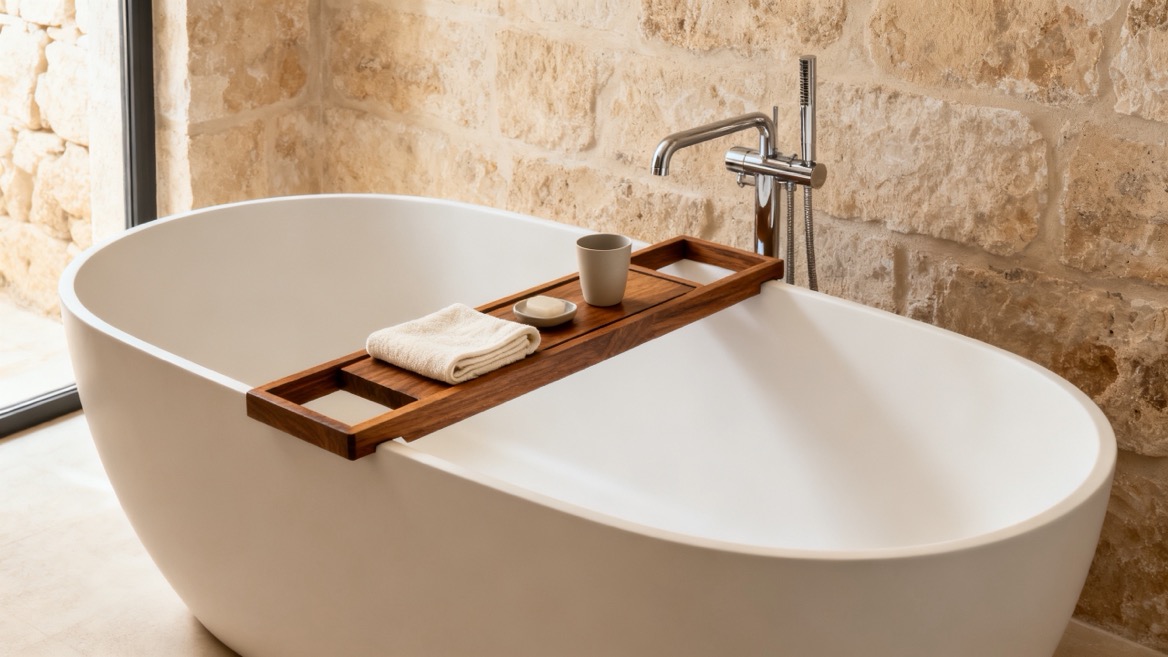
The purpose of a bath tray is to provide a convenient platform across a bathtub, keeping bathing essentials within reach without crowding the rim. Also called a bathtub tray, bath caddy, or bath bridge, it can hold soap, a washcloth, a book, or an unbreakable drink container while making the bathing area feel more organized.
However, an attractive tray is not automatically a practical one. Its usefulness depends on how securely it fits, how its material handles moisture, and whether its layout suits the person using it.
For homeowners, these details determine everyday convenience. For bathroom brands, wholesalers, and manufacturers, they also shape product specifications, customer expectations, and the quality of a coordinated bathtub collection.
A bath tray bridges the bathtub opening and rests on supporting surfaces at either side. Some models have a fixed length. Others have extending arms that accommodate a stated range of bathtub dimensions.
Common features include:
- A flat platform for toiletries.
- A book support or removable reading stand.
- Recesses for small accessories.
- Drainage openings.
- Protective contact pads beneath the supports.
These features serve different purposes. Drainage helps water escape, while contact pads can reduce direct contact between the tray and bathtub finish. Neither feature guarantees stability on an unsuitable rim.
A bath tray is an accessory, not a structural support. It should never be used as a seat, grab bar, or aid for entering and leaving the tub.
The most practical benefit is accessible organization.
Instead of balancing toiletries along a narrow edge, users can arrange a few essentials on one surface. A suitable tray can reduce the need to twist around or reach toward a distant shelf.
Placement still matters. The tray should remain within comfortable reach without obstructing movement, taps, or existing grab bars.
A tray can support a paperback, hold a washcloth, or provide a place for a drink in a stable, unbreakable container.
Its contribution is convenience rather than a guaranteed health benefit. By reducing clutter and unnecessary reaching, it can make the bathing experience feel less interrupted.
The best arrangement is usually simple: include what you actually use, and leave enough empty space to handle those items comfortably.
A bath tray also introduces a visible material and finish into the bathtub area.
Wood can provide contrast against a white tub. A coordinated solid-surface accessory can create a more integrated appearance. Metal or transparent designs offer other visual directions.
From a product-development perspective, this is where an accessory becomes part of a collection. Its proportions, finish, and detailing should complement the bathtub rather than compete with it.
Fit should come before decorative features. Independent product testing has identified narrow bathtub rims as a practical problem: even an adjustable tray can slip when one side lacks adequate support.
Before ordering, record:
1. The distance across the bathtub opening at the intended position.
2. The available supporting width on both sides.
3. The height and shape of each rim.
4. Clearance around taps, handles, walls, and grab bars.
5. Space needed to move the tray when entering or leaving.
Do not select a tray using only the bathtub's advertised overall width. The tray rests on particular contact areas, and those areas may be curved, sloped, narrow, or interrupted.
For trade buyers, a dimensioned bathtub drawing is more useful than a lifestyle photograph.
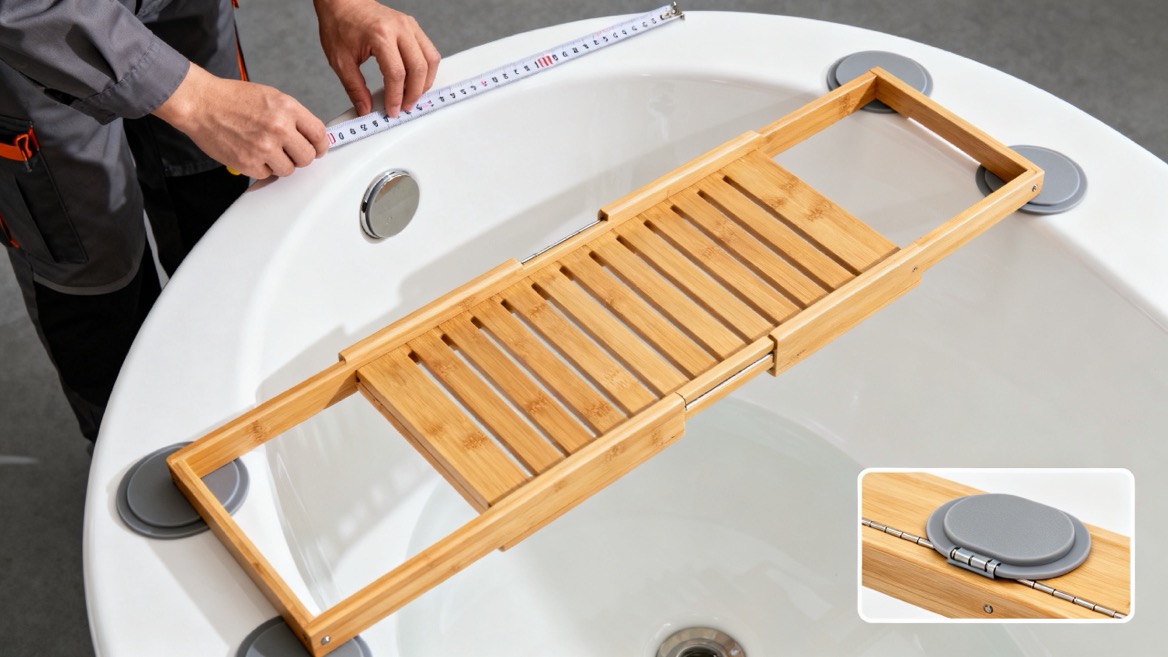
| Design | Main advantage | What to verify |
|---|---|---|
| Fixed-length tray | Simple construction and consistent appearance | Adequate support on both sides |
| Extendable tray | Adjustment across a specified range | Arm engagement, stability, and supported span |
| Tub-specific tray | Coordinated fit and proportions | Compatibility with the intended bathtub model |
"Extendable" does not mean "universal." A wider adjustment range also does not establish a higher load capacity.
Position the empty tray on the dry bathtub first. Check that it sits evenly and that its contact points remain supported.
Then add only the intended lightweight items, staying within the manufacturer's stated limit. Remove the tray if it rocks, slides, or interferes with safe access.
This is a fit check, not a substitute for laboratory testing.
There is no single best material for every bathroom. The right choice balances appearance, moisture exposure, cleaning requirements, weight, and construction quality.
| Material | Why buyers consider it | Main points to check |
|---|---|---|
| Bamboo or wood | Warm appearance and natural texture | Finish coverage, joints, drying instructions |
| Plastic | Lightweight construction and varied shapes | Stiffness, heat limits, cleaner compatibility |
| Metal | Slim profiles and contemporary styling | Alloy, coating, joints, corrosion performance |
| Acrylic | Transparent or colored appearance | Scratch resistance and cleaning restrictions |
| Solid surface | Coordinated colors and sculpted detailing | Formulation, thickness, weight, care guidance |
Wood exchanges moisture with its environment, which can cause dimensional changes. Surface treatments can help manage exposure, but they do not justify describing every wooden tray as waterproof.
For bamboo products, inspect the finish, glued joints, grooves, and underside—not just the visible top.
Public customer feedback illustrates why this matters. Some buyers report mold or discoloration, while others describe satisfactory long-term use. These comments identify potential concerns, but they do not establish a failure rate or prove that every product performs alike.
"Metal" is not a complete specification. Buyers should ask about the alloy, protective finish, fasteners, and suitability for the intended wet environment rather than assuming every metal tray is rustproof.
Likewise, acrylic and solid-surface products should not be treated as interchangeable. Their composition, fabrication, surface finish, and care requirements can differ.
For coordinated bathroom collections, request physical samples. Similar color names do not guarantee that a tray and bathtub will match under actual bathroom lighting.
A bath tray's load capacity depends on its design, material, thickness, span, joints, and support conditions. There is no reliable universal weight limit for all wooden, bamboo, or extendable models.
Use the limit stated for the specific product and configuration.
A centrally placed bottle can load a tray differently from several lightweight items spread across it. An adjustable tray may also behave differently at minimum and maximum extension.
For professional purchasing, request documentation that identifies:
- The tested tray model.
- Its position and extension during testing.
- The supporting surfaces.
- Load placement and duration.
- Acceptance criteria and observed deformation.
Avoid substituting an unsupported marketing number for this information. A tray that holds toiletries is still not designed to support a person's weight.
A bath tray does not make electrical equipment safe around water. Electrical-safety guidance recommends keeping electrical and electronic appliances away from the bathtub.
Do not place charging phones, plugged-in laptops, hair dryers, or mains-powered lights on the tray. A protective case or raised stand does not remove the underlying hazard.
For a simpler setup, choose a paperback, washcloth, and unbreakable container instead.
Heavy bottles, fragile glassware, and tall accessories can make an arrangement less forgiving if something shifts.
Choose a few lightweight items and keep them away from the tray's edges. Avoid arrangements that obstruct taps or require reaching across hot water.
Decorative photographs should not be treated as instructions for safe use.
A practical care routine is straightforward:
1. Remove toiletries and empty containers.
2. Wipe away water and product residue.
3. Clean using the manufacturer's approved method.
4. Dry the underside, joints, and contact pads.
5. Store where air can circulate.
Do not leave a wooden or bamboo tray sitting in pooled water. Inspect coatings, extending mechanisms, and protective pads regularly.
If a tray develops cracks, loose joints, persistent surface growth, or unstable supports, stop using it until the issue is properly assessed.
Public reviews and independent testing point to useful questions for both shoppers and product developers. These are qualitative signals, not market-wide statistics.
A tray with several holders still fails its purpose if it cannot rest securely on the bathtub.
Independent testing has documented difficulties with narrow wall-side ledges. Product pages should therefore explain support requirements, not simply list overall tray dimensions.
Retail feedback on bamboo trays includes both mold complaints and positive experiences.
The responsible response is not to promise that a natural material is maintenance-free. It is to specify the finish, explain drying requirements, and validate performance for the intended use.
A larger tray creates more storage space, but it can also feel cumbersome. Independent reviewers have described some larger designs as unwieldy.
For premium products, restrained dimensions and well-placed essentials may be more useful than adding another compartment.
For overseas brands, wholesalers, and manufacturers, a bath tray can be considered alongside the bathtub rather than added after the collection is complete.
The following framework is a proposed purchasing approach, not a claim about completed testing or existing production capabilities.
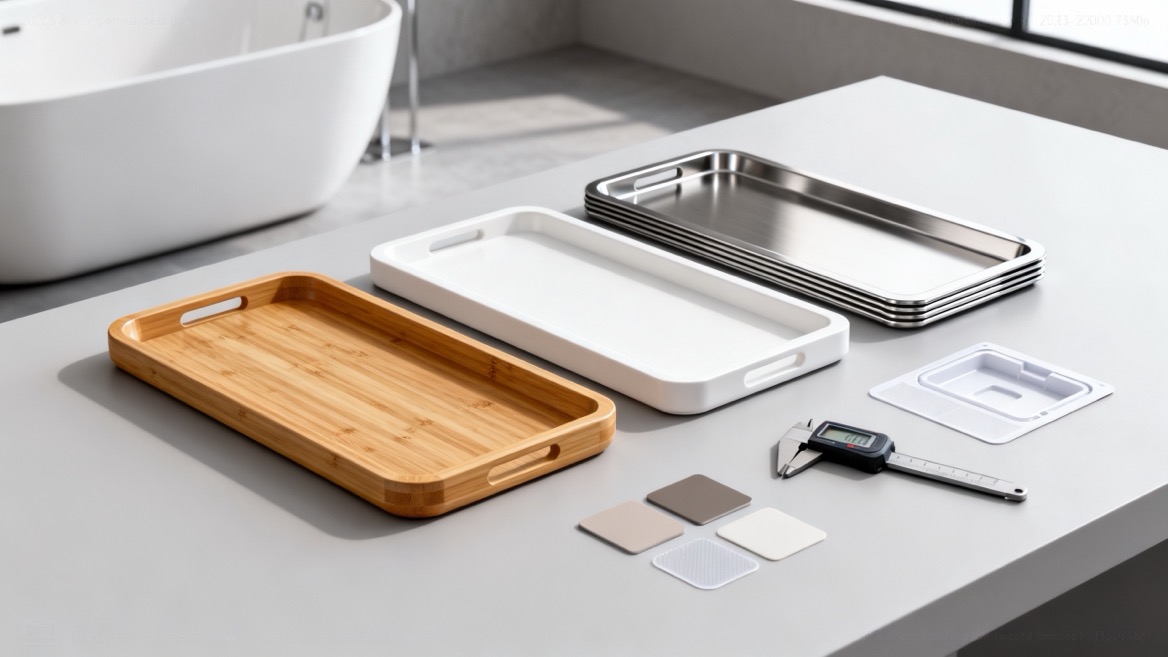
A useful development brief should include:
- Target customer and intended bathroom setting.
- Compatible bathtub models and dimensioned drawings.
- Preferred materials, colors, and surface finishes.
- Fixed or adjustable construction.
- Required contact protection and accessory features.
- Intended load rating and verification method.
- Branding, care instructions, and packaging requirements.
Separate essential requirements from optional styling features. This helps suppliers identify conflicts before sampling begins.
Sample approval should cover more than appearance.
Check contact stability on the intended bathtub, access around fittings, finish consistency, and the operation of adjustable parts. Review how the tray will be protected during transport, particularly at corners, joints, and projecting features.
Where testing is required, agree on the method and acceptance criteria in advance. Proposed checks should never be presented as passed certifications.
Jiaxing Miluo Smart Home Co., Ltd. focuses on customized modern bathroom products and solutions for overseas brands, wholesalers, and manufacturers through OEM and ODM cooperation.
To discuss a coordinated bathtub and accessory concept, send your bathtub drawings, target market, preferred finish, expected order quantity, and functional requirements. The first step is to establish product compatibility and confirm which customization options are feasible.
Its main purpose is to keep lightweight bathing essentials within reach on a platform across the bathtub. It also helps organize the bathing area.
No. Compatibility depends on the opening, rim shape, available supporting surfaces, and nearby fittings. Adjustable length alone does not guarantee a secure fit.
Do not assume so. Check the product's stated finish and care instructions. Bamboo trays still require drying and maintenance, and customer experiences vary.
It should not be used to support body weight. A bath tray is not a seat, step, grab bar, or mobility aid.
Choose a few lightweight items, such as soap, a washcloth, a paperback, or an unbreakable drink container. Keep electrical equipment away from the bathtub.
Potential options include dimensions, materials, finishes, branding, and accessory layouts. Feasibility should be confirmed against the bathtub design, production method, testing requirements, and order quantity.
1. [KingKonree — "What Is the Purpose of a Bath Tray?"]
Original article, dated March 26, 2025. Used as the starting point for topic coverage and to identify claims requiring qualification. The retrieved page did not display verifiable customer reviews. [kingkonree]
Technical basis for the discussion of wood moisture exchange, swelling, shrinkage, and moisture management. This is general material guidance, not a test report for a particular tray. [research.fs.usda]
3. [VDE — "Electrical Appliances in the Bathroom"]
Basis for the recommendation to keep electrical and electronic appliances away from bathtubs and showers. [vde]
4. [Wirecutter — "Our Favorite Bath Trays"]
Independent product-testing observations concerning bathtub measurements, narrow supporting rims, slipping, and oversized tray designs. These observations concern tested products, not all trays. [nytimes]
5. [Target — Brightroom Bamboo Bathtub Caddy: Product Information and Customer Reviews]
Source of mixed public feedback concerning moisture exposure, mold, finish durability, and satisfactory use. Reviews are anecdotal and were not used to calculate failure rates or represent Jiaxing Miluo customer experiences. [target]


