
Views: 298 Author: Miluo Smart Home Publish Time: 2026-11-06 Origin: Site


Content Menu
● What Is a Bathtub Caddy Used For?
● Why Add a Bathtub Tray to a Modern Bathroom?
>> Create a More Organized Bathing Space
>> Complete a Coordinated Bathroom Design
>> Improve Convenience Without Permanent Installation
● Bathtub Caddy Materials: What Should You Choose?
>> Solid Surface Bathtub Trays
● How to Measure Your Bathtub for a Caddy
>> Step 1: Choose the Intended Position
>> Step 2: Measure the Opening and Support Areas
>> Step 3: Check the Tray's Contact Points
● Adjustable vs. Fixed Bathtub Caddies
● What Public Customer Reviews Reveal About Bath Trays
● Bathtub Caddy Safety: Limits That Matter
● How to Clean and Maintain a Bathtub Caddy
● Custom Bathtub Caddies: A Procurement Checklist for Brands
>> Define Compatibility and Performance
>> Approve the Details That Affect Daily Use
>> Assess Packaging and Commercial Terms
● Develop a Coordinated Bathroom Collection with Jiaxing Miluo
>> Is a Bathtub Caddy the Same as a Bath Tray?
>> Do Bathtub Caddies Fit All Bathtubs?
>> Can You Use a Bathtub Caddy on a Freestanding Tub?
>> Which Bathtub Caddy Material Is Best?
>> Can a Bathtub Tray Hold a Laptop?
>> How Can You Reduce Mold Problems on a Bamboo Bath Tray?
>> Should a Bath Tray Stay on the Tub Permanently?
A bathtub caddy is a tray or bridge that rests across a bathtub, creating a convenient place for bathing essentials. Also called a bathtub tray, bath bridge, or bath rack, it can hold soap, a washcloth, a book, or a drink without crowding the tub's narrow edges.
However, a beautiful tray is not automatically a practical one. Its value depends on how securely it fits, how easily it dries, and whether its features suit the person using it.
From a bathroom product design perspective, I would start with fit and maintenance—not accessory slots. For homeowners, this means fewer frustrations. For brands and wholesalers, it provides a clearer foundation for selecting products that complement a bathtub collection.'
A bathtub caddy creates accessible storage during a bath. Unlike a shower organizer, which usually hangs from a fixture or attaches to a wall, a bath bridge spans the bathing area.
Common uses include:
- Keeping soap and bathing accessories within comfortable reach.
- Supporting a book on a suitable reading stand.
- Providing a designated place for a drink in a stable container.
- Organizing a coordinated bathroom presentation.
- Reducing clutter along the bathtub rim.
It is an optional comfort accessory, not an essential bathroom safety device. A good design should also be easy to remove before entering or leaving the tub.
A narrow bathtub edge offers limited room for toiletries. A properly fitted tray creates a defined storage area and helps separate frequently used items from the surrounding bathroom.
The benefit is practical rather than complicated: fewer objects balanced on curved surfaces and less unnecessary reaching.
A bath tray can connect the visual language of a bathtub, vanity, and surrounding finishes.
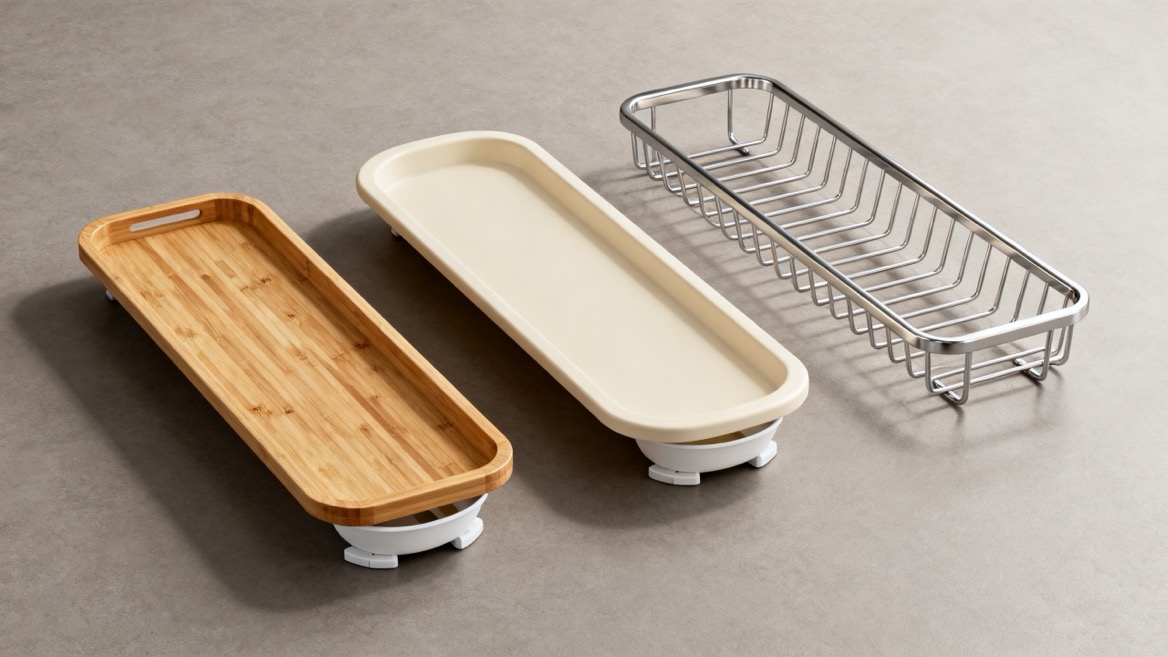
Bamboo introduces a warmer appearance. Metal offers a lighter visual profile. A coordinated solid surface tray can support a clean, architectural look.
For commercial collections, this accessory can help present the bathtub as part of a complete bathroom setting rather than an isolated fixture.
Many bath bridges are removable and require no drilling. This makes them useful where permanent shelving would be inconvenient.
However, removable does not mean universally compatible. The tub still needs suitable support surfaces, and the tray must remain stable during normal use.
Material selection should consider moisture exposure, cleaning requirements, weight, and the intended appearance.
| Material | Main appeal | What to inspect | Suitable direction |
|---|---|---|---|
| Bamboo | Warm, natural appearance | Coating, joints, underside drying | Residential spa styling |
| Solid surface | Coordinated colors and sculpted forms | Composition, weight, finish, support design | Premium bathroom collections |
| Metal | Slim profiles and open structures | Alloy, coating, joints, protective pads | Contemporary bath accessories |
| Plastic | Lightweight, practical construction | Rigidity, drainage, surface quality | Utility-focused applications |
Bamboo is popular for its natural appearance, but buyers should not confuse moisture resistance with unlimited water exposure.
Coatings, glued joints, and drying conditions affect how the finished product performs. Water trapped underneath the tray deserves particular attention.
Choose a design that is easy to lift, wipe, and dry. Follow the product's care instructions rather than assuming every bamboo tray needs the same oil treatment.
Solid surface can provide a coordinated appearance and support customized shapes. However, the term covers different formulations, so buyers should request the actual material specification.
Established solid surface care guidance also makes an important distinction: a surface can be durable without being scratchproof or resistant to every source of heat.
Assess the finished tray's weight, edge treatment, and support arrangement alongside its appearance. Do not assume that one brand's care instructions or performance claims apply to every formulation.
For metal designs, ask what the product is made from—not simply whether it is described as "rust resistant."
The base metal, surface treatment, joints, and exposed edges all deserve inspection. Protective contact pads also matter because the tray rests directly on the bathtub finish.
Examine the complete assembly, including sliding arms and fasteners, rather than evaluating only the main frame.

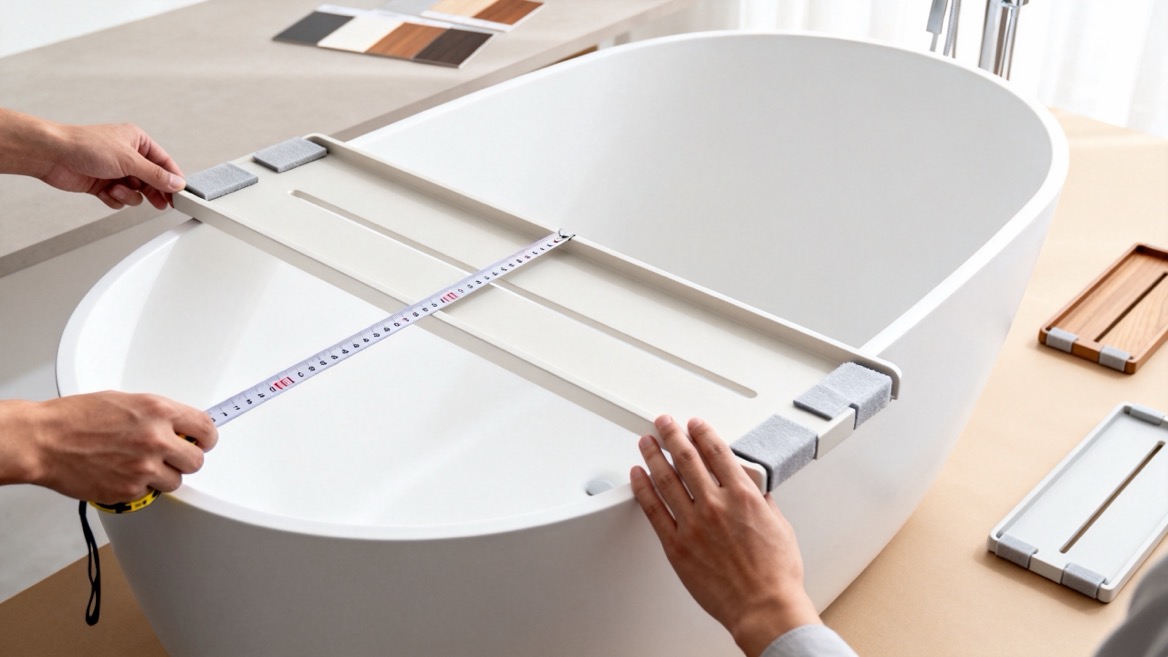
The most useful measurement is the actual support geometry where the tray will sit. Overall bathtub width alone does not establish compatibility.
Decide where the tray should rest during a bath. Check that it will not obstruct the faucet, controls, or the user's entry and exit route.
Measure at that location because curved and tapered tubs can vary along their length.
Record:
1. The clear distance across the bathing opening.
2. The outside width at the intended position.
3. The usable bearing surface on each side.
4. Any slope, curve, raised edge, or nearby obstruction.
A wide decorative rim is not necessarily a flat support surface.
Compare the measurements with the manufacturer's support requirements and adjustment range.
For an extendable bathtub caddy, confirm that both ends remain adequately supported at the required extension. A tray reaching across the tub does not automatically mean it fits securely.
For an unusual freestanding bathtub, a cardboard template can help assess shape and clearance. It cannot prove load capacity or slip resistance.
Check the actual sample for rocking, interference, and stable support before placing items on it. Never use body weight to test a bath tray.
An adjustable bathtub tray offers flexibility across compatible tubs. This can simplify a retail range, but the extension mechanism introduces additional components to inspect.
Check for:
- Smooth adjustment.
- Excessive sideways movement.
- Accessible cleaning surfaces.
- Secure end supports.
- Clear minimum and maximum dimensions.
A fixed bath bridge has no sliding mechanism and can create a cleaner appearance. However, its compatibility is more dependent on accurate dimensions.
For a coordinated bathtub collection, a model-specific tray may be more appropriate than a broad "universal fit" claim.
Public reviews of a bamboo bath rack show contrasting experiences. Some customers praise its convenience and report satisfactory performance. Others describe mold developing, including on the underside.
These comments are individual experiences, not controlled durability tests. They cannot establish a failure rate or predict the performance of a different product.
Nevertheless, they suggest useful questions for buyers:
- Can moisture collect beneath the support points?
- Can users easily clean the underside?
- Do the instructions explain drying and storage?
- Are joints and moving parts accessible?
- Does the product remain practical after the initial presentation?
The manufacturing lesson is straightforward: evaluate the product after wet use and cleaning, not only when it is dry and newly unpacked.
A bath tray is an accessory shelf. It is not a seat, transfer aid, or grab bar.
Do not lean on it while entering or leaving the bathtub. Remove it whenever it obstructs movement. Users who need assistance should use appropriately selected and installed bathing supports.
Electrical safety is equally important. A device holder does not make electronics safe around bathwater. Keep electrical and electronic appliances away from the bathtub, and never charge a device while bathing.
For children, a tray provides no protection against drowning. Direct adult supervision remains necessary, with young children kept within arm's reach.
For a simpler bathing setup, choose lightweight essentials and avoid open flames or fragile drinkware.
A useful routine begins immediately after bathing:
1. Remove accessories and lift the tray from the bathtub.
2. Clean it using the manufacturer's approved method.
3. Remove soap residue from contact pads and joints.
4. Wipe accessible surfaces dry.
5. Allow the underside to dry before storage.
Inspect the tray periodically for loose parts, cracked coatings, damaged pads, or changes in stability.
Do not apply one maintenance method to every material. Oil suitable for one bamboo product may be unnecessary for another coated design. Abrasive methods suitable for certain solid surface finishes may damage other finishes.
For hospitality projects, confirm cleaning-product compatibility before specifying the tray.
For overseas brands, wholesalers, and manufacturers, a bathtub caddy should be evaluated as part of a product system.
A clear development brief reduces ambiguity between the requested appearance and the delivered accessory.
Provide bathtub drawings, intended tray positions, rim profiles, and finish information.
Ask the supplier to document the proposed support arrangement, intended load, and validation method. Material descriptions alone cannot establish the load capacity of a finished tray.
Before confirming production, review:
- Overall dimensions and tolerances.
- Contact-pad material and attachment.
- Edge smoothness and corner treatment.
- Drainage and cleaning access.
- Adjustment behavior, where applicable.
- Branding position and surface finish.
- Care instructions and compatibility information.
Request a sample for assessment on the actual bathtub model. Photographs alone cannot demonstrate stable fit.
Include protective packaging, inspection criteria, replacement arrangements, and written warranty terms in the purchasing discussion.
Compare the complete offer rather than unit price alone. A less expensive tray may create additional work if compatibility information, packaging protection, or maintenance instructions are unclear.
Jiaxing Miluo Smart Home Co., Ltd. provides customized modern bathroom products and solutions, including bathtubs, for overseas brands, wholesalers, and manufacturers through OEM and ODM cooperation.
For projects considering a coordinated bath tray, start with the bathtub—not an isolated accessory image. Share your tub drawings, target market, preferred materials, finish references, and expected order quantity.
Contact Jiaxing Miluo to discuss bathtub customization and the feasibility of a matching accessory concept. Confirm available options, samples, performance requirements, and commercial terms before finalizing your collection.
Usually, yes. Bathtub caddy, bath tray, and bath bridge commonly describe an accessory spanning the bathtub. However, "bath caddy" can also describe a portable toiletry organizer, so check the product images and specifications.
No. Compatibility depends on the opening, rim shape, support surfaces, and tray design. Even an adjustable model needs adequate support at both ends. Check its stated dimensions against the intended bathtub.
Yes, when the tub provides suitable support and the tray is designed for that geometry. Thin, rounded, or sloping rims may require a model-specific solution rather than a standard adjustable tray.
There is no single best material for every project. Bamboo emphasizes natural styling, solid surface supports coordinated design, and metal offers slim construction. Evaluate the finished product's fit, maintenance, and documented specifications.
Do not assume it can. Load capacity must come from the manufacturer's information. More importantly, electrical and electronic appliances should be kept away from the bathtub; a tray is not an electrical safety barrier.
Remove soap residue, dry the underside, and store the tray where air can circulate. Follow the supplier's care instructions and inspect joints and coatings. Persistent moisture deserves attention even when the visible top looks dry.
Not necessarily. Removing it after use helps you clean and dry hidden contact areas. It should also be removed whenever it restricts entry, exit, cleaning, or access to bathing controls.
1. [KingKonree — "What Is a Bathtub Caddy, and Why Do You Need It for the Bathroom?"]
Used to identify the existing topic coverage and areas requiring reconstruction. Unverified statistics, lifespan estimates, and competitor-specific warranty claims were not carried into the rewritten article. [kingkonree]
2. [IKEA Australia — "HAVERN Bath Rack, Extendable, Bamboo"]
Product construction, care information, and public customer reviews. Supports the discussion of contrasting user experiences and concerns about moisture beneath bamboo trays. Reviews are anecdotal and do not establish a product-category failure rate. [ikea]
3. [Corian — "Solid Surface Care and Maintenance for Facility Managers"]
Manufacturer guidance on cleaning, surface damage, and heat precautions. Used as a material-specific reference, not as evidence that every solid surface formulation performs identically. [corian]
4. [VDE — "Electrical Appliances in the Bathroom"]
Consumer safety guidance explaining electrical risks in bathrooms and recommending that electrical and electronic appliances be kept away from showers and bathtubs. [vde]
5. [MedlinePlus — "Bathroom Safety for Adults"]
Patient guidance on bathroom fall prevention and appropriate bathing supports. Supports the distinction between a convenience accessory and equipment intended to assist safe bathing. [medlineplus]
6. [New York City Administration for Children's Services — "Water Safety"]
Guidance on continuous supervision and keeping young children within arm's reach around bathtubs. [nyc]


