
Views: 295 Author: Miluo Smart Home Publish Time: 2026-11-03 Origin: Site


Content Menu
● Why Bathroom Vanity Edges Swell in Humid Environments
>> Moisture-Resistant Does Not Mean Steam-Room Suitable
● Define the Exposure Zone Before Choosing Edge Banding
● PUR Edge Banding for Moisture-Resistant Bathroom Vanities
>> Control the Bond, Not Just the Glue Temperature
● Laser and Hot-Air Edge Banding: Understanding Zero-Joint Technology
>> What Zero-Joint Edging Can Improve
>> PUR Versus Laser Edging: Which Is Better?
● Selecting the Panel Core and Edge-Band Material
>> Build Compatibility Into the Material Specification
● Six Edge-Banding Techniques That Reduce Vanity Swelling
>> 1. Machine a Clean, Consistent Panel Edge
>> 2. Condition Materials Before Processing
>> 3. Maintain Continuous Bond-Line Coverage
>> 4. Inspect Corners and Edge-Band Ends
>> 5. Protect Every Subsequent Cutout
>> 6. Prevent Water From Collecting Around the Cabinet
● A Practical Validation Plan for OEM/ODM Buyers
>> Step 1: Define Realistic Exposure
>> Step 2: Test Representative Details
>> Step 3: Measure More Than Appearance
>> Step 4: Preserve Traceability
● Diagnose Failures Before Changing the Entire Construction
● Specify a Complete Moisture-Protection Package
>> Can Edge Banding Make a Bathroom Vanity Completely Waterproof?
>> Is PUR Edge Banding Better Than EVA for Humid Bathrooms?
>> Does Laser Edge Banding Prevent All Vanity Swelling?
>> Can Moisture-Resistant MDF Be Used Inside a Steam Room?
>> Which Details Should Buyers Inspect First?
>> How Should a Swollen Vanity Edge Be Repaired?
Moisture proofing starts where a bathroom cabinet is most vulnerable: its edges. For brands developing premium bathroom furniture, the right edge-banding techniques can help prevent vanity swelling, protect decorative finishes, and reduce moisture-related failures. However, a durable vanity requires more than an attractive strip around a panel.
My starting point when evaluating a specification is simple: assess the entire assembly, not just the visible surface. The substrate, adhesive, edge band, machined openings, and installation details must work together.
For Jiaxing Miluo Smart Home Co., Ltd., which provides customized modern bathroom products and OEM/ODM services for overseas brands, wholesalers, and manufacturers, this creates a useful product-development principle: define the exposure conditions before selecting the construction.
One distinction is essential. A vanity beside an enclosed steam shower faces different conditions from cabinetry installed inside an operating steam room. Edge banding can improve moisture resistance, but it does not automatically make wood-based cabinetry suitable for continuous steam exposure.
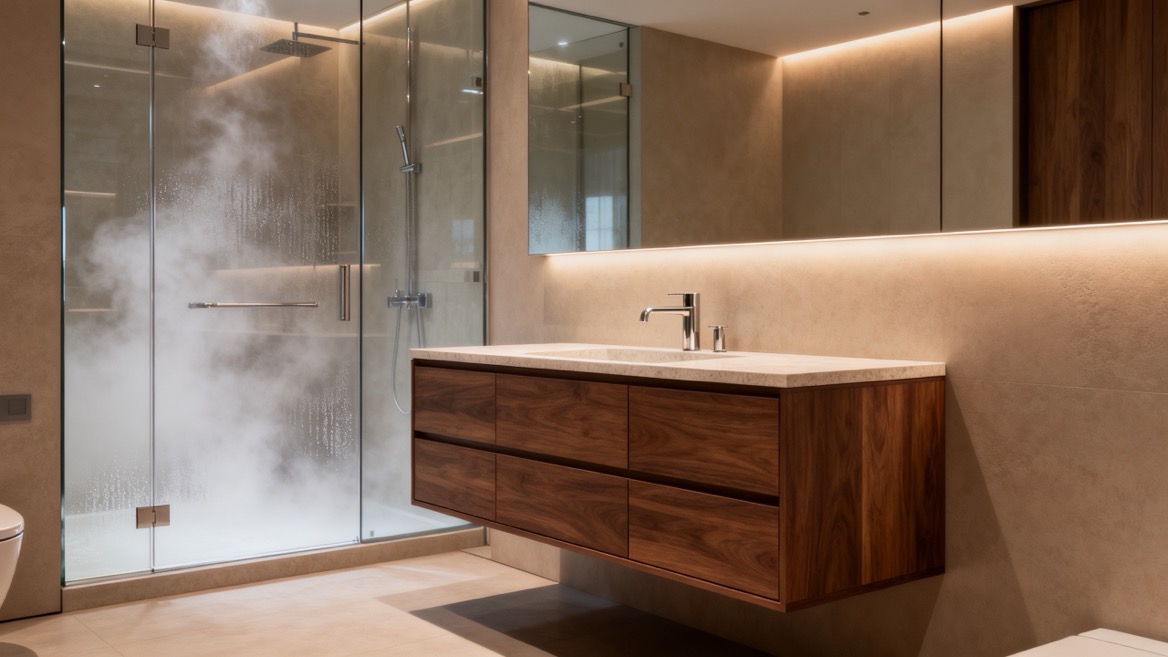
A decorative panel face may resist splashes while its cut edges remain vulnerable. Water entering an exposed wood-based core can cause localized expansion, raised joints, and distortion.
Several entry points deserve attention:
- Gaps between the edge band and panel face.
- Poorly bonded corners and edge-band ends.
- Unsealed plumbing cutouts.
- Hinge cups, fixing holes, and handle recesses.
- Damaged lower edges exposed to pooled water.
Steam introduces another challenge. Moisture can condense on cooler surfaces and collect around joints. Repeated wetting becomes particularly demanding when assemblies have little opportunity to dry.
Moisture-resistant MDF offers improved resistance to damp conditions compared with standard MDF. It is not automatically waterproof or suitable for prolonged direct water exposure.
The same distinction applies to a finished cabinet. A moisture-resistant board with premium edging is still an assembly with joints, penetrations, and installation limits.
For procurement, replace the vague requirement "waterproof vanity" with a defined exposure specification: splash frequency, expected humidity, steam proximity, cleaning methods, and drying opportunities.
A practical specification separates three environments.
| Installation zone | Main exposure | Recommended decision approach |
|---|---|---|
| Conventional bathroom | Intermittent humidity and splashes | Specify moisture-resistant construction and sealed vulnerable details |
| Outside an enclosed steam shower | Repeated humidity peaks and possible condensation | Validate the complete cabinet under representative exposure |
| Inside a steam enclosure | Direct steam, condensation, and potentially prolonged wetting | Require explicit suitability evidence for the complete assembly |
Commercial steam facilities can have substantially less drying time than intermittently used residential installations. This difference matters more than whether the furniture is described as "luxury" or "spa-grade."
Inside a steam enclosure, do not approve a wood-based vanity solely because it has PUR adhesive or a visually seamless edge. Consider alternative constructions only with documented suitability for the intended heat, moisture, cleaning, and structural conditions.
Reactive polyurethane hot-melt adhesive, commonly called PUR, is a strong candidate for demanding bathroom furniture applications.
Unlike conventional thermoplastic hot melts, reactive PUR develops its final properties through moisture-driven curing. Suitable formulations provide strong bonds and good resistance to heat and moisture.
For bathroom vanity manufacturing, PUR can support:
- Durable adhesion between compatible substrates and edging.
- Thin, controlled bond lines.
- Improved resistance to demanding humidity conditions.
- Reliable production when application and curing are controlled.
However, "PUR edge banding" describes an adhesive family, not a complete performance guarantee. Formulation, surface preparation, application quality, and curing conditions still determine the result.
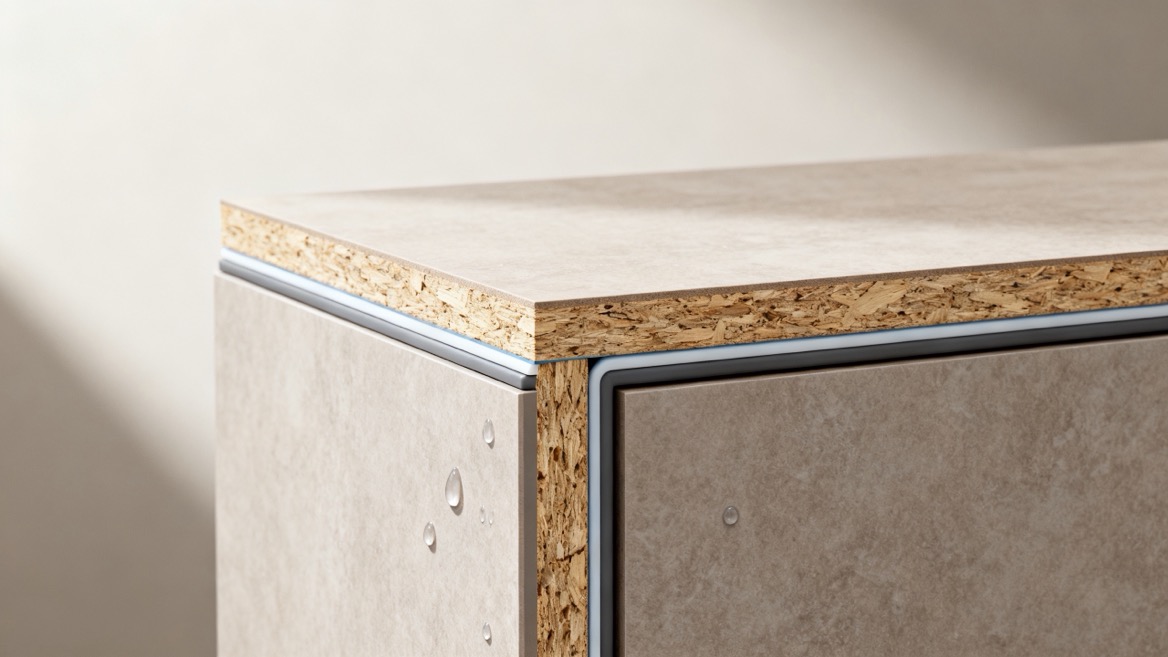
The adhesive supplier's processing instructions should govern production. Important variables include:
1. Panel and edging conditioning.
2. Cleanliness of the machined edge.
3. Adhesive temperature and application quantity.
4. Feed speed and available bonding time.
5. Pressure-roller alignment.
6. Curing conditions before testing or demanding exposure.
Avoid assigning one universal temperature or cure time to every PUR system. Those values must come from the selected adhesive's technical documentation.
A narrow joint is desirable, but not if achieving it leaves insufficient adhesive coverage.
Zero-joint edge banding uses edging with a functional layer activated by a compatible energy source, such as laser, hot air, or near-infrared technology.
The activated layer bonds the edge band to the board, creating a visually discreet transition without a conventional applied hot-melt glue line.
Properly processed systems can provide:
- A cleaner transition between the panel face and edge.
- Reduced visibility of the bonding line.
- Good heat and moisture resistance.
- A premium appearance for coordinated bathroom furniture.
Nevertheless, "zero joint" does not mean zero risk. The functional layer, substrate quality, activation settings, and pressure remain important.
There is no defensible universal winner.
REHAU describes strong moisture and heat performance for its zero-joint systems. Henkel, an adhesive manufacturer, argues that high-quality PUR systems can outperform laser edging in certain applications.
These differing supplier positions reinforce an important purchasing lesson: compare finished assemblies rather than marketing categories.
Ask both suppliers to demonstrate performance on the same panel construction, using the same exposure cycle and acceptance criteria.
Edge protection cannot compensate for an unsuitable substrate.
Moisture-resistant MDF may suit carefully controlled bathroom applications, but the board's intended use and limitations must be checked. Plywood also requires grade-specific evaluation; its name alone does not establish steam-room suitability.
Likewise, ABS, polypropylene, and PVC edging should be assessed as parts of a compatible bonding system.
Document the following:
| Component | Information to specify |
|---|---|
| Panel core | Manufacturer, product designation, thickness, intended exposure |
| Decorative face | Finish system and cleaning limitations |
| Edge band | Polymer, dimensions, primer or functional-layer requirements |
| Bonding system | Exact adhesive or activation technology |
| Machined openings | Approved sealing method and inspection criteria |
| Finished assembly | Exposure limits and validation requirements |
Do not select edge-band thickness as a stand-alone moisture rating. A thicker strip may improve impact protection in some designs, but it cannot correct an open bond line.
A sound bond begins before adhesive application.
Use suitable, maintained tooling to produce a consistent edge without excessive breakout. Remove machining dust and inspect the bonding surface.
Irregular edges make it harder to achieve continuous contact and controlled adhesive coverage.
Cold panels or edging can interfere with bonding by changing how quickly adhesive cools.
Condition materials according to the board, edging, and adhesive suppliers' instructions. Avoid treating room temperature alone as proof that a panel stored elsewhere has fully acclimatized.
The objective is uninterrupted contact across the bonding area.
Inspect production samples for gaps, unbonded sections, and inconsistent coverage. A visually attractive front edge does not prove that the entire joint is sound.
Corners and terminations deserve separate inspection because they combine machining transitions and potential water-entry paths.
Check for lifted ends, trimming damage, exposed core, and small openings. Correct defects before assembly rather than hiding them with cosmetic touch-up.
A fully edged panel can become vulnerable again when installers drill or cut it.
Include sink openings, pipe penetrations, fixing holes, and recessed hardware areas in the moisture-protection plan. Select sealing products compatible with the substrate and surrounding finishes.
Site modifications should follow the same approved detailing principles as factory machining.
Good edge banding is one layer of protection, not a substitute for sensible installation.
Detail countertop interfaces, plumbing connections, and cabinet positioning so leaks or routine splashes do not remain against exposed joints. Preserve required access for inspection and maintenance.
A useful development program evaluates the finished construction, not only a loose piece of edging.
The following is a proposed project-validation framework, not a published certification method or a claim about completed company testing.
Record where the vanity will sit relative to the steam enclosure. Specify anticipated wetting, cleaning chemicals, use frequency, and drying conditions.
For demanding installations, use suitably qualified testing support to translate those conditions into a repeatable protocol.
Include:
- Straight edges and external corners.
- Door and drawer-front edges.
- Plumbing cutouts.
- Hinge and fixing areas.
- Countertop-to-cabinet interfaces.
Test samples after the bonding system has received its required curing period.
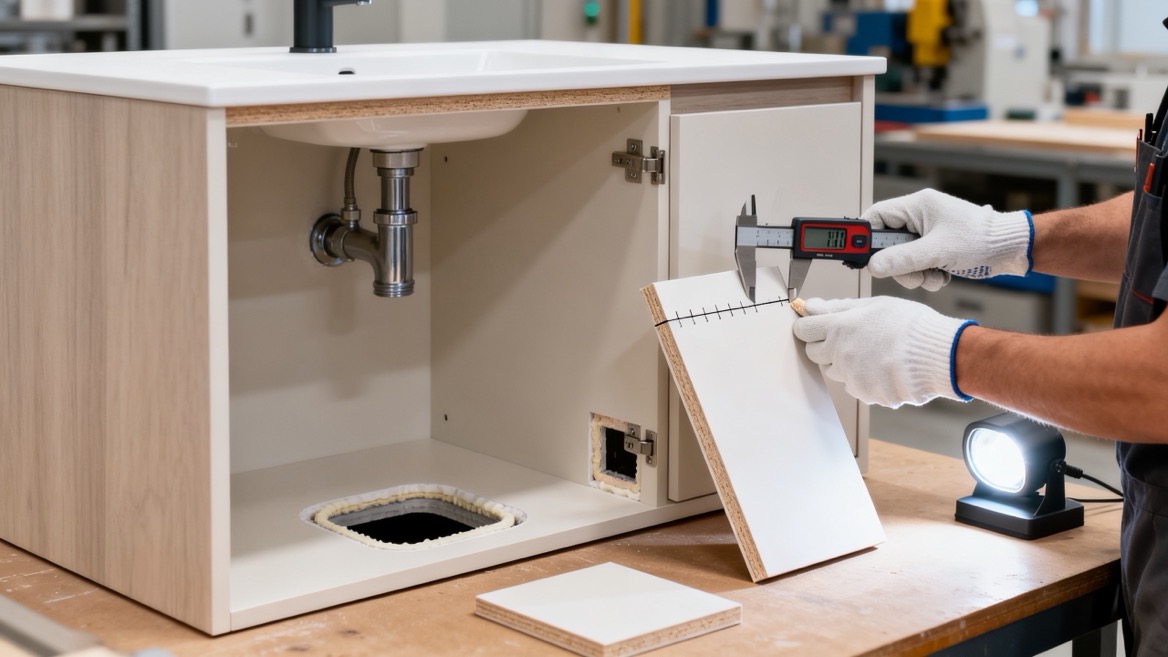
Record initial dimensions at marked locations. Following agreed exposure and recovery periods, inspect:
- Local thickness change.
- Edge lifting or joint opening.
- Blistering and surface damage.
- Door alignment and drawer operation.
- Changes around penetrations.
Define acceptance limits before testing. Do not invent a universal swelling percentage or declare a service-life guarantee from a short demonstration.
Keep material identities, production settings, sample photographs, and test conditions together.
This makes results useful when comparing suppliers, investigating failures, or approving later material substitutions.
The location of damage often suggests what to investigate first.
| Observed problem | Investigation priority |
|---|---|
| Swelling beside a pipe opening | Cutout sealing and plumbing leakage |
| Edge lifting without obvious core swelling | Bond compatibility, processing, or curing |
| Damage concentrated at lower corners | Water accumulation and corner integrity |
| Widespread panel distortion | Substrate suitability and overall exposure |
| Failure following installation modifications | Newly exposed edges and site detailing |
These are diagnostic starting points, not definitive failure diagnoses.
A disciplined investigation separates material selection, manufacturing quality, installation damage, and exposure beyond the agreed use conditions. This avoids replacing an adhesive when the actual problem is an unsealed opening.
For overseas brands and wholesalers, the most useful deliverable is not simply a sample labelled "waterproof."
Request a coordinated package containing:
- A material and component schedule.
- Edge-banding and penetration-sealing details.
- Representative validation results.
- Installation and cleaning instructions.
- Written exposure limitations.
- A process for approving material substitutions.
For a customized vanity project with Jiaxing Miluo Smart Home Co., Ltd., share your drawings, target market, installation zone, finish requirements, and expected steam exposure. Request an OEM/ODM development proposal that addresses substrate selection, edge protection, cutout detailing, and sample validation together.
The purchasing priority should be verification: establish what the finished vanity can tolerate before approving production.
Not by itself. Edge banding protects panel edges, but water can still enter through damaged joints, cutouts, hardware openings, or poorly detailed interfaces. Evaluate the complete assembly and its exposure limits.
Suitable PUR formulations are commonly selected for demanding heat and moisture conditions. However, performance depends on the exact formulation, compatible materials, processing quality, and curing. Compare product documentation and finished-sample results.
No. Zero-joint technology can improve the edge transition and moisture resistance, but it does not protect an unsealed pipe opening or make an unsuitable core appropriate for continuous steam.
Do not assume so. Moisture-resistant MDF is not automatically waterproof. Require explicit evidence that the complete construction is suitable for the intended steam-room conditions, or select another validated construction.
Start with lower corners, edge-band ends, sink and pipe openings, and any areas modified during installation. These locations can reveal weaknesses that are not apparent from the decorative face.
First identify and stop the moisture source. Cosmetic sealing does not restore a swollen core to its original condition. Assess whether the affected component needs replacement, then correct the entry path before returning it to service.
1. Henkel Adhesive Technologies. "Furniture and interiors." Guidance on edge-banding adhesives, processing demands, and PUR resistance to humidity and temperature. [next.henkel-adhesives]
2. Henkel Adhesive Technologies. "Choosing the right edgebanding technology in a volatile furniture market." Supplier perspective on PUR and laser-edge performance comparisons. [next.henkel-adhesives]
3. REHAU. "REHAU LaserEdge | Millwork & Cabinetry | Zero-joint edgeband." Functional-layer technology, activation methods, and stated performance benefits. [rehau]
4. EGGER. "Processing Instructions: PMMA Edging." Manufacturer processing guidance for thermoplastic edging and hot-melt application. Its instructions are product-specific, not universal settings for every edge material. [egger]
5. Schluter Systems. "Commercial steam showers." Explanation of demanding continuous-use conditions and reduced drying opportunities. This is enclosure guidance, not cabinetry approval. [schluter]
6. Schluter Systems. "Residential steam showers." Distinction between intermittent residential use and commercial steam exposure. [schluter]
7. Forest Plywood. "Moisture-Resistant MDF: Benefits & Best Uses." Explanation of moisture-resistant MDF and its limitations under direct water exposure. [forestplywood]


