
Views: 257 Author: Miluo Smart Home Publish Time: 2026-10-28 Origin: Site


Content Menu
● What Is a Bath Tray Used For?
>> Keeping Bathing Essentials Organized
>> Supporting a More Comfortable Bathing Routine
>> Completing the Bathroom's Visual Design
● What Real Bath Tray Reviews Reveal
>> Adjustable Does Not Mean Universally Compatible
>> Grip Pads Help, but Cannot Correct Every Fit Problem
>> Finish Quality Matters as Much as Appearance
● How to Measure Your Bathtub for a Bath Tray
>> Step 1: Measure the Overall Width
>> Step 2: Measure the Inner Opening
>> Step 3: Examine Both Supporting Surfaces
>> Step 4: Check Reach and Entry Clearance
>> Step 5: Trial the Fit Before Regular Use
● Which Bath Tray Material Is Best?
>> Plastic and Metal Bath Trays
>> Acrylic and Solid-Surface Options
● Bath Tray Safety: What It Can and Cannot Do
>> Never Use It as a Support Rail
>> Keep Plugged-In Electrical Equipment Away
>> Avoid Breakable and Unstable Items
>> Follow the Actual Load Instructions
● How to Clean and Store a Bathtub Tray
● Bath Tray Development for Brands and Wholesale Buyers
>> Build a Compatibility Matrix
>> Define the Documentation Before Ordering
● Coordinating Accessories With a Premium Bathtub Collection
● Plan a Better-Coordinated Bathroom Collection
>> Is a Bath Tray Worth Buying?
>> Will an Extendable Bath Tray Fit Every Bathtub?
>> Can a Bath Tray Be Used on a Freestanding Bathtub?
>> Are Bamboo Bath Trays Waterproof?
>> Can I Leave a Bath Tray Across the Tub Permanently?
>> How Much Weight Can a Bathtub Tray Hold?
A bath tray creates a convenient surface across your bathtub, keeping everyday essentials within comfortable reach. Also called a bathtub tray or bath caddy, it can hold a book, washcloth, soap, or drink without crowding the tub rim. Its purpose is simple: make bathing more organized and enjoyable.
However, an attractive tray is not automatically a practical one. Fit, stability, material quality, and cleaning requirements determine whether it becomes a useful accessory or another item to maintain.
For homeowners, the priority is comfortable everyday use. For bathroom brands, wholesalers, and manufacturers, the opportunity is broader: selecting accessories that complement the bathtub and deliver a consistent product experience.

A bathtub tray brings frequently used items together instead of scattering them around narrow ledges.
Depending on its design, it may accommodate:
- Soap and small toiletries.
- A folded washcloth.
- A paperback supported by a reading stand.
- A lightweight, nonbreakable drinking cup.
- Small personal-care accessories.
The practical benefit is easier access. You can arrange essentials before bathing rather than repeatedly reaching toward a distant shelf.
Nevertheless, storage space should not become an invitation to overload the tray. A few well-chosen items usually create a more comfortable setup than multiple bottles and decorative objects.
A reading support can make holding a book less tiring. A designated soap area can reduce clutter. A removable compartment may simplify preparation and cleanup.
These details explain why bath trays appeal to people who enjoy longer soaks.
They do not, however, make bathing medically therapeutic or guarantee stress relief. Their value lies in convenience, organization, and personal enjoyment.
A tray can connect the bathtub with surrounding finishes, cabinetry, and accessories.
Bamboo introduces a warm visual contrast against white sanitary ware. A restrained metal design can suit contemporary fittings. A custom accessory may coordinate more closely with a premium bathtub collection.
The best choice supports the bathroom's design without compromising usability.
Product photographs show appearance. User feedback and independent testing reveal what happens during actual use.
Public feedback commonly praises adjustable sizing, attractive finishes, and enough space for bathing essentials. Less positive experiences highlight slipping, wobbling, missing grip pads, or disappointing surface quality.
These observations suggest three useful buying principles.
An extendable bath tray can accommodate different widths, but it still needs suitable support on both sides.
A narrow wall-side ledge, curved rim, or sloping bathtub edge may prevent secure placement even when the advertised extension range appears correct.
Silicone contact pads can improve friction and protect contact surfaces. However, independent testing has documented slipping on particularly narrow rims despite the presence of silicone grips.
The lesson is straightforward: evaluate the tray and bathtub together, rather than treating a "slip-resistant" description as a guarantee.
A tray may look attractive online but feel rough around slots, joints, or edges.
Inspect these areas carefully. Smooth finishing affects handling, cleaning, and perceived quality—especially for products positioned as premium bathroom accessories.
Before comparing materials or decorative features, confirm fit.
A manufacturer's extension range is only one part of compatibility.
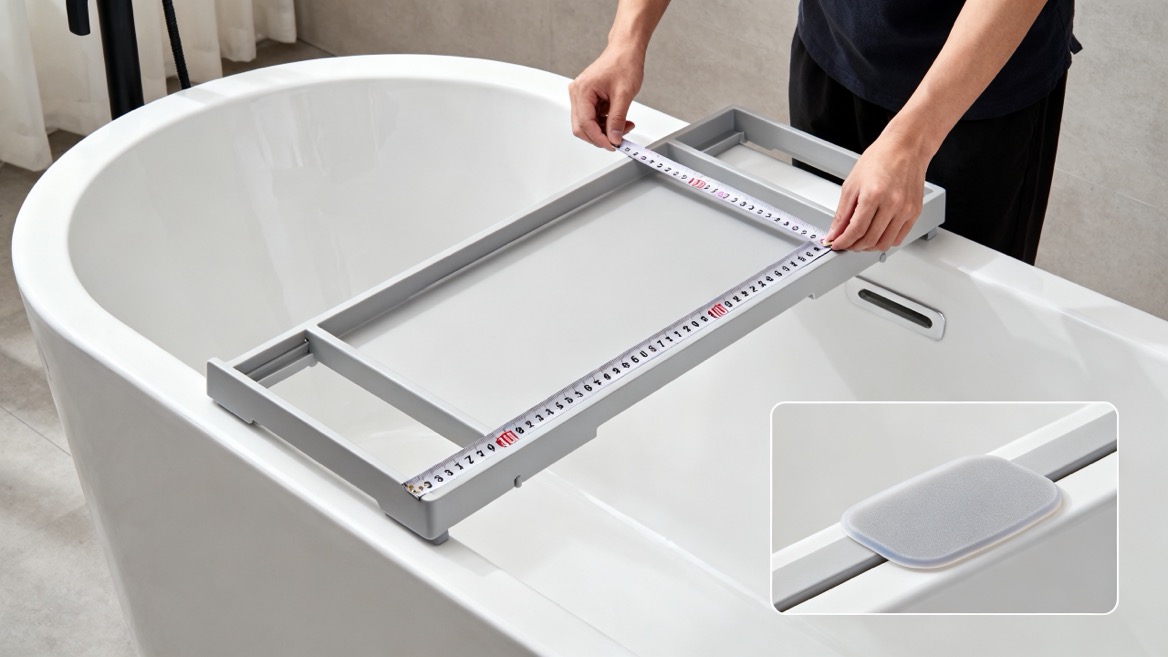
Measure across the bathtub at the exact position where the tray will sit.
Do not rely solely on the bathtub's advertised dimensions. Curved and sculptural tubs may vary in width along their length.
Record the distance between the inside edges of the tub.
Together, the overall width and inner opening help establish how much supporting rim is available.
Check whether the contact areas are flat, curved, sloped, or interrupted by fittings.
Pay particular attention to:
- Narrow ledges beside walls.
- Rounded freestanding bathtub rims.
- Shower screens or tracks.
- Nearby faucets and controls.
- Raised seams or uneven surfaces.
Ask the tray supplier to specify the required contact area rather than assuming a standard minimum.
Position the tray where items are easy to reach without stretching.
It should also be easy to move before entering or leaving the tub. A bath tray must never obstruct safe movement.
With the bathtub empty, position the tray and check for rocking or unsupported contact points.
Add lightweight items gradually within the manufacturer's stated limits. If the tray shifts, stop and resolve the compatibility problem before use.
There is no universal winner. Material selection should reflect the bathroom environment, expected maintenance, and the product's intended positioning.
| Material | Main appeal | Important checks |
|---|---|---|
| Bamboo | Warm appearance and lightweight designs | Finish coverage, joints, drying instructions |
| Solid wood | Distinctive grain and premium styling | Species, protective finish, maintenance |
| Plastic | Practical cleaning and varied shapes | Rigidity, surface quality, cleaner compatibility |
| Stainless steel or coated metal | Slim profiles and contemporary styling | Grade, coating integrity, corrosion guidance |
| Acrylic | Transparent appearance and visual lightness | Scratch resistance, stiffness, cleaning instructions |
| Solid-surface composite | Potential coordination with sanitary ware | Weight, formulation, support design, finish |
Bamboo and wood suit bathrooms where warmth and texture are important.
However, water resistance should not be confused with unlimited tolerance of standing water. Finish quality, exposed edges, joints, and drying habits all influence performance.
Do not assume that every bamboo tray is waterproof, maintenance-free, or environmentally superior. Such claims require product-specific evidence.
Plastic can offer straightforward cleaning and flexible design options. Its performance still depends on the particular material and construction.
Likewise, stainless steel and coated metal should not automatically be described as rustproof. Buyers should check the material specification, coating quality, and approved cleaning methods.
Acrylic can create a visually light appearance, while solid-surface materials may support coordinated bathroom collections.
For either option, assess more than color. Weight, edge finishing, stiffness, surface protection, and compatibility with the bathtub are equally important.
A bath tray is an accessory platform, not a safety device.
Do not lean your body weight on the tray, use it to stand, or depend on it when entering or leaving the bathtub.
A stated accessory load capacity does not make the product suitable for supporting a person.
People who need assistance should use appropriately specified bathing aids rather than improvised supports.
A tray does not create a safe electrical zone over water.
Keep chargers, extension leads, hair dryers, and other mains-powered equipment away from the bathtub. A device holder is a storage feature, not protection against electrical hazards.
Printed reading material is a simpler alternative, although it can still be damaged by splashes.
Nonbreakable drinkware is preferable to fragile glass near a hard bathtub surface.
Avoid top-heavy containers, unstable decorations, and open flames near books or towels. Keep the arrangement simple enough that removing one item does not disturb everything else.
Do not apply a generic weight limit to all trays.
Capacity depends on the product's construction, extension position, support conditions, and load distribution. If the supplier cannot provide clear instructions, request clarification before purchasing.
Good maintenance starts with the instructions for the specific product.
As a general routine:
1. Remove toiletries and other items after bathing.
2. Wipe away soap, oils, and visible residue.
3. Clean using the manufacturer's approved method.
4. Dry the surface, underside, joints, and contact pads.
5. Store where air can circulate.
Avoid leaving damp washcloths or wet soap permanently on the tray.
For bamboo and wood, regularly inspect edges and joints for finish damage or changes in condition. For metal products, check damaged coating areas and follow the supplier's corrosion-care guidance.
Do not assume that strong bathroom cleaners, abrasive pads, or dishwasher cleaning are suitable.
Replace or stop using a tray if it develops cracks, loose components, persistent instability, or other damage affecting safe placement.
For commercial buyers, a bath tray should be evaluated as part of the complete bathtub experience.
The most attractive accessory is not necessarily the best addition to a product range.
Match each proposed tray to specific bathtub models.
Record:
- Suitable placement positions.
- Required supporting surfaces.
- Compatible width range.
- Contact-pad arrangement.
- Potential interference with fittings.
- Recommended use and care instructions.
This information can support clearer product listings and help customer-service teams answer fit questions.
Review a sample on the intended bathtub rather than approving appearance alone.
A practical evaluation should include stability, edge quality, extension movement, pad attachment, cleaning access, and packaging protection.
For an adjustable design, request the conditions behind any load claim. A capacity statement without information about extension and support provides limited purchasing value.
These are proposed purchasing checks, not claims that a specific product has passed certification.

Agree on material descriptions, dimensional tolerances, inspection criteria, care labels, and replacement-component arrangements.
If making environmental or performance claims, request supporting documentation appropriate to those claims.
For hospitality projects, also consider cleaning speed, storage between uses, and whether decorative features create unnecessary maintenance.
Jiaxing Miluo Smart Home Co., Ltd. focuses on customized modern bathroom products and solutions, supporting overseas brands, wholesalers, and manufacturers through OEM and ODM services.
A coordinated bathroom project should consider accessory compatibility early, rather than treating it as a final styling decision.
For a new bathtub collection, prepare a brief covering the target customer, bathtub drawings, preferred finishes, intended accessories, and maintenance expectations.
This gives the development discussion a practical foundation. Any proposed tray supply, material option, or performance requirement should then be confirmed against actual manufacturing capabilities and approved samples.
For your next OEM or ODM bathroom project, contact Jiaxing Miluo Smart Home Co., Ltd. with your bathtub drawings, target market, preferred finishes, and accessory requirements.
Request a project discussion focused on product coordination, confirmed capabilities, and sample evaluation—so the finished collection works as convincingly as it looks.
Yes, when it solves a real convenience problem. It is useful for people who want a place for a book, washcloth, or small bathing essentials. It offers less value if it fits poorly or creates unwanted maintenance.
No. Extension range does not account for every rim shape, narrow ledge, or nearby fitting. Measure the intended position and confirm that both ends have suitable support.
Often, but compatibility depends on the rim profile and available contact area. Rounded or sloping edges require particular attention. Check the tray against the actual bathtub rather than relying on the "freestanding" category alone.
Not automatically. Performance depends on the product's construction and protective finish. Follow its care instructions, remove standing water, and avoid treating a water-resistant surface as suitable for prolonged immersion.
Only if its instructions and bathroom conditions make that appropriate. Regular drying and ventilation remain important. Moving it to a dry storage position can also make bathtub cleaning easier.
Use the limit stated for the specific product and follow its placement instructions. Do not assume that an extendable tray is stronger than a fixed design or that either can support body weight.
1. KingKonree, "What Is the Purpose of a Bath Tray?" Its broad material, load-capacity, and environmental claims were not adopted as verified specifications. [ar.kingkonree]
2. Wirecutter, "Our 3 Favorite Bath Trays." Independent product testing informing the discussion of bathtub measurements, narrow-rim compatibility, slipping, wobbling, and surface finishing. These findings concern tested products, not Jiaxing Miluo products. [nytimes]
3. Amazon, "Bath Caddy Tray for Bathtub — Bamboo Adjustable," Bamfan product listing and public customer feedback. Used qualitatively to identify contrasting experiences involving appearance, adjustability, storage, and stability; not used to calculate satisfaction rates. [amazon]
4. Umbra, "Aquala Bathtub Caddy & Tray." Manufacturer information covering extendable arms, silicone contact surfaces, accessory organization, and damp-cloth care. Its specifications apply to that particular product only. [umbra]
5. U.S. Consumer Product Safety Commission, "CPSC Approves New Federal Safety Rule for Hair Dryers," June 9, 2011. Authoritative background on electrical shock and electrocution hazards when energized appliances contact water. [cpsc]
6. U.S. Consumer Product Safety Commission, "McLee Creations Recalls MyOnlyStyler Root Booster Hair Dryers Due to Risk of Serious Injury or Death from Electrocution and Shock Hazards." Additional safety evidence concerning plugged-in electrical products falling into water. [cpsc]


