
Views: 264 Author: Miluo Smart Home Publish Time: 2026-10-24 Origin: Site


Content Menu
● Why Blum and Hettich Hardware Matters in Luxury Bathroom Vanities
>> Everyday Movement Shapes Perceived Quality
>> Hardware Supports the Design Language
● Blum vs. Hettich Hardware for Bathroom Vanities
>> Choose the System Before Finalizing the Cabinet
● Soft-Close Hinges and Drawer Slides: What Buyers Should Evaluate
>> Closing Control Is More Important Than a Label
>> Handleless Vanities Need Additional Planning
● Drawer Load Capacity: Specify the Working Assembly
>> Separate Runner Capacity from Storage Allowance
● Moisture Resistance: Premium Hardware Is Not Waterproof
>> Protect the Complete Cabinet
● What Durability Testing Really Tells Buyers
>> Ask for Applicable Evidence
● A Five-Step Hardware Approval Process for OEM/ODM Vanities
>> 2. Freeze the Hardware Schedule
>> 3. Approve an Assembled Sample
>> 4. Test Representative Loading
>> 5. Control Production Changes
● Design Insight: Plumbing Can Matter More Than Runner Capacity
● Commercial Value Beyond the Hardware Purchase Price
>> Plan for Replacement Before Production
● Custom High-End Vanities with Jiaxing Miluo Smart Home Co., Ltd.
>> 1. Is Blum or Hettich Better for High-End Bathroom Vanities?
>> 2. Are Blum and Hettich Fittings Waterproof?
>> 3. What Drawer Load Capacity Does a Bathroom Vanity Need?
>> 4. Can Soft-Close Hardware Be Used in Handleless Vanities?
>> 5. Does Premium Hardware Guarantee a Durable Vanity?
>> 6. What Should an OEM Buyer Request Before Ordering?
Blum/Hettich hardware in high-end vanities matters because luxury is experienced through movement, not just appearance. A bathroom cabinet may feature a striking countertop and flawless finish, yet feel disappointing if drawers wobble, doors slam, or storage becomes difficult to access. Well-specified hinges and drawer systems help turn attractive furniture into a convincing premium product.
For overseas brands, wholesalers, and manufacturers, hardware selection also affects production consistency, installation, maintenance, and replacement planning. At Jiaxing Miluo Smart Home Co., Ltd., our focus is customized modern bathroom products and OEM/ODM solutions. Within that approach, hardware should be treated as an engineering decision—not simply a branded accessory.
My central purchasing principle is straightforward: specify the complete system, then verify its performance in the finished vanity.
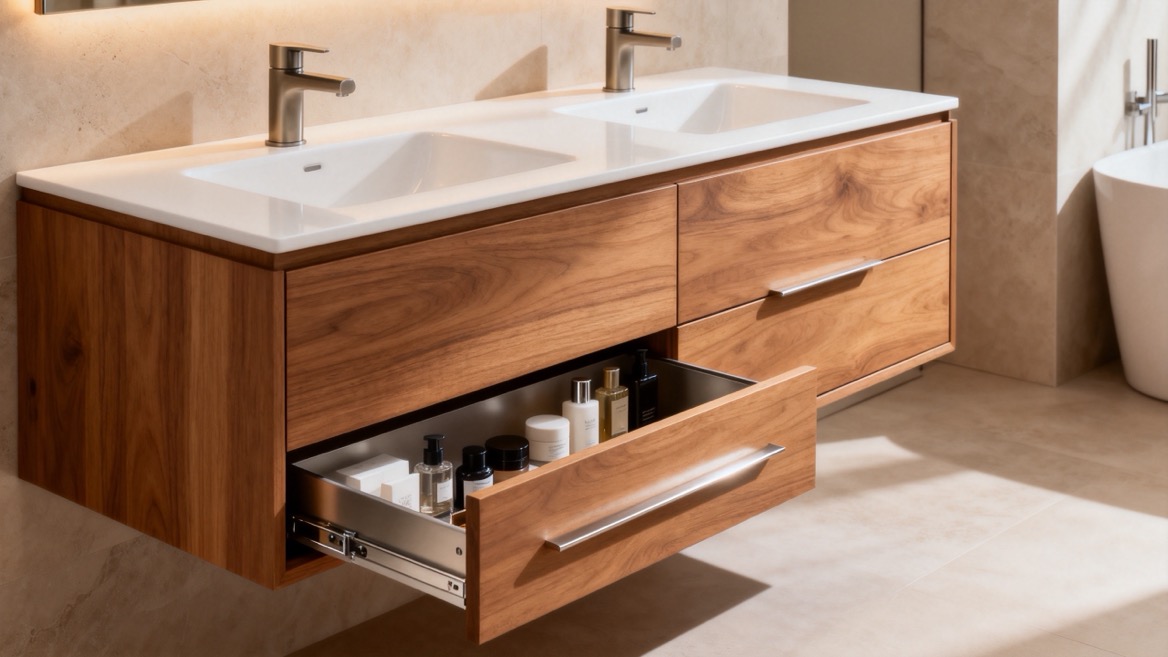
Customers interact with cabinet hardware every day. They pull out toiletries, reach for towels, and close doors while preparing for work or winding down at night.
Smooth drawer travel, controlled closing, and consistent alignment make those interactions feel deliberate. Conversely, rough movement can undermine an otherwise sophisticated bathroom design.
Blum offers integrated damping through products such as CLIP top BLUMOTION hinges. Hettich offers integrated Silent System damping in its Sensys hinge range.
However, "soft-close" is not a complete performance specification. The selected mechanism must suit the door or drawer, and the finished assembly must be installed correctly.
Modern bathroom vanities often combine wide drawer fronts, minimalist handles, and closely controlled gaps between panels.
These details leave little room for inconsistent assembly. Adjustable hardware helps installers refine the relationship between neighboring fronts.
Blum MOVENTO provides adjustment in four dimensions: height, side-to-side position, tilt, and depth. Hettich Actro 5D offers five-way adjustment for demanding furniture designs.
Adjustment improves precision, but it cannot compensate indefinitely for an inaccurate cabinet.
Neither brand is automatically the best choice for every project. Compare specific systems against the vanity's geometry, operating requirements, and destination-market support.
| Selection area | Blum examples | Hettich examples | Buyer's verification priority |
|---|---|---|---|
| Concealed hinges | CLIP top BLUMOTION | Sensys with Silent System | Door thickness, overlay, opening angle, and damping |
| Concealed drawer runners | MOVENTO | Actro 5D and selected Quadro systems | Runner length, load class, adjustment, and compatibility |
| Metal drawer systems | LEGRABOX and MERIVOBOX | AvanTech YOU | Drawer configuration, finish, accessories, and installation |
| Minimalist opening | Compatible TIP-ON BLUMOTION configurations | Compatible Push to open Silent configurations | Complete mechanism and required operating clearances |
| Additional corrosion protection | Selected hinges with BCOR finish | Verify the exact selected fitting | Documented finish and application suitability |
These are product-family comparisons, not interchangeable specifications. Components within each family vary, and market availability should be confirmed.
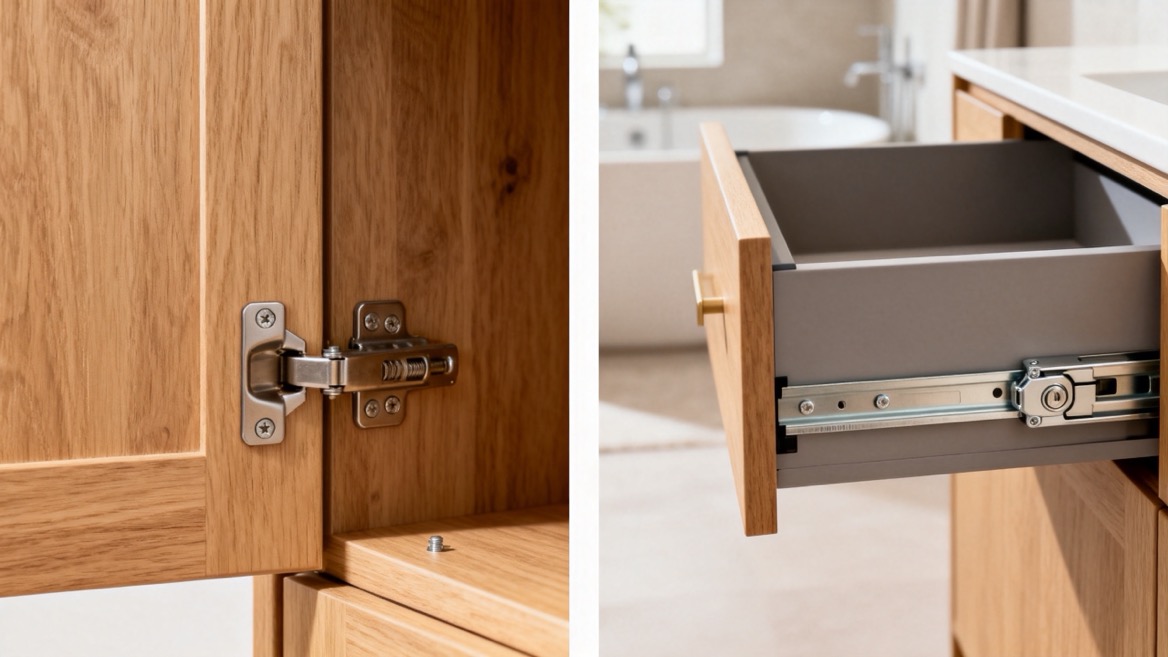
A hardware decision made after cabinet drawings are approved may require changes to internal dimensions, drilling, or drawer construction.
For OEM bathroom vanity production, select the runner and hinge configuration early enough to coordinate:
- Cabinet depth and drawer length.
- Door thickness and hinge position.
- Drawer-front dimensions and adjustment access.
- Basin, waste pipe, and trap clearances.
- Opening method and handle placement.
This sequence helps prevent a visually complete design from becoming mechanically compromised.
A premium soft-close bathroom vanity should close consistently under its intended operating conditions.
During sample review, test both empty and realistically loaded drawers. Check whether movement remains controlled, whether the drawer closes fully, and whether the front stays aligned.
For hinged doors, confirm that the hinge arrangement matches the door dimensions and construction.
A quiet showroom demonstration is useful, but it does not replace evaluation of the actual production configuration.
Push-to-open systems can support clean, uninterrupted fronts. However, handleless operation introduces requirements that conventional handled drawers may not share.
Check the required front gap, activation behavior, synchronization arrangements where applicable, and compatibility between opening and closing mechanisms.
Do not assume a standard soft-close runner can become push-to-open simply by adding an unrelated accessory. Specify a manufacturer-supported combination and test it in the intended cabinet.
Bathrooms store more than lightweight cosmetics. Bottles, cleaning supplies, appliances, and organizers can create substantial concentrated loads.
The relevant question is not, "Does this brand offer heavy-duty runners?" It is, "Which exact runner supports this drawer configuration?"
Hettich lists Actro 5D options with capacities up to 10, 40, or 70 kg. Blum's published MOVENTO range includes 40 and 70 kg load classes in specified configurations. Availability depends on the selected version and dimensions.
A runner's published capacity should not be presented automatically as the amount of customer belongings the drawer can hold.
Confirm the manufacturer's loading definition and account for the moving assembly, including the drawer structure, front, and accessories where applicable.
Consider this illustrative planning example:
- Drawer structure, front, and organizers: 10 kg.
- Intended contents: 18 kg.
- Combined moving weight: 28 kg.
This calculation helps establish a starting requirement. It does not, by itself, approve a runner or finished drawer.
Drawer dimensions, fastening, installation, and the manufacturer's application limits still require verification.
Bathrooms expose furniture to humidity, condensation, splashes, and cleaning products. Hardware selection must therefore consider the environment as well as movement.
Blum identifies warm, damp air and chemical vapors as potential influences on fitting surfaces. Its BCOR finish provides additional corrosion protection on selected hinges.
Blum reports that BCOR has undergone a 48-hour neutral salt spray test and a 24-hour acetic acid salt spray test under DIN EN ISO 9227.
These are coating-test results, not permission to expose the entire vanity to standing water.
A useful distinction is that countertop water resistance, cabinet moisture resistance, and hardware corrosion resistance are separate characteristics.
Even premium hinges cannot prevent damage caused by leaking plumbing or poorly protected cabinet openings.
For high-end bathroom vanity manufacturing, review:
- Sealing around basin and plumbing penetrations.
- Protection of exposed cabinet edges.
- Locations where water could collect.
- Compatibility of cleaning products with finishes.
- Ventilation and maintenance instructions.
Do not assume that every fitting carrying the same brand name has the same protective finish.
Blum states that its hinge testing includes 200,000 opening and closing cycles. Its published quality information also describes motion, load, corrosion, and material testing.
This provides useful evidence of the manufacturer's development and verification processes.
However, a cycle count is not a guaranteed service life for every bathroom installation. Actual performance depends on loading, environment, assembly, maintenance, and the surrounding cabinet.
When reviewing technical documentation, ask:
1. Does the information apply to the quoted product?
2. What configuration and loading were evaluated?
3. Is the claim about a component or the completed vanity?
4. Are installation and environmental limitations stated?
5. What warranty terms apply in the destination market?
Avoid converting laboratory results into unsupported claims such as "maintenance-free for twenty years."
The following workflow is a recommended purchasing framework, not a claim about completed customer projects.
Document the vanity dimensions, front materials, opening method, expected contents, and installation environment.
A compact residential cabinet and a wide double-basin vanity may require different hardware arrangements.
Make the Specification specific enough to reproduce.
Record the brand, product family, article numbers, runner lengths, load classes, finishes, mounting plates, and required accessories.
"Blum hardware" or "Hettich hardware" alone leaves too much open to interpretation.
Evaluate the complete vanity rather than an isolated hinge or runner.
Check:
- Door and drawer alignment.
- Smoothness throughout travel.
- Closing consistency.
- Plumbing clearance.
- Adjustment accessibility.
- Drawer removal and reinstallation.
Photograph the approved configuration and record any changes.
Use an agreed loading arrangement that reflects the intended storage application.
Observe drawer behavior during opening and closing, including whether the front remains stable.
Any contractual testing protocol should define its load, procedure, duration, and acceptance criteria.
Require written approval before changing hardware, accessories, drilling patterns, or compatible cabinet components.
A nominally similar replacement may alter assembly requirements or user experience.
Consider a hypothetical floating double vanity with wide drawers and concealed plumbing.
The initial instinct may be to select a higher-capacity runner. Yet the first constraint could be a trap occupying the drawer's travel path.
A better design sequence is to:
1. Confirm the basin and waste arrangement.
2. Map plumbing clearances.
3. Establish usable drawer geometry.
4. Select compatible runners and accessories.
5. Validate the assembled design.
A U-shaped drawer may improve access around plumbing, but its construction and contents distribution still need evaluation.
The lesson is that excellent hardware must work within a coordinated storage system.
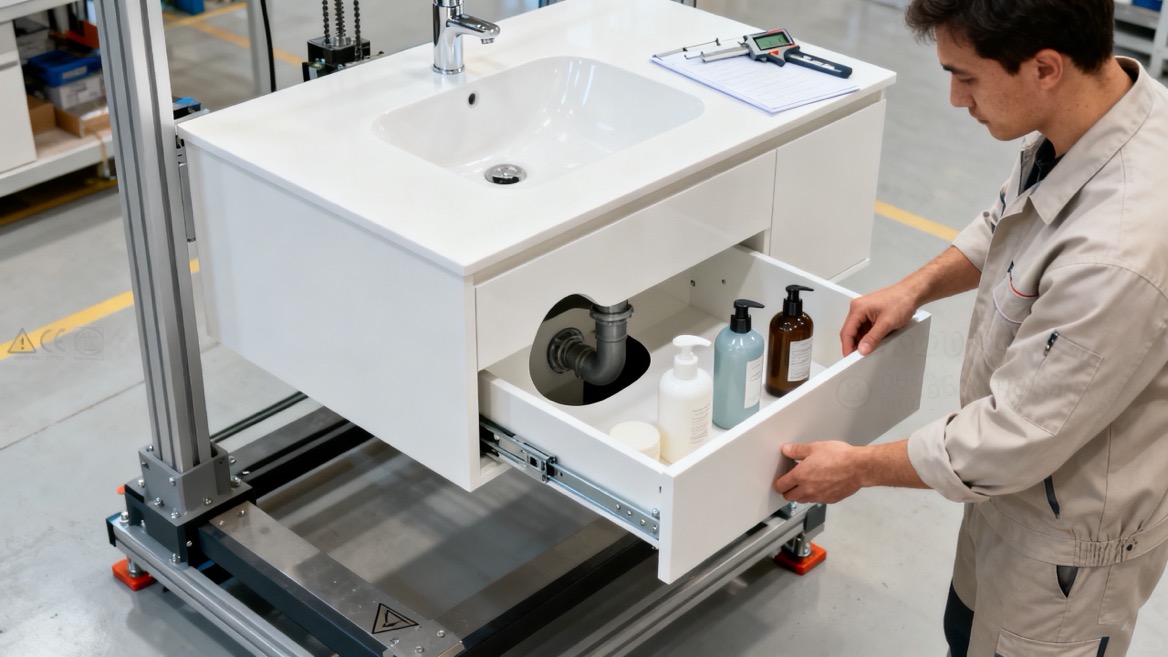
Premium hardware usually deserves a broader assessment than its unit price.
For overseas buyers, relevant cost categories include:
- Additional assembly or adjustment time.
- Installation difficulties.
- Replacement-part handling.
- Service visits and customer communication.
- Disruption caused by specification changes.
These are evaluation categories, not guaranteed savings. Without project records, it would be misleading to promise a particular reduction in complaints or maintenance costs.
Ask whether exact replacement components can be identified and sourced in the target market.
Keep article numbers, assembly instructions, and approved alternatives in the product file.
Clear documentation makes future troubleshooting more manageable than descriptions such as "standard premium hinge."
Jiaxing Miluo Smart Home Co., Ltd. provides customized modern bathroom products and integrated solutions, with OEM and ODM services for overseas brands, wholesalers, and manufacturers.
For a proposed Blum- or Hettich-equipped vanity range, begin with the commercial brief and technical requirements. Confirm component availability, procurement arrangements, cabinet compatibility, and sample approval before making product promises.
The strongest premium positioning connects appearance with verifiable details: named components, coordinated construction, controlled movement, and documented acceptance criteria.
Send Jiaxing Miluo your vanity drawings, target market, expected order volume, finish preferences, and preferred hardware family. Request a project-specific proposal covering the hardware schedule, cabinet configuration, and sample-validation requirements.
Both offer systems suitable for premium furniture. The better choice depends on the exact application, adjustment requirements, opening method, component availability, and support arrangements. Compare specified configurations rather than choosing by brand name alone.
Do not assume they are waterproof. Corrosion resistance depends on the selected product and finish. Hardware also needs protection from leaks, standing water, and unsuitable cleaning chemicals.
There is no universal capacity. Determine the intended contents and moving drawer weight, then check the selected runner's loading definition and application limits. Validate the complete assembly.
Yes, compatible systems can combine opening assistance and controlled closing. The exact combination must be manufacturer-supported, correctly installed, and tested with the intended front gaps and drawer configuration.
No. Cabinet construction, edge protection, fastening, plumbing design, installation, and maintenance remain important. Premium hardware strengthens a well-engineered vanity; it does not replace sound construction.
Request a detailed hardware schedule, approved drawings, an assembled sample, relevant technical documents, acceptance criteria, change-control requirements, and replacement-part information. Confirm that production must match the approved configuration.
1. [Blum — Product Quality]. Manufacturer information on hinge cycle testing, motion and load testing, corrosion testing, material evaluation, and production quality controls. [blum]
2. [Blum — CLIP top BLUMOTION]. Product information on integrated damping and hinge applications, including selected thick-door configurations. [blum]
3. [Blum — MOVENTO Assembly and Installation]. Manufacturer guidance on height, side-to-side, tilt, and depth adjustment, plus installation aids. [blum]
4. [Blum — Catalogue and Technical Manual: MOVENTO]. Published overview of MOVENTO runner characteristics, including four-dimensional adjustment and specified load classes. [publications.blum]
5. [Blum — Hinges with BCOR Surface Protection]. Information on environmental exposure, additional hinge protection, and stated salt spray testing under DIN EN ISO 9227. [blum]
6. [Hettich — Actro 5D Drawer Runner]. Manufacturer information on five-way adjustment, load-capacity options, and related runner platforms. [hettich]
7. [Hettich — Sensys Concealed Hinge]. Product information on integrated Silent System damping and selected hinge opening configurations. [hettich]
8. [Hettich — Drawer Runners for AvanTech YOU]. Product listings identifying compatible runner families and optional opening systems. [shop.hettich]


