
Views: 295 Author: Miluo Smart Home Publish Time: 2026-10-27 Origin: Site


Content Menu
● Why Resin Stone Tops and Dark Wood Vanity Bases Work Together
● What Does "Resin Stone" Mean for Bathroom Vanity Tops?
● Choosing Resin Stone Countertop Colors for Dark Wood Cabinets
>> Compare Samples Under Realistic Lighting
● Balancing Finish, Grain, and Vanity Proportions
>> Matte Versus Gloss Resin Stone Tops
>> Grain Direction and Door Layout
>> Countertop Thickness and Edge Appearance
● Engineering the Countertop and Cabinet as One System
>> Protect the Dark Wood Vanity Base
>> Coordinate Support and Installation
>> Check Basin, Faucet, and Drawer Clearances
● A Practical Sample-Approval Process for OEM and ODM Buyers
>> Stage 1: Approve the Material Pairing
>> Stage 2: Approve a Complete Vanity Assembly
>> Stage 3: Agree on Verification and Packaging
● An Illustrative Collection-Planning Example
● Maintenance Guidance That Supports the Product
● Develop a Coordinated Vanity Collection with Jiaxing Miluo
>> What Resin Stone Color Works Best with Dark Wood Vanity Bases?
>> Are Resin Stone Vanity Tops the Same as Quartz?
>> Can a Resin Stone Top Be Used on a Floating Vanity?
>> Are Dark Wood Bathroom Vanities Waterproof?
>> Can Scratches Be Removed from Resin Stone Countertops?
>> What Should an OEM or ODM Vanity Inquiry Include?
Pairing resin stone tops with dark wood vanity bases creates a bathroom centerpiece that balances clean surfaces with rich, natural-looking texture. For bathroom brands, wholesalers, and manufacturers, however, the real opportunity goes beyond appearance: a successful combination must also deliver consistent finishes, practical maintenance, and reliable installation.
My starting point for this pairing is compatibility. The countertop, cabinet construction, basin, hardware, and lighting should work as one coordinated product—not as individually attractive components assembled too late.
This guide explains how to develop that balance, from choosing countertop undertones to approving production samples for a customized bathroom vanity collection.
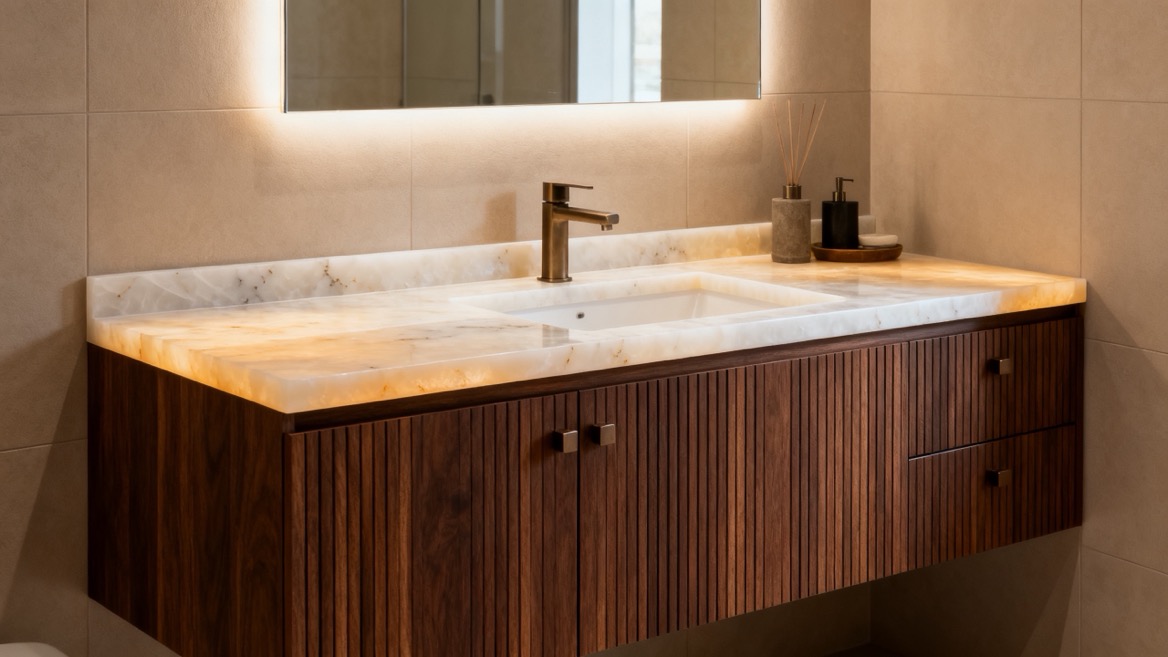
A pale countertop gives a dark cabinet visual definition. Meanwhile, wood grain introduces warmth that prevents a minimalist bathroom from feeling overly clinical.
The contrast also creates a clear hierarchy. The countertop establishes a clean horizontal line, while the cabinet anchors the composition below.
For a modern luxury bathroom vanity, consider three relationships:
- Color contrast: Does the countertop distinguish itself from the cabinet without appearing disconnected?
- Surface character: Do the countertop finish and wood grain complement rather than compete?
- Visual weight: Does the cabinet look appropriately proportioned beneath the basin and top?
High contrast is not always the best answer. Warm ivory over walnut can feel quieter and more residential than brilliant white over nearly black cabinetry. Both can work, but they communicate different brand identities.
Before selecting a finish, clarify the material specification.
"Resin stone" is a commercial description rather than a sufficiently precise purchasing specification. Suppliers may use it for different mineral-filled resin products, including cultured marble and certain solid-surface materials.
These products should not automatically share the same care instructions, repair methods, or performance claims.
Cultured marble typically combines mineral filler with polyester resin and a protective gel-coated surface. It can be molded into vanity tops with integrated basins.
Its maintenance requirements depend heavily on the surface coating. Abrasive cleaning and incompatible chemicals can damage that finish.
Solid-surface products generally combine mineral fillers with acrylic, polyester, or blended resin systems. Certain products are homogeneous through their thickness, allowing professional refinishing.
Corian, for example, provides repair guidance for its own solid-surface products. That guidance should not be extended automatically to every countertop sold as resin stone.
Ask the supplier to identify:
- Resin system and mineral filler.
- Gel-coated or homogeneous construction.
- Surface finish and approved cleaning methods.
- Available product-specific test reports.
- Repair procedures and warranty exclusions.
A sample labeled "white resin stone" is not enough to approve a production specification.
Begin with the wood undertone, not simply its darkness.
Walnut, espresso-stained oak, and charcoal woodgrain finishes may appear similarly dark online, yet behave differently beside the same countertop.
| Dark wood appearance | Countertop direction | Design effect | Approval concern |
|---|---|---|---|
| Warm walnut | Ivory or warm white | Soft, welcoming contrast | Avoid unexpectedly yellow combinations |
| Espresso brown | Neutral white or restrained veining | Crisp, tailored appearance | Check whether the top reads blue |
| Charcoal woodgrain | Soft white or pale gray | Architectural restraint | Prevent an overly cold palette |
| Smoked oak | Greige or muted cream | Understated coordination | Preserve enough tonal separation |
| Near-black wood | Off-white with subtle movement | Dramatic focal point | Control glare and competing patterns |
These combinations are design starting points, not universal rules. Approval should depend on physical samples viewed together.
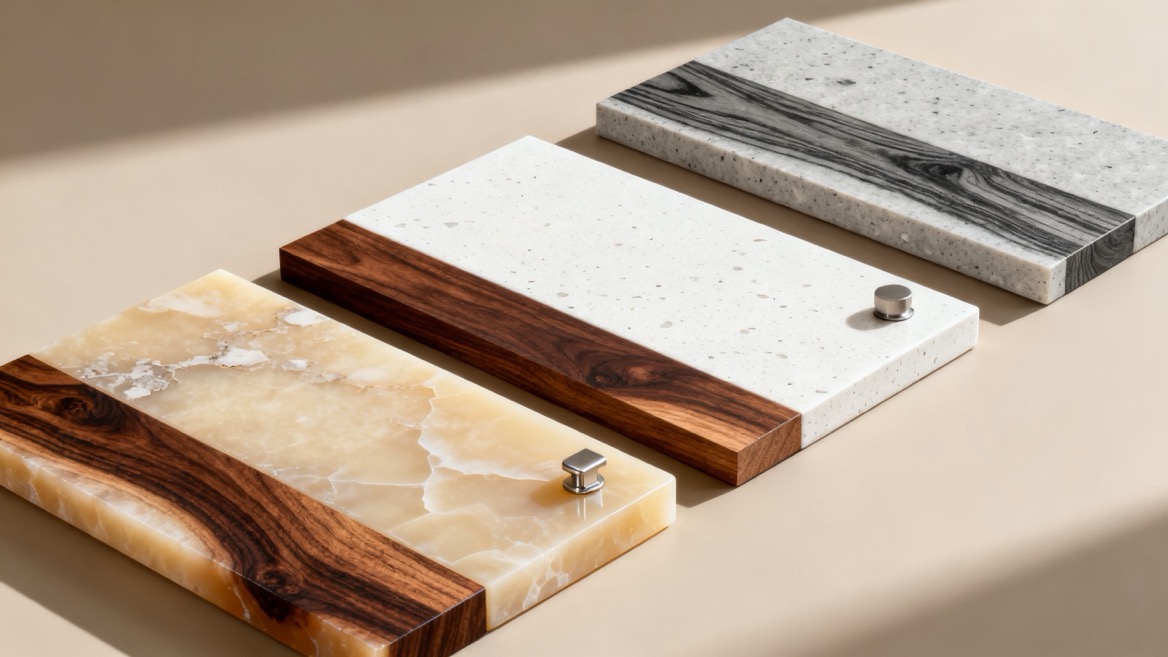
Dark wood already contributes movement through its grain. Strong countertop veining adds another visual pattern.
For a broadly adaptable collection, I would start with quiet mineral textures or restrained veining. More expressive patterns can become a separate statement range.
For double-basin tops, review the overall pattern composition. A small sample cannot show whether veining looks balanced around both bowls.
Place the countertop sample horizontally and the cabinet sample vertically, matching their installed orientation.
Review them under daylight and the intended bathroom lighting. Include the actual handle, faucet finish, and wall tile where possible.
Photographs help document approval, but they should not replace the physical reference samples.
A matte or satin appearance can create a quieter transition to wood cabinetry. A glossy top creates a sharper contrast with open-grain or low-sheen finishes.
Neither finish is automatically more durable. Scratch visibility, cleaning, and repairability depend on the particular material and finish system.
Approve the surface texture as carefully as the color. Two white tops can look nearly identical in photographs while feeling very different in use.
Horizontal grain can emphasize a long floating vanity. Vertical grain can add rhythm to tall doors or fluted fronts.
For multi-drawer cabinetry, specify whether grain continuity is required. Without that instruction, individually acceptable fronts may produce an inconsistent overall appearance.
Natural veneer also needs an agreed variation range. A single "perfect" sample cannot adequately represent every acceptable grain pattern.
A slim-looking edge can suit minimalist cabinetry, while a deeper profile may support a more substantial furniture style.
Distinguish visible edge thickness from structural construction. A thick-looking fascia does not necessarily mean the entire top has the same thickness.
Review edge details, basin depth, and drawer clearances together before approving the final proportions.
A well-matched resin stone bathroom vanity top can still fail as a product if the cabinet, plumbing, and installation details are poorly coordinated.
A wood appearance does not identify the cabinet substrate. The construction might involve solid timber, veneer over plywood, moisture-resistant MDF, or decorative panels.
Specify both the visible finish and the underlying material.
Moisture-resistant MDF is not waterproof. MEDITE's guidance, for example, requires suitable sealing and coating for humid interiors and advises avoiding wetting.
Inspect vulnerable details:
- Panel edges and underside surfaces.
- Faucet and plumbing penetrations.
- Basin-adjacent joints.
- Cabinet corners and fixing locations.
- Areas where splashes could collect.
Do not describe the entire vanity as waterproof solely because the countertop resists water.
Countertop support must follow the specific product's requirements. Do not assume that one material's allowable span or fixing method applies to another.
For floating vanities, confirm the complete load path from the countertop through the cabinet and brackets to the wall structure.
The installation drawing should identify support locations, approved fixing methods, access requirements, and any necessary wall reinforcement.
An integrated basin may simplify the visible countertop-to-bowl transition, but it does not eliminate plumbing coordination.
Check:
1. Basin position and usable bowl depth.
2. Faucet-hole arrangement and spout reach.
3. Drain and overflow compatibility.
4. Trap clearance behind drawers.
5. Access for installation and future servicing.
Resolve these relationships in drawings before tooling or bulk production.
The most useful improvement to a purchasing process is often a clearer approval sequence.
Rather than approving color first and discovering fit problems later, use three connected stages.
Review the countertop, cabinet finish, and hardware together.
Record the countertop code, cabinet finish reference, sheen, grain direction, and acceptable appearance variation.
Retain agreed reference samples with both buyer and supplier.
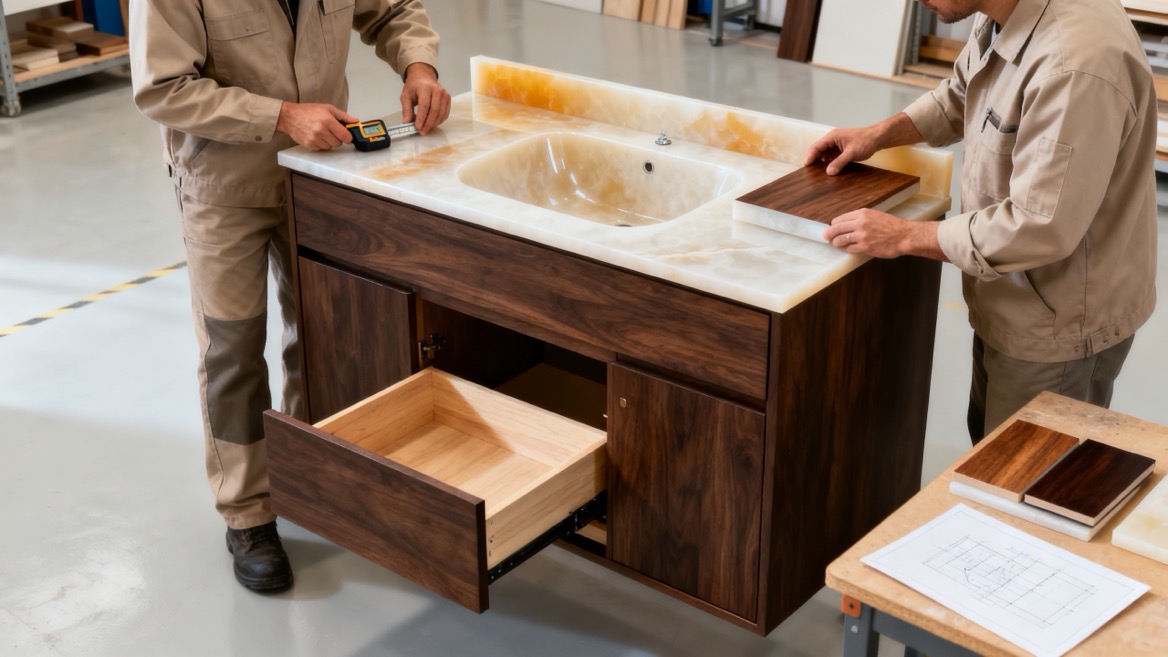
A complete first article reveals issues that separate samples cannot show.
Check basin alignment, countertop seating, drawer travel, door gaps, visible adhesive, plumbing access, and the appearance of exposed edges.
Assess the vanity from normal standing positions as well as close inspection. A technically acceptable joint can still look distracting in a premium collection.
Define product-specific checks before production.
Potential checks include dimensional inspection, cleaning compatibility, cabinet coating evaluation, and leak checks at assembled plumbing interfaces where applicable.
Set acceptance criteria and test methods in writing. An informal sample demonstration should not be presented as an accredited laboratory result.
Review packaging around vulnerable corners, basin areas, and finished cabinet surfaces. Transport protection belongs in product development, not only in shipping preparation.
Consider an overseas brand developing a warm, contemporary vanity range.
A sensible starting proposal could combine:
- A warm-white resin stone top with restrained movement.
- A dark walnut-look cabinet.
- A coordinated brushed-metal handle.
- A clean basin shape with serviceable plumbing access.
The first decision is not whether the combination looks attractive in a rendering. It is whether the approved materials remain coherent on the complete assembly.
A second countertop color could extend the range while retaining the cabinet design. However, confirm that the alternative uses compatible dimensions, basin geometry, support requirements, and installation instructions.
This is an illustrative planning approach, not a reported customer project or a claim about completed production.
Care instructions should distinguish the countertop from the wood cabinet.
For the top, specify manufacturer-approved cleaners and tools. Mild cleaning, rinsing, and drying provide a useful starting routine, but the actual product guidance takes priority.
Avoid placing hot styling tools directly on resin-based surfaces. Heat resistance should never be interpreted as permission for unrestricted direct heat.
For the cabinet, wipe away splashes promptly and avoid leaving wet items against edges or joints.
Repair advice also needs material-specific language. A homogeneous solid surface may permit professional refinishing, while a gel-coated top needs a different assessment.
Providing a short, accurate care sheet helps distributors explain the product without making unsupported promises.
Jiaxing Miluo Smart Home Co., Ltd. focuses on customized modern, high-end bathroom products and solutions, offering OEM and ODM services for overseas brands, wholesalers, and manufacturers.
For your next dark wood vanity collection, prepare a brief covering the target market, preferred dimensions, countertop appearance, cabinet construction, basin configuration, and expected order quantities.
Send your drawings, finish references, and destination-market requirements to Jiaxing Miluo to discuss material pairing, customization scope, sampling, and quotation.
Ask for a coordinated proposal covering the complete vanity assembly—not simply separate prices for a countertop and cabinet.
Warm white and ivory are useful starting points for walnut and espresso finishes. Pale gray can suit cooler wood tones. The final choice should be approved using physical samples under the intended lighting.
Not necessarily. Resin stone is used inconsistently in commercial descriptions. Request the exact composition and construction rather than assuming the term means engineered quartz, cultured marble, or solid surface.
Potentially, yes. Suitability depends on the top's weight, cabinet construction, brackets, wall structure, and the specified installation method. Have the complete support arrangement confirmed before approval.
A dark wood finish does not establish waterproof performance. The substrate, coating, edge protection, joints, and installation all matter. Even moisture-resistant wood-based panels require protection from direct water exposure.
Sometimes, but the repair method depends on construction. Certain homogeneous solid surfaces can be professionally refinished. Gel-coated products require different techniques. Obtain product-specific advice before sanding or polishing.
Include drawings, dimensions, countertop specifications, cabinet substrate, finish references, basin and faucet details, quantities, destination market, packaging requirements, and required documentation. A clearer brief makes proposals easier to compare.
1. ARSTAR. "What Is Cultured Marble?" Manufacturer explanation of mineral-filled polyester resin construction, gel coating, and basic care. Product descriptions apply to the manufacturer's stated materials, not every resin stone formulation. [arstarinc]
2. Corian Design. "Use & Care." Manufacturer guidance on heat protection, surface abrasion, and professional repair of Corian solid surface. Used only to explain this material category and its limitations. [corian]
3. MEDITE SMARTPLY. "FAQs—MEDITE MR." Manufacturer guidance distinguishing moisture resistance from waterproof performance and explaining sealing requirements in humid interiors. [mdfosb]
4. MEDITE SMARTPLY. "Understanding Moisture Resistant MDF." Explanation of moisture-resistant panel applications and the continuing importance of finishing and installation. [mdfosb]


