
Views: 298 Author: Miluo Smart Home Publish Time: 2026-10-29 Origin: Site


Content Menu
● Why Add Motion-sensor Lighting to Bathroom Vanities?
● Choose Different Sensors for Drawers and Kickplates
>> Drawer Lighting: Detect Opening Rather Than Occupancy
>> Kickplate Lighting: Detect Approach and Control Brightness
● Specify Comfortable LED Vanity Drawer and Kickplate Lighting
>> Match Color Temperature to the Bathroom
>> Use Color Rendering Where It Adds Value
>> Hide the Light Source, Not the Useful Light
● Plan Electrical Safety Before Finalizing Cabinet Construction
>> Match Protection to the Installation Location
>> Keep Drivers Accessible and Away From Plumbing Risks
● Size the LED Driver and Wiring Correctly
>> Illustrative Power Calculation
● How to Add Sensor Lighting to Vanity Drawers and Kickplates
>> Step 1: Map the Cabinet and Plumbing
>> Step 2: Define Separate Lighting Behaviors
>> Step 3: Choose Fixed or Moving Light Positions
>> Step 4: Install Profiles and Protected Connections
>> Step 5: Commission the Complete Assembly
● Develop a Written OEM or ODM Lighting Specification
● Validate the Prototype Before Production
● Bring a Coordinated Lighting Concept Into Your Next Vanity Collection
>> Can Motion-sensor Lighting Be Added to an Existing Vanity?
>> Should Drawer Lights and Kickplate Lights Share One Sensor?
>> Is 12 V or 24 V Better for Vanity Lighting?
>> Does an IP-rated LED Strip Make the Entire Vanity Waterproof?
>> Can Motion-sensor Kickplate Lighting Stay Off During Daylight?
>> Can These Lights Replace Bathroom Task Lighting?
Adding motion-sensor lighting to vanity drawers and kickplates makes a bathroom cabinet more convenient without changing its clean, modern appearance. Open a drawer, and its contents become easier to find. Approach the vanity at night, and a discreet floor-level light can illuminate the area without switching on the main lighting.
For overseas brands, wholesalers, and manufacturers, this feature also creates an opportunity to differentiate a vanity collection. However, successful integration requires more than attaching an LED strip beneath a cabinet.
My starting point when evaluating a specification is integration: the lighting, sensors, cabinet construction, electrical components, and maintenance access must work as one system. This guide explains how to develop that system for customized bathroom vanities and OEM or ODM projects.
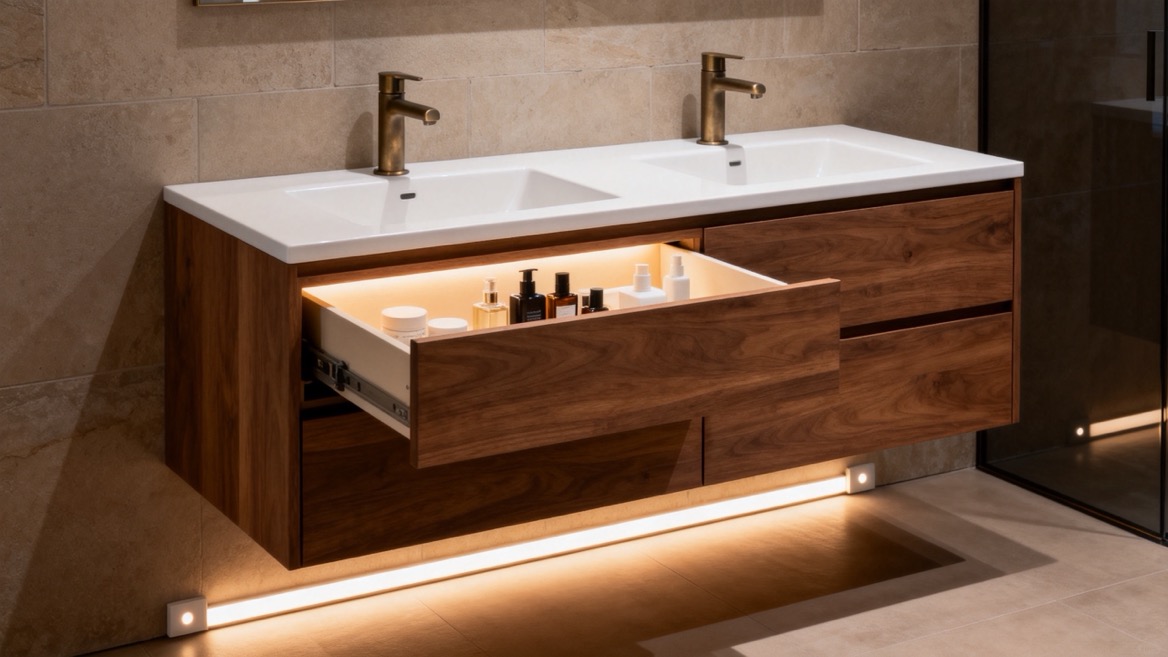
Drawer lighting and kickplate lighting serve different purposes.
Inside drawers, illumination helps users identify small toiletries and items stored behind organizers. Beneath the cabinet, lighting creates a low-level visual guide and emphasizes the vanity's shape.
A kickplate, also called a plinth or toe-kick panel, usually closes the recessed space beneath a floor-standing cabinet. A floating vanity has no conventional kickplate, but its underside can accommodate a similar lighting effect.
For premium collections, potential advantages include:
- Easier access to stored items.
- Hands-free activation.
- Adjustable nighttime illumination.
- A coordinated appearance across cabinets and mirrors.
- Product differentiation through useful functionality.
These lights should supplement, not replace, suitable general and mirror lighting. Their usefulness depends on placement, brightness, and reliable activation—not simply the number of LEDs installed.
"Motion-sensor vanity lighting" is a useful umbrella term, but one sensor type rarely suits every location.
A drawer light should respond predictably when the drawer opens.
Suitable approaches include magnetic contact switches and optical door or drawer sensors. A magnetic switch detects separation between its components. An optical sensor detects a change in the nearby surface or reflected signal, depending on its design.
Purpose-built drawer-opening detection is generally more appropriate than trying to detect a person moving inside a small compartment.
Before selecting a sensor, verify:
- Detection distance and mounting orientation.
- Compatibility with the drawer front and internal finish.
- Switching behavior when partially open.
- Clearance around runners and organizers.
- Whether individual drawers operate independently.
Test the actual drawer assembly. A sensor that works on a demonstration board may behave differently behind a dark drawer front or beside a reflective interior.
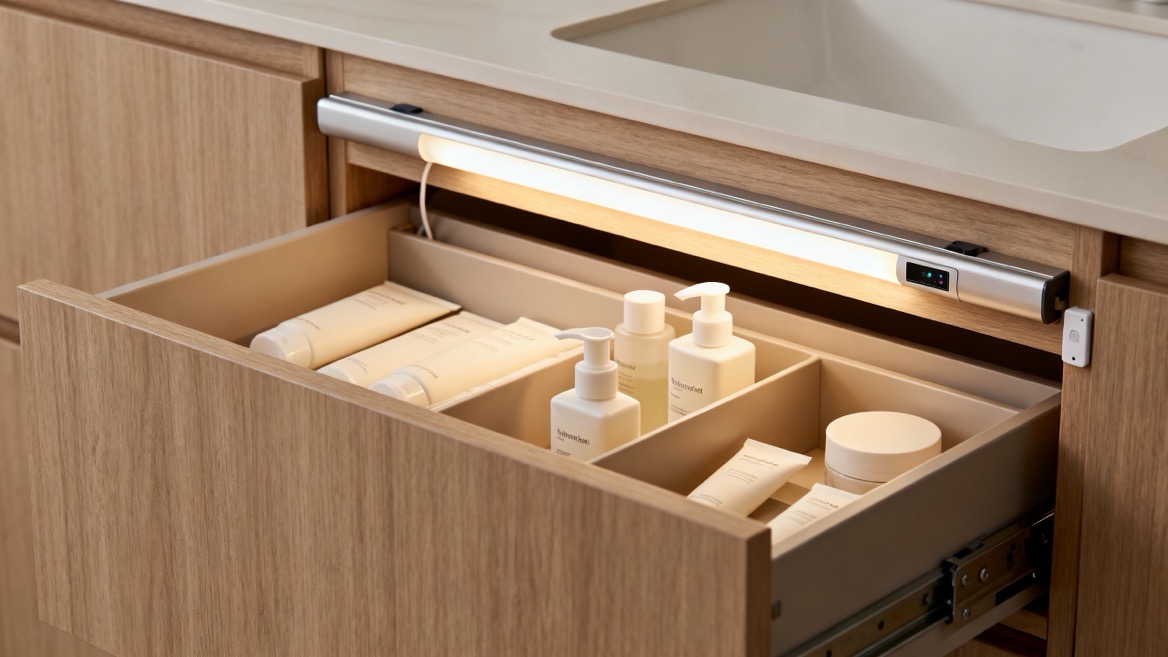
A passive infrared sensor, or PIR sensor, can activate lighting when a person enters its detection area.
Position matters. A recessed sensor may be obstructed by the cabinet, while one facing a doorway may trigger whenever someone passes outside.
For nighttime use, consider a compatible ambient-light sensor or controller that prevents unnecessary daytime activation.
| Lighting location | Suitable detection approach | Main design priority |
|---|---|---|
| Individual drawer | Magnetic or optical opening sensor | Reliable opening and closing response |
| Multiple drawers | Separate sensors with a compatible controller | Independent operation |
| Recessed kickplate | PIR motion detection | Detection without obstruction |
| Floating vanity underside | PIR with optional ambient-light control | Concealed light and controlled glare |
Confirm sensor voltage, switching capacity, and control compatibility before purchasing components.
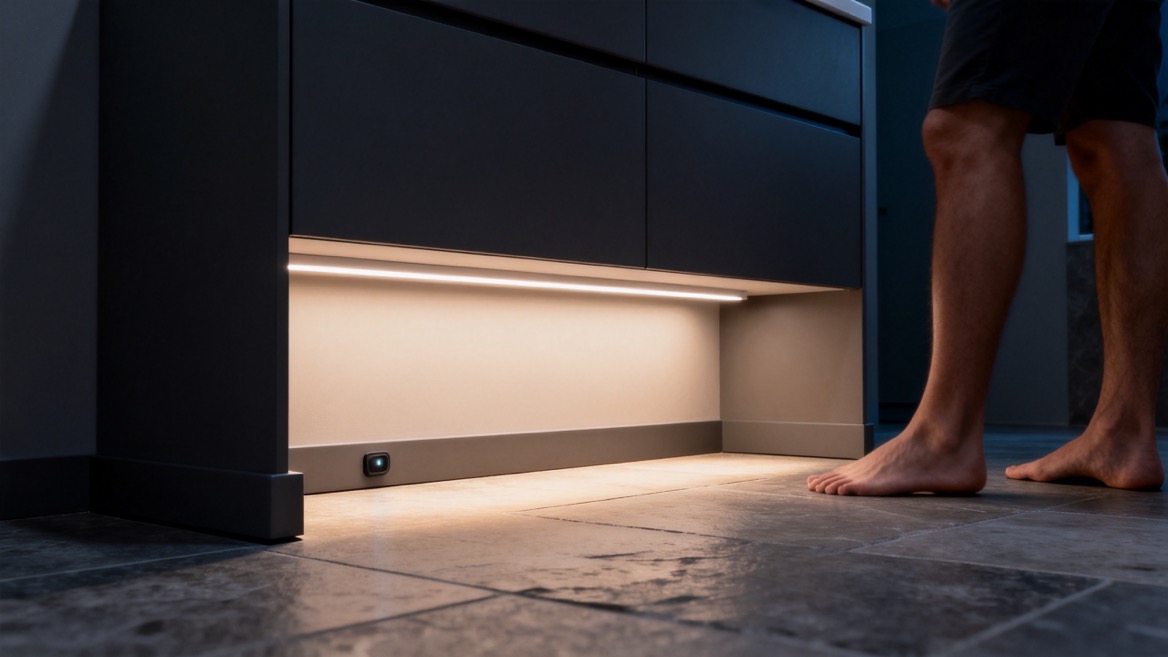
Color temperature describes whether white light appears warmer or cooler.
For a warm contemporary bathroom, 2700–3000 K is a useful design starting point. A neutral scheme may suit approximately 3500–4000 K.
These are project recommendations, not mandatory settings. Compare samples beside the selected cabinet finish, countertop, tiles, and mirror lighting.
Warm drawer lighting can look inconsistent beneath a noticeably cooler illuminated mirror. Specify the intended relationship rather than allowing each supplier to choose independently.
Color rendering describes how faithfully a light source reveals object colors.
A color rendering index of at least 80 is a common interior-lighting baseline. For a premium drawer-lighting specification, CRI 90 or above is worth considering where users need to distinguish similar-colored products.
CRI alone does not guarantee a pleasing result. Evaluate brightness, diffusion, and visible reflections in a physical sample.
Visible LED dots and bright reflections can undermine an otherwise refined vanity.
Use a compatible profile and diffuser, and position the light so users see illuminated contents or reflected floor light rather than exposed emitters.
For drawers, check that tall bottles do not block illumination. For kickplates, assess the effect on both matte and glossy floors.
An aluminum profile can provide mechanical support and assist heat management. Its suitability still depends on the strip manufacturer's installation requirements.
Bathrooms introduce moisture, cleaning water, and electrical-installation constraints. Low-voltage lighting does not remove those concerns.
An ingress protection rating describes an enclosure's resistance to solids and water. It does not establish that every part of a lighting assembly is suitable for every bathroom location.
A protected LED strip does not automatically protect:
- Cut ends.
- Cable joints.
- Sensor housings.
- Connectors.
- Drivers.
- Cable-entry points.
Requirements vary by destination market and installation position. For example, UK guidance applies bathroom zones with different equipment requirements. Those rules should not be treated as a universal international specification.
Have a qualified electrical professional confirm the applicable requirements, protective devices, and permitted component locations.
Locate the driver where its manufacturer permits installation, with appropriate ventilation and service access.
Avoid placing it directly beneath a likely plumbing leak or sealing it permanently behind cabinetry. A replacement should not require dismantling the countertop.
Keep mains-voltage work separate from the cabinet's low-voltage lighting assembly. A qualified installer should complete or verify fixed electrical connections according to local requirements.
Most LED strips used in furniture require a compatible constant-voltage supply. Match the specified voltage across the strip, driver, sensors, and controller.
For a given wattage, a 24 V system draws less current than a 12 V system. However, voltage alone does not determine allowable cable length or installation quality.
Consider a hypothetical vanity with:
- Two drawer strips, each 0.6 m long.
- One kickplate strip, 1.2 m long.
- LED strip consumption of 6 W per meter.
The combined strip length is 2.4 m, giving an LED load of 14.4 W.
If the selected driver manufacturer recommends limiting continuous loading to 80% of rated output, the strip-only calculation indicates at least 18 W of rated capacity.
Controller consumption, ambient temperature, derating, and other manufacturer requirements must also be considered. This example is a calculation method, not a universal driver recommendation.
Confirm:
1. Driver output voltage.
2. Total connected load.
3. Sensor and controller current ratings.
4. Cable size and length.
5. Connector ratings and polarity.
6. Dimming compatibility.
7. Maximum strip length per feed.
Voltage drop can cause uneven brightness. Follow the component supplier's wiring guidance rather than applying one cable size to every vanity.
Review drawer travel, runners, pipework, mounting brackets, and service spaces.
Mark proposed lighting positions before machining channels or ordering drawer components.
Specify drawer and kickplate operation independently.
For example, drawer lights can activate whenever their drawers open, while kickplate lighting operates only when movement is detected under low ambient light.
A 30–60-second kickplate timeout can be a starting point for prototype evaluation, not a fixed requirement.
A cabinet-mounted drawer light can simplify wiring if it illuminates the compartment effectively.
If a light moves with the drawer, provide an engineered cable-management arrangement. The cable must not stretch, pinch, rub against runners, or obstruct closing.
Check the complete opening and removal sequence.
Mount profiles using an appropriate method for the substrate and operating conditions.
Prepare bonding surfaces where adhesive is permitted. Do not rely on unsuitable tape to compensate for dust, textured finishes, or poor mechanical design.
Protect cable penetrations and preserve the cabinet's moisture-resistant detailing.
Test the vanity with realistic contents and the intended room conditions.
Check activation, timeout, brightness, reflections, cable movement, and driver access. Evaluate both day and night operation before approving the design.
For Jiaxing Miluo Smart Home Co., Ltd., lighting requirements should form part of the customized vanity development brief—not remain an informal accessory request.
As a manufacturer supplying modern bathroom products and solutions to overseas brands, wholesalers, and manufacturers, the company can use a structured brief to align cabinet design with buyer expectations.
| Specification item | Information to confirm |
|---|---|
| Product configuration | Vanity dimensions, drawer arrangement, plinth or floating design |
| Lighting appearance | Color temperature, output, diffuser, visible-light requirements |
| Control behavior | Sensor type, detection area, timeout, daytime operation |
| Electrical system | Voltage, load, driver, controller, connectors |
| Destination requirements | Applicable standards, documentation, installation instructions |
| Serviceability | Component access, replacement method, spare-part identification |
For OEM projects, review the buyer's drawings and component requirements. For ODM projects, approve the proposed lighting architecture before finalizing tooling and cabinet details.
Do not assume that a component certificate automatically establishes compliance of the finished vanity.
A working sample proves basic operation. A production-ready sample must also demonstrate repeatability, maintainability, and acceptable performance under intended conditions.
A useful validation plan includes:
- Repeated drawer operation with realistic loading.
- Sensor checks with different drawer finishes.
- Cable-clearance inspection throughout drawer travel.
- Daylight and nighttime activation tests.
- Temperature checks under specified operating conditions.
- Moisture-related evaluation appropriate to the product.
- Removal and replacement of serviceable components.
Set acceptance criteria before testing. Record methods, conditions, and results rather than describing the product as "durable" without supporting evidence.
This approach also makes supplier changes easier to evaluate: a replacement sensor should meet the approved behavior, not merely fit the same opening.
The most successful illuminated vanity combines useful light, predictable controls, safe electrical integration, and accessible components.
For your next OEM or ODM project with Jiaxing Miluo Smart Home Co., Ltd., submit your vanity drawings, target market, preferred finishes, and lighting requirements for a coordinated design review. Request a sample configuration covering drawer activation, kickplate detection, wiring access, and replacement planning before confirming production specifications.
Often, yes. Feasibility depends on wiring access, available space, moisture exposure, and cabinet construction. A retrofit should preserve drawer movement and provide safe access to the driver and connections.
Usually, separate control is more practical. Drawer lights need to respond to individual drawer openings, while kickplate lights respond to someone approaching. They may share a compatible power supply if the system is designed accordingly.
Both can work. Select the voltage according to component compatibility, connected load, wiring length, and manufacturer guidance. A coordinated system is more important than choosing a voltage in isolation.
No. The strip rating does not automatically cover cut ends, connectors, sensors, drivers, or the cabinet. Evaluate the complete installation and avoid describing a vanity as waterproof without appropriate evidence.
Yes, if the system includes compatible ambient-light control. Confirm whether that function is built into the sensor or requires a separate controller, then test it in the intended installation.
No. Drawer lights illuminate storage, and kickplate lights provide low-level guidance or decoration. Suitable mirror and general lighting remain necessary for grooming and normal bathroom use.
1. U.S. Department of Energy. "LED Basics." Background on LED controls, occupancy sensing, color temperature, and color rendering, including general interior CRI guidance. [energy]
2. U.S. Department of Energy. "Understanding LED Color-Tunable Products." Guidance on adjustable white light, warm-dimming behavior, and evaluating appearance through mock-ups. [energy]
3. NICEIC. "Bathrooms and Electrics—What You Need to Know." UK-specific guidance on bathroom electrical zones, water exposure, and equipment protection. Local requirements must be checked for other markets. [niceic]
4. Häfele. "LOOX—LED Lighting Systems." Manufacturer information distinguishing 12 V, 24 V, and constant-current system components; supports the importance of matching electrical architectures. [hafele.com]
5. Häfele India. "Door Sensor." Product information identifying a dedicated sensor for a Loox drawer profile; an example of purpose-designed drawer-lighting control, not a universal compatibility recommendation. [hafeleindia]
6. Flexfire LEDs. "How to Pick a Power Supply for My LED Strips." Manufacturer guidance on matching supply voltage and calculating power requirements for strip-light installations. [flexfireleds]
7. U.S. Department of Energy. "Purchasing Energy-Efficient Light Bulbs." Background on color temperature, color rendering, dimmability, and control compatibility. [energy]


