
Views: 264 Author: Miluo Smart Home Publish Time: 2026-11-01 Origin: Site


Content Menu
● 1. Bathroom Vanity Materials: Examine the Complete Construction
>> Compare Cabinet Materials Without Oversimplifying
● 2. Bathroom Vanity Size: Measure the Installed System
>> Check Clearance Before Choosing Width
>> Coordinate Plumbing and Drawers
● 3. Bathroom Vanity Countertops: Match Appearance to Maintenance
>> Understand Marble's Limitations
>> Evaluate the Basin and Countertop Together
● 4. Bathroom Vanity Storage: Measure Usable Capacity
>> Organize Around Everyday Items
● 5. Hardware and Finish: Specify Performance, Not Labels
>> Test the Fully Assembled Sample
>> Define Finish Acceptance Criteria
● 6. Floating or Freestanding Bathroom Vanity: Plan Installation Early
● 7. Custom Bathroom Vanity Procurement: Build a Clear Specification
>> Treat Compliance as Market-Specific
● 8. A Five-Step Bathroom Vanity Sample Approval Process
>> Step 1: Verify Dimensions and Fit
>> Step 2: Review Moisture Protection
>> Step 4: Inspect Appearance Consistently
>> Step 5: Approve Packaging and Documentation
● 9. Compare Total Cost, Not Just the Unit Price
● Develop a Better Bathroom Vanity Collection With Miluo
>> What Are the Most Important Features of a Bathroom Vanity?
>> Is Plywood Better Than MDF for Bathroom Vanities?
>> Is a Floating Bathroom Vanity Suitable for Every Bathroom?
>> Which Bathroom Vanity Countertop Requires the Least Maintenance?
>> What Should Buyers Request Before Ordering Custom Bathroom Vanities?
>> How Can Brands Reduce Bathroom Vanity After-Sales Problems?
The key features to look for in a bathroom vanity are moisture-resistant construction, accurate dimensions, practical storage, dependable hardware, a suitable countertop, and straightforward installation. For brands and wholesalers sourcing custom bathroom vanities, consistent manufacturing specifications and after-sales support matter just as much as appearance.
A vanity can look exceptional in a showroom yet disappoint after installation. Drawers may interfere with plumbing, exposed edges may absorb moisture, or a beautiful countertop may require more maintenance than customers expect.
My recommendation is to evaluate a vanity as a complete system—not simply a cabinet with a basin.
This guide explains how to assess modern bathroom vanities, compare meaningful specifications, and develop a clearer purchasing brief for residential collections and OEM/ODM projects.
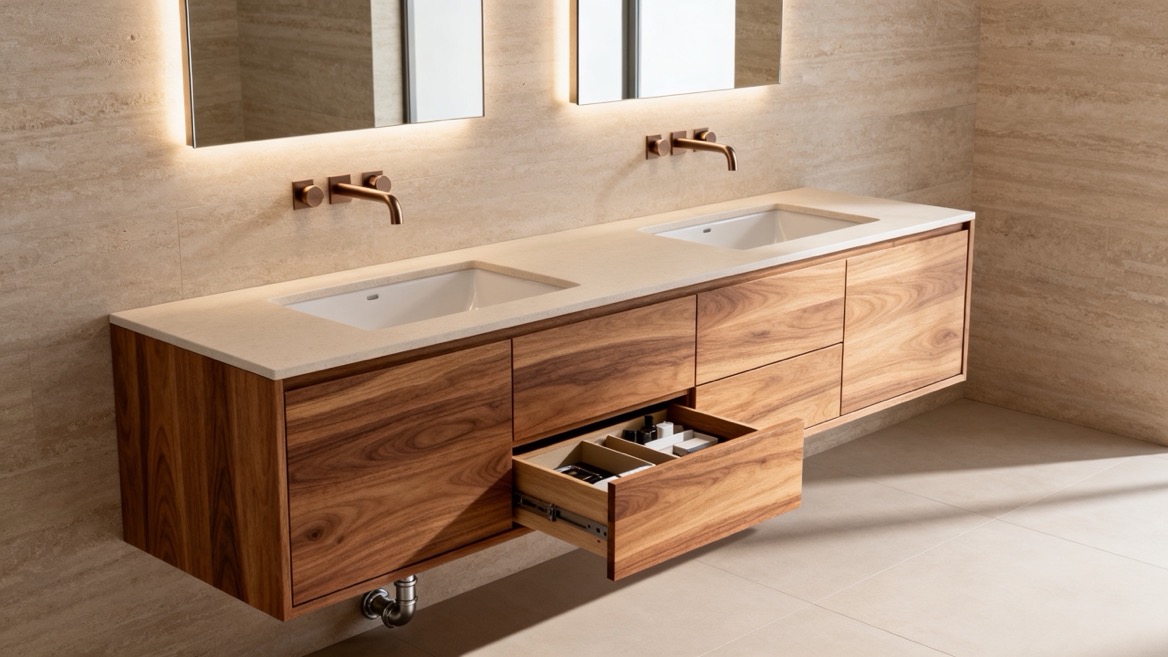
Material names provide a starting point, but they do not establish finished-product quality. Board grade, joint design, edge protection, coatings, and installation conditions all influence performance.
| Material | Potential advantages | What buyers should verify |
|---|---|---|
| Solid wood | Natural character and decorative flexibility | Species, moisture control, construction, and finish |
| Plywood | Layered construction and structural versatility | Grade, adhesive system, exposed edges, and coating |
| MDF | Smooth surface suitable for painted designs | Moisture-resistant grade, sealing, and intended exposure |
| Particleboard | Cost-effective panel construction | Grade, edge protection, fastening, and application limits |
Avoid assuming that every plywood cabinet is premium or that every MDF cabinet is unsuitable. Request the actual panel specification and evaluate the assembled product.
Moisture-resistant does not mean waterproof. A wood-based cabinet should not be expected to tolerate persistent leaks or standing water simply because its surface is coated.
Look beyond the visible door fronts. Check:
- Basin and faucet cutouts.
- Cabinet bottom edges.
- Plumbing penetrations.
- Back-panel joints.
- Drawer-front edges.
- Connections between the countertop and cabinet.
Ask how exposed cuts should be resealed during installation. A carefully finished cabinet can still become vulnerable if installers create unprotected openings.
The right bathroom vanity size depends on circulation, plumbing, storage access, and user comfort—not just available wall width.
Record the finished wall-to-wall dimensions, skirting details, door swing, supply connections, drain position, and countertop overhang.
Also establish whether published dimensions refer to the cabinet or the complete assembly. A projecting countertop can change the final installation footprint.
The National Kitchen & Bath Association recommends at least 30 inches of clear floor space in front of bathroom fixtures. Its planning guidance also identifies a 21-inch minimum associated with cited residential code provisions.
These figures are not interchangeable. One is a planning recommendation; the other reflects specified minimum provisions. Applicable local requirements and accessibility rules still need verification.
For compact bathrooms, reducing cabinet depth may improve circulation more effectively than reducing width. However, confirm basin compatibility and useful drawer depth before approving a shallow design.
Request an internal drawing showing:
- Drain and supply connection zones.
- Drawer travel and plumbing cutouts.
- Access to shutoff valves.
- Removable panels or service openings.
- Installation tolerances.
A double-sink bathroom vanity also needs coordinated basin spacing and usable counter space. Adding a second basin should not eliminate the storage or landing areas customers need.
A premium countertop should suit the customer's cleaning habits and the product's intended use.
Material selection involves trade-offs. Avoid describing any surface as universally stain-proof, scratch-proof, or maintenance-free.
| Countertop | Why buyers consider it | Important purchasing questions |
|---|---|---|
| Engineered quartz | Consistent decorative options and practical daily care | What cleaners, heat limits, and warranty exclusions apply? |
| Natural marble | Distinctive veining and natural variation | What sealing and acid-related precautions are required? |
| Solid surface | Integrated design possibilities and coordinated appearance | What finish, cleaning, and repair procedures are specified? |
| Ceramic basin and top | Familiar bathroom surface and practical configurations | What dimensional tolerances and support details apply? |
Natural marble requires a different care discussion from engineered surfaces. Acidic substances can etch susceptible stone, creating dull marks rather than ordinary surface stains.
Sealing should not be presented as protection against every type of damage. Buyers should obtain the stone supplier's specific maintenance instructions and communicate them clearly.
Check basin depth, faucet reach, overflow configuration, drain compatibility, and splash behavior.
A visually striking vessel basin may require different faucet positioning from an undermount basin. Integrated designs can simplify the appearance, but the actual product still needs correct drainage, cleaning access, and installation instructions.
External cabinet dimensions do not reveal how much practical storage a vanity provides.
Plumbing, drawer runners, structural rails, and basin depth can reduce usable space. Ask for internal dimensions rather than relying solely on product photography.
A useful layout may combine:
- Shallow drawers for grooming accessories.
- Taller compartments for upright bottles.
- Adjustable shelves for changing household needs.
- Removable organizers for cleaning.
- Accessible space for towels or spare toiletries.
Deep drawers are not automatically better. Without dividers, small items can become difficult to find.
For a shared bathroom, separate storage zones may offer more value than one oversized compartment.
My preferred evaluation method is simple: place representative items inside the sample. Check whether bottles stand upright, organizers clear the basin, and drawers remain accessible with plumbing installed.
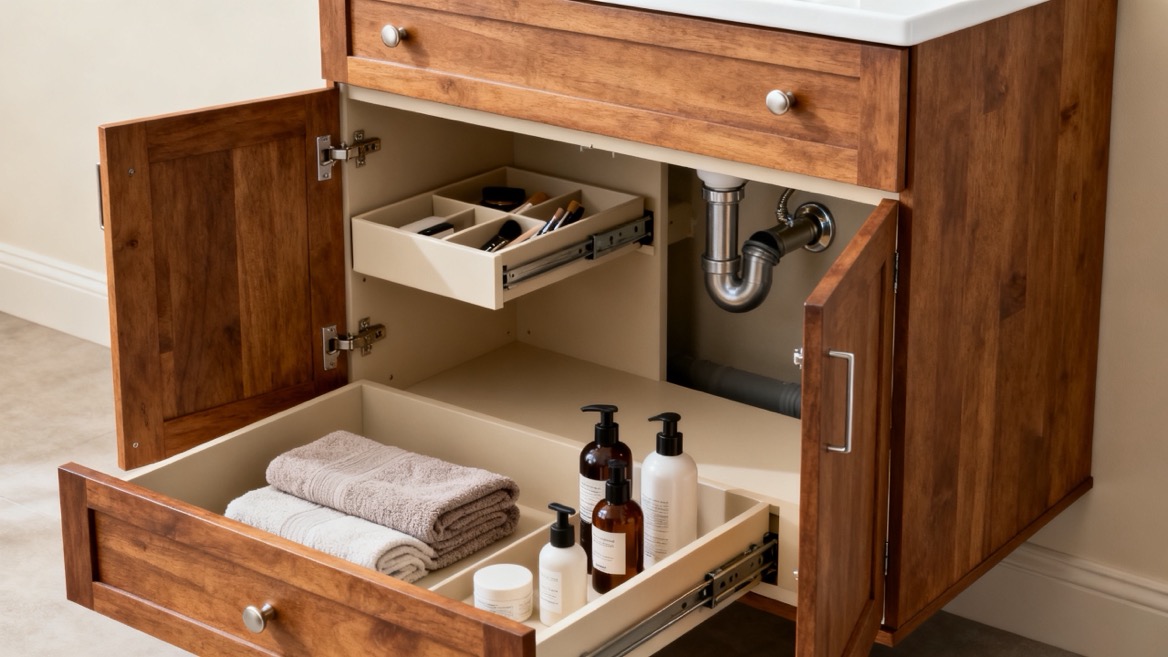
"Soft-close" describes a function, not a complete quality standard.
Two drawer systems may both close quietly when empty yet behave differently under load. Buyers should request the hardware model, rated capacity, adjustment options, and applicable test documentation.
During evaluation:
1. Load drawers within the hardware supplier's stated limits.
2. Open them through their full travel.
3. Check alignment and resistance to racking.
4. Confirm that soft-close engagement remains consistent.
5. Inspect access for adjustment and replacement.
Do not publish durability claims based only on a supplier's description of the mechanism.
Agree on an approved physical sample and inspection conditions.
Review color consistency, sheen, surface texture, edge coverage, and visible defects. Check darker finishes under angled light, where scratches or polishing marks may become more apparent.
For repeat orders, retain an approved reference sample. Screen images alone are not a reliable basis for production color approval.
A floating bathroom vanity creates an open visual effect and allows access beneath the cabinet. However, the installation depends on the wall construction, mounting system, and complete loaded assembly.
Buyers should request mounting details covering the cabinet, countertop, basin, stored contents, and foreseeable use.
Do not treat wall anchors as universally interchangeable. Fixings and reinforcement must suit the actual substrate and installation design.
A freestanding bathroom vanity also requires planning. Check leveling arrangements, plumbing access, wall attachment requirements, and the ability to clean around its base.
A premium product should remain serviceable after installation.
Ask whether drawers can be removed without dismantling the cabinet. Confirm that shutoff valves remain reachable and that replacement runners, hinges, handles, and mounting components can be identified.
These details rarely dominate showroom presentations, but they can strongly influence customer satisfaction.
For international buyers, a detailed product brief reduces ambiguity between design approval and production.
Jiaxing Miluo Smart Home Co., Ltd. focuses on customized modern, high-end bathroom products and solutions, providing OEM and ODM services for overseas brands, wholesalers, and manufacturers.
An effective brief should connect the desired appearance with measurable requirements.
| Specification area | Information to define |
|---|---|
| Target market | Destination, intended application, and applicable requirements |
| Dimensions | Cabinet, countertop, basin, tolerances, and plumbing zones |
| Construction | Panel types, thicknesses, joints, and edge treatment |
| Surface finish | Color reference, sheen, texture, and acceptance sample |
| Hardware | Model, capacity, adjustment, and replacement arrangements |
| Installation | Mounting method, substrate assumptions, and instructions |
| Packaging | Protection method, shipping route, and component identification |
| After-sales | Warranty scope, spare parts, and claim documentation |
For the United States, certain composite wood products and finished goods containing them fall under TSCA Title VI formaldehyde requirements.
Relevant materials include regulated hardwood plywood, MDF, and particleboard. Buyers should verify applicable certification, labeling, and recordkeeping requirements rather than accepting an unsupported "eco-friendly" description.
An emissions document does not establish moisture resistance, structural capacity, or complete product compliance. Each claim needs appropriate evidence.
A sample should answer practical questions before a bulk order is placed.
The following process is a recommended purchasing framework, not a claim about completed factory testing.
Compare the assembled sample with approved drawings. Check overall dimensions, basin position, countertop overhang, and installation clearances.
Inspect exposed edges, joints, cutouts, and plumbing openings. Agree on any relevant exposure tests, methods, and acceptance criteria before testing begins.
An informal splash demonstration is not proof of waterproof construction.
Install representative plumbing and storage items. Evaluate drawer access, faucet reach, cleaning access, and servicing.
Use agreed lighting and viewing conditions. Record approved color, sheen, visible gaps, and acceptable natural material variation.
Review assembly instructions, mounting information, care guidance, component labels, and protective packaging.
Record the approved configuration so later substitutions require explicit agreement.

A lower purchase price can lose its advantage if the product requires extra installation work, replacement components, or repeated customer support.
Compare quotations on the same basis:
- What is included in the assembly?
- Are countertop and basin supplied together?
- Which hardware model is specified?
- What packaging and documentation are included?
- Who supplies replacement parts?
- How are damage claims assessed?
A useful comparison considers product cost, freight, duties, installation, and an allowance for service or replacement exposure.
Avoid assigning invented failure rates. Use your own purchasing history where available, and identify uncertain assumptions separately.
The strongest bathroom vanity combines design appeal with a specification that installers, distributors, and end users can understand.
For your next OEM or ODM project, share your target market, drawings, preferred materials, finish references, quantity range, and intended delivery schedule with Jiaxing Miluo Smart Home Co., Ltd.
Request a coordinated development discussion covering cabinet construction, basin and countertop compatibility, storage layout, installation, packaging, and sample approval. A clear brief creates a stronger foundation for a differentiated bathroom collection.
Prioritize moisture-resistant construction, correct dimensions, practical storage, dependable hardware, countertop suitability, and installation access. Commercial buyers should also assess specification consistency, documentation, packaging, and replacement-part arrangements.
Neither material name guarantees a better finished cabinet. Compare the actual grade, construction, edge protection, finish, and exposure conditions. Moisture-resistant MDF can be considered for suitable applications, but it should not be treated as waterproof.
Not automatically. The wall construction, mounting system, plumbing position, and complete assembly load must be assessed. Where reinforcement is impractical, another configuration may be more appropriate.
Compare specific products rather than relying on broad material labels. Engineered quartz and solid surface are often considered for practical daily care, but both require manufacturer-specific precautions. Marble needs additional attention to acidic substances and care practices.
Request approved drawings, material specifications, hardware details, finish samples, installation information, packaging requirements, and relevant market documentation. Agree on sample acceptance criteria and substitution controls before production.
Resolve plumbing compatibility, mounting requirements, servicing access, care instructions, and spare-part identification during development. Keep records of the approved sample and provide installers with clear, product-specific documentation.
1. KingKonree, "What Are the Key Features to Look for in a Bathroom Vanity?" Original article reviewed as the starting point for restructuring. Its discussion covers materials, size, style, countertops, and storage; this rewrite adds procurement, verification, and serviceability considerations. [kingkonree]
2. National Kitchen & Bath Association, "Bathroom Planning Guidelines." Source for the distinction between the recommended 30-inch front clearance and the cited 21-inch minimum provisions. Local requirements must be checked independently. [media.nkba]
3. U.S. Environmental Protection Agency, "Formaldehyde Emission Standards for Composite Wood Products." Source for regulated composite wood categories and requirements affecting finished goods containing those materials. [epa]
4. U.S. Environmental Protection Agency, "Frequent Questions for Regulated Stakeholders About Implementing the Formaldehyde Standards for Composite Wood Products." Additional guidance on certification and stakeholder responsibilities. [epa]
5. Natural Stone Institute, "Learn About Cleaning Products for Natural Stone." Source for neutral-cleaner guidance and the risk of acidic products dulling or etching calcareous stone. [naturalstoneinstitute]
6. Corian, "Use & Care" and "Corian Solid Surface Care and Maintenance." Product-specific guidance supporting the need to distinguish routine care, finish-dependent maintenance, and chemical precautions. These instructions should not be generalized to every solid-surface brand. [corian]


