
Views: 210 Author: Miluo Smart Home Publish Time: 2026-10-06 Origin: Site


Content Menu
● What Is the Difference Between Pre-drilled and No-hole Basins?
>> Pre-drilled Basins: Faucet Openings in the Basin Itself
>> No-hole Basins: No Faucet Opening in the Basin
● Pre-drilled vs No-hole Basins: Comparison at a Glance
● Faucet Compatibility: The Most Important Technical Difference
>> Selecting Faucets for Pre-drilled Basins
>> Selecting Faucets for No-hole Basins
● Installation and Maintenance: Compare the Complete Arrangement
>> Pre-drilled Basins Support Defined Mounting Positions
>> No-hole Basins Require Earlier Coordination
>> Cleaning Claims Need Careful Wording
● Which Basin Configuration Fits Different Market Needs?
>> Overseas Brands: Build Coherent Bathroom Collections
>> Wholesalers: Prioritize Clear Specifications and Replacement Logic
>> Manufacturers: Coordinate Interfaces Across Components
>> Hospitality and Residential Projects: Specify for the Actual Setting
● Three Procurement Insights That Improve Product Decisions
>> 1. Compare Total Installed Cost, Not Basin Price Alone
>> 2. Keep Tap Holes, Overflows, and Drains Separate
>> 3. Do Not Confuse Tap-hole Configuration with Water Efficiency
● A Practical OEM and ODM Validation Workflow
>> Step 1: Define the Target Installation
>> Step 2: Freeze the Component Combination
>> Step 3: Review Drawings Before Sampling
>> Step 4: Test a Physical Assembly
>> Step 5: Approve Documents and Packaging
● Discuss Your Basin Configuration with Jiaxing Miluo
>> Are Pre-drilled Basins Better Than No-hole Basins?
>> Does a No-hole Basin Have No Drain Hole?
>> Can a No-hole Basin Use a Countertop-mounted Faucet?
>> Can One Faucet Fit Every Pre-drilled Basin?
>> Can Additional Holes Be Added After Delivery?
>> Which Configuration Is Better for OEM and ODM Orders?
Pre-drilled vs no-hole basins is more than a comparison of bathroom styles. For overseas brands, wholesalers, and manufacturers, the choice affects faucet compatibility, installation planning, inventory management, and the customer experience. A basin that looks right in a showroom can still create problems if its tap-hole configuration does not match the intended bathroom system.
At Jiaxing Miluo Smart Home Co., Ltd., our focus is customized modern bathroom products and solutions for OEM and ODM customers. From this product-development perspective, the most useful question is not which configuration is universally better. It is which configuration best supports your market, installation conditions, and product positioning.
The guiding principle is compatibility: select the basin, faucet, countertop, and drainage arrangement as one coordinated system.
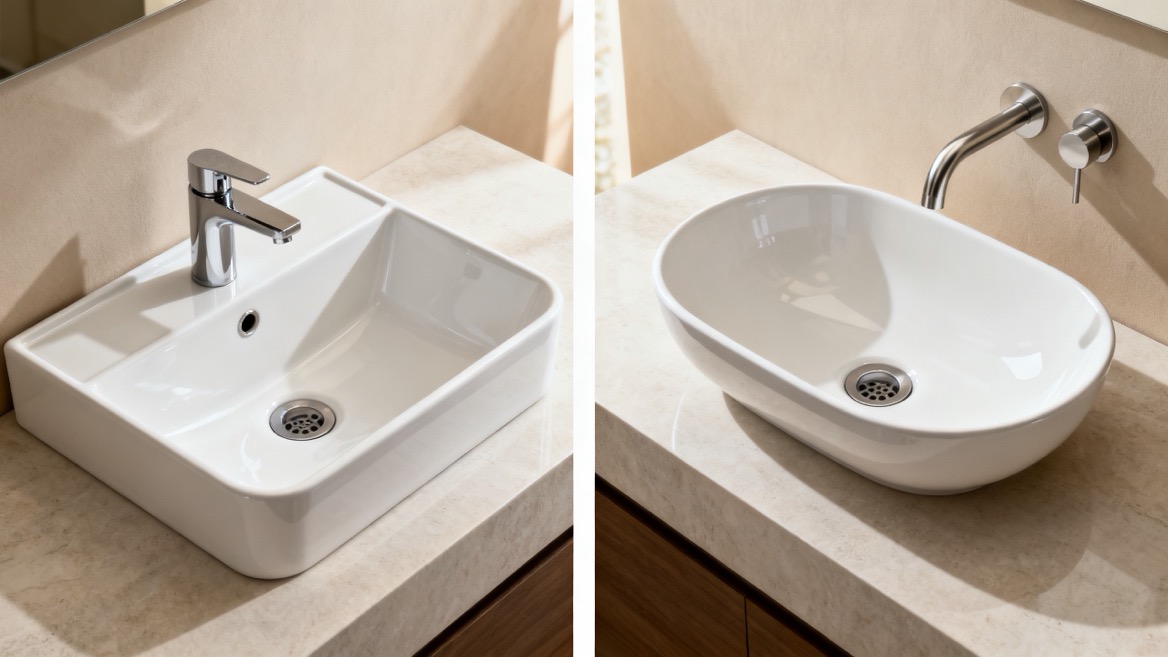
A pre-drilled basin has one or more factory-provided tap holes, usually positioned on a rear faucet deck. These openings establish where compatible faucet components can be mounted.
Common arrangements include:
- Single-hole configurations for compatible mixer faucets.
- Three-hole configurations for compatible centerset faucets.
- Three-hole configurations for separate widespread spouts and handles.
Hole count alone does not establish compatibility. Buyers must also check hole diameter, center-to-center spacing, mounting clearance, and the faucet manufacturer's requirements. Kohler's installation guidance specifically recommends measuring both hole diameter and spacing before selecting a faucet.
For product catalogs, describe the actual configuration rather than relying on "pre-drilled" as the complete specification.
A no-hole basin has no faucet mounting hole in its ceramic or other basin body. The faucet normally mounts separately, either through a suitable countertop or on the wall.
Importantly, "no-hole" refers to the tap-hole configuration. It does not mean that the basin lacks a drain opening, and it does not automatically indicate whether an overflow is present.
A no-hole basin may therefore suit several bathroom concepts, but the surrounding installation must provide a compatible faucet location.
The following table summarizes design and procurement considerations. These are selection principles, not universal price or performance rankings.
| Comparison factor | Pre-drilled basins | No-hole basins |
|---|---|---|
| Faucet location | On the basin's faucet deck | On the countertop or wall |
| Design flexibility | Constrained by the supplied hole arrangement | Greater freedom to position a separate faucet |
| Installation planning | Basin establishes the mounting position | Requires coordination beyond the basin |
| Replacement suitability | Useful when existing fittings match | Useful when separate faucet locations already exist |
| Visual character | Integrated basin-and-faucet arrangement | Uninterrupted basin surface |
| Procurement priority | Hole diameter, spacing, and deck clearance | Faucet reach, height, and mounting position |
| Inventory challenge | Matching variants to faucet configurations | Matching basin models to complete installation systems |
| Main risk | Ordering an incompatible faucet pattern | Leaving faucet placement unresolved |
| Suitable positioning | Coordinated collections and repeatable specifications | Design-led collections and customized layouts |
Neither format automatically represents a higher-quality product. Material quality, dimensional consistency, finishing, packaging, and system compatibility deserve separate evaluation.
Start with the faucet technical drawing, not its marketing image.
A single-hole mixer combines the spout and controls into one unit. A centerset faucet places its components on a shared base, while a widespread arrangement uses separate components. These distinctions affect the openings and mounting space required.
A practical specification should identify:
1. Number of tap holes.
2. Nominal hole diameter and permitted tolerance.
3. Center-to-center spacing where applicable.
4. Usable faucet-deck dimensions.
5. Clearance beneath the deck.
6. Compatible mounting hardware and deck thickness.
Avoid descriptions such as "fits standard faucets" without defining the relevant dimensions. What is familiar in one product range may not match another buyer's selected fitting.
For no-hole basins, faucet placement becomes part of the wider bathroom design.
A countertop-mounted faucet requires a suitable mounting opening outside the basin. A wall-mounted faucet requires coordinated wall connections and a compatible spout position. Kohler distinguishes wall-mounted faucets from basin-mounted installation styles, emphasizing that the fitting installs directly onto the wall.
Assess the relationship between:
- Spout outlet height and basin rim.
- Horizontal spout reach and bowl geometry.
- Water delivery angle and expected landing area.
- Handle movement and surrounding surfaces.
- Access for installation and future servicing.
Our recommended development approach is to approve the basin and intended faucet together. Independent approval of attractive components does not confirm that they work well as a pair.
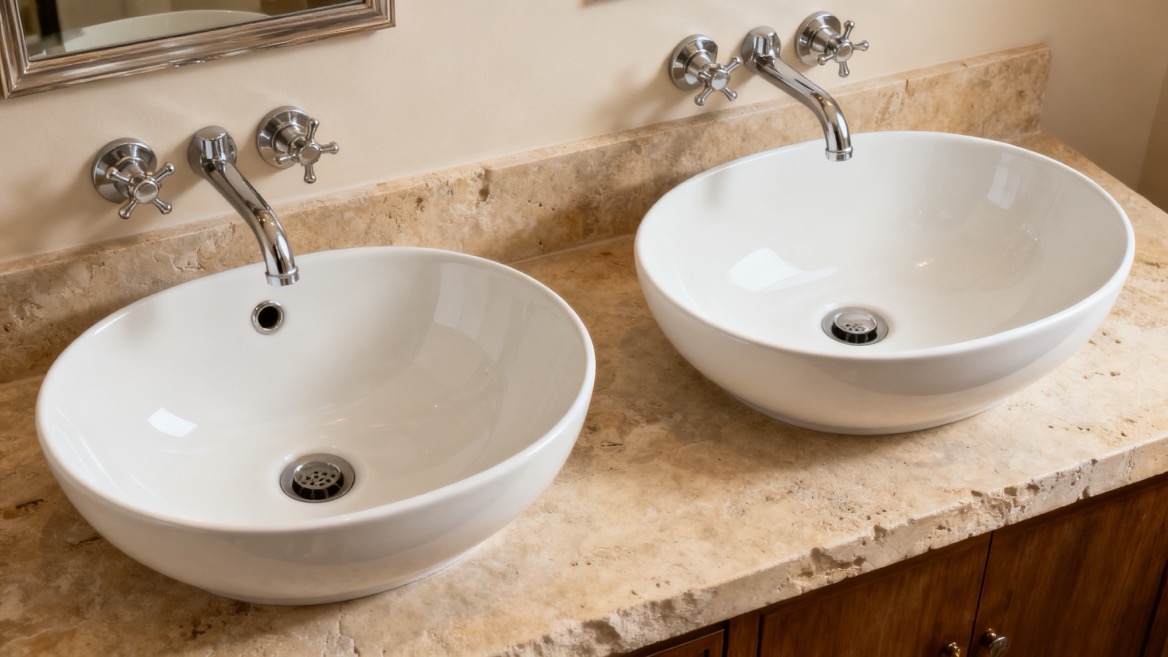
A factory-provided tap-hole arrangement reduces one design decision: the faucet position on the basin is already established.
This can support repeatable specifications for coordinated bathroom collections. However, installers still need to verify connections, access, sealing, drainage, and mounting instructions.
For replacement projects, the critical question is whether the new basin matches the intended faucet and surrounding installation. A similar appearance does not guarantee a like-for-like replacement.
No-hole basins transfer faucet-position decisions to the countertop or wall design.
For procurement teams, this means drawings should establish the installation arrangement before purchasing begins. Otherwise, the basin supplier, countertop fabricator, and plumbing installer may work from different assumptions.
Maintenance access should also be discussed during development. With a concealed wall-mounted fitting, for example, the service arrangement depends on the selected faucet system and wall construction—not on the absence of basin tap holes alone.
An uninterrupted basin surface may simplify wiping around the basin itself. Nevertheless, cleaning requirements remain elsewhere in the system: countertop-mounted fittings still have mounting bases, and wall-mounted fittings still have exposed surfaces.
Avoid claiming that no-hole basins are universally more hygienic. A stronger product description explains the actual surface layout, accessibility, and cleaning instructions without making unsupported health claims.
Brands benefit from a recognizable design language and clear product compatibility.
Pre-drilled basins can support collections built around a specified basin-mounted faucet. No-hole basins can support collections emphasizing independent faucet placement and uninterrupted ceramic forms.
The commercial opportunity is to offer understandable choices rather than unexplained variations. Product photography, technical drawings, and installation notes should show how each configuration belongs within the collection.
For wholesalers, an attractive product must also be easy to identify, recommend, and reorder.
A practical range might include a core pre-drilled collection and selected no-hole models. The right balance should follow actual customer inquiries, sales records, and installation requirements—not an assumed global preference.
Useful catalog filters include:
- Tap-hole count and spacing.
- Basin dimensions and mounting type.
- Overflow availability.
- Recommended faucet installation type.
- Compatible drain requirements.
These details help sales teams distinguish similar-looking products before an order reaches the installer.
Manufacturers incorporating basins into furniture or complete bathroom systems should focus on component interfaces.
Relevant checkpoints include countertop openings, cabinet clearances, basin support, faucet access, and drainage routing.
A no-hole basin may allow more faucet-position options, but those options still need engineering review. A pre-drilled basin defines the mounting position more closely, but its faucet deck must remain compatible with the chosen hardware.
A design-led hotel bathroom and a replacement-oriented residential range may have different priorities.
Rather than assigning one configuration to an entire sector, evaluate the specific project:
- Is concealed plumbing already planned?
- Must maintenance teams use a common replacement faucet?
- Are countertops standardized?
- Will identical combinations be repeated across many rooms?
- Are installation instructions available to local contractors?
These questions provide a stronger basis for selection than labels such as "luxury" or "economy."
Neither configuration is automatically cheaper.
Use this planning model:
Total installed cost = basin + faucet + countertop work + plumbing work + installation labor + project-specific access provisions.
For an existing installation, reusing compatible infrastructure may matter more than the basin's unit price. For a new project, coordinated design may change which arrangement is more practical.
Request quotations for complete configurations. Comparing an uninstalled pre-drilled basin with a fully specified no-hole system produces a misleading result.
A frequent specification mistake is treating these features as interchangeable.
They perform different functions:
- Tap holes provide mounting positions for faucet components.
- An overflow provides an additional drainage path when included.
- The waste outlet connects the basin to the drainage system.
Duravit explicitly distinguishes washbasins with and without overflows and recommends non-closable drain valves for its basins without overflow openings. Buyers should follow the selected basin manufacturer's instructions and applicable installation requirements.
Do not assume that a no-hole basin requires a particular drain simply because it has no faucet opening.
Water efficiency depends on the selected faucet and its operating characteristics, not whether the basin has tap holes.
For the U.S. market, EPA states that WaterSense-labeled bathroom faucets and accessories use a maximum of 1.5 gallons per minute, compared with the standard 2.2 gallons per minute, reducing flow by 30% or more. This is a faucet-related specification, not a basin certification.
Keep these claims separate in product literature. A compatible basin-and-faucet package can support a water-efficient bathroom concept, but the basin alone does not establish faucet performance.
Record the intended buyer, market, mounting arrangement, and project type.
Include applicable requirements for the complete system. Do not infer destination-market suitability from the basin's appearance or tap-hole count.
Identify the intended basin, faucet, drain, countertop, and supporting furniture.
For pre-drilled basins, confirm the hole configuration. For no-hole basins, document the separate faucet mounting position.
Check dimensions, tolerances, clearances, and installation access.
Drawings should distinguish nominal dimensions from acceptance limits. Any proposed customization should be confirmed against the chosen material and manufacturing process.
Assemble representative components and assess:
- Faucet installation and tightening access.
- Water delivery under the intended operating conditions.
- Splash behavior during realistic use.
- Drainage and connection sealing.
- Cleaning and maintenance access.
A sample review is a development checkpoint, not a substitute for required conformity assessment or product testing.
Finalize technical drawings, installation guidance, product descriptions, carton identification, and agreed inspection criteria.
Keep approvals traceable to the exact configuration. A changed faucet or countertop can require another compatibility review.
Send Jiaxing Miluo Smart Home Co., Ltd. your target market, basin dimensions, preferred faucet arrangement, overflow requirements, expected order volume, and branding brief.
Request a configuration review before finalizing your OEM or ODM order. The objective is a coordinated bathroom solution—not simply a basin that looks suitable in isolation.

Neither is universally better. Pre-drilled basins suit specified basin-mounted faucets. No-hole basins suit separately mounted faucets. Choose according to the complete installation and buyer requirements.
No. "No-hole" describes the absence of faucet mounting holes. The drain opening and any overflow provision are separate features.
Yes, when the countertop and faucet arrangement are suitable. Confirm mounting clearance, spout reach, basin geometry, and installation access before approval.
No. Hole diameter, count, spacing, deck dimensions, and mounting requirements must match. Kohler recommends checking hole dimensions and center spacing when selecting compatible fittings.
Do not assume so. Ask the basin manufacturer whether modification is permitted for that exact model and material. Unauthorized alteration may damage the product or affect the agreed warranty.
The better choice is the one that supports the intended product system. Pre-drilled designs prioritize defined faucet mounting; no-hole designs prioritize separate placement. Both require approved specifications and component validation.
1. Kohler. "How to Install a Bathroom Sink Faucet." Supports faucet installation categories, hole measurements, and compatibility checks. [kohler]
2. Duravit. "Sinks: High-quality Fittings, Modern Design." Supports distinctions involving faucet decks, mounting arrangements, overflows, and drain selection. [duravit]
3. U.S. Environmental Protection Agency. "Bathroom Faucets." Supports WaterSense flow-rate figures and independent certification requirements. [epa]
4. Pacific Northwest National Laboratory, Building America Solution Center. "Bathroom Faucets." Provides additional technical context on faucet flow testing and WaterSense performance criteria. [basc.pnnl]


