
Views: 230 Author: Miluo Smart Home Publish Time: 2026-09-03 Origin: Site


Content Menu
● The Short Answer: Mass Reduces the "Drum Effect"
● Stone Tub vs. Acrylic Tub During Water Filling
● How Water Creates Noise in a Bathtub
>> 3. Bathroom Reflection and Echo
● Why Stone Tubs Sound More Controlled
>> Higher Density Limits Vibration
>> Solid Construction Reduces Hollow Resonance
>> Mineral Fillers Help Dampen Energy
● Why Acrylic Tubs Can Sound Louder
>> Thin Shells Are More Likely to Resonance
>> Freestanding Design Makes Construction More Important
● A Practical Acoustic Test for Buyers
>> Step 1: Use the Same Faucet Condition
>> Step 2: Test an Empty Tub First
>> Step 3: Test at Shallow Water Depth
>> Step 4: Press the Sidewall Carefully
● The Quietest Bathtub Is Not Always the Best Choice
● Design Choices That Make Any Tub Quieter
>> Improve the Water Entry Point
>> Build a More Rigid Acrylic Structure
>> Avoid Installation-Related Rattles
● What Premium Buyers Should Request From a Supplier
● Expert Perspective: Sound Is Part of Luxury
● FAQ
>> 1. Are stone resin tubs always quieter than acrylic tubs?
>> 2. Why does an acrylic bathtub sound hollow when filling?
>> 3. Can an acrylic bathtub be made quieter?
>> 4. Does a heavier bathtub retain heat better?
>> 5. Is a stone bathtub suitable for upper-floor bathrooms?
>> 6. Do faucet type and water pressure affect bathtub filling noise?
>> 7. What should an OEM buyer test before approving a bathtub sample?
>> 8. Are stone resin bathtubs the same as natural stone bathtubs?
A quiet bath begins long before someone steps into the tub. When water first hits the basin, the bathtub itself either helps soften the sound or turns the filling process into a louder, hollow experience. Stone tubs are generally quieter than acrylic tubs during water filling because their dense, solid structure absorbs vibration more effectively and is less likely to resonate like a lightweight shell.
For overseas bathroom brands, wholesalers, developers, and private-label buyers, this difference is not merely a material specification. It directly affects perceived luxury, hotel-style comfort, product positioning, and the user's first sensory impression. In a premium bathroom, customers expect the sound of running water to feel controlled, deep, and relaxing—not sharp, echoing, or plastic-like.
At Jiaxing Miluo Smart Home Co., Ltd., we view bathtub acoustics as part of whole-bathroom product engineering. The most successful modern bathtub collections are not designed only for appearance. They balance visual form, material thickness, thermal performance, structural stability, drainage design, and acoustic comfort.
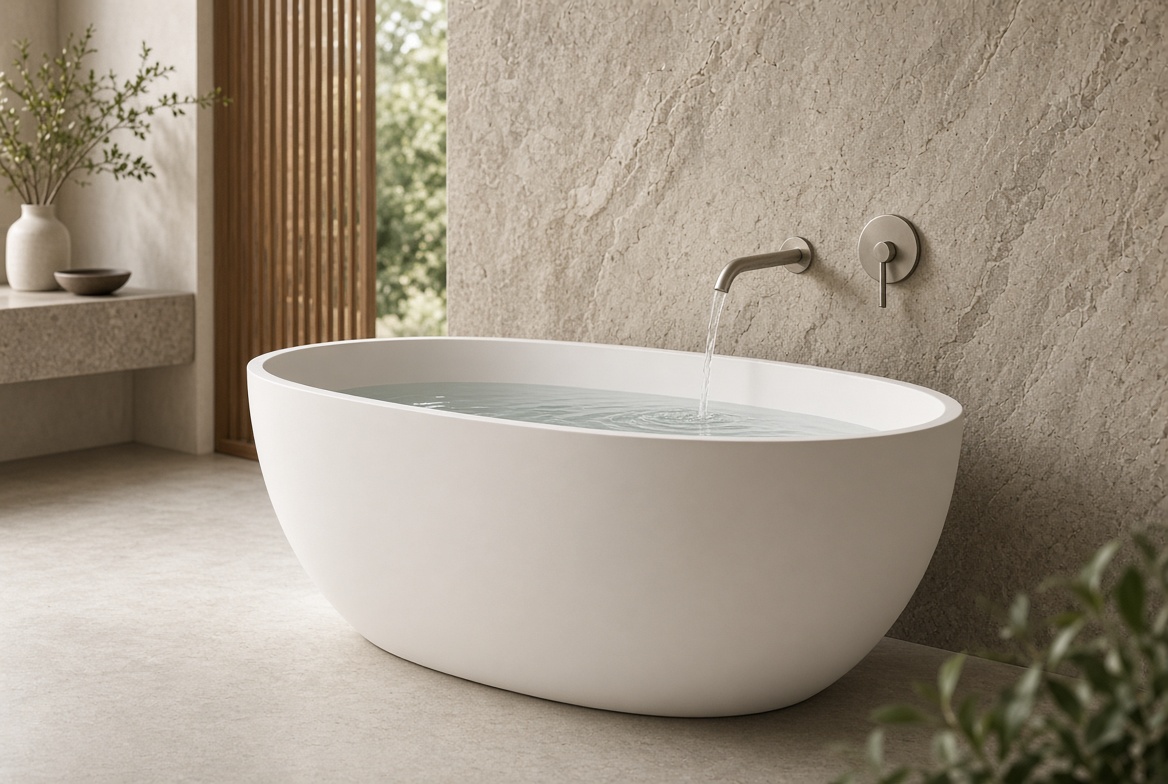
Stone tubs are quieter during water filling because they are usually made from a dense mineral-based composite or solid-surface material. Acrylic tubs are typically formed from acrylic sheets and reinforced with fiberglass or another backing material. Both can be high-quality products, but their physical behavior is different.
When water strikes a bathtub surface, it creates impact energy. That energy becomes:
- Audible splashing sound
- Vibration in the bathtub wall
- Resonance inside the tub cavity
- Reflected sound from surrounding bathroom surfaces
A stone resin bathtub has more mass and a more solid cross-section. It tends to resist vibration and dissipate some of the energy within the material. The result is a lower-pitched, more muted filling sound.
An acrylic bathtub has a lighter shell. If the shell is thin, poorly reinforced, or installed without adequate support, water impact can make the tub wall vibrate more easily. This may create the familiar hollow or drumming sound that some users associate with lightweight bathroom fixtures.
This does not mean every acrylic bathtub is noisy or every stone tub is silent. Design, wall thickness, reinforcement, installation method, faucet flow rate, and bathroom acoustics all matter. However, when comparing well-made products under similar conditions, a stone tub usually provides a calmer acoustic experience.
| Performance Factor | Stone Resin or Solid-Surface Tub | Acrylic Bathtub |
|---|---|---|
| Material structure | Dense, mineral-filled, solid or near-solid body | Thermoformed acrylic shell, usually reinforced |
| Water-filling sound | Lower-pitched and more muted | Can sound brighter, sharper, or more hollow |
| Vibration resistance | High due to greater mass and rigidity | Varies by shell thickness and reinforcement |
| Resonance | Lower tendency to act like a sounding board | Higher risk of shell resonance |
| Surface feel | Often matte, satin, or soft-touch | Usually glossy and smooth |
| Weight | Heavy | Light to medium weight |
| Installation demand | Requires verified floor loading and handling | Easier to move and install |
| Heat behavior | Strong thermal mass and stable temperature feel | Good insulation, but lower mass |
| Premium market position | Luxury residential, hospitality, design-led projects | Broad residential, value, and volume markets |
| Customization opportunity | Strong for sculptural forms and premium finishes | Strong for shapes, colors, and cost-efficient production |
The key point is not simply "stone versus acrylic." It is whether the bathtub shell has enough density, stiffness, thickness, and installation support to avoid unwanted vibration.
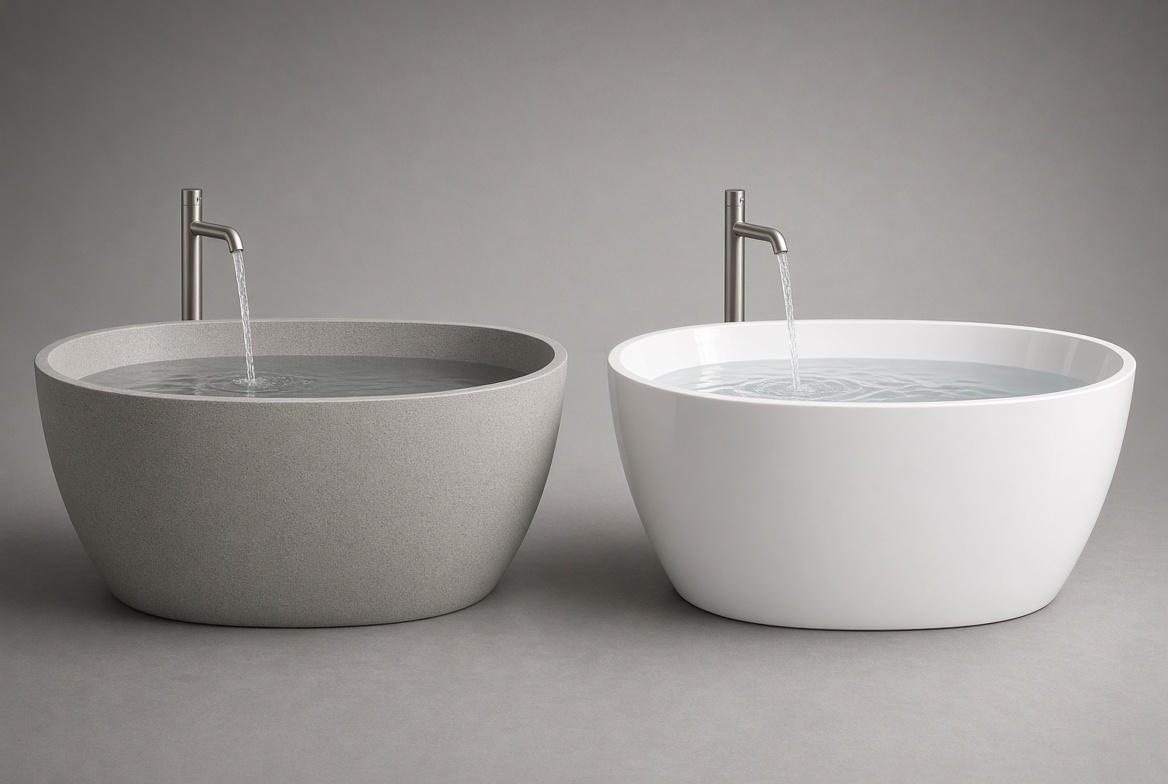
To understand why stone tubs are quieter, it helps to separate bathtub filling noise into three sources.
The first sound comes from water hitting the tub floor or sidewall. A high-flow waterfall faucet, wall-mounted spout, or exposed deck-mounted filler may create more impact than a lower-flow faucet with a controlled stream.
The sound changes depending on:
- Water flow rate
- Water drop height
- Faucet outlet shape
- Angle of the water stream
- Water depth already inside the tub
- Tub geometry and internal slope
When the tub is nearly empty, water hits a hard dry surface. This is often the loudest stage. As the water level rises, the water itself starts absorbing impact energy, and the sound becomes softer.
The tub body can vibrate after water impacts the surface. A lightweight bathtub wall behaves somewhat like a thin panel. If it is not sufficiently rigid or supported, it may amplify sound.
Acrylic has a relatively low density compared with mineral-filled solid-surface materials. Standard acrylic sheet data commonly lists a density around 1.19 g/cm³. The material can be durable and practical, but its lighter mass means the final bathtub construction depends heavily on shell thickness, fiberglass reinforcement, bottom support, and frame design.
By contrast, stone resin and similar mineral composite tubs use a blend of natural mineral content and polymer resin. The resulting material is heavier and more rigid, creating a less hollow acoustic response.
Even a quiet bathtub can sound loud in a highly reflective bathroom. Tile, glass shower screens, stone walls, porcelain surfaces, and large mirrors all reflect sound.
For example, a compact bathroom with full-height ceramic tile, a glass enclosure, and minimal textiles may make a normal bathtub fill sound much louder than the same tub in a larger room with curtains, wood cabinetry, towels, and softer finishes.
That is why premium projects should evaluate the complete bathroom sound environment, not the tub in isolation.
A stone resin bathtub has greater material mass than a typical acrylic shell. More mass makes it harder for the tub wall to move in response to water impact.
Think of tapping two objects:
- A thin plastic container often produces a light, hollow sound.
- A dense stone-like object produces a deeper, shorter sound.
The same principle applies during filling. The stone tub is less likely to "ring" or flex noticeably, so it produces less secondary noise from the shell itself.
Many stone resin tubs are formed as a solid, uniform body rather than a thin decorative shell over a large air cavity. This construction helps reduce the drum-like effect that can occur when a thin wall vibrates around an empty space.
Acrylic tubs can also be engineered with excellent reinforcement. However, in the lower-cost segment, insufficient backing layers, weak base structures, or inconsistent shell thickness may make the acoustic difference more obvious.
For a brand owner, this creates an important sourcing lesson: do not evaluate acrylic solely by appearance. A glossy acrylic tub can look premium in a catalog while producing a noticeably different sound and feel in real use.
Stone composite materials do not simply rely on weight. The interaction between mineral fillers and resin binders can help disperse vibration energy rather than allowing it to travel freely through a thin shell.
This is one reason stone resin products are often described as having a more "solid" feel. The benefit is both tactile and acoustic:
- Less perceived wall flex
- Less hollow sound when tapped
- More stable sound during filling
- More planted sensation when entering the tub
These qualities matter especially in freestanding tubs, where the bathtub is fully exposed and cannot rely on surrounding wall framing to conceal vibration.
Acrylic remains one of the most popular bathtub materials worldwide for good reasons. It is lightweight, versatile, warm to the touch, cost-efficient, and suitable for many shapes. The acoustic issue is not that acrylic is inherently poor. Rather, the final sound quality depends strongly on the engineering details.
A thin acrylic shell can vibrate when water strikes it. This vibration may be heard as a hollow or higher-pitched sound, especially before water accumulates in the basin.
The risk rises when the product has:
- Thin acrylic sheet thickness
- Limited fiberglass reinforcement
- Weak or incomplete bottom support
- A large unsupported sidewall
- An oversized body with a lightweight structure
- Poor bonding between shell and reinforcement layers
A well-engineered acrylic bathtub can reduce these issues through thicker sheets, multi-layer reinforcement, foam or resin backing, metal frames, and properly designed support feet.
A built-in acrylic bathtub can gain support from the surrounding deck, wall structure, mortar bed, or enclosure. A freestanding tub does not have those same structural advantages. Its body must perform independently.
For freestanding acrylic tubs, manufacturers should carefully control:
1. Acrylic sheet grade and thickness
2. Fiberglass or composite reinforcement coverage
3. Bottom-board strength
4. Steel frame or adjustable foot design
5. Drain-area reinforcement
6. Sidewall deflection tolerance
7. Packaging protection during export transport
These construction details influence not only filling noise, but also long-term shape stability, crack resistance, and customer satisfaction.
A buyer does not need an advanced laboratory to identify major differences between tub constructions. A structured comparison test can reveal useful information before placing a large OEM or ODM order.
Install or position both tubs under the same water outlet. Keep the faucet height, flow rate, water pressure, and stream angle consistent.
A high waterfall filler may exaggerate differences. For a fair comparison, test with both a normal bath spout and the intended project faucet.
Run water for 20 to 30 seconds into an empty tub. Listen for:
- Hollow resonance
- Panel vibration
- Sharp high-frequency splashing
- Noticeable rattling
- Sound changes when the stream hits different areas
This stage reveals the tub shell's behavior most clearly.
Repeat the test when the tub contains a shallow layer of water. This shows how quickly the sound becomes controlled as the water absorbs impact.
A stone tub often sounds more consistent between the empty and shallow-fill stages. A lighter acrylic shell may show a bigger change.
With the tub empty, apply gentle hand pressure to accessible sidewalls. Excessive flex can indicate a shell that may be more prone to vibration. This is not a substitute for formal quality testing, but it is a useful field check.
Use the same smartphone position for each recording. While a phone app is not a certified measurement instrument, it can help a sourcing team compare product samples under repeatable conditions.
For formal product development, factories and brand owners can conduct controlled sound-pressure testing in a defined acoustic environment. This is particularly valuable for hospitality projects, luxury developments, and brands that want to make measurable comfort claims.
Stone tubs offer clear acoustic advantages, but material selection should match the project's priorities. A quiet fill is important, yet it is only one part of the buying decision.
| Buyer Priority | Better Starting Option | Reason |
|---|---|---|
| Luxury freestanding centerpiece | Stone resin or solid surface | Quiet, substantial, premium appearance |
| High-volume residential supply | Reinforced acrylic | Competitive cost and easier logistics |
| Upper-floor renovation | Acrylic | Lower weight reduces handling complexity |
| Boutique hotel or spa | Stone resin | Elevated sensory experience and visual impact |
| OEM collection with many shapes | Acrylic or engineered stone | Depends on budget, molds, and finish requirements |
| Minimalist matte bathroom design | Stone resin | Strong match for modern architectural styling |
| Fast installation and transport efficiency | Acrylic | Easier handling and lower shipping weight |
A stone bathtub can be significantly heavier, which affects freight costs, warehouse handling, delivery planning, and floor-load verification. This is especially relevant for overseas shipments and renovation projects in multi-story buildings.
Acrylic may be the better commercial choice when a buyer needs a lightweight tub, cost control, easy installation, or broad mass-market appeal. The goal should not be to replace acrylic everywhere. The goal is to develop the right acoustic and structural specification for the intended market.
The material sets the baseline, but thoughtful design can improve water-filling comfort in both stone and acrylic tubs.
A faucet that releases water directly onto a steep sidewall may create more splash and noise than one aimed toward a gently sloped basin area.
Consider:
- Lower faucet outlet height
- Aerated or laminar flow options
- A water stream directed toward a curved interior surface
- A spout location that avoids a flat, exposed basin floor
- Flow-rate control that balances fast filling with comfort
For premium acrylic products, manufacturers can reduce acoustic weaknesses through:
- Thicker sanitary acrylic sheets
- Full or targeted fiberglass reinforcement
- High-density backing materials
- Stronger baseboards
- Reinforced drain zones
- Stable metal frames
- Better load distribution at adjustable feet
The strongest acrylic bathtub is not simply the one with the most reinforcement material. It is the one with consistent reinforcement in the right areas, especially on the base, rim, drain zone, and broad sidewalls.
A tub can be structurally sound but still create unwanted noise if it is installed incorrectly. Installers should verify:
- The floor is level
- Adjustable feet are fully supported
- The drainpipe is not contacting the shell
- The faucet piping is secured
- The tub is not touching rigid wall surfaces in a way that transfers vibration
- Any required expansion gaps are maintained
A common field problem is blaming the bathtub material when the actual issue is a loose drain assembly, unstable feet, or a pipe touching the tub body.
For brands sourcing high-end bathtubs, acoustics should be discussed during sampling rather than after production begins. Include the following requirements in the product development brief.
- Material composition and target product weight
- Acrylic sheet thickness or stone composite formulation
- Reinforcement specification and coverage area
- Baseboard and frame configuration
- Maximum acceptable sidewall flex
- Faucet position and recommended water-flow range
- Empty-tub filling sound comparison during sample approval
- Drain and overflow noise-control details
- Packaging method for long-distance transport
- Installation instructions for stable support and vibration control
For an ODM project, the most valuable approach is to create a product specification that connects appearance with real use conditions. A thin-wall bathtub may reduce material costs, but it can weaken the premium experience through extra flex, a hollow sound, and lower perceived durability.
In product development, buyers often focus first on dimensions, color, shape, and price. These are essential factors, but luxury is experienced through more than visual design.
A customer notices the bathtub's surface temperature. They notice how stable the tub feels when stepping in. They notice whether water filling sounds calm or disruptive. They notice whether the drain creates gurgling noise. These details create the difference between a product that looks premium online and one that feels premium every day.
Stone tubs are quieter because they make less of the water impact energy audible. Their dense, rigid construction helps reduce vibration and hollow resonance. Acrylic tubs can still deliver excellent performance, especially when engineered with thicker shells, robust reinforcement, and a stable installation system.
For bathroom brands and project buyers, the best decision is not based on a single material label. It should be based on target positioning, expected usage, installation conditions, logistics requirements, and the desired sensory experience.
Jiaxing Miluo Smart Home Co., Ltd. supports OEM and ODM bathtub development for international brands, wholesalers, and manufacturers seeking modern, high-end bathroom solutions. Whether the collection requires a sculptural stone resin freestanding tub or a reinforced acrylic design optimized for efficient shipping and installation, the development process should begin with the end user's complete experience—including the sound of the first flowing water.
In most comparable designs, yes. Stone resin tubs usually have greater mass and a more solid structure, which helps reduce vibration and hollow resonance. However, a heavily reinforced premium acrylic tub can be quieter than a poorly designed stone composite tub. Construction quality remains essential.
The sound usually comes from water impact causing the lightweight acrylic shell or reinforcement structure to vibrate. Large unsupported areas, thin walls, limited backing, and insufficient base support can make this effect more noticeable.
Yes. Manufacturers can use thicker acrylic sheets, improved fiberglass reinforcement, rigid bottom boards, stable support frames, foam backing, and better structural design. Installers can also reduce noise by preventing pipe contact, ensuring level support, and eliminating loose components.
Often, yes. Dense mineral-based materials generally have greater thermal mass, which can contribute to a stable temperature feel during bathing. Actual performance also depends on wall thickness, room temperature, water temperature, and the tub's surface construction.
It can be, but the building structure should be assessed first. Stone resin tubs weigh more than acrylic products, and the total installed load includes the tub, water, bather, fittings, and any supporting platform. Buyers should obtain product weight data and consult qualified project professionals where necessary.
Yes. Higher water pressure, greater drop height, and a direct stream striking a flat tub surface can increase splash and impact noise. A carefully positioned spout and controlled flow can make either a stone or acrylic bathtub quieter.
Test the empty-tub filling sound, shallow-water filling sound, sidewall rigidity, base stability, drain noise, overflow performance, faucet compatibility, surface finish, and packaging durability. Testing should reflect the intended installation and user environment.
Not necessarily. A natural stone bathtub is carved from real stone, while a stone resin or solid-surface bathtub is generally a manufactured composite that combines mineral content with resin binders. Stone resin can provide a similar substantial feel while allowing more consistent shapes, finishes, and production control.
1. [Allplastics — Acrylic Sheets Technical Data Sheet]
2. [K-Mac Plastics — Acrylic Material Technical Data]
3. [Corian Design — Solid Surface Documentation]
4. [Perimost — Stone Resin Bathtub Pros and Cons]
5. [Horow — Resin Bathtubs Guide: Materials, Benefits, Installation, and Care]
6. [Magnus Home Products — Acrylic vs. Resin Bathtubs]
7. [Hansel Stone — Best Bathtub Material: Durability and Luxury]


