
Views: 215 Author: Miluo Smart Home Publish Time: 2026-10-20 Origin: Site


Content Menu
● What Causes a Ring Around the Drain in Stone Basins?
>> Hard-Water Deposits and Soap Residue
>> Installation-Related Dark Halos
● Identify the Basin Material Before Choosing a Cleaner
>> Natural Marble, Limestone, and Travertine Basins
>> Granite and Other Siliceous Stone Basins
>> Engineered Stone and Mineral-Composite Basins
● How to Clean a Ring Around a Stone Basin Drain Safely
>> Step 1: Photograph and Inspect the Area
>> Step 3: Rinse and Dry Completely
>> Step 4: Escalate Only After Identifying the Problem
● Preventing Drain Rings Through Everyday Stone Basin Care
>> After Use
● OEM and ODM Design: Prevent the Problem Before Production
>> Evaluate Drainage With the Actual Drain Installed
>> Specify the Drain Interface Clearly
>> Test Staining Compatibility on Representative Samples
● A Practical Troubleshooting Workflow for Importers
● Does Sealing Prevent Rings Around Stone Basin Drains?
● Develop a Better Basin Specification With Jiaxing Miluo
>> Why does my stone basin have a white ring around the drain?
>> Can I use vinegar to remove limescale from a marble basin?
>> Why is there a dark halo around my basin drain?
>> Will sealing stop hard-water stains completely?
>> Should every stone basin be resealed once a year?
>> When should I contact a stone-restoration professional?
Avoiding the "ring around the drain" in stone basins starts with understanding what the ring actually is. A chalky white circle, a dark halo, and a dull patch may look similar at first, but they require different solutions. The cause could be hard-water deposits, soap residue, absorbed oils, installation materials, or damage to the stone's finish.
For homeowners, the priority is straightforward: keep the basin attractive without damaging it. For bathroom brands, wholesalers, and manufacturers, the challenge extends to material selection, drain compatibility, installation instructions, and after-sales care.
My guiding principle is diagnosis before treatment. A stronger cleaner is not necessarily a better cleaner. The most effective approach combines appropriate maintenance with a basin-and-drain assembly designed to minimize persistent wet areas.
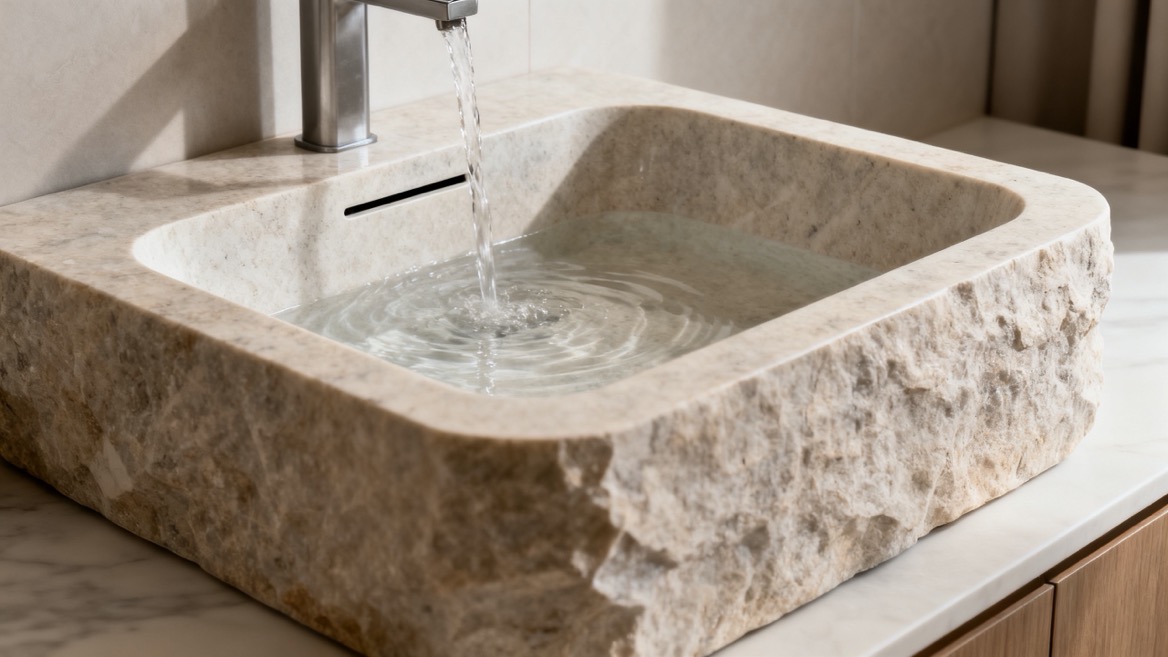
The drain area brings together water, soap, personal-care products, metal components, and sealing materials. When discoloration develops here, its appearance provides useful clues—not a definitive diagnosis.
| Appearance | Possible cause | Recommended first step |
|---|---|---|
| White, chalky circle | Hard-water mineral deposits | Check water hardness and approved cleaning options |
| Waxy or cloudy film | Soap or cleaning-product residue | Clean gently, rinse thoroughly, and dry |
| Dark halo around the flange | Retained moisture, oil, or incompatible putty | Observe after drying and review installation materials |
| Orange-brown discoloration | Iron-related staining or corrosion | Inspect the drain and seek material-specific advice |
| Dull patch without raised residue | Etching or finish damage | Stop aggressive cleaning and consult a restoration specialist |
Water hardness primarily reflects dissolved calcium and magnesium. As water evaporates, mineral residue can remain on bathroom surfaces. Soap and excessive cleaning-product residue can add another visible layer.
The U.S. Geological Survey classifies water hardness, expressed as calcium carbonate, as follows:
- Soft: 0–60 mg/L.
- Moderately hard: 61–120 mg/L.
- Hard: 121–180 mg/L.
- Very hard: above 180 mg/L.
These categories help buyers understand maintenance conditions. They do not predict exactly when a drain ring will appear, because usage, drying habits, and basin geometry also matter.
A dark ring that closely follows the drain flange deserves an installation check.
Regular oil-based plumber's putty can stain porous materials, including marble and granite. Depending on the assembly, the correct solution may be an approved stain-free putty, a specified silicone sealant, or a supplied gasket.
Do not assume that every product labeled "silicone" or "stain-free" suits every basin. Compatibility must cover the stone, surface treatment, drain components, and intended application.
Acid-sensitive stone can lose its finish when exposed to vinegar, lemon-based cleaners, or unsuitable descalers.
That dull area is not necessarily something sitting on the surface. It may represent a change to the surface itself. Repeated scrubbing will not restore removed polish and may make the affected area more noticeable.
"Stone basin" is a broad commercial description, not a complete material specification.
Before recommending a maintenance method, establish whether the product is natural stone, an engineered mineral composite, or another manufactured material. Confirm whether the visible surface is polished, honed, coated, or otherwise treated.
These stones commonly contain calcium carbonate, which is sensitive to acids.
For routine cleaning, use a manufacturer-approved neutral cleaner and a soft cloth. Avoid household vinegar, lemon juice, toilet cleaners, and general-purpose limescale removers unless the basin manufacturer explicitly approves the exact product.
A cleaner that removes mineral scale from ceramic may damage a calcareous stone basin.
Siliceous stones are generally more resistant to common household acids than calcareous stones. However, that does not make acidic cleaning a sensible default.
Mineral composition varies, and some stones contain acid-sensitive components. Sealers and drain finishes also introduce separate compatibility requirements.
Do not automatically apply natural-stone care instructions to an engineered product.
Request the manufacturer's written guidance for the exact formulation and finish. Confirm permitted cleaners, prohibited chemicals, repair methods, and whether sealing is required.
For international buyers, "stone-look" is an appearance description. It should never replace a material declaration.

Start with the least aggressive approved method. The objective is to remove residue without altering the basin finish or damaging the drain.
Record the ring before cleaning. Note whether it appeared immediately after installation or developed gradually.
Check for:
- Raised or gritty deposits.
- A greasy or waxy film.
- Persistent dampness.
- Discoloration concentrated beneath the flange.
- Reduced gloss without visible buildup.
These observations help distinguish a maintenance issue from a possible installation or restoration problem.
Apply a neutral stone cleaner approved for the basin. Follow its dilution and contact-time instructions.
Use a clean microfiber cloth. Avoid abrasive powders, rough pads, and improvised scraping tools.
More detergent is not better. Excess cleaner can leave a film that makes the basin look cloudy again.
Rinse away cleaning residue, then dry the bowl and the accessible drain perimeter with a soft cloth.
Observe the area after drying. A dark patch that lightens may involve moisture, but this observation alone does not establish the cause.
If residue remains, ask the basin supplier for a compatible treatment.
For suspected oil staining, a stone professional may recommend a suitable poultice. For etching, refinishing may be necessary. For suspected metal staining, both the stain and its source require attention.
Do not mix cleaning chemicals. In particular, bleach and ammonia must never be combined.
Daily prevention should be simple enough for users to maintain consistently.
Rinse away toothpaste, soap, and cosmetic residue. Wipe the bowl dry, paying particular attention to the area beside the drain flange.
Drying removes the water that would otherwise evaporate and leave residue behind.
Use an approved neutral cleaner, rinse thoroughly, and dry with a soft cloth.
Keep the drain accessible according to its instructions. Remove accumulated hair and debris without dragging tools across the stone.
Do not repeat increasingly aggressive cleaning.
Instead, review:
1. Local water hardness.
2. Whether water remains around the flange.
3. Cleaning-product concentration.
4. Sealant or putty compatibility.
5. Possible leakage or persistent moisture.
A recurring ring is useful diagnostic information. Treating the visible mark alone may leave its cause unchanged.
For brands sourcing custom stone basins, drain-ring prevention should enter the development brief—not just the care leaflet.
The following are proposed design-review checkpoints, not claims about a particular factory's existing test results.
A bare basin does not represent the finished installation.
Review samples using the proposed drain, gasket, sealing material, and mounting arrangement. A flange that stands proud of the surrounding surface may create a local retention area.
During evaluation:
- Install the basin in its intended orientation.
- Run water across the bowl.
- Observe where water remains after drainage.
- Photograph residual wet areas under consistent lighting.
- Compare alternative drain assemblies where necessary.
Define acceptable performance before approving samples. There is no universal drainage-time figure that should be invented for every material and design.
A useful purchasing specification should identify:
- Drain-hole dimensions and tolerances.
- Flange seating geometry.
- Compatible drain models.
- Overflow or non-overflow configuration.
- Approved sealing materials.
- Installation and tightening instructions.
The objective is coordination between components. A visually attractive basin and a premium drain can still perform poorly together if their interface is unsuitable.
Before approving installation materials, assess them on the actual stone and finish.
Include the intended putty or sealant, relevant cleaners, and representative personal-care products. Record exposure conditions, cleaning procedures, and observed changes.
Accelerated screening can identify potential incompatibilities. It should not be presented as proof of unlimited service life or complete stain resistance.
Consider a hypothetical complaint: a customer reports a dark ring shortly after installing a pale natural-stone basin.
The wrong response is to send a generic descaler recommendation.
A more useful investigation follows three stages:
1. Establish timing. Did the ring appear before normal use, immediately after installation, or months later?
2. Identify materials. Obtain the basin specification, drain model, putty or sealant name, and installation photographs.
3. Compare observations. Does gentle cleaning change the mark? Does drying lighten it? Is discoloration concentrated at the flange?
An early ring following the drain outline makes installation materials worth investigating. A gradual chalky buildup in a hard-water location points toward a different maintenance pathway.
Neither pattern proves the cause. This workflow narrows the investigation without exposing the customer's basin to unnecessary chemical treatment.
Sealing may improve stain resistance in suitable natural stone, but it is not a complete prevention system.
Many stone sealers are impregnating treatments that act as repellents. They do not make the surface stain-proof, stop minerals from accumulating on top, or repair poor drainage.
Not every stone requires sealing. Engineered or coated products may have entirely different requirements.
Ask the supplier to specify:
- Whether sealing is needed.
- Which treatment is compatible.
- How application readiness is assessed.
- What curing conditions apply.
- How maintenance or reapplication needs are determined.
Avoid promising a universal annual resealing schedule. Material, treatment, and service conditions differ.
For overseas brands, wholesalers, and manufacturers, a premium bathroom product should combine appearance with clear installation and maintenance requirements.
Jiaxing Miluo Smart Home Co., Ltd. provides customized modern bathroom products and OEM/ODM services. A productive development brief should therefore address not only basin dimensions and styling, but also the drain interface, material identity, finish, and intended market conditions.
Send Jiaxing Miluo your drawings, target market, preferred material, drain specifications, and care requirements. Request a coordinated sample-review plan covering drainage, installation-material compatibility, and customer instructions before finalizing the production specification.

A white ring may be hard-water mineral buildup or soap residue. Begin with approved neutral cleaning, thorough rinsing, and drying. Persistent deposits require a treatment compatible with the exact basin material.
No. Vinegar can etch marble and other calcareous stones. Ask the manufacturer for an approved treatment rather than using a general household descaling recipe.
Possible causes include retained moisture, oils, or incompatible installation materials. Regular oil-based plumber's putty can stain porous stone. Review installation details before selecting a stain-removal method.
No. Suitable sealing can improve resistance to absorbed stains, but mineral deposits can still accumulate on the surface. Rinsing, drying, and appropriate drainage remain important.
No. Some stones do not require sealing, and maintenance intervals vary. Follow guidance for the specific stone, finish, and treatment rather than applying a fixed calendar rule.
Seek professional advice when the area remains discolored after gentle cleaning, shows etching, develops suspected metal staining, or repeatedly stays damp. Avoid further aggressive treatment while the cause remains uncertain.
1. Natural Stone Institute — "Care & Cleaning of Natural Stone." Supports material identification, neutral cleaning, acid sensitivity, stain diagnosis, sealing limitations, and professional restoration guidance. [naturalstoneinstitute]
2. U.S. Geological Survey — "Hardness of Water." Supports the definition of water hardness, calcium and magnesium content, hardness classifications, and mineral-buildup context. [usgs]
3. Oatey — "Plumber's Putty: What It Is, How to Use It and When Not to Use It." Supports warnings about oil-based putty staining porous materials and the need for assembly-specific compatibility checks. [oatey]
4. Use Natural Stone — "5 Common Mistakes to Avoid When Cleaning Your Natural Stone Surfaces." Provides additional industry guidance on unsuitable acids, abrasive cleaning, and specialist intervention. [usenaturalstone]


