
Views: 243 Author: Miluo Smart Home Publish Time: 2026-10-18 Origin: Site


Content Menu
● Why Bathroom Vanity Durability Depends on More Than Water Resistance
● Best Bathroom Vanity Countertop Materials for Humid Bathrooms
>> Porcelain: Low Water Absorption With Fabrication Considerations
>> Engineered Quartz: Low Maintenance and Consistent Appearance
>> Solid Surface: Integrated Design and Repairability
>> Granite and Marble: Distinguish Durability From Maintenance
● Bathroom Vanity Cabinet Materials: What Should Buyers Specify?
>> Plywood: Evaluate the Grade, Bond, and Finished Protection
>> Moisture-Resistant MDF: Suitable Conditions Still Matter
>> Alternative Cabinet Materials: Verify the Complete Assembly
● Bathroom Vanity Material Comparison for B2B Buyers
● Five Construction Details That Can Make or Break a Vanity
>> 1. Edge Sealing and Plumbing Openings
>> 2. Basin, Countertop, and Wall Junctions
>> 4. Wall Mounting and Load Support
● How to Validate a Custom Vanity Before Bulk Production
● Match the Material Specification to the End Market
>> Premium Residential Collections
>> Hospitality and Multi-Unit Projects
>> Humid or Poorly Ventilated Bathrooms
● Plan Your Custom Bathroom Vanity With Jiaxing Miluo Smart Home
>> What is the best bathroom vanity material for high humidity?
>> Is moisture-resistant MDF waterproof?
>> Is plywood automatically better than MDF for bathroom cabinets?
>> Does a quartz vanity countertop need sealing?
>> Can marble work in a frequently used bathroom?
>> Can a bathroom vanity be completely waterproof?
The most durable bathroom vanity materials for high-moisture areas combine a water-resistant countertop with a properly protected cabinet structure. Porcelain, engineered quartz, and solid surface are strong countertop options. For the cabinet underneath, the substrate, sealed edges, hardware, and installation details deserve equal attention.
For overseas brands, wholesalers, and manufacturers, this distinction matters. A beautiful countertop cannot prevent an exposed cabinet edge from swelling after a plumbing leak.
My recommendation is to evaluate the vanity as a system, not simply as a collection of attractive materials. This guide explains how to compare surfaces, specify cabinet construction, and assess custom bathroom vanities before committing to production.

Bathroom furniture faces several different moisture conditions:
- Humid air after showers.
- Repeated splashes around the basin.
- Condensation near cold plumbing.
- Standing water from leaks or wet cleaning.
These conditions are not interchangeable. A material suitable for humid interiors may still fail under prolonged direct water contact.
"Moisture-resistant" also does not mean "waterproof." The first describes improved tolerance under specified conditions. The second requires a clearly defined exposure claim and supporting evidence.
For purchasing teams, the better question is: What happens when water reaches the weakest part of the finished vanity?
That weak point may be a pipe opening, an unsealed underside, or a joint hidden behind the basin.
Porcelain is a strong option for bathroom vanity countertops because of its low water absorption and easy-clean surface.
For porcelain tile, the established classification requires water absorption of 0.5% or less under the relevant test method. However, buyers should verify the actual countertop product's technical data rather than treating a tile classification as certification for every porcelain slab or basin.
Porcelain's limitations are mainly practical. Exposed edges can chip under impact, and cutouts require appropriate fabrication and support.
For custom projects, confirm:
- Edge profiles and vulnerable corners.
- Support around basin openings.
- Transport protection.
- Installation and repair instructions.
Ceramic and porcelain should not automatically be treated as identical. Glazing, body composition, and product specifications affect performance.
Engineered quartz offers a useful combination of moisture resistance, design consistency, and straightforward maintenance.
Many established quartz products are nonporous and do not require sealing. This makes them attractive for collections where customers expect a stone-like appearance without routine resealing.
However, quartz is not immune to damage. Direct heat from styling tools, aggressive chemicals, and impact at exposed edges remain concerns.
Ask the surface supplier for product-specific care instructions. Also confirm whether the selected pattern is available consistently across repeat orders.
For branded collections, replacement availability can matter as much as the appearance of the first sample.
Solid surface is particularly useful when the design calls for an integrated basin, coordinated backsplash, or visually continuous countertop.
Established solid surface products are nonporous. Some can also be refinished or repaired, making them appealing where maintainability matters.
The trade-off is scratch and heat sensitivity. Dark colors and certain finishes may show everyday wear more readily.
Do not assume every acrylic or polyester formulation performs identically. Request technical information for the exact material and finish.
For hospitality or multi-unit projects, ask whether local technicians can perform repairs. Repairability has limited value if the necessary service is unavailable in the destination market.
Granite and marble can support premium bathroom designs, but they require a more specific maintenance discussion.
Granite's absorption varies. Some products benefit from an impregnating sealer, while others may need little additional treatment. Follow the stone supplier's assessment rather than imposing one universal resealing schedule.
Marble introduces another issue: acid sensitivity. Acidic cleaners can etch its surface, and sealing does not eliminate that chemical reaction.
Choose marble when its natural character justifies the maintenance requirements. It is less suitable when the purchasing priority is minimal care across many installations.
Plywood can be a practical cabinet substrate, but "plywood vanity" is not a complete specification.
Buyers should identify panel construction, adhesive bond classification, thickness, finishing, and protection around machined openings.
An exterior bond classification describes adhesive performance under moisture exposure. It does not make the wood itself immune to decay.
Likewise, "marine-grade" should not be interpreted as permission to leave a vanity wet indefinitely.
For high-moisture applications, inspect the entire cabinet, including:
- Bottom panels and rear edges.
- Plumbing cutouts.
- Fastener penetrations.
- Concealed joints.
- Surfaces finished after machining.
A protected panel can become vulnerable when installers create new openings without resealing them.
Moisture-resistant MDF can support smooth painted finishes and detailed door profiles in appropriately designed bathroom furniture.
However, it remains a wood-based panel. Manufacturers explicitly distinguish humid-interior suitability from waterproof performance.
Specify the exact board grade rather than accepting "green board" as sufficient identification. Color alone does not establish performance.
All faces and edges need an appropriate finishing system. Cut edges deserve particular attention because they can absorb moisture more readily than panel faces.
For locations with predictable standing water or repeated direct spray, request a construction specifically validated for that exposure rather than relying on a moisture-resistant label.
Polymer-based panels and metal constructions may be considered when reducing reliance on absorbent wood-based components is a priority.
Nevertheless, material names alone do not establish overall durability.
Request evidence covering fastener retention, structural loading, finish adhesion, dimensional stability, and hardware compatibility. Where metal is used, include corrosion protection and cleaning compatibility in the discussion.
The objective is not to replace one unverified marketing claim with another. It is to match documented assembly performance to the intended bathroom environment.
The following table is a selection guide, not a universal performance ranking.
| Material | Typical application | Main advantage | Key limitation or purchasing check |
|---|---|---|---|
| Porcelain | Countertop or basin | Low water absorption | Verify product data, edge protection, and support |
| Engineered quartz | Countertop | Low-maintenance surface | Check heat precautions and chemical compatibility |
| Solid surface | Countertop and integrated basin | Design flexibility and potential repairability | Confirm formulation, finish, and repair guidance |
| Granite | Countertop | Natural appearance and durable surface | Assess absorption and sealing requirements |
| Marble | Premium countertop | Distinctive natural veining | Explain acid etching and maintenance |
| Specified plywood | Cabinet structure | Flexible construction options | Verify panel grade and protect exposed wood |
| Moisture-resistant MDF | Finished doors or cabinet components | Smooth painted appearance | Avoid prolonged wetting; seal every surface |
Select the countertop and cabinet independently, then assess how they connect. A strong specification needs both material suitability and reliable joint detailing.
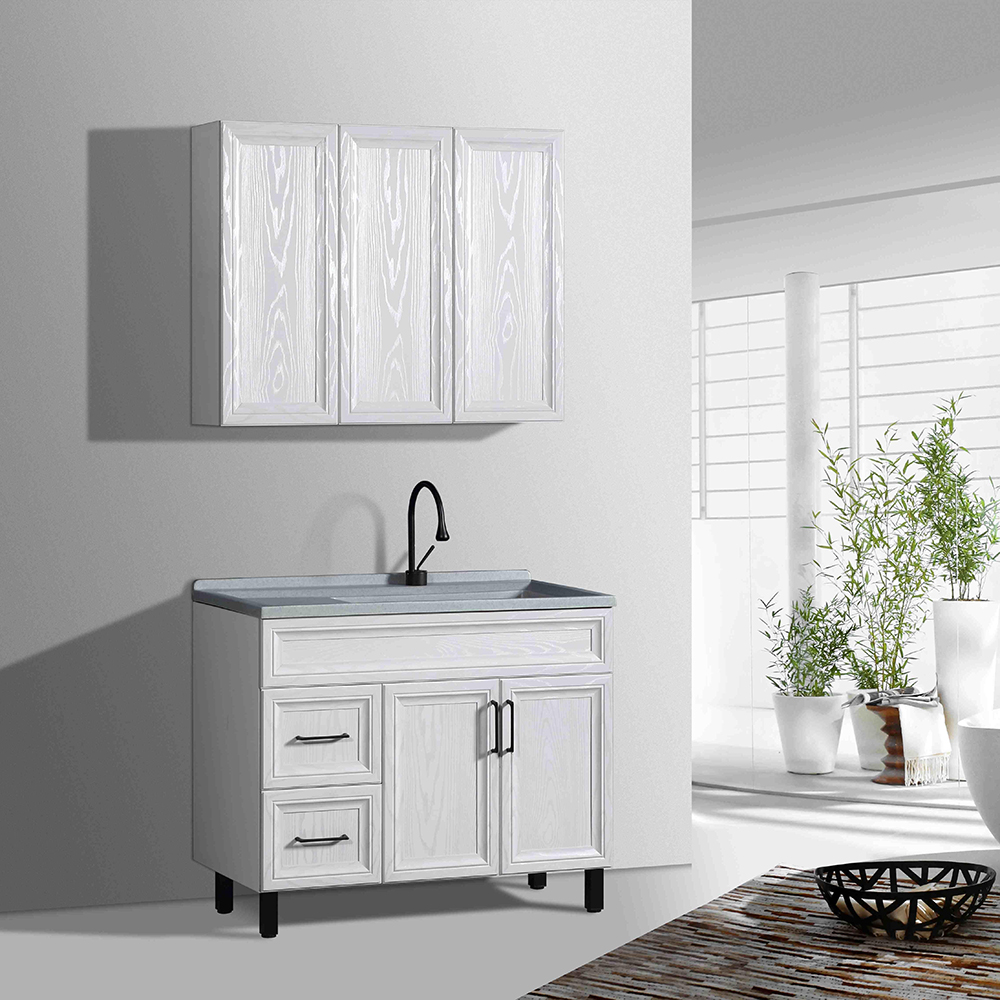
Inspect machined edges, not just visible exterior surfaces. Pipe cutouts and cabinet undersides should receive the specified protection.
Ask whether finishing occurs before or after machining and how newly exposed material is treated.
These interfaces need compatible sealants, suitable joint design, and accessible maintenance.
An integrated basin can reduce certain joints, but it does not eliminate drain connections or wall junctions.
Hinges, drawer slides, brackets, and fasteners should match the expected environment.
If corrosion testing is supplied, check the test method, duration, acceptance criteria, and actual component tested. A test report is not automatically a service-life guarantee.
A floating vanity still needs appropriate structural support.
Heavy countertops, stored contents, and everyday use all affect loading. Confirm the bracket arrangement and wall-fixing requirements before production.
Plumbing should remain accessible without damaging the cabinet.
Removable components and practical access openings make inspections and repairs easier. They also help installers identify leaks before hidden moisture damage spreads.
A polished sample proves appearance. It does not necessarily prove moisture durability.
For OEM and ODM purchasing, use a documented validation process:
1. Define the exposure. Describe normal humidity, expected splashing, cleaning practices, and foreseeable leak risks.
2. Approve the specification. Record substrate grades, finishes, edge treatments, hardware, and installation requirements.
3. Examine a finished assembly. Include the basin, countertop, cabinet, fittings, and plumbing openings.
4. Agree on testing. Use suitable methods, documented conditions, and measurable acceptance criteria.
5. Record changes. Check swelling, peeling, joint opening, discoloration, and drawer operation.
6. Control production consistency. Confirm that bulk materials and processes match the approved sample.
A factory splash demonstration can reveal obvious weaknesses, but it should not be presented as equivalent to a standardized laboratory assessment.
Photographs, measurements, and retained samples make the approval process easier to review later.
Prioritize the intended finish, daily usability, and care expectations.
Quartz or solid surface may suit buyers seeking easier maintenance. Marble can suit customers who accept its care requirements in exchange for natural variation.
Prioritize repeatability, cleaning compatibility, service access, and replacement planning.
Evaluate the cleaners actually used by the operator. Confirm whether damaged doors, drawers, or countertops can be replaced individually rather than requiring a complete new vanity.
Material selection cannot compensate for persistent moisture problems.
Indoor moisture guidance recommends keeping relative humidity below 60%, ideally between 30% and 50% where practical. Showering can temporarily raise humidity, so effective extraction and drying remain important.
Treat this guidance as an environmental management target, not as a guarantee that a particular cabinet will resist damage.
Jiaxing Miluo Smart Home Co., Ltd. focuses on customized modern, high-end bathroom products and solutions, with OEM and ODM services for overseas brands, wholesalers, and manufacturers.
For a productive project discussion, prepare your target market, drawings, dimensions, preferred finishes, countertop requirements, expected exposure conditions, and order quantities.
Ask for a coordinated specification covering the cabinet, basin, countertop, hardware, packaging, and installation information. Product availability and performance claims should be confirmed for the proposed configuration.
Share your project brief with Jiaxing Miluo Smart Home to discuss material combinations, customization priorities, and sample evaluation before bulk purchasing.

There is no single best material for every component. Porcelain, quartz, and solid surface are useful countertop options. Cabinet durability depends on the specified substrate, finishing, sealed openings, and overall construction.
No. Moisture-resistant MDF is intended for specified humid-interior conditions, not prolonged soaking. It needs appropriate sealing and finishing, and direct wetting should be avoided.
No automatic ranking applies to every product. Compare actual panel grades, construction, coatings, exposure conditions, and finished-assembly performance. A material label alone does not establish durability.
Many established engineered quartz products do not require sealing. Follow the selected manufacturer's instructions because product formulations, finishes, and maintenance requirements can differ.
Yes, provided the owner accepts its care requirements. Use suitable cleaners, address spills promptly, and understand that sealing improves stain resistance but does not prevent acid etching.
A claim about a waterproof panel does not establish that the complete vanity is waterproof. Ask what exposure the claim covers and whether testing includes joints, hardware, openings, and the assembled product.
1. KingKonree. "What Are the Most Durable Bathroom Vanity Materials for High-Moisture Areas?" Published May 24, 2025. Original article reviewed for its material categories and content gaps; not used as evidence of Jiaxing Miluo's capabilities. [Read the original article]. [kingkonree]
2. U.S. Environmental Protection Agency. "A Brief Guide to Mold, Moisture and Your Home." Supports the discussion of ventilation, moisture control, and recommended indoor relative humidity. [Read the guidance]. [epa]
3. Tile Council of North America. "Porcelain vs. Non-Porcelain." Explains the porcelain tile classification of water absorption at or below 0.5%, measured using ASTM C373. This classification is not presented as certification of an unspecified countertop product. [Read the technical explanation]. [tcnatile]
4. Caesarstone. "Caesarstone Technical Data Manual." Supports the discussion of its engineered quartz products, nonporosity, sealing requirements, cleaning, and heat precautions. Product-specific information should not be assumed to cover every quartz formulation. [Read the technical manual]. [caesarstoneus]
5. Corian. "Corian Solid Surface Care and Maintenance." Supports the discussion of nonporosity, repairability, scratch removal, and precautions against direct heat. These characteristics must be checked for other solid surface products. [Read the care document]. [corian]
6. Natural Stone Institute. "Sealing Natural Stone Countertops." Explains how sealers can reduce moisture migration and improve stain resistance, while recognizing variation among stone products. [Read the sealing guidance]. [naturalstoneinstitute]
7. Natural Stone Institute. "Natural Stone Care & Cleaning." Supports the distinction between staining and acid etching and the recommendation to use suitable non-acidic cleaners on marble. [Read the care guidance]. [naturalstoneinstitute]
8. APA — The Engineered Wood Association. "Plywood." Explains that bond classification concerns adhesive moisture resistance and does not establish fungal decay resistance. [Read the plywood guidance]. [apawood]
9. MEDITE SMARTPLY. "FAQs — MEDITE MR." Confirms that moisture-resistant MDF is not waterproof, is intended for humid interior conditions, and should be fully sealed and coated. [Read the manufacturer's guidance]. [mdfosb]


