
Views: 264 Author: Miluo Smart Home Publish Time: 2026-10-17 Origin: Site


Content Menu
● Why Light-colored Stone Basins Need Particular Attention
>> Staining, Etching, and Deposits Are Different Problems
● What Is Nano-Coating for Stone Basins?
>> Water Repellency Is Not Oil Repellency
● How Nano-Coating Can Improve Everyday Basin Performance
>> Better Preservation of the Intended Appearance
● First Identify the Basin Material
>> Natural Marble, Limestone, and Travertine
>> Granite and Other Siliceous Stones
>> Engineered Stone and Solid-Surface Composites
● Nano-Coating vs. Conventional Stone Sealer
● What Research Demonstrates—and What It Does Not
● A Practical Validation Plan for OEM and ODM Buyers
>> Step 1: Compare Matched Samples
>> Step 2: Test Relevant Bathroom Contaminants
>> Step 3: Evaluate Appearance After Cleaning
>> Step 4: Repeat After Cleaning Cycles
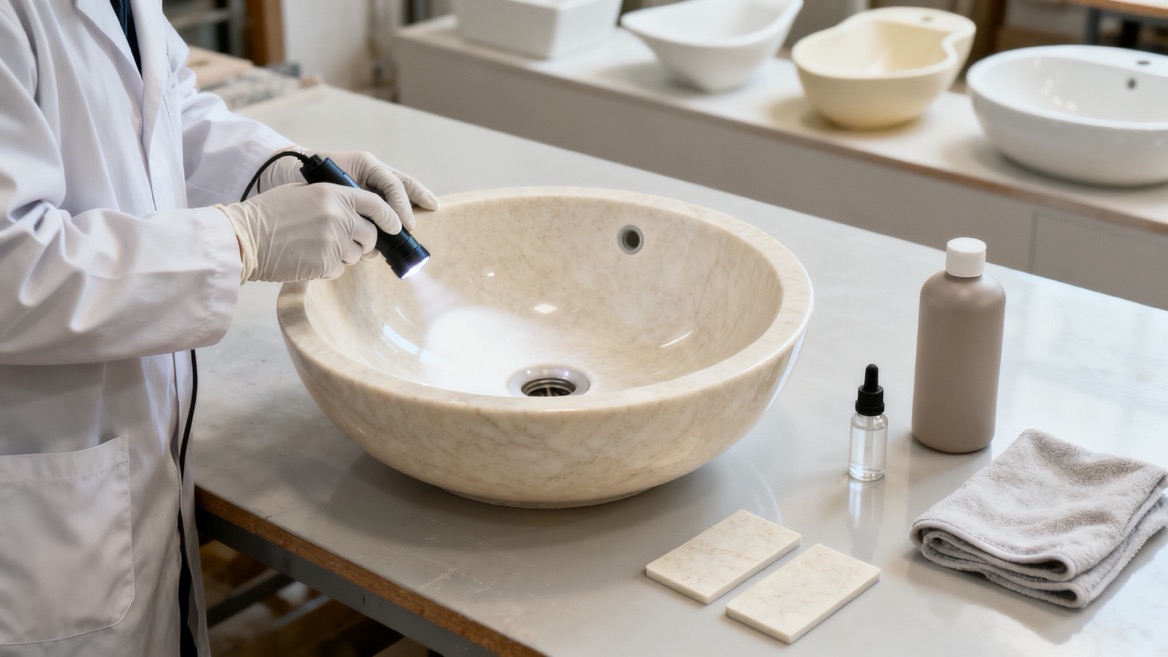
>> Step 5: Inspect the Complete Basin
● A Hypothetical Hospitality Specification
● How to Maintain Nano-Coated Light-colored Stone Basins
>> When Should the Treatment Be Renewed?
● Turning Surface Protection into a Better OEM/ODM Specification
● Specify Protection That Fits Your Basin Project
>> Is nano-coating necessary for every light-colored stone basin?
>> Can nano-coating prevent stains on white marble basins?
>> Does nano-coating prevent acid etching?
>> Will nano-coating change the basin's color?
>> How long does nano-coating last?
>> Can I use normal bathroom cleaner on a coated stone basin?
Light-colored stone basins bring warmth, texture, and understated luxury to modern bathrooms. However, preserving that appearance requires more than choosing an attractive material. A compatible nano-coating for light-colored stone basins can help reduce liquid absorption, improve stain resistance, and make routine cleaning more manageable.
The important word is compatible. "Nano-coating" is not a universal performance standard, and not every white or cream basin needs the same treatment. Protection must match the substrate, surface finish, intended use, and cleaning routine.
From a product-specification perspective, the real question is not whether a basin carries a fashionable coating label. It is whether the finished product can maintain its appearance under realistic bathroom conditions.

White, ivory, beige, and pale gray finishes create a clean visual foundation. They also make certain forms of discoloration especially noticeable.
Cosmetics, oily skincare products, colored liquids, and persistent moisture can compromise the appearance of an absorbent stone surface. Around the drain or beneath accessories, small changes may become visually distracting.
However, light color does not automatically mean high porosity. Absorption depends on the material's mineral structure, fabrication, finish, and existing treatment.
These problems require different solutions:
| Surface problem | What happens | What a suitable coating may do |
|---|---|---|
| Absorbed staining | Contaminants enter accessible pores | Reduce or delay penetration |
| Temporary darkening | Water enters an absorbent surface | Reduce water uptake |
| Acid etching | Acid reacts with susceptible minerals | Ordinary repellents do not reliably prevent it |
| Mineral deposits | Dissolved minerals remain after evaporation | May simplify cleaning, but cannot prevent deposition |
| Scratching | Abrasion damages the finish | Should not be assumed to provide scratch resistance |
This distinction matters commercially. A basin can resist staining yet remain vulnerable to acidic cleaners. Describing it simply as "fully protected" creates expectations that the product may not meet.
"Nano-coating" generally describes a treatment involving nanoscale components or structures. Depending on the formulation, protection may work within accessible surface pores, at the surface, or through a combination of mechanisms.
Some systems use silica-based components or siloxane chemistry to change how liquids interact with stone. Others form a more continuous surface layer.
These approaches are not interchangeable.
A buyer should request the treatment's technical documentation rather than infer its properties from the word "nano." Relevant information includes approved substrates, application conditions, curing requirements, chemical resistance, and maintenance instructions.
A hydrophobic treatment resists wetting by water. An oleophobic treatment resists wetting by oils.
This distinction is especially relevant in bathrooms, where facial oils, creams, and cosmetics may contact the basin.
A dramatic water-beading demonstration does not establish resistance to oily staining. For a light-colored bathroom basin, both water-based and oil-based challenges deserve attention during sample evaluation.
A properly selected treatment can make a meaningful difference. Nevertheless, benefits should be verified on the actual finished basin rather than assumed from a coating supplier's general claims.
Impregnating stone treatments act as repellents. They can reduce the rate at which certain liquids enter an absorbent substrate.
This provides a more forgiving cleanup window, not permission to leave spills indefinitely.
For pale stone, slowing penetration can help preserve a more consistent appearance around frequently wetted areas.
When residues remain closer to the surface, routine cleaning may become easier. That can support a better ownership experience in residential bathrooms and hospitality settings.
However, an easy-clean finish is not self-maintaining. Soap films, cosmetic residues, and mineral deposits still require removal.
A protective treatment should support the design rather than change it unexpectedly.
For white or cream basins, evaluate:
- Color shift or darkening.
- Changes in gloss.
- Uneven patches or application marks.
- Visibility of natural veining.
- Differences between treated and untreated edges.
Treatments marketed as stone enhancers intentionally deepen color. They may therefore be unsuitable when preserving a pale, natural appearance is the priority.
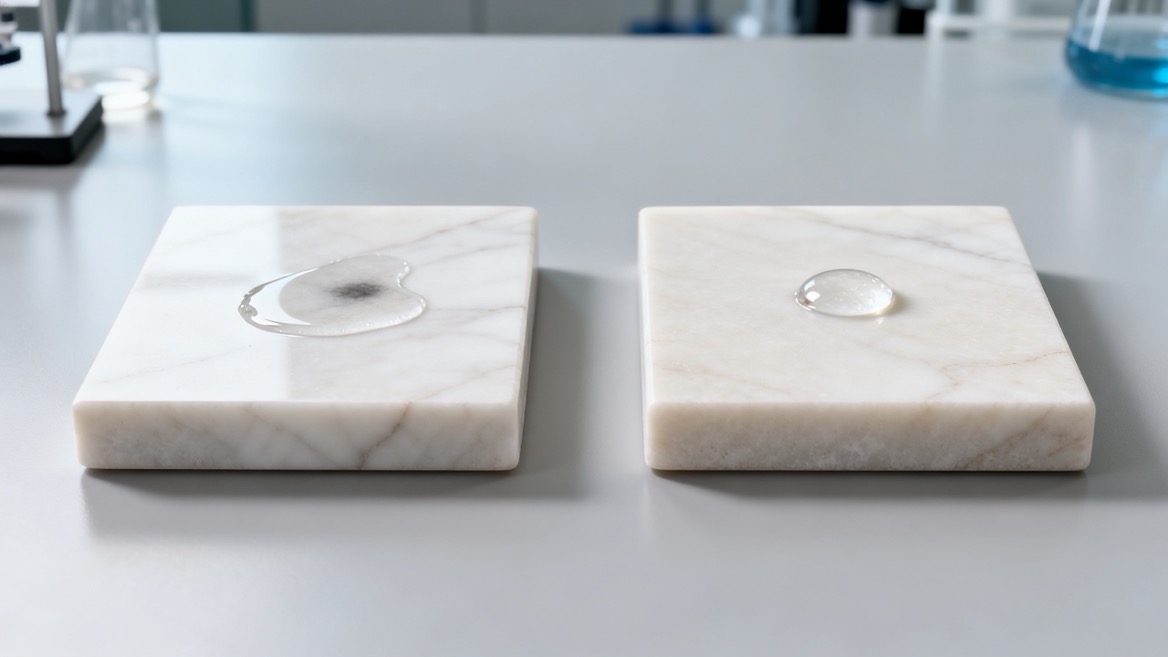
"Stone basin" can describe substantially different products. A treatment suitable for natural marble should not automatically be applied to a resin-based composite.
These materials commonly contain acid-sensitive calcium carbonate. A compatible repellent may improve stain resistance, but ordinary impregnating treatments do not remove the underlying risk of acid etching.
Material selection and cleaning instructions remain essential.
Absorption and treatment requirements vary. Some dense stones may gain limited benefit from additional impregnation.
The practical approach is to assess the specific material and finish rather than apply a blanket sealing rule.
Engineered quartz, mineral-filled resin, and other composite basin materials require their own compatibility assessment.
A treatment intended for porous natural stone may not penetrate a dense composite or bond satisfactorily to its surface.
For these products, follow the substrate manufacturer's recommendations and validate any additional finish before production approval.
The distinction is less straightforward than marketing language suggests. A nano-formulated treatment may itself be an impregnating sealer.
| Selection factor | Conventional impregnating treatment | Nano-marketed treatment |
|---|---|---|
| Basic purpose | Usually reduces liquid penetration | Depends on formulation and design |
| Appearance | Often intended to preserve a natural finish | May preserve or modify the finish |
| Oil resistance | Product-specific | Product-specific |
| Acid protection | Generally not established by impregnation alone | Must be separately demonstrated |
| Service life | Depends on exposure and maintenance | Also depends on exposure and maintenance |
| Buying decision | Review documentation and testing | Apply the same evidence requirements |
My recommendation from a specification standpoint is to compare demonstrated outcomes, not terminology.
A well-documented conventional treatment may be a better choice than a poorly documented nano-coating.
Published stone-protection research has investigated silica nanoparticles and hybrid systems for improving surface water repellency.
This supports the technical basis for developing hydrophobic stone treatments. It does not establish that every commercial nano-coating performs equally well.
Laboratory specimens also differ from complete bathroom basins. Curved bowls, drain openings, repeated cleaning, and product residues introduce additional variables.
A strong procurement decision therefore separates three questions:
1. Can the coating technology work?
2. Does this formulation work on this substrate?
3. Does the finished basin retain useful protection after realistic use?
The third question is often the most important for overseas brands and wholesalers.
The following framework is a proposed purchasing protocol, not a claim about completed testing or a universal certification requirement.
It gives buyers and manufacturers a clearer basis for agreeing on performance before an order proceeds.
Request coated and uncoated samples from the same material and finish.
Record their starting appearance under consistent lighting. Otherwise, natural variation may be mistaken for a coating effect.
Agree on representative substances, such as:
- Liquid hand soap.
- Facial oil or moisturizer.
- Toothpaste.
- Colored cosmetics.
- Water from the intended use environment.
Define exposure duration, cleaning method, and inspection conditions in advance.
Potentially damaging challenges belong on test pieces, not a customer's installed basin.
Check for residual staining, gloss changes, darkening, haze, and surface damage.
A sample that beads water but shows visible oily discoloration may not meet the intended application.
Evaluate performance after repeated cleaning with the proposed maintenance product.
The point is to understand retained performance—not merely the appearance of a freshly treated sample.
Review coating consistency around the rim, bowl, drain opening, and overflow where present.
Flat sample results alone cannot establish complete-basin application quality.
Consider a hotel brand developing an ivory stone basin for guest bathrooms.
Its priorities might include a consistent pale finish, straightforward housekeeping, and clear maintenance instructions.
Rather than specifying only "nano-coated," the purchasing team could require:
1. An approved reference sample.
2. No unacceptable visible color or gloss change.
3. Agreed stain-challenge results.
4. Repeat evaluation after cleaning cycles.
5. Written restrictions on incompatible cleaners.
6. A defined inspection and remedial procedure.
This converts a vague feature into a reviewable product specification.
The commercial value lies in clearer expectations between the brand, manufacturer, installer, and housekeeping team.
Good maintenance protects both the finish and the underlying material.
A practical routine is straightforward:
1. Remove cosmetics and spills promptly.
2. Clean with a compatible pH-neutral product.
3. Use a soft cloth rather than an abrasive pad.
4. Rinse away cleaning residue.
5. Dry the bowl and surrounding wet areas.
For acid-sensitive stone, avoid vinegar, lemon-based products, and acidic bathroom descalers.
If mineral deposits develop, use a product approved for both the stone and its treatment. A cleaner safe for ceramic sanitaryware may not be safe for marble.
There is no reliable universal recoating schedule.
Service life depends on formulation, application, substrate, cleaning frequency, and exposure. Follow the treatment supplier's instructions and investigate changes in absorption or cleanability.
Water beading can provide a useful observation, but it should not serve as the sole measure of remaining stain protection.
For overseas brands, wholesalers, and manufacturers, surface protection belongs in the product brief—not as an undefined finishing note.
Jiaxing Miluo Smart Home Co., Ltd. provides customized modern bathroom products and solutions through OEM and ODM services. Within that development process, coating suitability should be discussed alongside material selection, basin geometry, finish, and intended market.
Buyers should request the available supporting documents, which may include:
- Substrate and coating specifications.
- Application and curing instructions.
- Relevant test reports.
- Safety and handling information.
- Maintenance guidance.
- Written warranty scope and exclusions.
Any performance claim should correspond to evidence for the selected product configuration.
Nano-coating can be an important part of protecting an absorbent, light-colored stone basin. Its value comes from verified stain resistance and practical maintenance benefits—not from the label alone.
Contact Jiaxing Miluo Smart Home Co., Ltd. with your target material, preferred color, basin design, intended application, and cleaning expectations. Request a discussion of compatible protection options and a sample-validation plan before approving your OEM or ODM specification.
No. Protection requirements depend on the substrate, absorption, finish, and application. Dense or factory-finished materials may not benefit from an additional treatment. Evaluate the actual basin before specifying one.
A compatible treatment can improve resistance to certain stains, but it does not make marble stain-proof. Prompt cleanup remains important, particularly for oily cosmetics and strongly colored substances.
Ordinary hydrophobic or impregnating treatments should not be assumed to prevent etching. Acid-resistant protection requires separate evidence for the complete coating system and substrate.
It may. Results depend on the formulation and surface. Approve a treated sample under consistent lighting, especially when maintaining a pale matte finish is important.
There is no universal lifespan. Ask for documented durability information, maintenance requirements, and renewal guidance relevant to the intended use. Avoid relying on unsupported multi-year promises.
Only if it is compatible with both the substrate and coating. A pH-neutral stone cleaner is generally a safer starting point, but the product-specific maintenance instructions take priority.
1. Natural Stone Institute. "Care & Cleaning of Natural Stone." Guidance on stone composition, repellents, staining, etching, and maintenance. [naturalstoneinstitute]
2. Daltile. "Natural Stone Care & Maintenance." Guidance on neutral cleaners, treatment categories, color-enhancing sealers, and acid sensitivity. [daltile]
3. United Arab Emirates University research portal. "Fabrication of Super-hydrophobic Surfaces for Enhanced Stone Protection." Research describing the role of silica nanoparticle dimensions in treated marble's water-repellent behavior. [research.uaeu.ac]
4. Natural Stone Institute. "Stone Care: Everything to Know." Educational overview of stone sealers, cleaning products, and treatment expectations. [naturalstoneinstitute]


