
Views: 220 Author: Miluo Smart Home Publish Time: 2026-09-08 Origin: Site


Content Menu
● What "Saving 40%" Really Means in Freestanding Tub Sourcing
● Why Jiaxing Is a Strategic Manufacturing Location
● Where the Cost Savings Come From
>> 1. Fewer Commercial Markups
>> 2. Better Material-to-Market Matching
>> 3. OEM and ODM Development Reduces Brand Commoditization
>> 4. Packaging Engineering Protects Margin
● Factory-Direct Versus Distributor Purchasing
● A Practical 40% Savings Framework
>> Step 1: Define the Target Customer
>> Step 2: Build a Clear Product Specification Sheet
>> Step 3: Request a Comparable Sample
>> Step 4: Calculate Landed Cost Before Approving Production
>> Step 5: Create a Repeat-Order Improvement Loop
● Choosing the Right Freestanding Tub Material
>> Solid Surface and Resin Stone
>> Acrylic
>> Marble-Look and Transparent Resin
● How Miluo Supports International Buyers
● Questions to Ask Before Ordering
● FAQ
>> 1. Can buying freestanding tubs factory-direct really save 40%?
>> 2. What is the minimum order quantity for customized freestanding tubs?
>> 3. Are solid-surface freestanding tubs suitable for hotels?
>> 4. What information should I send for an accurate bathtub quotation?
>> 5. Is an acrylic or solid-surface freestanding tub better for my business?
>> 6. Can I add my own logo and packaging to a freestanding bathtub order?
>> 7. How should I compare bathtub suppliers in China?
For bathroom brands, wholesalers, developers, and hospitality buyers, buying freestanding tubs factory-direct from Jiaxing can materially improve both margin and product control. The often-cited "save 40%" opportunity is not a guaranteed price reduction on every order; it is a practical sourcing benchmark that may be achievable when buyers remove avoidable trading layers, consolidate procurement, optimize specifications, and order at commercially efficient volumes.
Jiaxing Miluo Smart Home Co., Ltd. manufactures customized high-end bathroom products for international buyers, including freestanding bathtubs, basins, vanities, shower bases, and coordinated bathroom solutions. With a product range spanning solid-surface, resin-stone, marble-look, transparent resin, and acrylic bathtub options, the company supports OEM and ODM programs for private-label brands, distributors, contractors, and project buyers. The company also states that it has more than 25 years of manufacturing and export experience, over 100 patents, a 13,000-square-meter factory, and products sold in 56 countries.
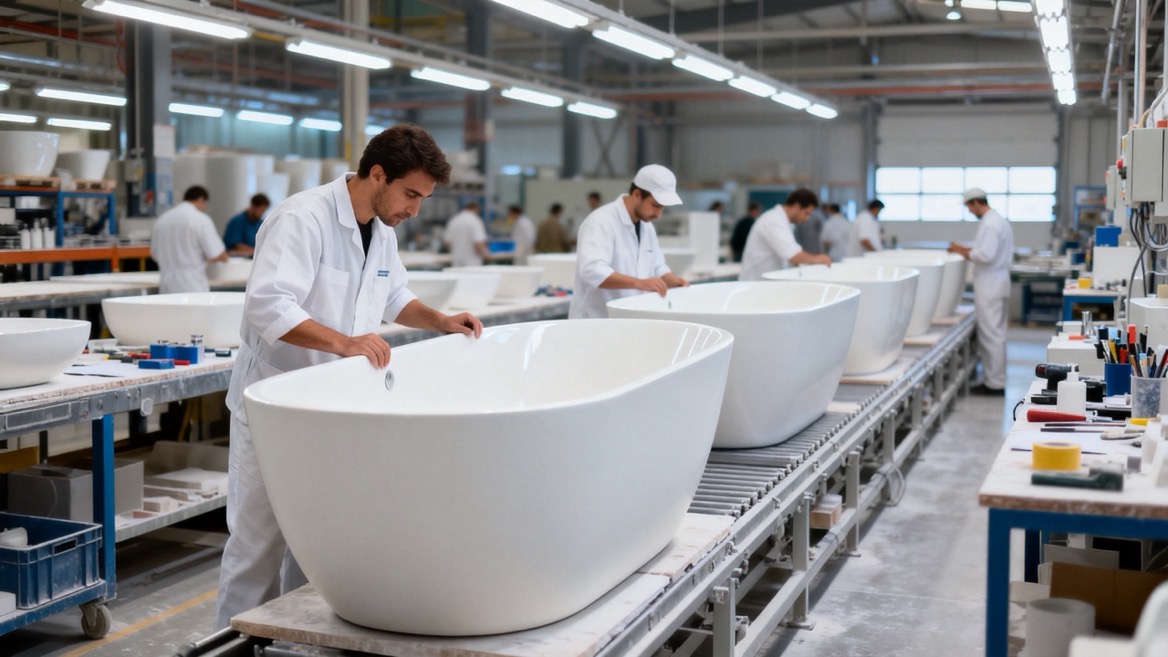
A factory-direct freestanding tub purchase does not mean that every buyer will automatically receive a 40% lower invoice price. Freight, duties, packaging standards, customization, order quantity, and destination market all affect the final landed cost.
Instead, the 40% figure should be understood as a total supply-chain optimization target. It reflects the potential difference between purchasing through several commercial layers and building a direct manufacturer relationship with a qualified Jiaxing bathtub factory.
In a conventional sourcing model, the product may pass through several parties before reaching a bathroom brand, showroom, contractor, or retailer:
1. The original bathtub manufacturer
2. A local export agent or trading company
3. An overseas importer
4. A regional distributor
5. A wholesaler or dealer
6. The final retailer, project contractor, or buyer
Every layer adds value in some cases. A distributor may offer local stock, fast delivery, warranties, or installation support. However, every layer also adds markups, duplicated administration, fragmented communication, and sometimes limited design flexibility.
When brands and professional buyers source directly from a freestanding tub factory in Jiaxing, they can reduce or eliminate several of these layers. The benefit is not simply a lower unit price. It is greater influence over the entire cost structure.
| Cost Area | Multi-Layer Purchasing Model | Factory-Direct Purchasing Model |
|---|---|---|
| Product price | Includes intermediary margins | Negotiated directly with manufacturer |
| Product specifications | Often limited to stock models | Adjustable dimensions, finishes, branding, and packaging |
| Sampling process | Communication may pass through several parties | Buyer communicates with production-side team |
| Packaging decisions | Usually standardized by importer or distributor | Can be designed around shipping and retail requirements |
| Brand identity | Often generic product presentation | Private label, logo, manuals, cartons, and inserts can be customized |
| Quality feedback | May be delayed or filtered | Can be reported directly for corrective action |
| Container planning | Often handled separately by different suppliers | Can support more coordinated product planning |
| Long-term margin | Shared across more parties | More value retained by the buyer’s business |
The strongest savings usually occur when a buyer combines several decisions: direct purchasing, repeatable product specifications, optimized packaging, consolidated shipments, and stable forecast volumes.
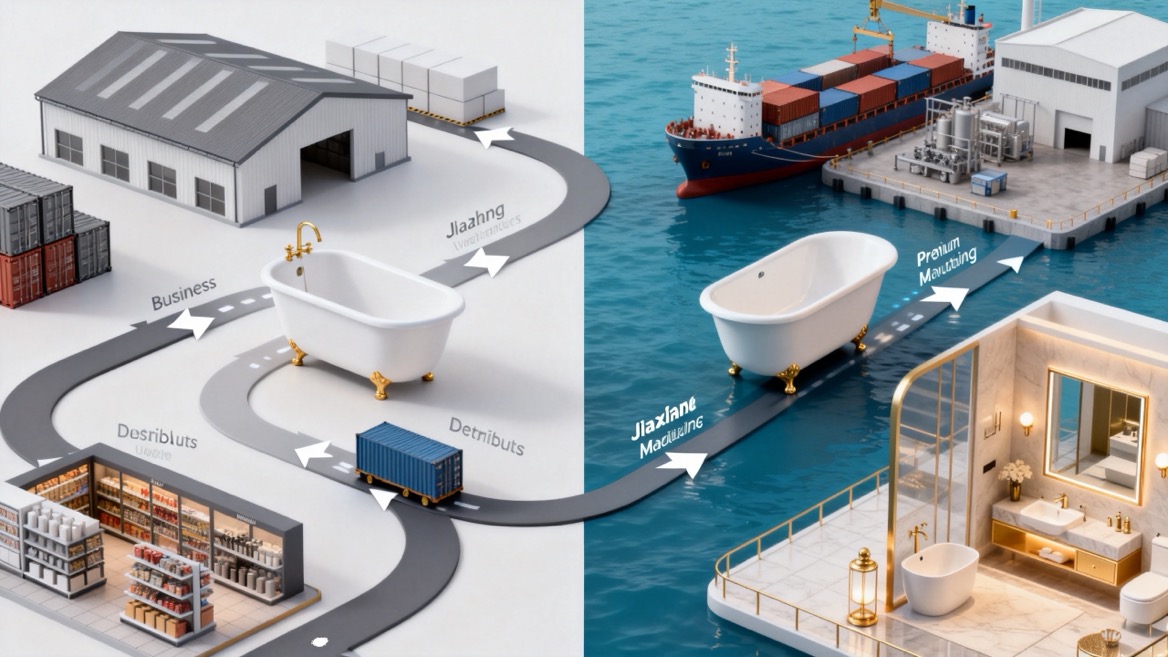
Jiaxing is located in Zhejiang Province, within a highly developed manufacturing and export region on China's eastern coast. Its proximity to Shanghai and Ningbo gives overseas buyers practical access to major international shipping routes, which matters when sourcing large, high-cube products such as freestanding bathtubs. Jiaxing Miluo identifies its location near Shanghai Port and Ningbo Port as an advantage for international export logistics.
A bathtub is not a compact commodity. Its shipping cost is influenced by volume as much as weight. This makes factory location, carton engineering, loading plans, and container utilization especially important.
For importers, a factory-direct sourcing strategy from Jiaxing can offer several operational advantages:
- Access to established export infrastructure for ocean freight and international documentation
- Shorter decision paths between product development, quality teams, and export coordination
- Broader material options for different market positions and price targets
- More practical mixed-product planning for buyers sourcing bathtubs, basins, vanity tops, and related bathroom products
- Faster design iteration when the manufacturing team can review drawings, finishes, mold requirements, and packaging requirements directly
For a high-end bathroom brand, a factory's location matters less than its ability to consistently convert design intent into repeatable production. Jiaxing's manufacturing ecosystem supports the practical side of that process: materials, component sourcing, export handling, and access to global shipping gateways.
The strongest factory-direct buying programs do not rely on one dramatic discount. They reduce a series of small and medium-sized costs that can accumulate across an annual purchasing plan.
The clearest saving comes from reducing intermediary margins.
A trading company or distributor may be useful when a buyer needs low quantities, local inventory, financing, or on-the-ground service. But brands with predictable demand and established import capability often have a commercial reason to work closer to the source.
Factory-direct purchasing allows the buyer to negotiate based on:
- Annual estimated volume
- Model mix
- Material selection
- Surface finish
- Packaging level
- Branding requirements
- Container loading plan
- Payment terms
- Repeat-order forecast
This creates a more transparent commercial conversation. Instead of paying for an already-marked-up catalog item, the buyer can work from a specification and a production-based quotation.
One of the most expensive sourcing mistakes is specifying a product that does not match the intended market.
For example, a buyer may select a premium solid-surface freestanding tub for a project that only requires a mid-range acrylic solution. Conversely, a luxury showroom brand may choose a low-cost product that cannot support its desired tactile feel, finish consistency, or long-term positioning.
Miluo's bathtub portfolio includes solid-surface, resin-stone, acrylic, marble-look, and transparent resin options, allowing buyers to develop different product tiers rather than forcing a single material into every market segment.
This is where a direct relationship becomes valuable. A qualified manufacturer can help buyers compare:
| Product Requirement | Potential Material Direction | Commercial Consideration |
|---|---|---|
| Premium residential or hospitality focal point | Solid surface or resin stone | Higher perceived value, durable non-porous finish, premium presentation |
| Broad wholesale program | Acrylic | Lower entry cost and lighter handling profile |
| Statement luxury collection | Marble-look or transparent resin | Visual differentiation for showrooms and design-led projects |
| High-traffic hospitality use | Dense solid-surface material | Emphasis on cleanability, repairability, and finish durability |
| Private-label retail line | Acrylic or selected solid-surface models | Balance unit cost, packaging, stock strategy, and brand positioning |
The goal is not to buy the lowest-cost bathtub. The goal is to buy the right freestanding tub specification for the customer, sales channel, and expected retail price.
A generic bathtub sold by dozens of competitors becomes a price-comparison product. That creates margin pressure.
A private-label freestanding tub program can change the commercial equation. OEM and ODM services allow a buyer to differentiate through elements such as:
- Customized dimensions
- Distinctive rim profiles
- Color options
- Matte or polished finishes
- Overflow configuration
- Drain positioning
- Logo placement
- Branded packaging
- Product manuals
- Retail-ready inserts
- Exclusive mold development for qualified programs
Jiaxing Miluo states that it provides bespoke OEM and ODM solutions, including the ability to convert architectural drawings into customized products with specific dimensions and finishes. It also describes custom mold-opening work for project-based basin development.
From a brand strategy perspective, this matters because a differentiated product can protect price integrity. A bathtub that is not directly comparable to a widely available stock item gives the buyer more control over positioning, distribution, and retail pricing.
For freestanding tubs, damaged goods can erase the benefit of a lower purchase price very quickly.
The right packaging is not a minor operational detail. It is part of the product's financial design. Buyers should evaluate the packaging system as carefully as the bathtub itself.
A strong packaging review should address:
- Individual carton strength
- Internal protection at vulnerable edges
- Foam density and placement
- Pallet requirements
- Moisture protection
- Corner protection
- Label placement
- Handling instructions
- Barcode requirements
- Drop-test expectations where applicable
- Loading orientation
- Container stacking plan
A premium solid-surface bathtub may have a higher purchase cost than a lighter acrylic model, but the lowest quoted price is not necessarily the lowest landed cost. A professional buyer should compare the expected cost of product, packaging, freight, damage claims, replacement shipments, warehouse handling, and customer service.
The real metric is landed margin, not unit price alone.
Both factory-direct and distributor purchasing can be valid. The right route depends on the buyer's commercial maturity, order volume, product complexity, and inventory model.
| Buying Route | Best For | Main Advantage | Main Limitation |
|---|---|---|---|
| Local distributor | Small orders, urgent replenishment, buyers needing domestic stock | Convenient access and lower import complexity | Higher unit cost and limited customization |
| Trading company | Buyers new to overseas sourcing or requiring broad supplier coordination | Consolidation and sourcing support | Less direct control over production communication |
| Factory-direct supplier | Brands, wholesalers, importers, developers, and repeat project buyers | Stronger cost control, customization, and product development access | Requires structured purchasing, planning, and quality management |
| Hybrid model | Brands needing both direct sourcing and local service | Flexible inventory and market support | Requires careful channel and pricing coordination |
For many established buyers, the optimal approach is a hybrid model. Core, predictable bathtub collections can be sourced directly from the manufacturer. Local partners can then support rapid fulfillment, installation questions, replacement inventory, or smaller customers.
The following example illustrates how the potential saving can develop across a purchasing program. It is an illustrative sourcing framework, not a promise of a specific price outcome.
Assume a bathroom brand purchases 300 freestanding tubs annually.
| Annual Cost Driver | Traditional Multi-Layer Model | Factory-Direct Optimization Opportunity |
|---|---|---|
| Product purchase price | Higher due to intermediary margins | Direct specification-based pricing |
| Custom design fees | May be added repeatedly by different parties | One development process with manufacturer |
| Packaging inefficiency | Standard cartons may increase damage or freight volume | Packaging can be tailored to the product and channel |
| Mixed sourcing | Separate orders increase administrative burden | Bathtubs, basins, and vanities may be planned together |
| Product differentiation | Generic models encourage price comparison | Private-label specifications support stronger pricing |
| Warranty and rework | Communication can be slower | Direct corrective action and repeat-order improvement |
| Total commercial impact | Margin spread across multiple layers | More margin retained by the buyer |
To approach a substantial total saving, buyers should avoid treating procurement as a one-time negotiation. The better method is to build a purchasing system.
Before requesting prices, define who will buy the tub.
Is the target customer:
- A luxury homeowner?
- A hotel developer?
- A bathroom showroom?
- A regional plumbing distributor?
- A project contractor?
- A design-and-build firm?
The customer determines the correct material, dimensions, finish, carton presentation, and retail price range.
A vague request such as "please quote a modern freestanding bathtub" almost always produces inconsistent quotations.
A professional specification sheet should include:
1. Target dimensions and water capacity
2. Preferred material and finish
3. Color requirements
4. Drain and overflow specifications
5. Faucet compatibility
6. Required certifications for the destination market
7. Logo or private-label requirements
8. Packaging and barcode requirements
9. Quality acceptance criteria
10. Expected annual volume and first-order quantity
This document helps the manufacturer quote accurately and reduces costly changes later.
Do not evaluate only from photography, renderings, or a digital catalog.
A serious sample evaluation should include:
- Surface consistency under strong light
- Color accuracy
- Edge smoothness
- Drain alignment
- Stability on a level floor
- Finish resistance to common bathroom cleaners
- Packaging integrity
- Installation instructions
- Actual weight and handling practicality
- Compatibility with intended faucet and drain components
For solid-surface freestanding tubs, buyers should also assess the material feel, wall thickness consistency, non-porous surface quality, and repairability. Miluo describes its high-density resin-composite solid-surface tubs as durable, scratch-resistant, non-porous, and designed for easy cleaning in residential and high-traffic settings.
The factory price is only one part of the decision.
Use this formula:
Landed Cost per Tub=(Product Cost + Packaging + Inland Transport + Ocean Freight + Insurance + Duties + Port Charges + Local Delivery)/Number of Saleable Units
Then add a realistic allowance for:
- Quality inspection
- Warehousing
- Damage reserve
- Replacement stock
- Marketing materials
- Customer service
- Installation support
- Currency movement
This gives decision-makers a true view of margin rather than an incomplete comparison based on ex-factory price.
The first production run should not be treated as the final version of the program.
After receiving the shipment, document feedback from warehouses, installers, showrooms, sales teams, and end users. Review damage patterns, installation questions, finish feedback, carton problems, and product return reasons.
Then convert those findings into the next purchase order.
This continuous-improvement approach is especially important for premium bathroom products. Small improvements in carton protection, drain fitting instructions, label positioning, or finish options can create meaningful financial gains at scale.
Material choice affects price, installation, user experience, durability, and market appeal. It should be selected strategically rather than emotionally.
Solid-surface freestanding tubs are commonly selected for premium residential, hospitality, and design-led projects. Buyers often value their substantial appearance, smooth finish, non-porous character, and ability to fit modern minimalist bathroom concepts.
Miluo positions its solid-surface tubs as high-density resin-composite products designed for durability, scratch resistance, cleanability, and thermal insulation.
This material category can be a strong choice when the buyer needs:
- A premium tactile experience
- Matte-white or refined contemporary finishes
- Long-term brand positioning
- Better visual consistency than natural stone
- A repairable surface
- A centerpiece bathtub for luxury interiors
Acrylic freestanding tubs are often used for broader price-sensitive programs. They can be lighter and easier to move during installation, making them useful for residential projects, retail channels, and markets where shipping weight or installation labor is a major concern.
However, acrylic quality varies significantly. Buyers should ask about reinforcement, structure, gloss consistency, color stability, base design, and long-term rigidity.
For buyers serving boutique hotels, luxury showrooms, high-end residences, and visually distinctive commercial projects, marble-look and transparent resin bathtubs can create strong visual differentiation.
These designs are not suitable for every market. Their strongest role is often as a signature product that raises the perceived value of an entire collection.
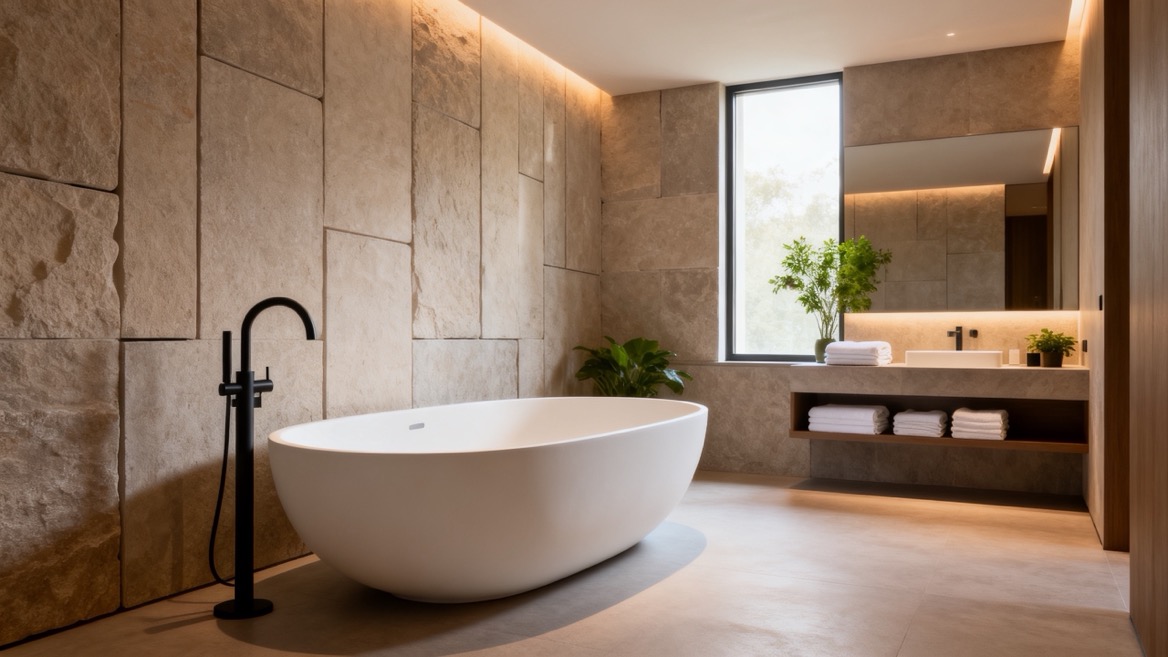
Jiaxing Miluo Smart Home Co., Ltd. presents itself as a manufacturer of customized, high-end bathroom products and solutions for residential and commercial projects. Its stated product offering includes bathtubs, basins, bathroom vanities, shower trays, and related premium bathroom accessories.
For international brands and project buyers, the company's value proposition centers on four practical areas:
- Factory-direct OEM and ODM support for customized product development
- Broad material selection, including solid surface, resin stone, acrylic, marble-look finishes, and transparent resin
- Coordinated bathroom-product sourcing, helping buyers develop a more complete collection
- Export-oriented operations supported by proximity to Shanghai and Ningbo ports
Miluo also states that its products are tested to meet international market requirements and that it holds cUPC and CE certifications. Buyers should still verify which exact models, components, markets, and certificates apply to their intended order before finalizing a purchase.
That verification step is not bureaucracy. It is essential procurement discipline.
Before placing a factory-direct freestanding tub order, ask the manufacturer these questions:
1. What is the exact material composition and wall construction?
2. Which certifications apply to this specific model and destination market?
3. Can you provide a pre-production sample or approved finish standard?
4. What are the product dimensions, net weight, gross weight, and carton dimensions?
5. How many units fit safely in a 20-foot and 40-foot container?
6. What quality checks are completed before packing?
7. What packaging upgrades are available for retail, distribution, or project delivery?
8. Can the overflow, drain position, color, finish, and branding be customized?
9. What is the lead time for samples, first orders, and repeat orders?
10. What spare parts, care instructions, and after-sales documentation are included?
A supplier that answers these questions clearly is usually easier to work with over the long term.
Buying freestanding tubs factory-direct from Jiaxing can help qualified buyers improve their total purchasing economics, product differentiation, and supply-chain control. The strongest results come from strategic collaboration—not from chasing the lowest quotation.
For brands, wholesalers, and project buyers, the potential "40% savings" should be viewed as a structured commercial opportunity. It can come from eliminating unnecessary markups, selecting the right materials, engineering packaging properly, consolidating bathroom-product sourcing, and developing a customized product range that protects margin.
Jiaxing Miluo Smart Home Co., Ltd. offers factory-direct OEM and ODM support for freestanding bathtubs and coordinated modern bathroom products. Its product range and customization capabilities can help overseas buyers create collections aligned with their brand position, project requirements, and target price points.
Request a detailed factory-direct quotation from Jiaxing Miluo Smart Home Co., Ltd. with your target tub dimensions, material preference, destination country, annual volume, packaging requirements, and private-label needs. A clear specification is the fastest route to an accurate cost comparison and a more profitable bathtub program.
It can, but it is not guaranteed. The total saving depends on the number of intermediaries removed, annual order volume, customization level, shipment planning, packaging efficiency, and destination-market costs. The best comparison is total landed cost and expected margin, not only the product's factory price.
Minimum order quantity varies by material, model, color, packaging requirements, and whether a new mold is needed. Stock-style products usually require lower volumes than fully customized OEM or ODM projects. Buyers should provide an annual volume forecast as well as the first-order quantity.
They can be suitable for hotels, resorts, serviced apartments, and premium residential developments when the product is selected and tested for the project's needs. Solid-surface tubs are often valued for their substantial appearance, smooth non-porous surface, easy cleaning, and contemporary design flexibility.
Send the preferred model or design drawing, dimensions, material, color, finish, drain and overflow requirements, destination country, expected order quantity, packaging needs, certification requirements, and private-label details. Clear information reduces quotation errors and shortens development time.
Neither material is universally better. Acrylic can be suitable for lighter, more price-sensitive programs. Solid surface can be better for premium brands, luxury projects, and buyers who want a more substantial visual and tactile product. Your target retail price, customer expectations, shipping strategy, and product positioning should guide the choice.
Yes, private-label programs can include logo placement, custom cartons, manuals, care cards, barcode labels, and other brand elements, subject to the supplier's requirements and order volume. Jiaxing Miluo states that it offers customized OEM and ODM solutions for brand-specific product development.
Compare more than price. Review the supplier's manufacturing experience, material knowledge, product range, customization process, sample quality, certificates for the intended market, packaging standards, communication speed, export documentation, quality-control process, and ability to support repeat orders.
1. Jiaxing Miluo Smart Home Co., Ltd. — [Luxury Bathtubs & Basins | Custom Bathroom Vanities from China Direct Manufacturer]
2. Jiaxing Miluo Smart Home Co., Ltd. — [Wholesale Bathtub Manufacturer & Supplier]
3. Jiaxing Miluo Smart Home Co., Ltd. — [Wholesale Solid Surface Bathtub Manufacturer & Supplier]
4. Industry Research — [Freestanding Bathtub Market Size & Trends]
5. Industry Research — [Free Standing Bathtubs Market Size, Share, Growth and Industry Analysis]


