
Views: 264 Author: Miluo Smart Home Publish Time: 2026-10-10 Origin: Site


Content Menu
● Why Faucet Height Alone Cannot Prevent Basin Splashing
● Understanding Faucet Height for Above-counter Basins
>> Overall Faucet Height Versus Spout Outlet Height
>> Spout-to-Rim Clearance Versus Water-Drop Distance
● What Is the Best Faucet Height Above a Vessel Sink?
>> Calculate Clearance from the Installed Rim
● Matching Spout Reach with the Basin's Landing Zone
>> Evaluate the Stream, Not Just the Outlet
>> Should Water Land Directly on the Drain?
● How Basin Shape Changes Faucet Selection
>> Shallow Above-counter Basins
>> Curved and Angular Basin Interiors
● Water Flow, Aerators, and Pressure: The Other Half of the Equation
>> Water Efficiency Does Not Equal Splash Certification
>> Test Across Expected Operating Conditions
● A Practical Six-Step Faucet and Basin Matching Process
>> 1. Establish the Finished Installation
>> 2. Review the Faucet Drawing
>> 4. Assemble a Representative Sample
>> 5. Test Empty-Basin and Handwashing Behavior
>> 6. Document and Recheck Changes
● An Industry-Based Splash Test for OEM and ODM Projects
● Designing Tolerance into a Bathroom Product Collection
● Troubleshooting Splashing Before Changing the Faucet
● Coordinate Your Next Basin Collection with Jiaxing Miluo
>> How High Should a Faucet Be Above an Above-counter Basin?
>> Can a Tall Faucet Cause More Splashing?
>> Does a Deeper Vessel Sink Always Splash Less?
>> Can an Aerator Fix a Splashing Basin?
>> Are Wall-mounted Faucets Better for Vessel Sinks?
>> What Should Buyers Provide for an OEM or ODM Evaluation?
Matching faucet height with above-counter basins to prevent splashing requires more than choosing a tall tap. Spout clearance, reach, basin depth, water flow, and the stream's landing position all influence performance. For bathroom brands, wholesalers, and manufacturers, coordinating these details helps turn an attractive vessel sink into a comfortable, practical washing station.
At Jiaxing Miluo Smart Home Co., Ltd., our focus is customized modern, high-end bathroom products and solutions for overseas OEM and ODM customers. From a product-planning perspective, I would treat the faucet and basin as one functional system—not two independently selected accessories.
The central principle is compatibility: provide enough space for comfortable handwashing without introducing unnecessary height or directing water against splash-prone surfaces.

An above-counter basin, also called a vessel sink or countertop washbasin, raises the bowl above the worktop. A faucet designed for an inset sink may therefore leave insufficient clearance.
However, simply choosing the tallest faucet can create another problem. An unnecessarily elevated outlet increases the distance water travels before reaching the bowl. Depending on the stream and impact surface, this can increase unwanted droplets.
Three interactions deserve attention:
- Outlet height determines working clearance and water-drop distance.
- Spout reach determines how far the outlet extends into the bowl.
- Basin geometry determines where water lands and how it redirects.
A visually balanced combination can still perform poorly. For example, a tall faucet with a short spout may send water onto the basin's rear wall rather than its lower interior.
My recommendation is to assess the complete water path before approving the appearance.
Overall faucet height describes the fixture's external dimensions. It does not necessarily tell you where water leaves the spout.
For splash prevention, the more useful measurement is spout outlet height: the vertical distance from the mounting surface to the water outlet.
Two faucets with similar overall heights can have different outlet positions. Always review the dimensional drawing rather than relying on product photographs or descriptions such as "tall vessel faucet."
Spout-to-rim clearance is the vertical distance between the outlet and the basin rim.
Water-drop distance is the distance between the outlet and the interior surface where the stream lands.
These measurements are not interchangeable. A deep basin can provide modest rim clearance while still allowing a substantial drop to its bottom.
| Measurement | What it helps determine |
|---|---|
| Installed basin rim height | Whether the faucet clears the bowl |
| Spout outlet height | Actual outlet position above the countertop |
| Spout-to-rim clearance | Space available near the bowl opening |
| Spout reach | Outlet position relative to the mounting point |
| Interior depth and profile | Landing location and splash containment |
| Stream direction | Whether water travels vertically or forward |
Record all measurements from clearly identified reference points.
There is no single faucet height that suits every above-counter basin.
Native Trails' vessel-faucet guidance recommends positioning the outlet a few inches above the rim, with sufficient room for handwashing but without excessive height. That is useful planning guidance, not a universal installation standard.
The appropriate clearance depends on:
- Basin height and usable interior depth.
- Faucet outlet angle and reach.
- Intended handwashing position.
- Water flow and operating pressure.
- The manufacturer's installation requirements.
Instead of specifying a fixed clearance across an entire collection, establish a candidate arrangement and validate it with the actual basin and faucet.
For a countertop-mounted faucet:
Rim clearance=Spout outlet height−Installed rim height
Consider a hypothetical basin whose installed rim is 150 mm above the countertop. A faucet outlet positioned 230 mm above the countertop provides 80 mm of rim clearance.
This calculation confirms geometry only. It does not prove comfortable access or low-splash performance.
Include mounting rings, supports, and any installation details that change the finished rim elevation.
Height receives most of the attention, but incorrect reach can undermine an otherwise suitable combination.
A short spout may direct water against the rear inner wall. An excessively long spout may bring the stream too close to the front edge or interfere with hand positioning.
Spout reach generally describes a horizontal product dimension. The water's actual landing point also depends on outlet angle and stream behavior.
A forward-directed stream can land farther into the basin than the outlet's vertical projection suggests.
Use a side-view drawing to identify:
1. Faucet mounting position.
2. Outlet location.
3. Expected stream direction.
4. Basin interior profile.
5. Intended handwashing area.
Then verify the drawing with running water.
Not necessarily.
The lower interior is generally a more suitable target than a high basin wall, particularly in shallow bowls. However, landing directly on a raised or curved drain cap may produce an unfavorable splash pattern.
Treat the drain assembly as part of the pairing. Compare landing positions around the lower interior and retain the arrangement that offers comfortable access and controlled splash behavior.
"Centered over the drain" is a layout choice, not automatic proof of compatibility.
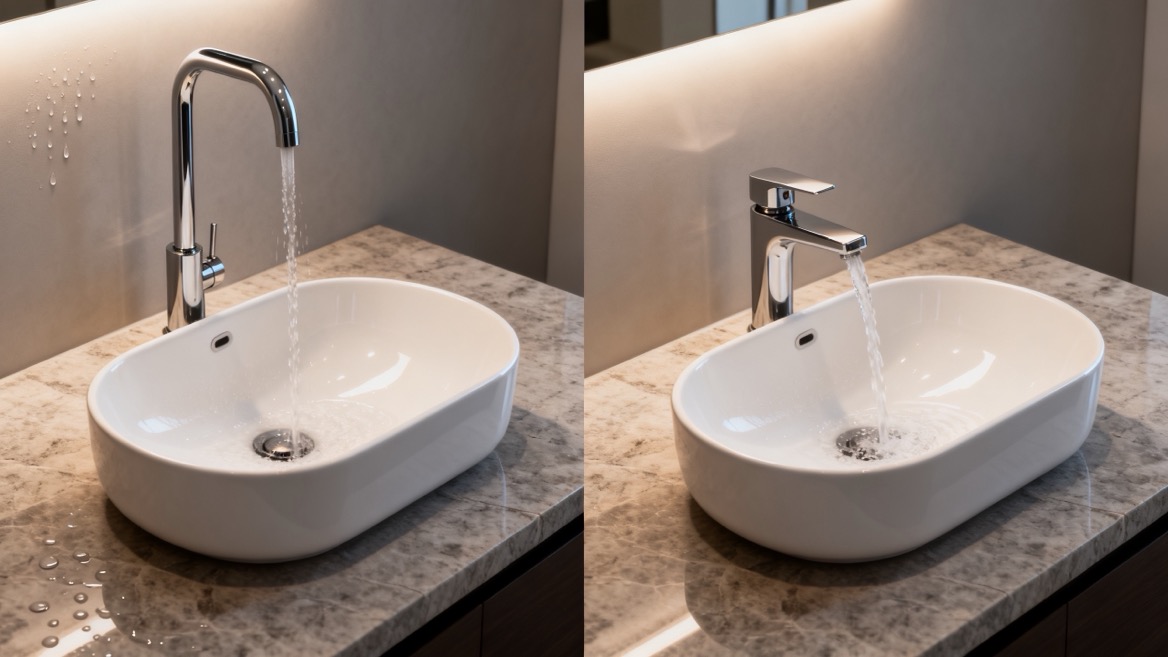
Shallow basins offer less vertical containment. Their appearance may suit minimalist bathrooms, but faucet placement needs careful evaluation.
Prioritize controlled flow, a suitable lower-interior landing position, and sufficient—not excessive—working clearance. Avoid allowing the stream to strike a high sidewall.
A deeper bowl can contain more droplets, but depth alone does not guarantee a dry countertop.
Excessive outlet height, poor reach, or an unsuitable stream can still cause splashing. Check whether users can wash comfortably without reaching awkwardly into the bowl.
The surface struck by the stream influences its redirection.
Evaluate the actual interior profile rather than assuming every round basin or rectangular basin behaves alike. Slopes, corners, drain positions, and transitions between the wall and bottom all deserve attention.
For customized collections, dimensional drawings should show usable internal geometry, not only external width and height.
A well-positioned faucet can still splash if its stream is unsuitable for the basin.
Aerators and outlet devices affect flow rate and stream characteristics. Their performance should be assessed with the complete assembly rather than treated as a guaranteed solution.
The U.S. EPA states that WaterSense-labeled bathroom faucets and accessories use a maximum of 1.5 gallons per minute. This represents at least a 30% reduction compared with the referenced standard flow of 2.2 gallons per minute.
That information supports water-efficiency decisions. It does not certify that a particular faucet will avoid splashing in every vessel basin.
A lower-flow option may be worth evaluating, but geometry and user interaction remain important. Confirm destination-market requirements separately.
Pressure and flow are related but different measurements.
Assess performance under the operating conditions specified for the faucet and expected in the intended installation. Include gentle opening, normal use, and full permitted opening.
If splash behavior changes considerably, investigate the outlet device, stream direction, and installation conditions before replacing the basin.
Record countertop level, installed rim height, basin position, and mounting requirements.
For wall-mounted faucets, include the finished wall surface and valve installation requirements.
Confirm outlet height, reach, outlet angle, handle clearance, mounting dimensions, and servicing requirements.
Do not substitute overall height for outlet height.
Overlay the faucet and basin profiles. Identify whether the expected stream reaches the lower interior without striking the rim or upper wall.
Use this to shortlist combinations, not to declare them splash-free.
Use the intended basin, faucet, drain, and mounting arrangement.
A different drain cap or outlet accessory can change the result, so avoid approving a combination using substitute components.
First observe the stream without hands beneath it.
Then repeat normal handwashing movements. Hands redirect water, so an apparently controlled empty-basin stream may behave differently during use.
Record dimensions, operating conditions, component identities, and observations.
If the basin profile, faucet position, drain, or outlet device changes, review the combination again.
Hansgrohe's ComfortZone method evaluates faucet-and-basin combinations through free-space assessment, spray testing at different pressures, and practical handwashing simulation.
This provides a useful industry example: compatibility is demonstrated by evaluating the pairing, not inferred from height alone.
For an OEM or ODM project, I would adapt that principle into a documented internal screening procedure. This would not constitute certification under another manufacturer's program.
A proposed test record could include:
| Test area | Suggested observation |
|---|---|
| Free space | Can hands move naturally beneath the stream? |
| Empty-basin operation | Do droplets escape during opening and closing? |
| Handwashing | Does normal movement wet the surrounding countertop? |
| Operating conditions | Does behavior change across the specified range? |
| Repeatability | Are repeated observations reasonably consistent? |
Agree on acceptance criteria before testing. Without predefined criteria, "acceptable splashing" becomes a subjective judgment.
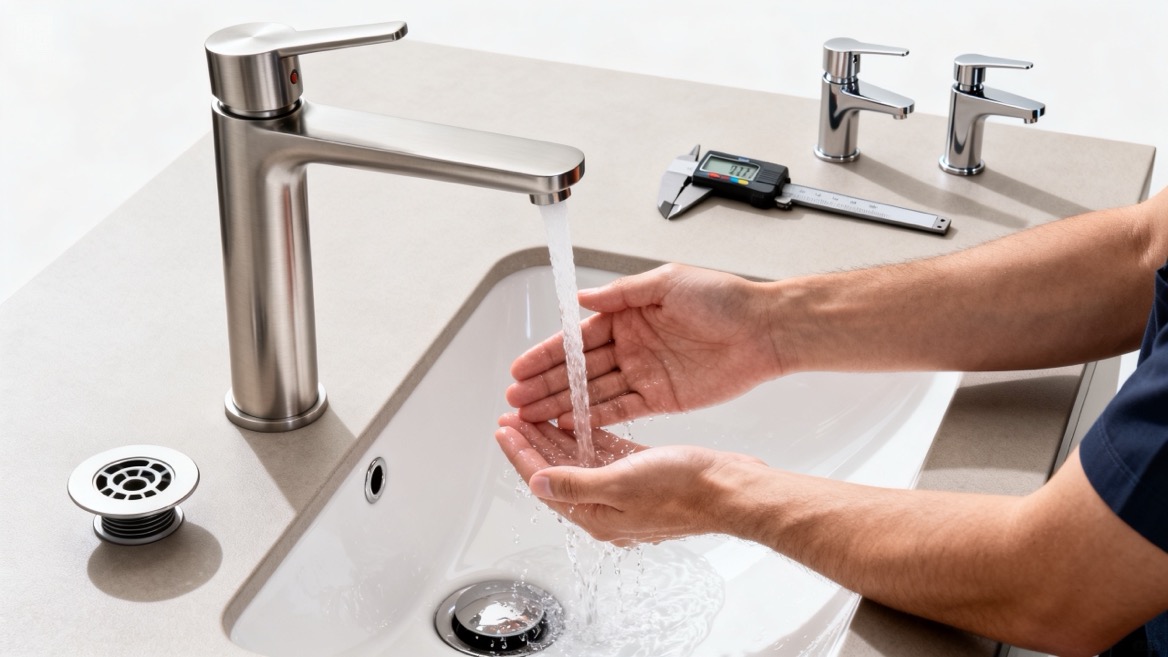
A pairing that works in one carefully positioned sample may be sensitive to small installation differences.
For international supply projects, consider basin dimensional variation, faucet-hole placement, mounting components, and finished installation position.
The practical question is: will the pairing remain usable within the declared manufacturing and installation tolerances?
A useful development exercise is to test selected boundary conditions rather than only the nominal layout. For example, evaluate the intended faucet position and the permitted installation-position limits.
Do not invent tolerance values. Use approved drawings, supplier specifications, and agreed inspection requirements.
This turns a successful prototype into a more defensible product specification.
| Symptom | Possible contributor | First check |
|---|---|---|
| Water strikes the rear wall | Insufficient reach or unsuitable angle | Compare the stream path with the basin profile |
| Droplets rebound near the drain | Drain-cap impact | Observe the exact landing point |
| Splashing increases at full opening | Flow or stream behavior | Test the specified operating range |
| Hands feel cramped | Insufficient usable clearance | Assess actual handwashing movement |
| Water travels toward the front rim | Excessive forward projection | Review reach, angle, and basin position |
These are diagnostic starting points, not guaranteed causes. Change one variable at a time so that improvements can be attributed to the correct adjustment.
For overseas brands, wholesalers, and manufacturers, a premium basin collection needs coordinated appearance, installation, and everyday usability.
Contact Jiaxing Miluo Smart Home Co., Ltd. with your basin concept, intended faucet specifications, target market, and OEM or ODM requirements. Request a project discussion focused on basin geometry, faucet compatibility, sample evaluation, and installation documentation before finalizing the collection.
It should provide comfortable handwashing clearance without unnecessary elevation. A few inches above the rim is published manufacturer guidance, but the final position should be validated with the actual pairing.
Yes, excessive outlet height can contribute. However, reach, stream direction, basin shape, and operating conditions also influence the result.
No. Depth may improve containment, but water striking an unfavorable surface can still escape. Evaluate the complete assembly.
It may help if the existing stream or flow is unsuitable. It cannot reliably compensate for water striking the rim or an upper sidewall.
Not automatically. They offer placement flexibility, but finished-wall projection, outlet elevation, basin position, and concealed installation requirements must be coordinated.
Provide basin drawings, faucet specifications, the intended drain, countertop layout, destination market, operating requirements, and target installation dimensions. Physical samples improve the assessment.
- [Hansgrohe — "Find the Right Faucet for Every Sink"]. Manufacturer documentation supporting the discussion of free-space assessment, pressure-dependent spray testing, and simulated handwashing. [pro.hansgrohe-usa]
- [Native Trails — "A Perfect Pairing: Selecting Your Vessel Sink Faucet"]. Expert guidance by Dion Wilson, Waterhouse Kitchen & Bath Studio, supporting the discussion of rim clearance, reach, stream angle, and wall-mounted positioning. [nativetrailshome]
- [U.S. Environmental Protection Agency — "Bathroom Faucets"]. Official source for the WaterSense maximum flow figure and comparison with standard faucet flow. These figures concern water efficiency, not universal splash prevention. [epa]


