
Views: 212 Author: Miluo Smart Home Publish Time: 2026-08-29 Origin: Site


Content Menu
● Why High-Rise Stone Tub Delivery Is Different
>> A 150kg Tub Is Not the Total Load
● Stone Tubs vs. Standard Bathtubs
>> Measure the Product and the Package
>> Verify Freight-Elevator Capacity
● Build a Floor-by-Floor Delivery Plan
>> Recommended Delivery Sequence
>> Use a Controlled Team, Not Extra Hands
● Choose the Right Moving Equipment
>> Packaging Is Part of the Installation Strategy
● Protect the Hotel and the Tub
● Improve Efficiency Through Product Design
>> Design Features That Support High-Rise Installation
>> Failure 1: Ordering Before Verifying Access
>> Failure 2: Using Net Weight Only
>> Failure 3: Removing Packaging Too Early
>> Failure 4: Treating Every Room the Same
>> Failure 5: Ignoring Replacement Access
● A Practical 50th-Floor Checklist
● Partner With a Bathtub Supplier That Plans Beyond Production
● FAQ
>> 1. Can a 150kg bathtub be moved in a freight elevator?
>> 2. How many workers are needed to move a 150kg stone bathtub?
>> 3. Does a hotel need a structural review for a freestanding stone tub?
>> 4. Should the bathtub remain inside its crate until it reaches the guest room?
>> 5. What is the biggest risk when moving stone tubs into high-rise hotels?
>> 6. Can an OEM supplier customize a bathtub for high-rise projects?
>> 7. Are stone-look composite bathtubs easier to install than natural stone tubs?
Moving a 150kg stone bathtub into a 50th-floor hotel guest room is not a standard delivery task. It is a coordinated high-rise logistics operation involving bathtub design, packaging, freight-elevator capacity, route verification, labor planning, floor-load review, and final bathroom installation.
For luxury hotel developers, contractors, and bathroom brands, the objective is not simply to get a heavy bathtub upstairs. The objective is to deliver a premium stone tub to the correct room, at the correct time, with zero injury, zero surface damage, zero elevator disruption, and zero rework. Jiaxing Miluo Smart Home Co., Ltd. supports OEM and ODM partners with customized modern bathroom products designed around both visual requirements and real-world installation conditions.
A 150kg bathtub may appear manageable when viewed only as a product specification. In a high-rise project, however, the weight is only one element. Dimensions, center of gravity, protective-crate size, elevator turning radius, corridor width, floor finishes, room sequencing, drainage location, and lifting points can all determine whether installation proceeds smoothly or causes costly delays.
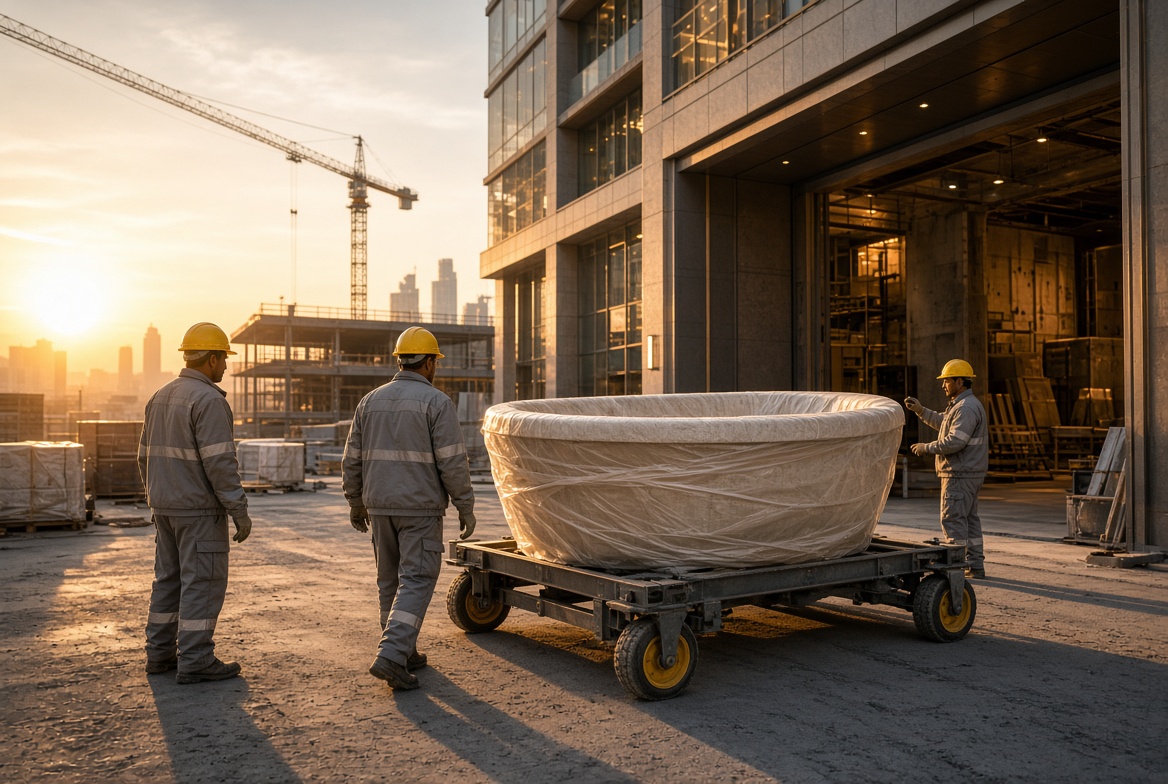
A stone bathtub installation on the ground floor can often be completed with a pallet jack, rolling cart, several trained handlers, and a short route from the unloading area. A 50th-floor guest-room installation introduces several additional constraints.
The delivery team must move the tub through multiple transition points:
1. Loading dock or site entrance
2. Temporary storage area
3. Freight elevator lobby
4. Freight elevator cabin
5. High-floor corridor
6. Guest-room door opening
7. Bathroom entrance
8. Final installation position
Every transition point creates a new risk. A bathtub that fits through the main hotel entrance may not fit through the freight-elevator door. A crate that fits inside the elevator may not allow enough turning space in a guest-room corridor. A tub that reaches the bathroom may be impossible to rotate into its final position once walls, vanities, glass partitions, or doors are installed.
The most efficient high-rise bathtub move is planned before production begins—not solved on delivery day.
For hotel projects, this is especially important because guest-room layouts are often repeated dozens or hundreds of times. A small delivery mistake can become a large-scale cost issue when the same bathtub must be transported to 100, 200, or 500 rooms.
A 150kg stone tub is only the starting point. The handling team must account for the complete moving load:
| Load Component | Typical Consideration |
|---|---|
| Stone bathtub | 150kg net product weight |
| Protective packaging | Crate, foam, edge protectors, straps, pallet |
| Moving equipment | Dollies, lifting frame, skates, suction equipment |
| Workers and tools | Personnel, rigging gear, temporary protection |
| Water and occupant after installation | Important for structural review |
| Concentrated contact points | Critical for floor and elevator protection |
The installed bathtub also creates a different engineering question. A freestanding tub may weigh 150kg when empty, but its operating load includes bathwater and the user. The project team should verify the floor structure, support conditions, and load distribution before selecting the model and approving the installation location.
Stone bathtubs vary substantially by material, wall thickness, dimensions, and production method. Natural stone products can be much heavier than 150kg, while engineered stone, solid-surface, acrylic, and lightweight composite alternatives may reduce handling complexity. A supplier should provide verified net weight, packaged weight, dimensions, and recommended lifting instructions for the exact approved model rather than relying on a generic category estimate.
The central comparison in this project is not merely "heavy versus light." It is the difference between a 150kg stone tub and a conventional hotel bathtub in terms of logistics, installation risk, visual value, and long-term positioning.
| Factor | 150kg Stone Bathtub | Standard Acrylic or Steel Tub |
|---|---|---|
| Product weight | High; requires controlled mechanical handling | Lower; may be easier to carry and position |
| Luxury appearance | Premium, sculptural, natural or mineral-inspired | Practical, familiar, more standardized |
| Freight planning | Requires elevator and route verification | Usually simpler, but still requires access checks |
| Surface protection | Important due to polished, matte, or stone-look finishes | Important, but many products are more impact tolerant |
| Installation labor | Usually needs a specialist crew and lifting equipment | Often needs fewer handlers and simpler tools |
| Floor-load review | Recommended for upper-floor installations | Still relevant, but the product load is lower |
| Custom design potential | High for OEM and ODM dimensions, colors, finishes, and drainage | High-volume standardized formats are more common |
| Guest experience | Strong focal point for luxury suites and premium bathrooms | Functional and cost-efficient for typical rooms |
| Replacement planning | Must be planned carefully due to weight and access | Easier to replace in many renovation scenarios |
A stone-look bathtub is often selected because it supports a high-end hospitality concept: spa-like bathrooms, calm neutral palettes, tactile surfaces, and freestanding visual impact. But the product must also be engineered for transport.
For a 50th-floor hotel project, an OEM or ODM supplier can reduce delivery risk by optimizing several product details:
- Reducing unnecessary wall thickness while preserving stiffness and visual quality
- Designing a stable base that distributes load effectively
- Providing safe, non-visible lifting or handling provisions where appropriate
- Selecting durable surface materials that resist scratching during installation
- Creating packaging that protects corners without making the crate unnecessarily oversized
- Aligning drain position, overflow design, and installation tolerances with the hotel's bathroom layout
- Producing modular or lightweight alternatives where the freight route is restrictive
The best bathtub is not always the heaviest-looking product. It is the product that delivers the intended luxury experience while remaining feasible to manufacture, ship, lift, install, maintain, and eventually replace.
Before a purchase order is finalized, conduct a complete vertical transport survey. This survey should be reviewed jointly by the hotel developer, architect, general contractor, MEP contractor, elevator manager, installer, and bathtub supplier.
The survey should document the exact route from truck to bathroom.
Do not assess access based only on the finished bathtub dimensions. The team must also evaluate the dimensions of the shipping crate, pallet, protective foam, and lifting equipment.
Record the following measurements:
- Bathtub length, width, height, and net weight
- Packaged length, width, height, and gross weight
- Doorway clear opening width and height
- Elevator door opening width and height
- Elevator cabin width, depth, and interior height
- Corridor width at straight sections and turns
- Guest-room entrance width
- Bathroom door width and swing direction
- Distance between walls, vanities, toilets, shower glass, and partitions
- Ceiling height where lifting equipment will operate
- Turning radius required to rotate the tub into its final position
A tub can fail an access survey even if it physically fits through each individual opening. The issue is often the turning movement between openings. For example, a 1,700mm freestanding bathtub may enter a 1,000mm-wide corridor, but it may not rotate 90 degrees at a tight corridor-to-room transition.
The freight elevator is the critical asset in a 50-story installation. The project team should obtain the elevator manufacturer's specifications and confirm the following:
- Rated load capacity
- Cabin dimensions
- Door opening dimensions
- Floor loading limits
- Permitted point loads
- Approved freight classification
- Availability during construction or renovation
- Requirement for elevator protection
- Operating restrictions and building-management procedures
Elevators and hoists must be operated within the manufacturer's stated specifications and limitations. Do not assume that an elevator with a high nominal weight rating can safely accept any concentrated load configuration. A stone tub on a small pallet or narrow wheeled dolly may create a localized loading condition that requires a load-spreading platform.
For the most reliable result, use a load-distribution base under the tub or crate. This can spread the weight across a larger elevator-floor area and reduce the chance of floor finish damage or concentrated loading concerns.
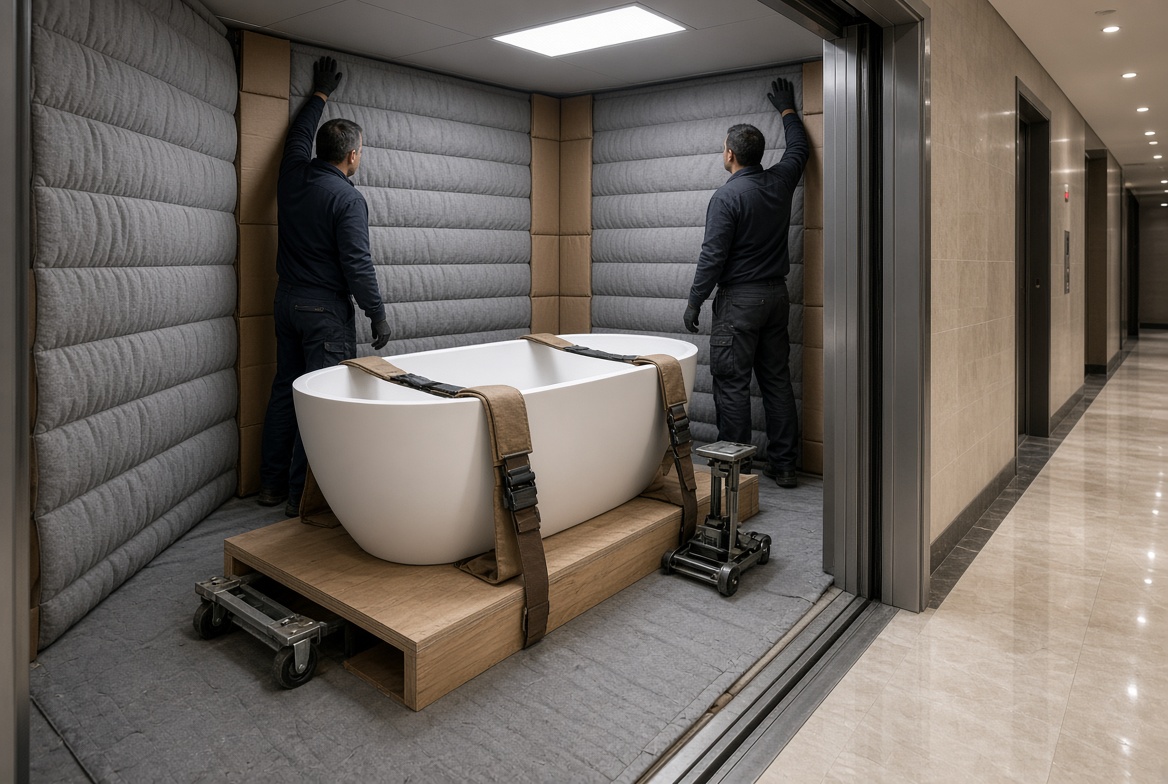
Moving 150kg stone tubs efficiently means treating the project as a repeatable system. A luxury hotel may have dozens of identical room types, so the delivery plan should be standardized, tested, and improved after the first few successful installations.
1. Confirm room readiness. The drain, water connections, waterproofing, and required wall finishes should be complete. Remove obstacles before delivery begins.
2. Reserve the freight elevator. Allocate a controlled time window and coordinate with other trades to avoid congestion.
3. Protect the route. Cover elevators, corridor floors, room flooring, corners, door frames, and finished wall surfaces.
4. Stage tubs by installation zone. Deliver only the quantity that can be safely installed or securely stored that day.
5. Use appropriate lifting equipment. Select rated dollies, lift tables, machinery skates, gantries, or other equipment based on the actual product geometry.
6. Move one tub at a time. Avoid overloading elevators, corridors, or staging areas with multiple heavy units.
7. Position before connecting plumbing. Confirm tub alignment, drain location, clearance, and final visual orientation.
8. Inspect and sign off. Record condition, room number, installer, delivery time, and any damage or deviation.
This sequence reduces unnecessary handling. Every additional lift, temporary placement, or reorientation increases the possibility of damage.
A common mistake is to respond to a heavy bathtub by assigning more workers without assigning clear roles. More people can create confusion if no one controls the movement.
For a 150kg bathtub, the delivery crew should include:
- A designated lift supervisor
- Trained equipment operators
- Spotters for doors, corners, and elevator thresholds
- An installer familiar with the bathroom layout
- A quality-control representative for surface inspection
The team should agree on simple commands before moving the product: lift, stop, lower, turn, clear, and hold. Communication is especially important in narrow hotel corridors, where a minor steering error can damage premium wall panels, stone flooring, joinery, or door frames.
Manual handling should not be the primary strategy for a 150kg bathtub. Guidance on material handling emphasizes reducing physical strain, using mechanical aids, and limiting pushing and pulling forces. Stair-climbing hand trucks may be useful for appropriate loads, but large bathtubs require a method selected specifically for their weight, shape, route, and stability.
The right equipment depends on the bathtub material, base design, packaging configuration, and route conditions. There is no universal "best" tool for every stone tub installation.
| Equipment | Best Use | Key Benefit | Important Limitation |
|---|---|---|---|
| Heavy-duty platform dolly | Smooth corridors and level routes | Simple controlled transport | Requires secure load restraint |
| Machinery skates | Heavy tubs with stable flat bases | Low-profile movement and high capacity | Less suitable for uneven surfaces |
| Hydraulic lift table | Height adjustment at bathroom entry | Reduces awkward manual lowering | Requires clear operating space |
| Mobile gantry or lifting frame | Final placement where overhead clearance permits | Precise vertical positioning | Needs approved lifting points and trained operators |
| Vacuum lifting equipment | Smooth, non-porous surfaces when manufacturer-approved | Can assist controlled handling | Must never be used beyond rated capacity or on unsuitable finishes |
| Load-spreading boards | Freight elevator and finished floors | Reduces concentrated load risk | Must be sized and secured correctly |
| Protective moving blankets and corner guards | All stages | Prevents scratches and impact damage | Must not conceal unsafe rigging conditions |
For stone-look, solid-surface, and composite bathtubs, surface protection deserves special attention. Abrasive materials, metal buckles, exposed pallet nails, and unpadded straps can permanently mark a premium matte surface. Installers should use clean padded contact materials and inspect every product before removing protective films.
For overseas hotel projects, packaging must protect the bathtub from factory to guest room. Yet excessively large crates can create access problems at the jobsite.
An effective packaging strategy balances four objectives:
- Impact protection during container shipping and unloading
- Moisture resistance for long-distance logistics
- Efficient dimensions for freight elevators and corridors
- Fast unpacking near the installation location
Jiaxing Miluo Smart Home Co., Ltd. can support brand and project partners with custom packaging concepts that reflect the tub's material, shape, installation route, and destination-market requirements. For repeated hospitality projects, packaging labels should clearly show room number, model code, orientation, gross weight, handling symbols, and opening instructions.
This reduces searching, re-handling, and incorrect deliveries on high floors.
High-rise delivery risk is not limited to the bathtub. A 150kg unit can also damage the building if the route is not protected.
The highest-risk areas usually include:
- Freight-elevator thresholds
- Passenger-elevator lobbies
- Carpeted corridors
- Stone or tile flooring
- Door frames
- Plasterboard corners
- Glass partitions
- Finished vanity tops
- Bathroom waterproofing areas
- Newly installed fittings and fixtures
Before each delivery shift, inspect the protection system. Check that floor protection is flat, dry, secure, and strong enough for wheeled equipment. Loose protective boards can create a trip hazard or destabilize a dolly.
Never drag a stone tub directly across finished flooring. Even if the tub appears stable, direct dragging can scratch the tub base, damage tile or stone, and create uncontrolled movement.
A practical approach is to create a "last 10 meters" plan. This is the final route from the guest-room door to the bathroom installation point. It is often the tightest and most expensive section of the move. The team should test this route with a full-size mock-up, a dimensional template, or the first approved tub before mass installation begins.
For OEM and ODM bathtub programs, the highest-value decisions are made early. Product design can reduce installation time, labor cost, and project risk without compromising the visual identity of a luxury bathroom collection.
A project-focused bathtub design may include:
- A narrower transport profile with a spacious internal bathing area
- Optimized weight-to-strength ratio
- Reinforced but lightweight composite construction
- Integrated leveling feet or concealed adjustable supports
- A base geometry compatible with professional moving equipment
- Pre-confirmed drain and overflow positioning
- Optional removable packaging sections for tight access routes
- Surface finishes engineered for easy cleaning and repairability
- Dedicated installation templates for plumbing teams
For example, a hotel brand may request a deep oval freestanding stone-look bathtub with a premium matte finish. Rather than simply increasing wall thickness to create a substantial feel, the manufacturer can use material engineering, structural reinforcement, and optimized geometry to achieve the design intent while controlling product weight and improving upper-floor delivery feasibility.
This is where supplier experience matters. A bathtub factory should understand not only molding, finishing, quality inspection, and export packaging, but also the realities of freight elevators, hotel corridors, contractor schedules, and installation sequencing.
The most expensive bathtub-delivery problems are usually predictable.
A developer approves a large luxury tub based on a rendering, then discovers it cannot turn into the guest-room bathroom.
Prevention: Complete the route survey and create a dimensioned access drawing before production approval.
The installation team confirms that the elevator can carry 150kg but ignores the crate, tools, personnel, and concentrated load from moving equipment.
Prevention: Calculate gross transported weight and use a load-distribution plan.
The tub is unpacked at the loading dock, then exposed to impacts throughout the building route.
Prevention: Keep protective packaging in place as long as possible and remove it near the installation room.
Guest rooms can have different door swings, corridor turns, vanity layouts, or construction progress.
Prevention: Group rooms by access condition and inspect each delivery zone before moving tubs.
A hotel may install the tub successfully during construction, but future renovation becomes difficult after corridors, doors, and fixed furniture are completed.
Prevention: Document the replacement route and maintain installation records for each model.
Use this checklist before moving a 150kg bathtub into a high-rise guest room:
- Confirm the exact bathtub model, net weight, gross weight, and dimensions
- Verify freight-elevator capacity and interior dimensions
- Confirm elevator booking and building-management approval
- Measure all route openings, turns, and ceiling clearances
- Check corridor and guest-room readiness
- Confirm bathroom drain location and floor-level requirements
- Install floor, wall, door-frame, and elevator protection
- Select rated handling equipment
- Prepare load-spreading boards where needed
- Assign a lift supervisor and trained crew
- Keep the bathtub protected until final positioning
- Conduct a final finish inspection before handover
- Record room number, batch number, and installation condition
A luxury bathtub can elevate a hotel bathroom, strengthen a brand's design language, and create a memorable guest experience. But a premium product must be supported by practical installation planning.
For a 50th-floor project, efficient stone tub delivery begins with the product specification. It requires confirmed weights, route-aware dimensions, custom packaging, reliable export coordination, and professional installation guidance. Choosing the right OEM and ODM partner can turn a difficult high-rise delivery into a repeatable, controlled process.
Jiaxing Miluo Smart Home Co., Ltd. works with overseas bathroom brands, wholesalers, developers, and manufacturers to develop customized modern bathroom collections, including freestanding bathtubs and integrated bathroom solutions. We can help evaluate product dimensions, packaging options, material choices, and installation requirements before mass production begins.
Contact our team to discuss your high-rise hotel bathtub project, OEM requirements, custom tub dimensions, packaging specifications, and delivery-route challenges.

Yes, provided that the freight elevator's rated capacity, cabin dimensions, door opening, floor-load conditions, and operating rules are verified in advance. The total transported load includes the bathtub, packaging, moving equipment, and personnel—not only the 150kg net tub weight.
The correct number depends on the route and equipment. A trained team should use mechanical handling equipment rather than relying on manual lifting. Assign a lift supervisor, equipment operators, and spotters, with roles determined through a risk assessment.
A structural review is strongly recommended, particularly on upper floors. The assessment should consider the bathtub's empty weight, water capacity, occupant load, installation footprint, and the building's structural system. Natural stone tubs can create significantly higher installed loads than their empty product weight suggests.
Usually, yes. Keep the product protected as long as practical. The packaging may need to be partially removed before the elevator or room entry if access is restricted, but this should be planned in advance with adequate temporary protection.
The biggest risk is inadequate route planning. A product may be within the elevator's weight limit but still fail because of crate size, corridor turns, doorway width, floor protection, or final bathroom access.
Yes. A capable OEM or ODM supplier can adjust bathtub dimensions, material selection, wall thickness, base configuration, drainage position, packaging, labeling, and installation documentation to better suit a project's access and design requirements.
Often, yes. Stone-look composites and solid-surface materials may achieve a similar visual effect at a lower weight than natural stone. However, the exact product weight, stiffness, finish durability, and installation requirements must be confirmed for the specific model.
1. [Occupational Safety and Health Administration — Material Hoists, Personnel Hoists, and Elevators]
2. [Occupational Safety and Health Administration — Materials Handling: Pushing, Pulling and Carrying]
3. [OIX Design — Stone Bathtub Installation Planning Guide]
4. [Marble Seven — Stone Bathtub Types, Materials, Installation and Care Guide]
5. [Oatey — Houston Hilton Bathtub-to-Shower Conversion Case Study]
6. [Murphy Elevator — Freight Elevator Guide for Industrial Applications]


