
Views: 220 Author: Miluo Smart Home Publish Time: 2026-08-20 Origin: Site


Content Menu
● Why Rooftop Resin Stone Tubs Need Special Planning
>> A Practical Rooftop Load Example
● Structural Capacity: The First Approval Gate
>> Put the Tub Near Structural Support
>> Do Not Estimate From Product Weight Alone
● Resin Stone Tub vs. Rooftop Terrace Requirements
● Waterproofing and Drainage: The Most Common Risk Area
>> Essential Waterproofing Details
>> Drainage Must Work in Real Conditions
● Plumbing for Outdoor and Semi-Outdoor Tubs
>> Plan These Connections Early
● Weather, UV, and Material Performance
● Delivery and Installation Logistics Often Decide the Project
● A Pre-Order Checklist for Buyers and Specifiers
● Can a Rooftop Terrace Support a Freestanding Resin Stone Tub?
● Build a Rooftop Bathing Experience With Confidence
● FAQ
>> 1. Can a resin stone bathtub be placed directly on rooftop tiles?
>> 2. How heavy is a freestanding resin stone tub when filled?
>> 3. Is a rooftop bathtub more likely to leak?
>> 4. Can resin stone tubs remain outdoors all year?
>> 5. Do rooftop tubs need a special drain?
>> 6. Are smaller tubs safer for rooftop terraces?
Yes—freestanding resin stone tubs can be installed on rooftop terraces, but only when the terrace structure, waterproofing system, drainage design, access route, and local requirements are professionally verified first. A rooftop installation should never be treated like placing ordinary outdoor furniture: a filled freestanding resin stone tub can create a substantial concentrated load and introduces ongoing water-management risks.
For brands, developers, wholesalers, and hospitality projects, a resin stone bathtub can turn a rooftop terrace into a premium wellness feature. However, the product specification and installation design must work together from the earliest project stage.

A rooftop terrace tub combines three loads in one location:
- The empty bathtub weight
- The weight of the water
- The weight of the bather or bathers
Resin stone is valued for its sculptural look, matte finish, solid feel, and durability. Yet compared with many acrylic freestanding tubs, it is generally heavier. Product examples on the market range widely: a 55-inch resin stone model may weigh about 225 lb, while larger solid-surface models can exceed 400 lb before water is added.
Water is the largest variable. One US gallon of water weighs approximately 8.34 lb. Therefore, a 70-gallon tub contains about 584 lb of water when filled to its stated capacity—before adding the tub itself or a user.
Consider a modern 59-inch freestanding resin stone tub with:
| Load component | Example figure | Estimated weight |
|---|---|---|
| Empty resin stone bathtub | 220 lb | 220 lb |
| Water capacity | 70 gallons | 584 lb |
| One adult bather | 180 lb | 180 lb |
| Total operating weight | — | 984 lb |
This is only a planning illustration. Actual water volume depends on the overflow level, bather displacement, and how full the tub is used. A 59-inch stone-resin tub with a 70-gallon capacity and approximately 220 lb net weight is commercially available, illustrating why terrace projects require engineering review rather than visual judgment.
The key question is not simply whether the rooftop can hold a bathtub. It is whether the structural system can safely support the complete operating load at that exact location, including long-term use and applicable safety margins.
Before selecting a rooftop freestanding bathtub, obtain an assessment from a qualified structural engineer familiar with the local building system and regulations.
The engineer should review:
- The terrace slab type and thickness
- Supporting beams, columns, walls, and transfer structures
- Existing dead loads from pavers, planters, furniture, screens, and finishes
- Design live loads for the terrace
- The tub's final footprint and position
- Point-load or concentrated-load effects
- Seismic, wind, and vibration requirements where applicable
In many projects, the safest placement is near a load-bearing wall, beam line, column zone, or another structurally reinforced area. The worst location may be the center of a long-span slab, even if that spot offers the best view.
A beautiful rooftop soaking area should be planned around the structure—not the other way around.
A supplier's "net weight" is only the starting point. The project team should calculate:
Operating tub load=tub weight+water weight+maximum user weight+accessories
Accessories may include a deck-mounted faucet, platform, bath tray, external insulation, decorative stone, and nearby users standing around the tub.
For example, a large resin stone bathtub may weigh 418 lb empty and hold 74 gallons of water. With water alone adding approximately 617 lb, the combined empty-tub-and-water load already exceeds 1,000 lb before the user enters.
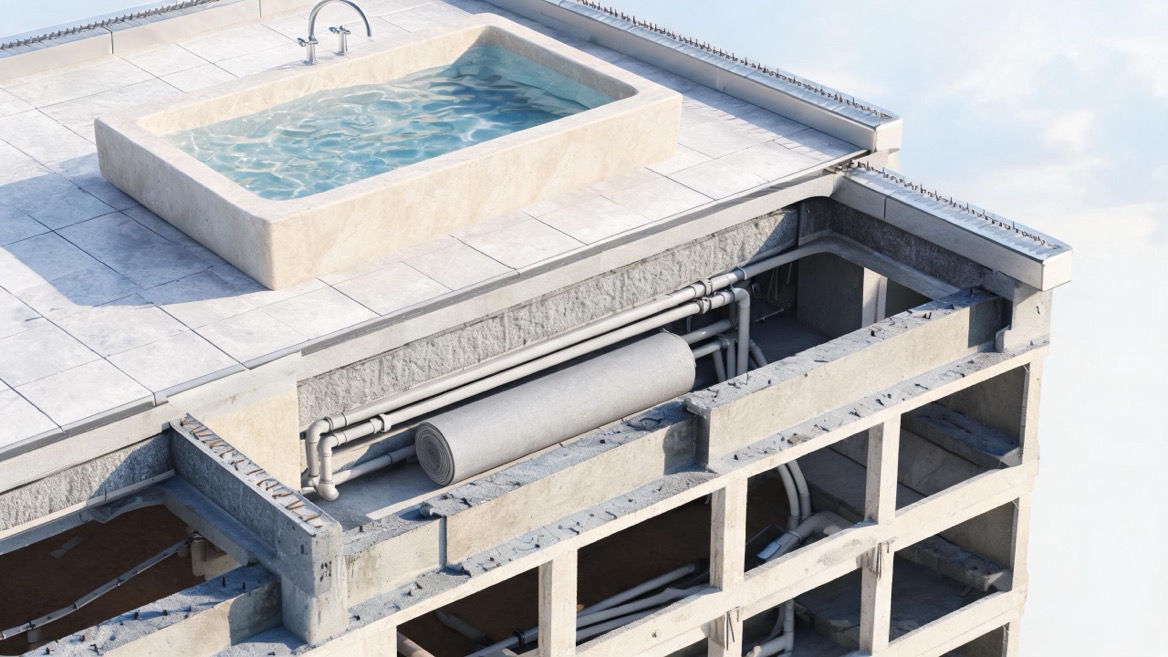
A rooftop terrace installation is possible because a well-designed terrace can accommodate substantial amenities. But it also requires more coordination than a standard indoor bathroom installation.
| Installation factor | Freestanding resin stone tub | Rooftop terrace requirement |
|---|---|---|
| Weight | Usually heavier than acrylic alternatives | Structural verification is essential |
| Base | Flat, stable support needed | Level, reinforced, non-flexing substrate |
| Water supply | Requires hot and cold water connection | Outdoor-rated, insulated, serviceable piping |
| Drainage | Uses a tub drain and overflow | Dedicated waste line with proper fall and access |
| Waterproofing | Water may splash around the base | Multi-layer waterproofing and protected penetrations |
| Weather exposure | Material must suit the environment | UV, temperature, wind, and freeze-thaw evaluation |
| Maintenance | Drain and fittings need service access | Access panel or removable deck detail required |
| Delivery | Heavy and bulky product | Crane, hoist, lift size, stairs, and route planning |
Freestanding does not mean infrastructure-free. The tub may stand independently as a design object, but it still depends on engineered plumbing, drainage, waterproofing, and support below.
A rooftop terrace already performs a critical protective function for the building. Installing a bathtub adds more water exposure, more penetrations, and a higher consequence if water escapes.
The waterproofing design should be treated as a dedicated wet-area assembly—not simply a standard exterior deck with a tub placed on top.
A robust rooftop bathtub zone should include:
- A correctly sloped surface directing water away from the building
- Compatible waterproofing membrane beneath the finish layer
- Properly detailed drains and membrane terminations
- Waterproofed pipe penetrations
- Overflow routing that does not discharge onto the roof surface
- Threshold, flashing, and wall-junction detailing
- A drainage path for splashed water and rainwater
- Inspection access for the drain trap and pipe connections
Never rely on the tub drain as the terrace drainage system. Rainfall, splashes, cleaning water, and an accidental overflow must have a separate, reliable route to roof drains.
A rooftop bathtub area should be tested before final handover. The team should perform a controlled water test to confirm that:
1. The terrace surface drains without ponding.
2. The bathtub drain empties at the intended speed.
3. The overflow operates correctly.
4. No leakage occurs at pipe penetrations or waterproofing transitions.
5. Service access remains practical after final finishes are installed.
This procedure is especially important for hotels, villas, serviced apartments, and high-end residential developments, where maintenance failures can affect floors below.
A rooftop resin stone tub needs more than a visually attractive floor-mounted faucet. Plumbing should be designed for climate, maintenance, and water pressure.
- Hot and cold water lines: Size them for the desired filling time and fixture flow rate.
- Waste pipe: Confirm diameter, fall, venting approach, and connection location.
- Overflow system: Specify an integrated overflow compatible with the selected tub.
- Isolation valves: Allow maintenance without shutting down the whole property.
- Freeze protection: Insulate and protect pipes in cold climates.
- Access point: Ensure technicians can reach valves, trap, and fittings later.
- Backflow protection: Follow local plumbing requirements, particularly where hand showers or filling spouts may create cross-connection risks.
For a luxury guest experience, filling time matters. An oversized soaking tub with a deep water capacity can feel impractical if the plumbing system fills it slowly or loses hot-water temperature before the tub is ready.
Outdoor conditions vary significantly by market. A resin stone bathtub specified for an enclosed bathroom may need additional evaluation for a fully exposed rooftop terrace.
Ask the manufacturer to confirm the product's suitability for:
- Direct sunlight and UV exposure
- Large day-to-night temperature changes
- Rain, humidity, and salt air
- Freeze-thaw cycles
- Wind-blown debris and surface cleaning methods
- Thermal movement around surrounding decking or tiles
A high-quality resin stone formulation can offer a premium solid-surface appearance and repairable characteristics, but the complete installation system matters just as much as the material itself. Sealants, fittings, deck finishes, and plumbing components must all be selected for the exposure level.
For coastal projects, specify corrosion-resistant hardware and outdoor-rated metal finishes. For cold-climate projects, avoid designs that leave water trapped in exposed supply lines or concealed drainage components.
Many rooftop tub projects fail before installation because delivery access is considered too late. A resin stone bathtub may be too long, heavy, or bulky for an elevator, stairwell, doorway, or narrow terrace opening.
Before order confirmation, verify:
- Packed dimensions and gross weight
- Elevator door, car, and load capacity
- Stairwell turning radius
- Door and corridor clearances
- Crane or hoist permissions
- Roof-edge lifting plan
- Temporary protection for finished surfaces
- Safe handling capacity at the installation area
A 63-inch resin stone tub, for example, may weigh more than 330 lb as a product and over 450 lb in its shipping package. The gross shipping weight—not only the net product weight—matters for logistics.
For OEM and ODM programs, this is where custom dimensions create real commercial value. A supplier can help a brand develop a tub size, drain location, overflow configuration, and packaging strategy that match the target project's architectural constraints.
Use this checklist before finalizing a rooftop freestanding resin stone tub.
1. Obtain written structural approval for the proposed tub location.
2. Confirm the maximum filled operating weight.
3. Review tub dimensions, footprint, water capacity, and drain position.
4. Confirm whether the tub is suitable for exposed outdoor use.
5. Coordinate supply, drainage, venting, overflow, and isolation valves.
6. Design terrace waterproofing and secondary drainage separately from the tub drain.
7. Plan service access for all concealed plumbing components.
8. Verify the delivery route and lifting method using packed dimensions.
9. Confirm local permits, building requirements, and liability responsibilities.
10. Complete leak, drainage, and functional testing before project handover.
It can—but only after a project-specific review. There is no universal "safe rooftop tub weight" because each terrace has a different structural design, span, age, finish build-up, and load history.
A compact resin stone tub may weigh around 225 lb empty, while larger designs can exceed 400 lb. Water capacity can add hundreds of pounds more. That difference directly affects the appropriate tub model, location, and reinforcement approach.
For this reason, the best project workflow is:
1. Confirm structural and waterproofing conditions
2. Choose the tub size and water capacity
3. Coordinate plumbing and drainage
4. Verify logistics
5. Manufacture and install to the approved specification
A rooftop terrace freestanding resin stone tub can become a defining feature for luxury villas, boutique hotels, wellness resorts, and premium residential developments. The opportunity is real—but the installation must be engineered as a complete system.
Jiaxing Miluo Smart Home Co., Ltd. supports overseas brands, wholesalers, and project buyers with customized modern bathtub solutions, including OEM and ODM development. From tub dimensions and finish options to drain positioning and project-oriented packaging, the right manufacturing partner can help reduce design compromises before production begins.
Contact Jiaxing Miluo Smart Home Co., Ltd. to discuss a customized freestanding resin stone tub solution for your rooftop terrace project.
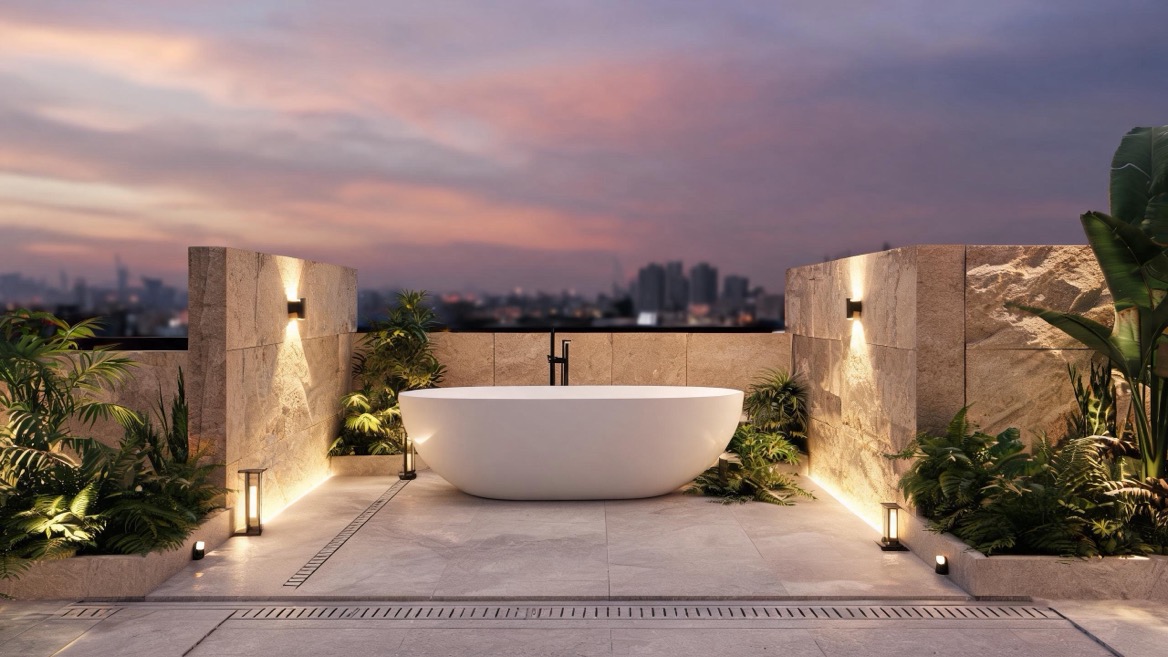
Not without verification. The tiles, adhesive, waterproofing layer, screed, and slab below must be assessed as a complete system. The tub should sit on a flat, stable, fully supported surface, and the load should be approved for that exact location.
It depends on tub weight, capacity, and user weight. A 220 lb tub holding 70 gallons of water can reach about 804 lb before a bather enters. With a 180 lb adult, the total becomes approximately 984 lb.
It can be if waterproofing, drainage, penetrations, or service access are poorly designed. A properly detailed system with separate terrace drainage, tested waterproofing, and accessible plumbing greatly reduces the risk.
That depends on the material specification and local climate. Confirm UV resistance, temperature tolerance, freeze-thaw suitability, and cleaning guidance with the manufacturer before specifying a tub for full outdoor exposure.
They need a correctly sized and properly sloped waste connection, an integrated overflow, and accessible service points. The terrace must also have independent rainwater drainage; the tub drain should not be used as the terrace's only water-removal method.
A smaller tub may reduce total operating weight, but it is not automatically safe. Structural capacity depends on the tub's location, footprint, support conditions, water depth, and the existing terrace design.
1. [ARTSTONE 55-Inch Stone Resin Freestanding Bathtub Product Specifications]
2. [Home Depot Product Specification Sheet: Freestanding Bathtub]
3. [ARTSTONE 59-Inch Resin Stone Freestanding Bathtub Product Specifications]
4. [SAGE SSF6736 Resin Stone Freestanding Bathtub Specification Sheet]
5. [Elemento Bath 59-Inch Round Solid Surface Freestanding Bathtub]
6. [Magnus Home Products: 65-Inch Yipsen Resin Freestanding Tub]


