
Views: 263 Author: Miluo Smart Home Publish Time: 2026-09-27 Origin: Site


Content Menu
● What Makes a Freestanding Tub Worth Buying?
>> Check the Interior, Not Just the Exterior
● Which Freestanding Tub Size Fits the Room?
● Compare Freestanding Bathtub Materials
>> Consider Entry and Accessibility
● Plan Installation Before Ordering
>> Calculate a Preliminary Loaded Weight
● What Should OEM and ODM Buyers Verify?
>> Create a Sample-to-Production Gate
● How Should You Use Customer Reviews?
● Keep the Tub Looking Its Best
● Build a Collection Buyers Can Trust
>> What is the best material for a freestanding tub?
>> Are freestanding tubs comfortable for daily use?
>> How much space does a freestanding tub need?
>> Can a freestanding tub be installed upstairs?
>> Does a freestanding bathtub need an overflow?
>> What should I request from an OEM bathtub supplier?
The best freestanding tubs do more than look impressive in a photograph. They feel comfortable when filled, fit the finished bathroom, work with the planned plumbing, and arrive with clear installation information. For brands and wholesalers developing a premium bath collection, the right freestanding bathtub is not one universal model. It is a combination of size, material, comfort, installation requirements, and consistent manufacturing quality.
This guide explains how to choose a luxury freestanding soaking tub from both the buyer's and the sourcing team's perspective. It also outlines what to verify before approving a custom bathtub for an OEM or ODM program.

A sculptural silhouette attracts attention, but everyday use determines satisfaction. Bathers notice the backrest, usable water depth, entry height, and ease of cleaning. Installers notice drain alignment and faucet access. Distributors notice finish consistency, shipping damage, and missing documentation.
A strong product decision accounts for all three experiences. The tub should suit its intended user, fit its installation site, and be reproducible at the required quality. Treat a beautiful design that fails one of these tests as a product still needing work.
Exterior length does not tell you how much room a bather will have. A thick rim or sharply angled wall can reduce usable space. Likewise, a deep-looking shell may hold less water than expected because of its overflow position.
Request the internal length, internal width, water depth to the overflow, and capacity at that level. If possible, sit in a physical sample. Check shoulder support, foot position, and whether the rim helps or hinders entry. For a double-ended tub, assess both reclining positions rather than assuming they are identical.
Measure the bathroom after allowing for tile, vanity depth, door swing, storage, and faucet location. Then compare those measurements with the tub's technical drawing. A lifestyle image cannot establish whether the drain will align or whether the filler can be serviced.
| Planning scenario | Tub direction to explore | Most important check |
|---|---|---|
| Compact bathroom | Shorter oval or back-to-wall profile | Interior legroom and access |
| Standard primary bath | Balanced oval or rectangular profile | Circulation and faucet reach |
| Large focal-point bath | Sculptural or double-ended design | Proportion, floor load, and delivery |
| Hotel or multi-unit project | Repeatable standard footprint | Consistent rough-in and replacement |
These are selection scenarios, not universal size rules. A shorter tub with a space-efficient interior may feel roomier than a larger model with thick sides. Compare usable dimensions before choosing by exterior length alone.
A bathtub that fits the room must still pass through the building. Check the packaged dimensions against doorways, stairs, elevator openings, and tight turns. Confirm the proposed filler reaches the bowl without striking the rim or directing water outside it.
Also consider cleaning and service. A narrow gap behind a tub may be harder to maintain than an intentionally planned, accessible layout. Agree on placement before flooring and plumbing work are finalized.
Material affects weight, touch, appearance, handling, and maintenance. No material is automatically best at every price point. Compare the construction of the specific model, not just a broad label such as "premium acrylic" or "stone resin." Material guides consistently identify meaningful differences in weight, installation demands, durability, and care.
| Material | Why buyers consider it | What to verify |
|---|---|---|
| Reinforced acrylic | Relatively light; accommodates varied shapes | Reinforcement, flex, finish, and care |
| Solid surface or stone resin | Substantial feel; sculptural appearance | Formulation, weight, finish, and repair method |
| Enameled cast iron | Classic look; durable construction | Floor load, enamel condition, and delivery |
| Enameled steel | Crisp form and hard-coated surface | Coating integrity and chip-care guidance |
Reinforced acrylic can be practical for a broad retail range because it is relatively light and adaptable to different shapes. Still, two acrylic tubs can differ substantially. Ask how the shell is reinforced, supported, and inspected; check whether the finished sample feels stable in use.
Solid surface can support a distinctive premium look, but formulations vary. Request the exact material description, finished weight, care guide, and repair procedure. If a supplier makes a measurable claim about heat retention or scratch resistance, request the test method before repeating it in product copy.
Cast iron brings different handling and structural considerations. Enameled steel requires attention to coating condition and the manufacturer's guidance if the surface is chipped. For every material, use the actual model's instructions—not a general industry claim—to explain maintenance to customers.
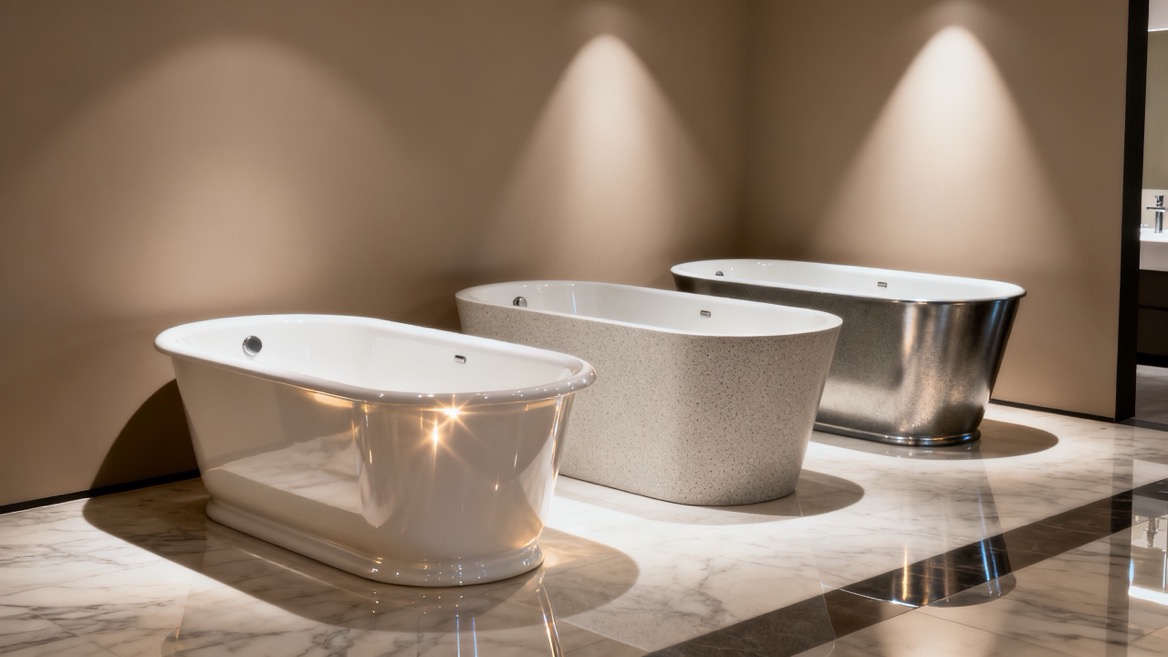
An oval tub can soften a contemporary bathroom. A rectangular profile can complement a linear layout. A slipper tub offers a raised back, while a double-ended tub allows reclining from either end. Shape alone does not guarantee comfort.
Test the relationship between the backrest and the overflow height. Check foot space, rim grip, entry height, and how the lower back meets the shell. If the product targets hospitality or a broad retail audience, have people of different heights assess the same sample.
A deeper tub may make entry more difficult for some users. Plan the route into the bath, the surrounding floor, and reachable controls rather than judging comfort only while seated.
Do not describe a conventional freestanding shell as an accessible bathtub without assessing the complete installation. Where accessibility requirements apply, they may address seats, clearances, grab bars, and controls—not simply the tub's shape.
Installation problems can turn a premium bath into an expensive service issue. Use the model-specific installation manual and have a qualified installer review the site before the plumbing rough-in. Installation guidance emphasizes floor support, dry fitting, drain alignment, level placement, and leak testing.
1. Confirm the drain. Match its centerline and connection to the approved drawing.
2. Position the filler. Check spout reach, water direction, supply lines, and service access.
3. Inspect the floor. Verify levelness and the finished surface.
4. Assess the load. Include the tub, water, and user, particularly for upstairs installations.
5. Check access. Make sure the protected tub can travel through the building.
6. Dry-fit and test. Follow the manufacturer's instructions and check drain and overflow connections before completing the installation.
Avoid publishing one wall-clearance or drain-rough-in figure for every tub. The correct layout depends on the model, faucet, floor, and service plan.
For early planning, add empty tub weight + water weight + bather weight. Water weighs approximately 8.34 pounds per US gallon. For example, a hypothetical 110-pound tub containing 65 gallons of water with a 180-pound bather would create a combined load of approximately 832 pounds.
That figure is not a determination that the floor is adequate. A qualified professional must assess how the tub supports and distributes its load. Also ask whether the stated water capacity is measured to the overflow or by another method; maximum capacity and a typical occupied bath are not necessarily the same.
For a brand, the best freestanding bathtub is one it can sell consistently. An attractive prototype is insufficient if production units vary in color, dimensions, finish, or drain fit.
Request a specification pack containing exterior and interior dimensions, tolerances, finished weight, material construction, drain and overflow details, installation instructions, care guidance, and packaging requirements. Define which characteristics are inspected on every unit and how defects will be recorded and resolved.
Confirm that any test reports or certifications apply to the specific product and destination market. Do not assume documentation for one model covers the entire collection.
1. Define the market. Identify the target user, sales channel, and intended price position.
2. Approve the drawing. Agree on dimensions, drain position, finish, and filler interface.
3. Evaluate a sample. Check comfort, appearance under showroom lighting, and installation fit.
4. Record a master standard. Preserve approved color, finish, packaging, and inspection criteria.
5. Review pilot production. Check repeatability, labeling, spare parts, and protection during transit.
For an ODM project, establish ownership of approved drawings and tooling, plus a process for design changes. For an OEM project, confirm branding, carton artwork, manuals, and replacement-part identifiers before production. These details influence the customer experience well after the tub leaves the factory.

Reviews can expose issues that specifications miss. Group verified feedback into comfort, finish, delivery, installation, and cleaning. A recurring comment about a steep backrest may justify a design review. A damaged carton may indicate a packaging or handling problem rather than a defect in the shell.
Avoid turning an individual impression into a universal performance claim. If a reviewer says a tub "holds heat well," that does not establish a comparable test result. Check the model, context, and supporting service records before using the observation in marketing.
No customer-review text was supplied for this rewrite. Add quotations only after checking their wording, model relevance, authenticity, and permission to use them.
Care instructions should match the actual material and finish. As a general starting point, use a soft cloth and the manufacturer's recommended non-abrasive cleaner, then rinse and dry the surface. Do not promise that a finish resists every stain, chemical, or scratch. Installation guidance also recommends checking drain and overflow fittings as part of ongoing care.
For a private-label range, make the care guide easy to find. Clear instructions and identifiable replacement parts can prevent avoidable complaints and simplify after-sales support.
The best freestanding tubs balance bathing comfort, room fit, material quality, installation readiness, and dependable supply. Start with the intended user and project drawing. Then validate the physical sample and production controls before finalizing finishes or marketing claims.
Developing a private-label bathtub range? Share your target market, expected order volume, preferred material, bathroom layout, and design brief with Jiaxing Miluo Smart Home Co., Ltd. Request a model-specific specification pack, sample plan, customization scope, and OEM or ODM quotation. Confirm available capabilities and commercial terms directly before making purchasing commitments.
There is no universal winner. Reinforced acrylic offers lighter handling and design flexibility; solid surface can provide a substantial sculptural appearance; cast iron brings different durability and weight considerations. Compare specific models, not material names alone.
They can be. Check the backrest angle, usable interior length, entry height, and water level at the overflow. A physical sample provides better evidence than an exterior photograph.
It depends on the tub, faucet, cleaning access, and room circulation. Use a measured floor plan and the model's installation drawing rather than a generic gap.
Possibly, but a qualified professional should assess the loaded tub and the floor structure. The empty tub's weight alone is not enough for this decision.
Requirements depend on the project and jurisdiction. Confirm whether the selected model includes one, identify compatible drain parts, and have the installer check local requirements.
Request approved drawings, material and finish specifications, sample criteria, inspection requirements, installation and care documents, packaging details, replacement-part information, and relevant model-specific documentation.
- [Aquatica USA, "Best Freestanding Tubs by Size, Material, Comfort, and Style"] — original article identified for the rewrite; its full text could not be retrieved for a paragraph-by-paragraph assessment. [aquaticausa]
- [Bath Fitter, "What Are Bathtubs Made of? Bathtub Materials: Pros & Cons"] — material, weight, installation, and maintenance considerations. [bathfitter]
- [Kingston Brass, "How to Install a Freestanding Tub"] — floor support, dry fitting, plumbing checks, leak testing, and care. [kingstonbrass]
- [United States Access Board, "Chapter 6: Bathing Rooms"] — accessibility considerations for bathing facilities. [access-board]
- [U.S. Environmental Protection Agency, "WaterSense Specification for Homes, Version 2.0 Supporting Statement"] — water-weight conversion used in the illustrative calculation. [epa]


