
Views: 258 Author: Miluo Smart Home Publish Time: 2026-10-01 Origin: Site


Content Menu
● Start with the visual relationship
● Compare the basin and bathtub separately
● Choose undertones before color names
>> White basin and white bathtub
>> Neutral basin and neutral bathtub
>> Dark basin and light bathtub
● Match the finish, not just the hue
>> Why lighting can break a match
● Test a pairing before approval
● Specify color for OEM and ODM projects
● Consider appearance after installation
>> Should a basin and freestanding bathtub be the exact same white?
>> Can a matte bathtub work with a glossy basin?
>> Which should I choose first: the basin or the bathtub?
>> What is the safest color pairing for a premium bathroom collection?
>> How can I check whether two whites will look different after installation?
>> Is a Delta E number enough to approve a matched basin and bathtub?
>> Can a black bathtub be paired with a white basin?
A basin and a freestanding bathtub do not need identical colors to look like a set. They need a deliberate relationship. The most reliable approach is to choose the bathtub as the room's larger visual anchor, then select a basin that either matches its undertone and finish or contrasts with it in a controlled way. That matters especially when the two products use different materials: a "white" basin and a "white" bathtub can look noticeably different once they sit under the same bathroom lighting.
For a premium bathroom collection, color coordination is both a design decision and a product-specification decision. A rendering can suggest the right direction, but physical samples, agreed lighting conditions, and clear production references determine whether the finished pair delivers it. This guide covers both perspectives: how to make the room feel cohesive and how brands, wholesalers, and manufacturers can specify a basin-and-bathtub pairing with confidence.
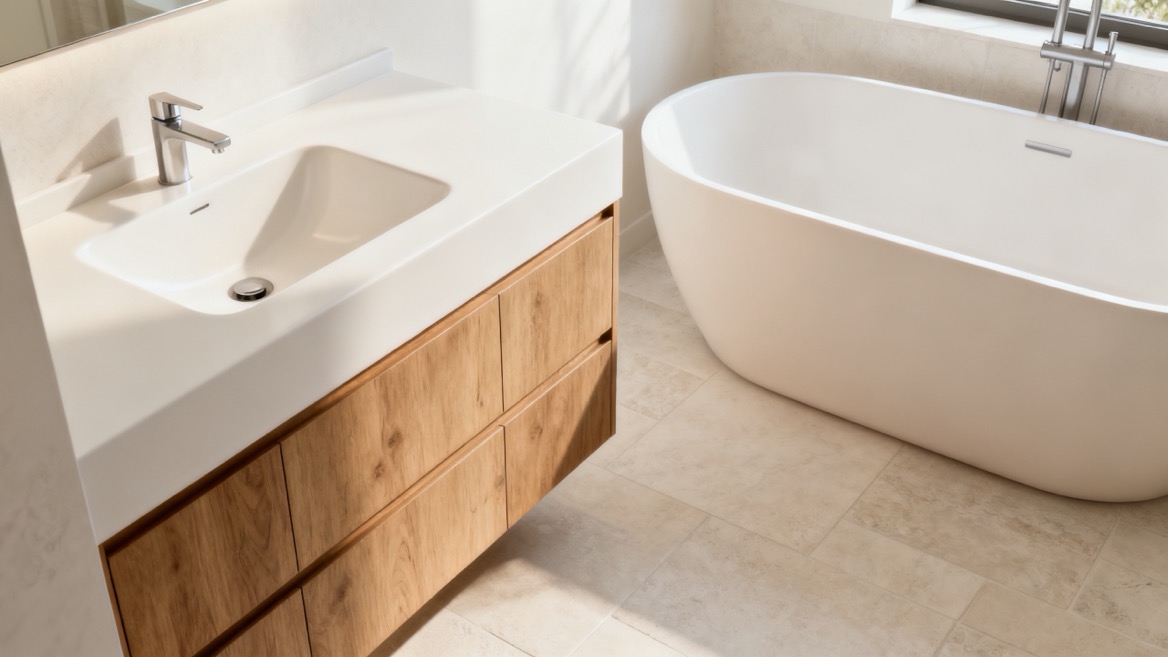
Before comparing color codes, decide what the basin and bathtub should do in the room. There are three useful approaches.
| Approach | Basin and bathtub relationship | Best use | Main risk |
|---|---|---|---|
| Close match | Similar hue, undertone, and sheen | Calm, continuous interiors | A near-match may look accidental if the difference is visible |
| Tonal pairing | Same color family, different depth | Warm, layered bathrooms | Too many intermediate shades can weaken the design |
| Intentional contrast | Clearly different light and dark colors | A sculptural focal point | Contrast may overpower a small or visually busy room |
A close match is more demanding than it sounds. If a glossy basin is cool, blue-white while the freestanding bathtub is a warm, creamy white, their shared label will not make them look coordinated. The discrepancy may be most obvious where the basin meets a white countertop or where the tub stands against pale tile.
A tonal pairing is often more forgiving. An ivory bathtub with a slightly deeper sand-colored basin, for example, reads as an intentional family rather than an unsuccessful attempt at an exact match. Intentional contrast can be simpler still: a dark basin beside a clearly light bathtub gives the eye an obvious explanation for the difference.
The key question is not "Are they the same color?" It is "Will their relationship still look intentional in the installed room?"
A basin and a freestanding bathtub play different visual roles. The basin sits within a concentrated group of finishes: countertop, vanity, faucet, mirror, and wall surface. The bathtub occupies a much larger visible area and may be seen from across the room. As a result, a color that feels subtle on a small basin can feel dominant on a full-size tub.
| Design factor | Basin | Freestanding bathtub | What to coordinate |
|---|---|---|---|
| Visual scale | Small, detail-rich focal point | Large, architectural form | Judge the tub at room scale, not just from a swatch |
| Surroundings | Close to countertop and faucet | Close to floor, wall, and tub filler | Compare each product against its immediate background |
| Viewing distance | Often seen up close | Often seen from the doorway | Check both adjacent samples and a full-room mock-up |
| Finish | Sheen is visible around the rim and bowl | Sheen affects a broad curved surface | Approve both color and gloss level |
| Daily use | Frequent contact with water and products | Broad surface exposed to bathing and cleaning | Confirm material-specific care requirements |
This difference in scale explains why a matched-color program should not stop at selecting two products from the same palette. The products must also work with the room around them. A warm-white tub may feel balanced against limestone-look flooring, while a cooler basin might still work at the vanity if a stone countertop creates a clear transition. If the basin and tub sit directly in the same sightline, however, that shift deserves closer inspection.
From a collection-planning perspective, start with the least flexible element. If the project already specifies tile and flooring, select the tub against those fixed finishes first. Then choose the basin in the context of the vanity. If you are developing a coordinated product range from scratch, decide whether buyers should understand the pieces as an exact-match set, a tonal family, or a set of designed contrasts.
Color names are helpful for browsing, but they are poor approval tools. "White," "stone," "beige," and "gray" describe broad families rather than precise appearances. Within each family, undertones can pull warm, cool, green, pink, or blue.
White-on-white is a classic combination, but it is the pairing most likely to expose a subtle mismatch. Place the actual basin and tub finish samples side by side. If one looks noticeably yellow or blue against the other, do not assume that distance will hide it. Try them against the proposed tile and countertop as well.
If the difference is small but persistent, you have two choices: refine the finishes toward a closer match, or make the distinction purposeful. A warm-white tub with a distinctly pale-stone basin may look more considered than two whites that almost—but do not quite—agree.
Cream, sand, taupe, and stone tones can create depth without a strong light-dark contrast. Keep their undertones aligned, then let one product be slightly lighter or darker. For instance, a warm ivory freestanding bathtub can work with a beige basin when the floor and vanity repeat some of that warmth.
Avoid selecting neutrals from isolated screen images. A small swatch photographed against white may appear darker or more saturated than it does in a finished bathroom.
A charcoal or black basin can give definition to a light bathtub scheme. This works best when another permanent element—such as the vanity, floor, or architectural trim—carries a related dark tone. Otherwise, the basin may look detached from the rest of the room.
The reverse arrangement, a dark freestanding bathtub with a light basin, makes the tub the unmistakable statement piece. Give it visual space. If every surface around it also competes for attention, the basin-to-tub relationship becomes harder to read.
Two surfaces can have similar measured color yet look different because they reflect light differently. A polished basin creates bright highlights. A matte tub spreads light more softly across its curves. Texture, translucency, and surface coatings also affect what the eye sees.
That does not mean matte and glossy products cannot be paired. It means their difference should be designed, not discovered after delivery. A glossy white basin can sit comfortably with a matte white tub if the room has a clear finish hierarchy—for example, polished details at the vanity and softer surfaces around the bathing area. If the aim is a seamless matched set, request samples that represent the final production finish rather than approving pigment alone.
Ask the supplier to identify the finish on each sample and product specification. Terms such as "matte white" should be backed by an approved physical reference, because buyers may otherwise assume that two suppliers—or two product lines—mean the same thing.
A basin and bathtub may appear to match in one light and separate in another. Color professionals call this metamerism: two surfaces can look alike under one light source but different under another. It is particularly relevant when coordinating products made with different materials or finish systems.
Check samples under the lighting the customer will actually use: daylight where available, vanity lighting, and the room's general evening lighting. Look at them together, then move them into their expected positions. A sample held beside a window is not a substitute for one viewed next to the selected vanity or tub wall.
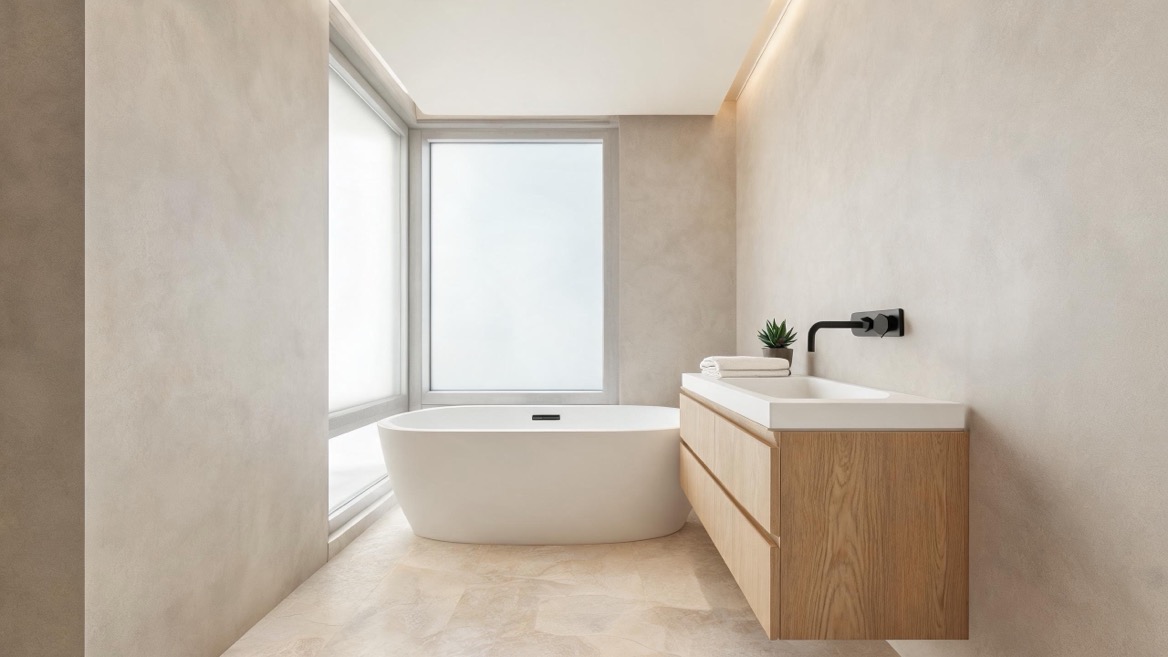
The strongest basin-and-bathtub combinations are usually easy to describe. That clarity helps designers present them, helps buyers merchandise them, and helps manufacturers specify them.
| Palette | Basin | Freestanding bathtub | Supporting finishes |
|---|---|---|---|
| Soft monochrome | Warm white | Warm white | Pale stone and restrained metal accents |
| Layered neutral | Sand | Ivory | Warm timber tones and beige tile |
| Graphic contrast | Charcoal | White | Dark vanity details and quiet walls |
| Sculptural dark | Light stone | Black or deep gray | Simple floor and wall surfaces |
| Muted color | Pale sage | Neutral white | Repeated sage in a fixed surface or cabinetry |
These are design examples, not universal rules. Before approving any palette, ask whether the surrounding finishes explain the basin-to-tub relationship. A colored basin does not have to repeat the bathtub color, but its color should have a second point of connection in the room.
Current industry reporting also supports a measured approach to color. The National Kitchen & Bath Association's 2025 bath reporting highlighted natural colors, intentional lighting, new sink colors and finishes, and easy-care surfaces. Its later year-in-review noted light neutrals with sage and olive greens in bathroom design. Those findings provide useful direction, but they do not replace testing a specific product pairing in its intended setting.
For homeowners, a physical sample check can prevent an expensive disappointment. For private-label buyers, it can prevent a mismatch being repeated across a collection. Use the same sequence for both, adding formal records when the products will be manufactured at scale.
1. Define the target relationship. Record whether the pair is intended as a close match, a tonal pairing, or a deliberate contrast.
2. Collect final-finish samples. Request representative samples for the basin and bathtub, including the intended sheen and surface texture.
3. Add fixed room materials. View the samples beside tile, countertop, flooring, and cabinetry—not on a blank desk.
4. Check more than one light source. Compare them in daylight and under the specified bathroom lighting.
5. Change viewing position. Inspect the samples together at close range, then assess product mock-ups or full-size pieces from the doorway.
6. Approve in writing. Record the approved samples, finish names, and any acceptable differences before production or purchase.
Do not let a beautiful render become the sole color standard. It is excellent for showing composition, but a screen image cannot establish exactly how two finished surfaces will look under the customer's lights.
Imagine a warm-white freestanding bathtub, a white countertop basin, pale beige wall tile, and a timber vanity. If the basin appears blue-white next to the countertop while the bathtub appears creamy next to the tile, first compare the physical samples under the same light. The answer may be to select a warmer basin. It may instead be to choose a visibly different stone-toned basin and repeat that tone in the vanity area.
The objective is not to force every surface into one shade. It is to remove the impression that an almost-match happened by accident.
A consumer chooses a bathroom. A brand or wholesaler must also choose a repeatable specification. This is where an attractive concept becomes a reliable product program.
For a coordinated basin and freestanding bathtub collection, the approval package should identify:
- The master physical sample for each product and finish.
- The material and finishing process for each item.
- The approved visual relationship between basin and bathtub.
- The lighting conditions used for review.
- The measurement method and tolerance, if numerical color control is required.
- The process for approving production samples and later batches.
Instrument readings can help teams communicate color differences, but a number without its method is incomplete. Datacolor notes that Delta E results depend on the formula and measurement conditions; a CIELAB Delta E value should not be treated as interchangeable with a CIEDE2000 value. Specify the formula, illuminant, observer, and other relevant conditions rather than requesting only "Delta E below" an unexplained threshold. Continue to use visual approval for the finished pairing.
A practical way to structure development is to approve the design intent first, then the production reference. For example, a brand may approve "warm-white tub with a slightly deeper warm-white basin" as the range concept. It should then approve actual finished samples to define what those words mean for the order. This distinction leaves room for good design while reducing ambiguity in manufacturing.
Jiaxing Miluo Smart Home Co., Ltd. works with overseas brands, wholesalers, and manufacturers on customized modern bathroom products and OEM/ODM solutions. For a proposed coordinated range, the most productive starting brief is not simply "make both products white." It is a defined pairing direction, target materials, expected finish, reference samples, and intended market positioning. Available colors, processes, tolerances, and order terms should be confirmed for the specific project rather than assumed.
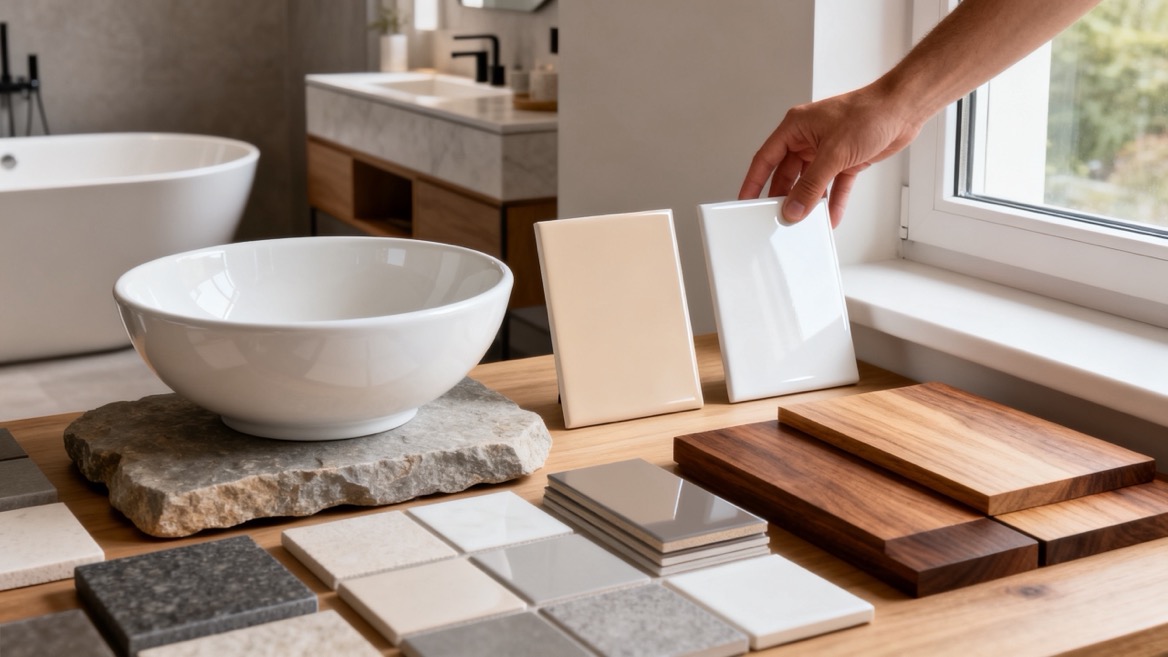
A pairing is not successful only on opening day. Water residue, inappropriate cleaners, and changes in surface appearance can alter how coordinated products feel over time. Different materials may also require different care instructions.
When evaluating samples, ask for the care guidance that applies to each finished product. For acrylic baths, Sterling advises wiping with a soft, damp sponge or cloth and avoiding abrasive brushes or scouring pads. That guidance should not automatically be applied to every basin material; confirm the basin supplier's instructions separately.
Also think about replacement planning. If a brand expects to sell the basin and bathtub as a continuing collection, it should keep approved finish references and document changes to materials or processes. A replacement basin ordered later should be checked against the same approved pairing intent—not judged only by an unchanged color name.
Choose a close match when the room calls for quiet continuity and you can approve both products against physical finish samples. Choose a tonal pairing when you want warmth and depth without a sharp focal point. Choose intentional contrast when the bathtub's form or the basin's detail deserves emphasis, and repeat the contrast elsewhere in the room.
For brands, wholesalers, and manufacturers developing a coordinated range, send Jiaxing Miluo Smart Home Co., Ltd. your target palette, basin and bathtub designs, material preferences, finish references, and expected order requirements. Request a project-specific discussion of sample approval and OEM/ODM options before committing to a color claim or collection launch.
Not necessarily. An exact-looking match can create a calm result, but two products labeled "white" may have different undertones or sheens. Compare finished samples together. If a true match is not achievable or desirable, a clearly tonal or contrasting choice can look more intentional than a near-match.
Yes. Treat the difference as part of the design. View final-finish samples under the planned lighting and decide whether the gloss difference adds useful hierarchy or makes the products appear unrelated. Matching color alone will not answer that question.
In a new bathroom, start with the product and fixed finishes that dominate the room visually—often the freestanding bathtub, floor, and wall surfaces. Then select the basin with its countertop and vanity in view. In a renovation, begin with whichever materials will remain.
A coordinated neutral pair is a flexible starting point, but there is no universally safe shade. The dependable choice is a pairing with a clear design intent, approved physical samples, and documented finishes. Its suitability still depends on the collection's materials and target interiors.
Put final-finish samples together against the chosen room materials. Review them in daylight and under the proposed bathroom lights, both close up and from a normal viewing distance. If they match under one light but not another, discuss the result before approval rather than relying on photographs.
No. Numerical color comparison can support quality control, but the formula and measurement conditions must be specified, and the finished products still need visual review. A bare Delta E limit does not describe sheen, texture, or how the pair appears in the room.
Yes. It creates an intentional contrast rather than a matched-color effect. Keep the surrounding surfaces relatively controlled, and repeat a related dark tone in at least one fixed element so the bathtub feels integrated rather than isolated.
1. National Kitchen & Bath Association. ["Bath Trends Summit Highlights NKBA's 2025 Bath Trends Report."] Industry survey context and reported bathroom design priorities. [nkba]
2. National Kitchen & Bath Association. ["Year in Review: Top Kitchen & Bath Trends of 2025."] Reporting on bathroom palettes, finishes, and lighting. [nkba]
3. Datacolor. ["What Is Metamerism?"] Explanation of why a color match can change under different lighting. [datacolor]
4. Datacolor. ["Can You Have Consistent Results Across Different Color Spaces?"] Guidance on Delta E formulas and measurement specifications. [datacolor]
5. KOHLER. ["Freestanding Bathtubs."] Examples of freestanding bathtub materials and listed color/finish options. [kohler]
6. Sterling Plumbing. ["Acrylic Baths: Care and Cleaning."] Material-specific acrylic bath care guidance. [sterling.kohler]


