
Views: 210 Author: Miluo Smart Home Publish Time: 2026-09-29 Origin: Site


Content Menu
● How Does a Linear Slot Drain Work in a Stone Wash Basin?
● Linear Slot Drain vs. Round Drain: The Main Trade-Offs
● Pros of Linear Slot Drains in Stone Wash Basins
>> A Cleaner Look for Modern Bathroom Collections
>> More Freedom in Basin Layout
>> A Distinctive OEM or ODM Product Detail
● Cons of Linear Slot Drains in Stone Wash Basins
>> Hidden Areas Can Be Harder to Clean
>> More Interfaces Mean More Details to Verify
>> Water Performance Cannot Be Judged by Slot Length
>> Custom Parts Can Complicate Later Repairs
● Expert Check: Test the Drainage Assembly, Not Just the Basin
● Stone Selection and Care: A Design Decision
● Which Drain Is Better for Your Project?
>> Are linear slot drains better than round drains for stone wash basins?
>> Do linear slot drains drain water faster?
>> Are slot drains difficult to clean?
>> Can a linear slot drain be used with natural marble?
>> Does a stone wash basin with a slot drain need an overflow?
>> What should an OEM or ODM buyer request from the supplier?
A linear slot drain can make a stone wash basin look like a single, uninterrupted surface. Instead of drawing the eye to a round waste fitting, it guides water through a narrow opening into a concealed channel below. For a premium bathroom collection, that is a compelling design choice. Yet the decision should not rest on appearance alone: drainage performance, access for cleaning, stone care, installation, and replacement parts all affect whether the basin works well after it leaves the showroom.
The most useful comparison is therefore a stone basin with a linear slot drain versus the same type of basin with a conventional round drain. Neither option is inherently superior. A slot drain offers greater freedom to shape a distinctive basin, while a round drain usually offers a simpler route to installation and routine servicing.
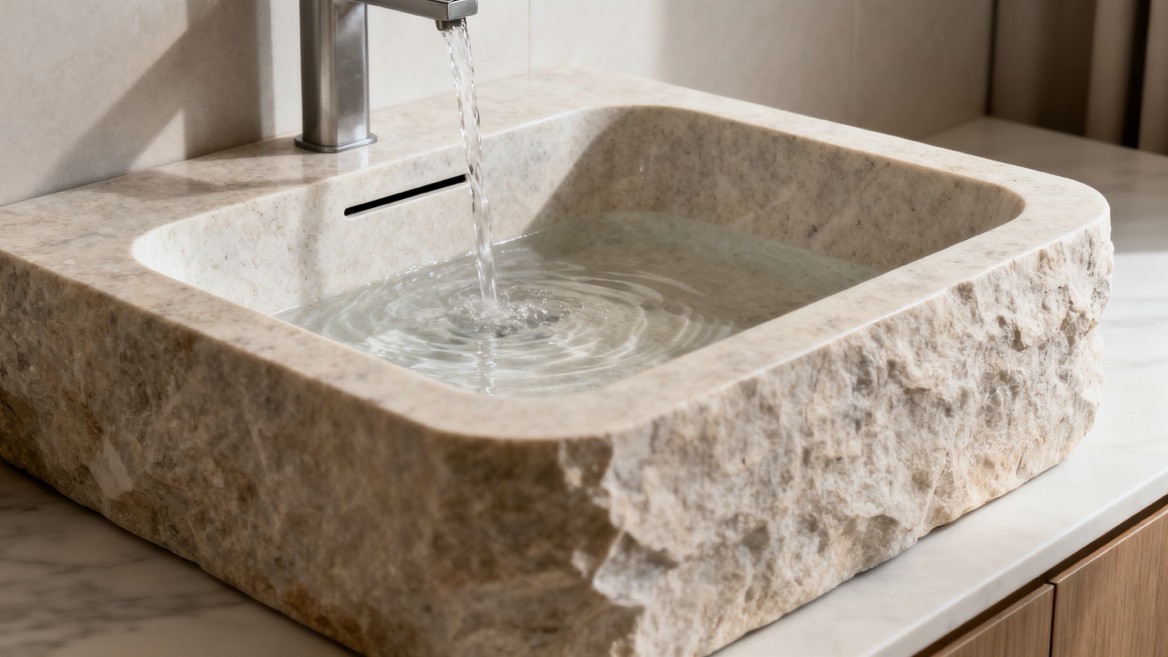
A linear slot drain uses an elongated opening cut into, or assembled within, the basin. Water passes through the slot into a collection channel or drain pan, then flows to the waste connection. Some designs leave the opening visible. Others conceal it beneath a stone cover or integrate a metal component into the basin.
That description matters because "slot drain" is not one fixed construction. The channel may be formed as part of the basin or attached beneath it. Its length, outlet position, access method, and connection can all vary. A buyer should review the complete drainage assembly, not just a photograph of the finished top surface.
The term *stone wash basin* also covers materials with different properties. Natural marble, granite, limestone, and engineered stone do not respond identically to fabrication or cleaning. Material selection should be confirmed before the slot geometry and care instructions are finalized.
| Decision factor | Linear slot drain in a stone basin | Conventional round drain in a stone basin |
|---|---|---|
| Appearance | Creates a restrained, architectural line; hardware can be less visible | Leaves a recognizable fitting within the bowl |
| Design flexibility | Supports elongated or asymmetrical basin concepts | Works readily with familiar bowl shapes |
| Water movement | Depends on basin slope, channel shape, outlet, and faucet flow | Depends on bowl slope and the selected waste fitting |
| Cleaning access | Concealed surfaces may need a removable cover or underside access | The fitting is generally easier to see and reach |
| Installation | May require a coordinated basin, channel, seal, and outlet assembly | Often uses more familiar components and installation steps |
| Future service | Custom pieces should be documented and available as spares | Compatible replacements may be easier to source, subject to the fitting specification |
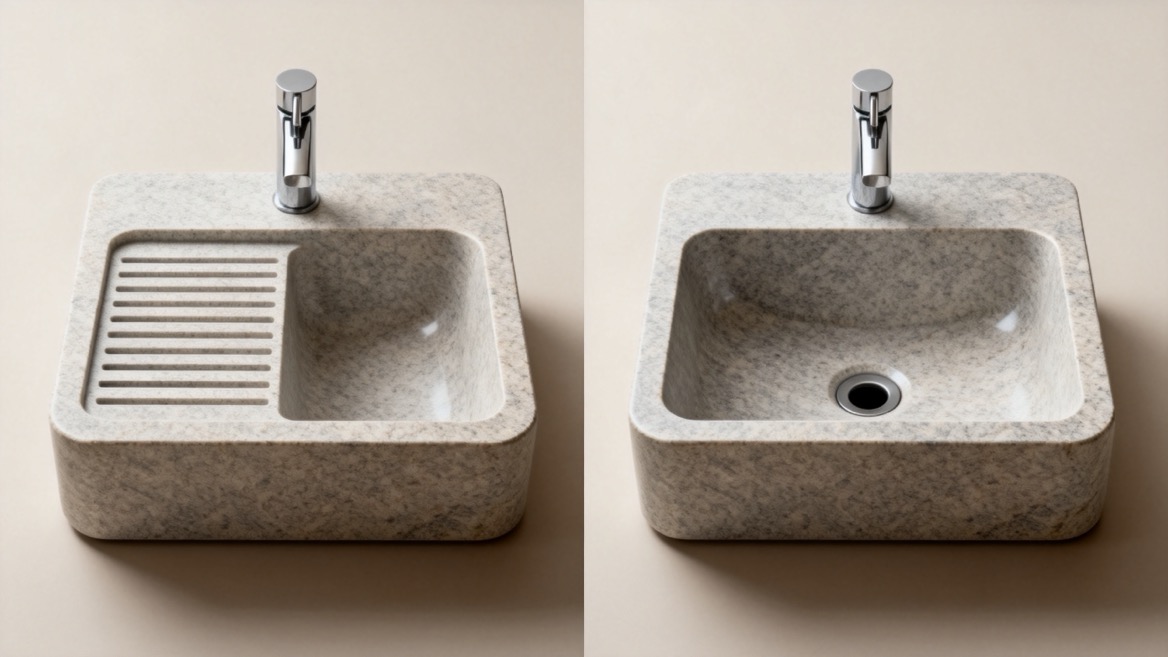
The strongest argument for a slot drain is visual. A long, narrow opening can align with the edges of a rectangular basin, vanity top, or wall panel. With a concealed cover, the surface may read almost as one continuous piece of stone.
For brands developing a coordinated bathroom range, that detail can help distinguish a collection without adding a prominent decorative fitting. Drain makers already offer sink-specific slot products for stone and other basin materials, including options with customized dimensions and finishes. That shows the concept is an established design approach, although individual assemblies still need project-specific evaluation.
The effect is especially persuasive when the faucet, basin slope, slot, and vanity proportions have been designed together. A slot inserted into an otherwise conventional bowl may not deliver the same result.
A round drain usually establishes an obvious focal point near the low point of a bowl. A linear opening can instead sit toward the rear, extend across part of the basin, or become part of an asymmetrical composition. This gives designers room to explore broad washing areas and quieter visual geometry.
That freedom comes with an engineering obligation: the water still needs a reliable path to the outlet. A long slot does not mean the entire underside can be flat. The concealed channel must collect water and direct it to its connection, while the visible basin surface must guide water toward the opening.
For an overseas brand, a slot drain can be more than a styling feature. Its position, cover treatment, stone finish, and relationship to the faucet can form a recognizable product language across multiple basin sizes.
The strongest designs make that detail useful as well as recognizable. A cover that lifts out cleanly, for example, preserves the minimalist appearance while giving the owner access for maintenance. In product development, serviceability is part of the premium experience, not an afterthought.
A narrow opening conceals the channel, but it can also conceal soap residue, hair, and debris. Whether cleaning is easy depends on the actual construction. A removable cover or reachable channel gives users a clearer maintenance route than a permanently closed cavity.
This is an important distinction for hospitality projects and other settings where many people use the same basin. A feature that looks effortless in a product image may demand more attention from cleaning staff. Ask how the user reaches the channel and trap before approving the design.
The stone around the slot needs appropriate care too. The Natural Stone Institute advises mild, non-acidic cleaning for acid-sensitive stone and notes that vinegar or lemon can etch calcareous materials. Care instructions for the channel should never assume that a cleaner safe for one component is safe for the surrounding stone.
A slot-drain basin may combine fabricated stone, a channel or pan, a sealing interface, and a waste connection. A supplier of underside drain pans, for instance, describes an assembly that attaches beneath a slot and collects water for a standard plumbing connection. That is one possible method, not a universal specification.
Each interface should have an identified drawing, material, installation method, and inspection point. Buyers should establish who supplies the waste fitting and who is responsible for the connection beneath the basin. A watertight-looking top surface does not verify the concealed assembly.
A round drain is not free from installation risks, but its components and access points are often more familiar to installers. That can make it a more forgiving choice for projects where local site conditions are uncertain.
It is tempting to assume that a longer opening automatically drains faster. It does not. The opening, the channel below it, the outlet, and the downstream plumbing all form one flow path. If one section restricts flow, extra visible slot length may provide little benefit.
Faucet placement also matters. Water that strikes a shallow or flat area can spread across the basin before it reaches the opening. A prototype should be tested with the specified faucet and realistic use, rather than an unspecified stream poured directly into the slot.
Neither a linear nor a round drain should be described as clog-proof. Both need a practical method for removing debris.
A bespoke stone cover or channel can be difficult to replace if dimensions, finish, and attachment details are not recorded. For a single private bathroom, that may be manageable. For a brand selling a collection across markets, it becomes a spare-parts and customer-support issue.
A clear product file should identify the cover, channel, seal, and waste fitting separately wherever possible. It should also explain what can be removed without damaging the stone. If a concealed component fails, the buyer needs to know whether it can be serviced in place.
For procurement teams, the most valuable extra step is a sample acceptance test agreed before production. It turns claims such as "fast drainage" and "easy cleaning" into observable results without pretending that one unverified figure applies to every design.
1. Confirm the assembly drawing. Record the stone material, slot and channel geometry, outlet position, waste connection, cover-removal method, and any proposed overflow arrangement.
2. Install a representative sample. Use the intended faucet position and a relevant vanity or support structure, rather than testing the basin loose on a bench alone.
3. Observe normal use. Run water at the expected faucet settings. Check how it reaches the slot, whether it spreads toward the rim, and where it remains after shutoff.
4. Inspect concealed areas. Check accessible connections for leaks and confirm that the channel can be cleaned as described.
5. Repeat after cleaning. Remove and refit any cover. Make sure routine access does not chip an edge, disturb a seal, or require an impractical tool.
6. Approve documented criteria. Record photographs, observations, approved components, and the result of any revisions in the final product specification.
For North American projects, also ask the responsible plumbing professional which requirements apply to the proposed waste fitting. ASME A112.18.2/CSA B125.2 covers plumbing waste fittings of NPS-2 and smaller; that fact alone does not certify a complete custom basin. Where an accessible lavatory is required, review the installation as a whole, including clear floor space, height, and protection from exposed pipes.
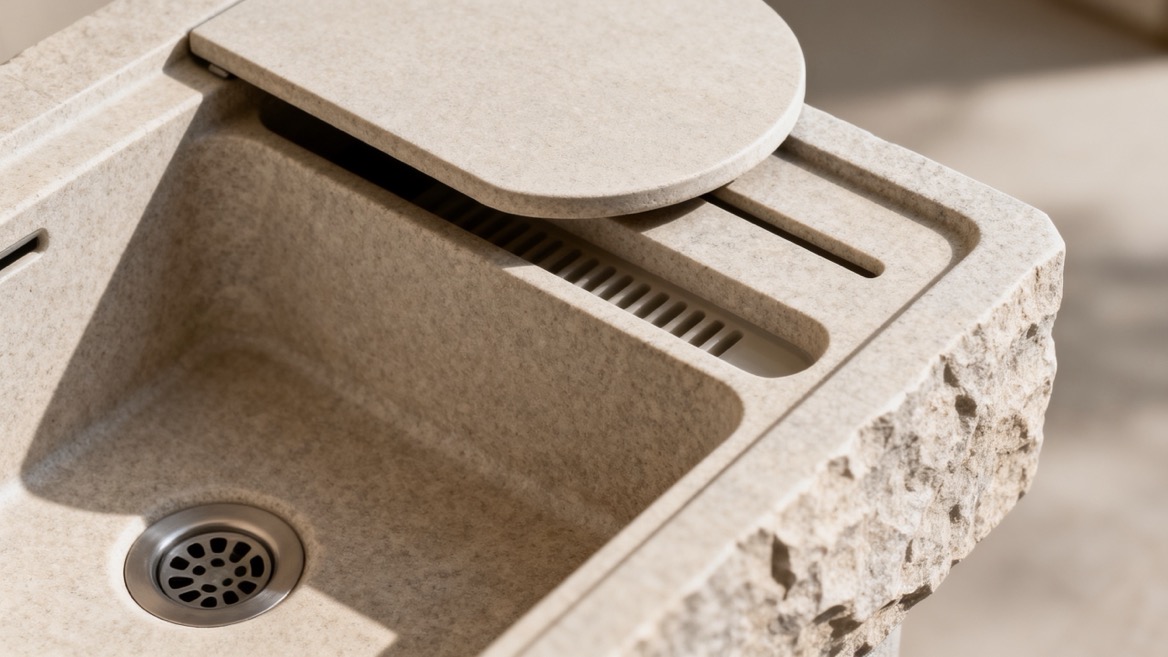
The drain detail cannot be separated from the stone. Slot edges, concealed surfaces, and areas where water may linger deserve particular attention during material selection and sample review. The care instructions should name the actual stone or engineered material used, rather than promising that every "stone basin" can be maintained in the same way.
For natural stone, a sensible user guide should emphasize gentle cleaning, rinsing, and drying. The Natural Stone Institute explains that an impregnating treatment may improve stain resistance, but it does not make stone stain-proof; some stones may not need such treatment. Sealer selection and maintenance should follow the stone supplier's recommendations.
Do not present aggressive channel-cleaning chemicals as a universal shortcut. A cleaner recommended for an isolated plastic component may be inappropriate beside natural stone or another finish. If the maintenance procedure cannot be explained simply and safely for the assembled basin, revisit the design.
Choose a linear slot drain when the basin's architectural appearance is a central selling point and the project can support prototype testing, documented installation, and accessible maintenance. It is well suited to a carefully developed premium collection where the basin and drain are specified as one product.
Choose a round drain when straightforward replacement, familiar installation, or easier visibility of the waste fitting matters more than a concealed look. It may also be the better starting point when the final faucet, vanity, or local plumbing requirements have not yet been settled.
For brands, wholesalers, and manufacturers evaluating a custom basin, the deciding question is not "Which drain looks better?" It is: Which complete assembly can we confidently produce, install, clean, and support? Jiaxing Miluo Smart Home Co., Ltd. can use that question to guide an OEM or ODM design brief. Send your target market, basin material, dimensions, faucet specification, preferred drain appearance, and expected order requirements to begin a sample and specification review.
Not in every case. Slot drains can provide a cleaner visual line and more layout freedom. Round drains can simplify access and replacement. Compare complete basin assemblies against the same design and maintenance requirements.
Not necessarily. Drainage depends on the basin slope, opening, concealed channel, outlet, and plumbing connection. Test the proposed assembly with its intended faucet before making a performance claim.
They can be if the channel is concealed and cannot be reached easily. A removable cover and documented cleaning method make maintenance more practical. Confirm how the user accesses the channel before purchase.
It can be considered, but material-specific fabrication and care need review. Marble is an acid-sensitive stone, so the cleaning plan must protect both the basin surface and the drain assembly.
Do not assume that a slot drain provides an overflow. Specify whether an overflow is required for the intended product and market, then have the complete arrangement reviewed against applicable local requirements.
Request an assembly drawing, material and component specifications, installation and cleaning instructions, sample-test criteria, and a spare-parts plan. These documents make it easier to assess both the finished appearance and long-term support.
1. Natural Stone Institute, "[Care & Cleaning of Natural Stone]" — stone classifications, cleaning guidance, acid sensitivity, and sealing limitations. [naturalstoneinstitute]
2. Infinity Drain, "[Beyond the Shower: Bringing Architectural Drainage to Sinks and Vanities]" — sink-specific slot-drain configurations, materials, and customization examples. [infinitydrain]
3. Expressions LTD, "[Sink Linear Drain Pan—Black ABS for Slot Drains]" — an example of an underside collection-pan assembly and its installation considerations. [expressions-ltd]
4. CSA Group, "[ASME A112.18.2-2020/CSA B125.2:20: Plumbing Waste Fittings]" — scope of the plumbing waste-fitting standard. [csagroup]
5. U.S. Department of Justice, "[2010 ADA Standards for Accessible Design]" — lavatory and sink accessibility requirements, including Section 606. [ada]
6. Signature Hardware, "[How to Clean, Seal, & Repair Natural Stone]" — practical cleaning, drying, and stone-protection guidance for wet-use products. [signaturehardware]


