
Views: 210 Author: Miluo Smart Home Publish Time: 2026-08-13 Origin: Site


Content Menu
● Floor-Mounted vs Wall-Mounted Faucets at a Glance
● When a Floor-Mounted Faucet Is the Better Choice
>> Design freedom for center-positioned tubs
>> Strong visual impact in premium bathrooms
>> Practical advantages of floor-mounted tub fillers
● When a Wall-Mounted Faucet Is the Better Choice
>> A cleaner solution for smaller layouts
>> Cleaner maintenance around the bathtub
>> Installation requires precision
● Installation Reality: The Rough-In Comes First
>> Floor-mounted faucet rough-in checklist
>> Wall-mounted faucet rough-in checklist
● Water Delivery, Comfort, and Daily Use
>> Spout reach matters more than many buyers expect
>> Material and cartridge quality
● Choosing by Bathroom Scenario
● Expert Recommendation for Brands and Projects
● Create a Coordinated Freestanding Tub Collection
● FAQ
>> 1. Can a wall-mounted faucet be used with a freestanding bathtub?
>> 2. Is a floor-mounted faucet only suitable for large bathrooms?
>> 3. Which faucet type is easier to clean?
>> 4. Does a freestanding tub require a floor-mounted faucet?
>> 5. What should buyers check before ordering a floor-mounted tub filler?
>> 6. Why is spout reach important for a wall-mounted tub faucet?
>> 7. Can OEM buyers customize bathtub faucet finishes?
Choosing between a floor-mounted faucet and a wall-mounted faucet is one of the most important decisions when designing a freestanding bathtub space. The best option is not simply the most striking fixture—it must match the tub position, plumbing route, floor structure, wall construction, bathing habits, and the intended visual character of the room.
For premium bathroom brands, wholesalers, and project buyers, this decision also affects installation complexity, product specifications, after-sales requirements, and the overall value perceived by the end customer. At Jiaxing Miluo Smart Home Co., Ltd., we approach bathtub and faucet selection as one coordinated system rather than separate products. A well-designed freestanding tub deserves a faucet that fits its proportions, installation conditions, and daily use.
This guide compares floor-mounted vs wall-mounted faucets for freestanding tubs from practical, aesthetic, technical, and sourcing perspectives.
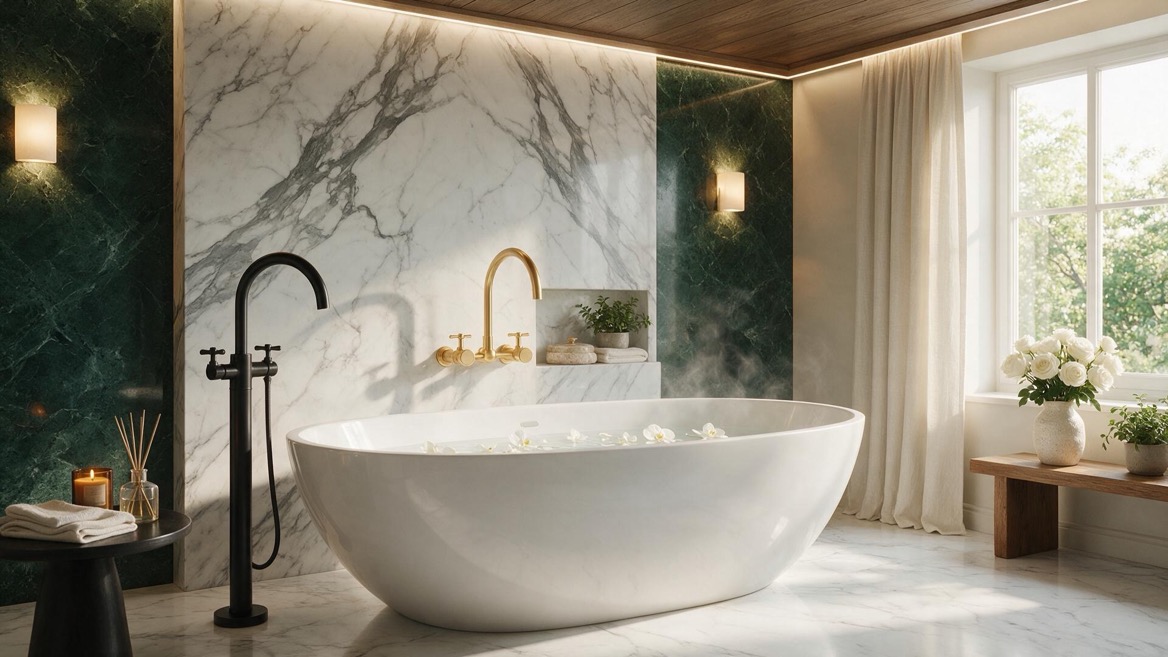
A floor-mounted faucet, also called a freestanding tub filler, rises from the finished floor beside the bathtub. Its hot and cold water supplies run below the floor and connect to a concealed rough-in valve or mounting system.
A wall-mounted faucet is installed through the wall near the bathtub. The supply lines and valve body are hidden inside the wall, while the spout, controls, and hand shower components remain visible.
| Feature | Floor-Mounted Faucet | Wall-Mounted Faucet |
|---|---|---|
| Plumbing direction | Through the floor | Through the wall |
| Best tub placement | Center of room, open-plan layouts, island tubs | Tub placed near or against a wall |
| Visual effect | Sculptural, dramatic, luxurious | Clean, architectural, minimalist |
| Placement flexibility | High, especially away from walls | Limited by wall location and framing |
| Floor clearance | Requires a visible base on the floor | Keeps the floor around the tub clear |
| Installation priority | Correct floor rough-in and strong anchoring | Accurate in-wall valve position and framing |
| Cleaning | Base needs regular wiping | Easier to mop around the tub |
| Retrofit suitability | Depends on below-floor access | Depends on wall access and finish removal |
| Typical use | Large suites, hotel bathrooms, show homes | Compact bathrooms, contemporary projects |
Neither design is universally better. The right answer starts with the bathtub location—not with the faucet finish or silhouette.
A floor-mounted bathtub faucet is usually the strongest choice when a freestanding tub sits away from the wall. It allows the tub to become a focal point without forcing the layout toward a nearby plumbing wall.
For example, imagine an oval solid-surface bathtub positioned beneath a window in the middle of a master bathroom. A wall-mounted spout may be impossible because there is no suitable wall behind the tub. A floor-mounted tub filler can stand beside the rim, creating a balanced composition while delivering water exactly where it is needed.
Floor-mounted faucets give designers greater freedom because they are not tied to a vertical wall plane. This makes them particularly suitable for:
- Island freestanding tubs
- Oval and round bathtubs
- Clawfoot-inspired tubs without faucet holes
- Large hotel suite bathrooms
- Window-facing or panoramic bathroom layouts
- Luxury villas with open circulation around the tub
A freestanding tub filler can be installed on either side of the bath, subject to the manufacturer's rough-in requirements, the user's reach, and safe clearance around the tub. This flexibility helps designers create a more symmetrical or more intentionally asymmetrical layout.
A tall floor-mounted faucet naturally attracts attention. It can visually frame a bathtub, particularly when the fixture finish coordinates with shower hardware, vanity mixers, drain trim, towel rails, or lighting details.
Popular combinations include:
- Matte black faucet with a white acrylic or solid-surface bathtub
- Brushed nickel faucet with a soft grey stone-look tub surround
- Brushed gold faucet with warm white marble finishes
- Gunmetal faucet with dark, minimalist bathroom surfaces
- Chrome faucet with a classic glossy white freestanding tub
The key is proportion. A very tall faucet beside a compact tub can look oversized. Conversely, a low, short-spout faucet may look visually weak beside a deep soaking tub. Product development teams should evaluate faucet height, spout reach, handle position, and tub rim height together.
Beyond appearance, floor-mounted designs offer meaningful functional benefits:
- They work well when the bathtub is not close to a wall.
- They avoid drilling through the bathtub rim.
- They can be paired with tubs that have no pre-drilled faucet holes.
- Many models include a hand shower for rinsing hair, cleaning the tub, or assisting with bathing.
- They can create a highly coordinated "spa suite" presentation in retail displays.
Some high-flow freestanding tub filler systems are designed to fill large tubs quickly. For instance, certain floor-mount configurations use cartridges rated around 10–12 gallons per minute, although final performance depends on local pressure, valve design, pipe sizing, and the full plumbing system. A faster fill is valuable for deep soaking tubs, but buyers should confirm the local water-use regulations before specifying a high-flow fixture.
Floor-mounted faucets are not automatically the easiest solution. Their installation requires careful planning before the finished flooring is installed.
The most common challenges include:
- Water lines must be routed beneath the floor.
- The rough-in valve must align precisely with the finished tub position.
- The faucet base must be securely anchored to stable structural support.
- A future leak may require access below the floor or removal of flooring.
- The fixture base creates one more area to clean around.
- The faucet can feel visually crowded in narrow bathrooms.
A floor-mounted fixture should never be selected only because it looks impressive in a catalog image. The project team must verify the floor construction, waterproofing detail, tub footprint, and final faucet centerline before installation begins.
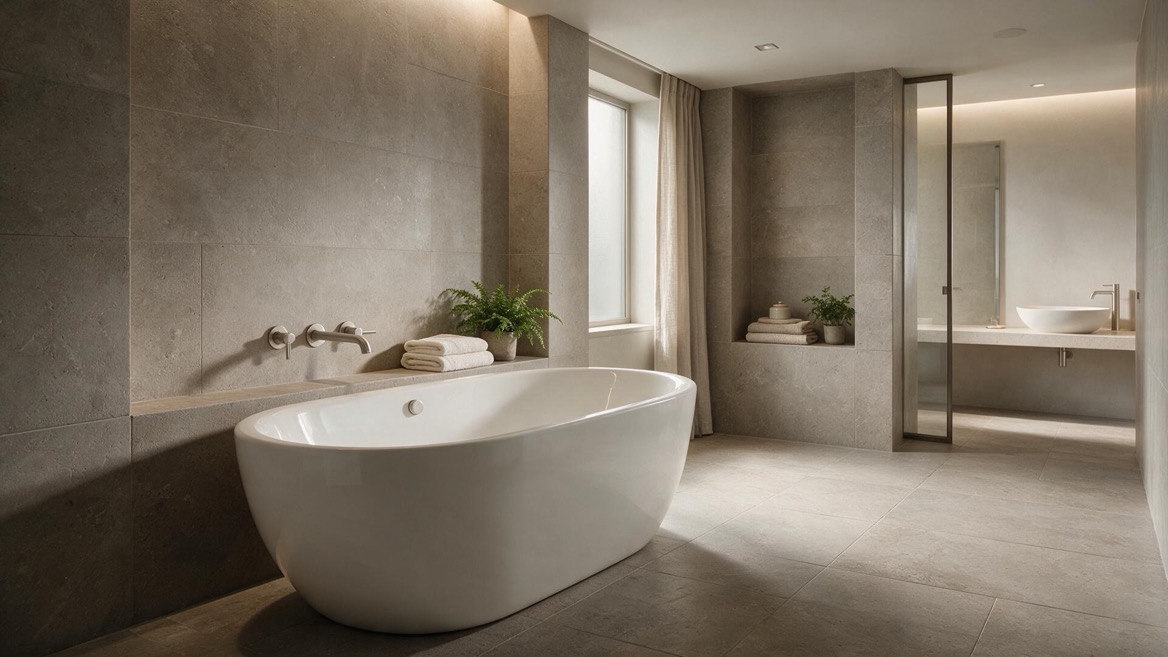
A wall-mounted faucet is often the better option when the freestanding tub is placed near a wall. It creates a clean, uncluttered appearance and keeps the floor open around the bathtub.
This style is especially effective for modern bathrooms where the goal is visual calm. The wall-mounted spout appears to emerge from the wall, while the valve body and supply lines remain concealed behind tile, stone, microcement, or wall panels.
Wall-mounted faucets can make a bathroom feel more spacious because they remove the tall faucet column and base from the floor. This is useful in apartments, boutique hotels, and compact residential bathrooms where every visible element affects the sense of space.
They are a strong option for:
- Freestanding tubs installed close to a feature wall
- Small and medium-sized bathrooms
- Contemporary or minimalist interiors
- Tub areas with stone, tile, or microcement feature walls
- Projects that need easier floor cleaning
- Bathrooms where below-floor plumbing access is limited
For a rectangular freestanding bathtub positioned 100–150 mm from a tiled wall, a wall-mounted tub faucet can look more intentional than a floor-mounted unit squeezed into a narrow gap.
Without a faucet base standing on the floor, the area around the tub is easier to sweep and mop. This may sound minor during product selection, but it matters in hospitality, rental properties, and busy family homes.
Wall-mounted faucets also reduce visual clutter. The open floor area can make premium tile, stone, or large-format porcelain surfaces more visible. For designers creating a calm wellness atmosphere, this simplicity is often a major advantage.
The clean appearance of a wall-mounted faucet depends on accurate concealed installation. The valve body must be fixed securely within the wall, and the finished spout projection must deliver water safely into the bathtub.
Before finalizing the wall finish, installers should confirm:
1. The exact bathtub position.
2. The finished wall thickness, including tile, adhesive, panels, or stone.
3. The faucet spout reach from the finished wall face.
4. The spout height above the tub rim.
5. The outlet position relative to the internal basin.
6. The location of handles, diverters, and hand shower brackets.
7. Access requirements for serviceable components.
If the spout is too short, water may strike the tub rim rather than flow into the basin. If it is too high, splashing may increase. If the valve body is installed at the wrong depth, trim plates may not sit flush against the finished wall.
This is why wall-mounted fixtures work best when the bathtub manufacturer, faucet supplier, installer, and interior designer coordinate their drawings early in the project.
The most expensive mistakes usually happen before the visible faucet trim is installed. In premium bathtub projects, the rough-in stage deserves the same attention as the final finish selection.
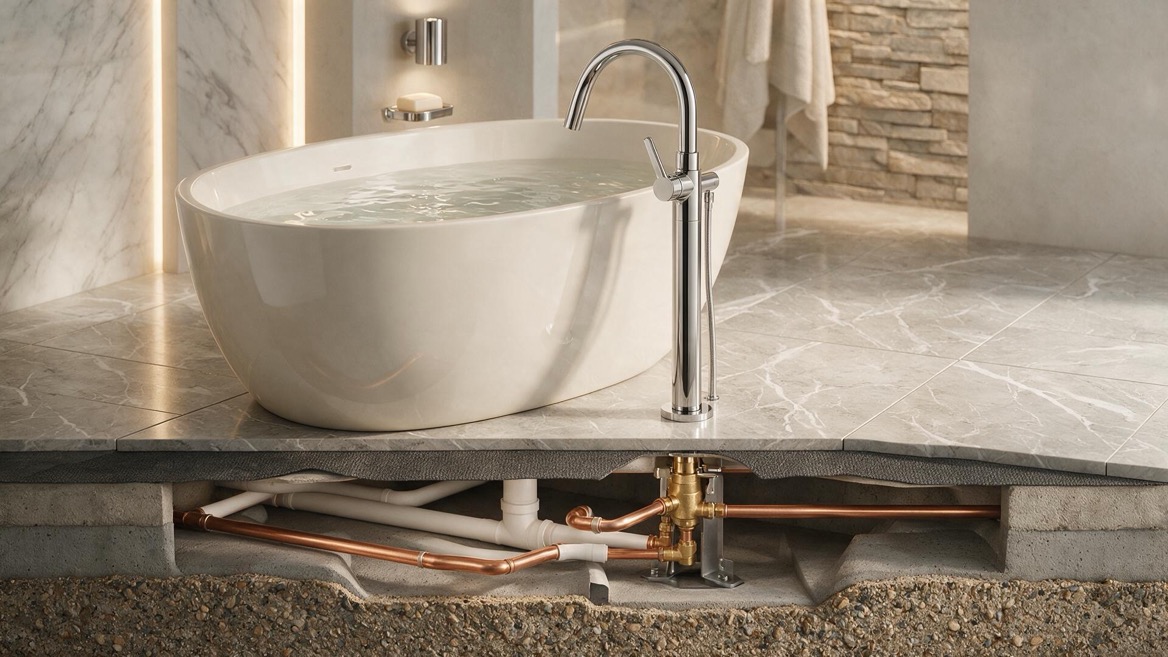
For a floor-mounted faucet, confirm:
- The exact tub centerline and faucet location
- The distance between faucet outlet and bathtub rim
- The required rough-in valve model
- Finished floor thickness
- Floor joist or concrete slab conditions
- Anchoring points and structural reinforcement
- Waterproofing around penetrations
- Access strategy for future maintenance
- Compatibility between rough-in kit and final trim
Many faucet brands sell the rough-in body separately from the decorative trim. This gives project buyers flexibility to complete structural work first and choose the final finish later. However, compatibility must be verified carefully. A visually similar trim may not fit another manufacturer's concealed valve system.
For wall-mounted faucets, verify:
- Stud or masonry wall structure
- Valve body depth
- Finished wall thickness
- Spout reach and tub rim position
- Hand shower hose routing
- Water outlet direction
- Service access where required
- Waterproofing behind the wall finish
- Compatibility of trim, valve, and diverter components
For both installations, pressure testing should happen before tile, stone, paint, or flooring is completed. This helps identify connection issues while the plumbing remains accessible.
The best faucet for a freestanding tub should do more than match the room. It should fill the tub efficiently, operate smoothly, and make bathing comfortable.
The water stream should fall well inside the bathtub basin. A spout that barely reaches past the rim can cause splashing, mineral buildup on the tub edge, and an awkward user experience.
When evaluating a faucet, compare:
- Faucet spout reach
- Tub rim width
- Distance from mounting point to inner basin
- Tub height
- Waterfall or aerated outlet style
- Expected water pressure
A floor-mounted faucet may have generous reach because its body can be positioned close to the tub. A wall-mounted faucet must compensate for the distance from wall face to tub interior. This makes accurate drawings particularly important for wall-mounted installations.
For many end users, a hand shower is not an optional accessory. It improves flexibility for rinsing the tub, washing hair, cleaning feet, bathing children, or supporting users with limited mobility.
For floor-mounted products, the hand shower should return securely to its holder and direct residual water into the tub rather than onto the floor. For wall-mounted systems, buyers should inspect the hose length, bracket position, diverter operation, and the overall visual balance between spout and hand shower.
A premium faucet should be evaluated beyond finish color. Key quality indicators include:
- Brass or other corrosion-resistant primary body materials
- Reliable ceramic cartridge construction
- Stable handle movement
- Durable diverter operation
- Consistent electroplating or PVD finish process
- Clear spare-parts strategy
- Tested connection interfaces
- Detailed installation instructions
For OEM and ODM programs, manufacturers should provide clear technical drawings, rough-in specifications, finish samples, packaging requirements, and inspection standards. These details reduce installation confusion and help brand partners maintain consistent product quality across markets.
The following guide simplifies the decision process for common freestanding tub layouts.
| Bathroom Scenario | Recommended Faucet Type | Why |
|---|---|---|
| Tub centered in a large room | Floor-mounted faucet | It can serve the tub without relying on a nearby wall |
| Tub placed near a feature wall | Wall-mounted faucet | It creates a clean, integrated visual effect |
| Compact apartment bathroom | Wall-mounted faucet | It preserves visible floor space |
| Luxury villa master suite | Floor-mounted faucet | It provides a stronger sculptural focal point |
| Renovation with accessible subfloor | Floor-mounted faucet | Below-floor plumbing may be practical |
| Renovation with accessible plumbing wall | Wall-mounted faucet | Wall routing may be less disruptive |
| Freestanding tub beneath a window | Floor-mounted faucet | It avoids conflict with the window wall |
| Minimalist stone-wall bathroom | Wall-mounted faucet | It supports a clean architectural composition |
For brands developing a modern bathtub collection, do not treat the faucet as an afterthought. Offer faucet recommendations alongside each freestanding tub model.
A useful product-pairing system could include:
- Recommended faucet mounting type
- Suitable faucet height range
- Recommended spout reach
- Compatible finish families
- Required rough-in information
- Drain and overflow finish options
- Hand shower availability
- Installation clearance drawing
This approach helps distributors, showrooms, designers, and installers select compatible products faster. It also strengthens the overall presentation of a bathtub collection by showing customers a complete, coordinated bathing solution rather than a single standalone product.
For most center-positioned tubs, a floor-mounted faucet is the practical and visually powerful choice. For tubs placed close to a wall, a wall-mounted faucet is usually the cleaner and more space-efficient solution. The best result comes from matching the faucet installation method to the tub layout before construction starts.
Jiaxing Miluo Smart Home Co., Ltd. supports international brands, wholesalers, and project buyers with customizable modern bathroom products and integrated bathtub solutions. From freestanding tubs to coordinated faucet styles, finishes, dimensions, packaging, and branding options, our team can help turn a product concept into a market-ready collection.
Contact Miluo Smart Home to discuss your OEM or ODM freestanding bathtub and faucet requirements, request technical drawings, or develop a customized premium bathroom range for your market.
Yes. A wall-mounted faucet can work very well with a freestanding bathtub when the tub is placed close enough to a wall. The spout must have sufficient reach to deliver water into the inner basin rather than onto the tub rim.
No. A floor-mounted faucet can work in a medium-sized bathroom, but it needs enough clear space around the tub to avoid a crowded appearance. It is most effective when the bathtub is positioned away from the wall or when no suitable plumbing wall is available.
A wall-mounted faucet is generally easier to clean around because there is no floor-mounted base beside the tub. A floor-mounted faucet requires regular cleaning around its base, especially in hard-water environments.
No. Freestanding tubs can use floor-mounted, wall-mounted, deck-mounted, or tub-mounted faucet configurations, depending on the tub design and bathroom layout. The correct option depends on plumbing access and the intended installation position.
Buyers should confirm the required rough-in kit, faucet height, spout reach, mounting location, finished floor thickness, supply connection type, structural support, and compatibility with the selected bathtub.
Spout reach determines whether the water stream lands inside the bathtub. If the spout is too short, water may hit the rim and splash outside the tub. Always compare the finished wall position with the tub's internal basin location.
In many cases, yes. OEM and ODM programs may offer finish customization, including chrome, matte black, brushed nickel, brushed gold, gunmetal, and other project-specific options. Buyers should confirm minimum order quantities, finish testing standards, sample approval procedures, and lead times.
1. [The Home Depot — Bathtub and Shower Faucet Installation Types]: Overview of freestanding and wall-mounted tub faucet configurations, including floor-routed and wall-concealed plumbing approaches. [homedepot]
2. [Ferguson Home — How to Choose the Right Tub Filler]: Guidance on placement flexibility for floor-mounted fillers and wall-mounted options for tubs positioned near a wall. [fergusonhome]
3. [Kohler — Freestanding Bath Installation Guide]: Installation documentation noting compatibility of certain freestanding baths with either wall-mounted or freestanding faucets, plus floor support and drain considerations. [techcomm.kohler]
4. [Kohler — Freestanding and Wall-Mount Supply Installation Guide]: Technical installation guidance covering wall framing, pipe support, rough-in location, temporary plugs, and leak checks. [techcomm.kohler]
5. [Delta Faucet — Floor-Mount Tub Filler Rough-In R4700-FL]: Example of a separately specified floor-mount rough-in system, including brass body, stainless mounting plate, and 1/2-inch sweat connections. [deltafaucet]
6. [Delta Faucet — Freestanding Tub Filler Product Information]: Product-design examples involving floor-mount installation, hand shower positioning, rough-in flexibility, mounting plates, and stated flow-rate configurations. [deltafaucet]
7. [Kohler — Freestanding Bath Faucet Specification Sheet]: Technical reference for floor rough-in dimensions, water connections, and floor-structure considerations for a freestanding bath faucet. [techcomm.kohler]


