
Views: 211 Author: Miluo Smart Home Publish Time: 2026-07-28 Origin: Site


Content Menu
● Why Seamless, Joint-Free Bathroom Design Matters Today
● What Are Solid Surface Materials?
● Solid Surface vs Traditional Materials: A Practical Comparison
>> 1. Solid Surface vs Ceramic Basins
>> 2. Solid Surface vs Natural Stone (Marble/Granite)
● How Seamless Vanity and Basin Integration Works
● Industry Trends Driving Demand for Seamless Bathrooms
>> 1. Growth in Hospitality and Luxury Residential Projects
>> 2. Customization as a Competitive Advantage
>> 3. Sustainability and Lifecycle Value
● Common Mistakes When Choosing Materials
● Choosing the Right Solution for Your Market
● Why OEM/ODM Solid Surface Solutions Are Gaining Popularity
● Actionable Takeaways for Buyers and Brands
● Ready to Elevate Your Bathroom Product Line?
● FAQ
In today's high-end bathroom market, creating seamless, joint-free bathroom looks with solid surface materials has become a defining trend for premium vanity and basin solutions. From my experience working closely with international B2B buyers and manufacturers, the shift toward integrated, minimalist aesthetics is not just visual—it reflects evolving expectations around durability, hygiene, and customization.
For brands, wholesalers, and project developers, understanding how solid surface materials enable seamless bathroom design—and how they compare to traditional materials—is essential for making informed sourcing decisions.

Modern bathroom design is increasingly driven by clean lines, uninterrupted surfaces, and easy maintenance. Seamless construction plays a central role in achieving this.
Key advantages of joint-free designs:
- Enhanced hygiene: No seams means fewer places for bacteria and mold to accumulate
- Premium aesthetics: Continuous surfaces create a luxurious, modern appearance
- Simplified maintenance: Easier cleaning with no grout lines or joints
- Improved durability: Reduced risk of cracking or leakage at connection points
For hospitality projects, residential developments, and branded bathroom collections, these benefits translate directly into higher perceived value and lower lifecycle costs.
Solid surface materials are engineered composites, typically made from a blend of natural minerals (like aluminum hydroxide) and acrylic or polyester resins.
Unlike traditional materials, they offer thermoformability, allowing manufacturers to create fully integrated vanity tops and basins without visible seams.
Core characteristics:
- Non-porous and hygienic
- Repairable and renewable
- Seamlessly joinable
- Customizable in shape, size, and color
From a manufacturing standpoint, this flexibility is particularly valuable for OEM and ODM projects, where differentiation is critical.
To understand the real value of seamless design, it is important to compare solid surface materials with commonly used alternatives.
Ceramic remains widely used, especially in cost-sensitive markets. However, it has limitations.
Comparison highlights:
- Seamlessness:
Solid surface allows integrated sink and countertop; ceramic is typically separate
- Design flexibility:
Solid surface supports custom shapes; ceramic relies on molds
- Repairability:
Solid surface can be sanded and restored; ceramic chips are permanent
- Weight:
Solid surface is lighter, easing installation
Best use case:
Ceramic works for standard products; solid surface excels in custom, high-end projects.
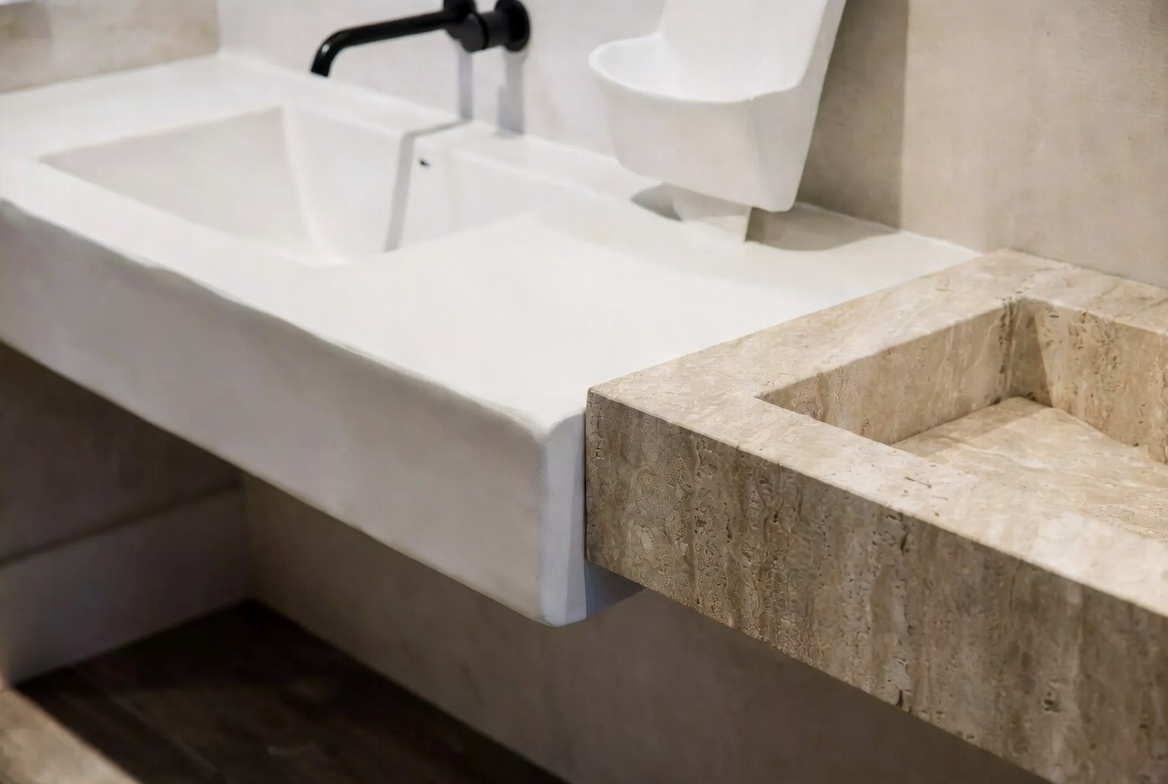
Natural stone conveys luxury but introduces practical challenges.
Key differences:
- Porosity:
Stone requires sealing; solid surface is naturally non-porous
- Seams:
Stone installations often show joints; solid surface can be invisible
- Consistency:
Stone varies in pattern; solid surface offers uniformity
- Maintenance:
Stone is more sensitive to stains and chemicals
Industry insight:
Many premium brands are shifting toward solid surface to achieve consistent product lines across global markets.
Quartz is another engineered material but behaves differently.
Comparison points:
- Seam integration:
Solid surface allows invisible joints; quartz seams are visible
- Thermoforming:
Solid surface can be shaped into curves; quartz cannot
- Repairability:
Solid surface is repairable; quartz damage is harder to fix
- Heat resistance:
Quartz performs slightly better under high heat
Conclusion:
Quartz is strong for countertops, but solid surface is superior for integrated vanity-basin systems.
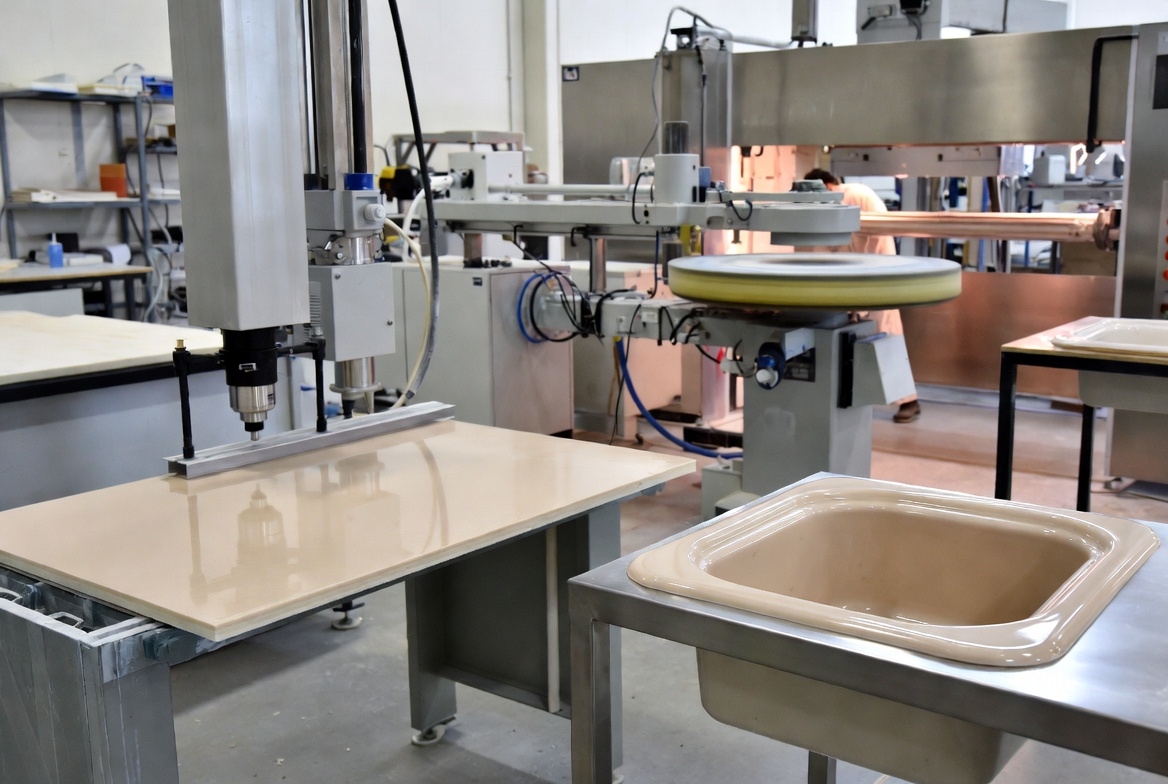
From a production perspective, achieving a joint-free look requires advanced fabrication techniques.
1. Material preparation:
Solid surface sheets are cut to required dimensions
2. Thermoforming:
Heat is applied to shape curves and basin contours
3. Seam bonding:
Specialized adhesives create chemically fused joints
4. Sanding and polishing:
Surfaces are refined until seams become invisible
5. Quality inspection:
Ensures structural integrity and aesthetic consistency
This process enables true one-piece vanity solutions, which are highly valued in international projects.
From recent project data and buyer feedback, several trends are accelerating adoption:
Hotels and serviced apartments prioritize:
- Easy cleaning for housekeeping efficiency
- Long-term durability
- Consistent design across multiple units
Solid surface solutions align perfectly with these requirements.
Brands increasingly seek unique product lines to differentiate in crowded markets.
Solid surface enables:
- Custom colors and finishes
- Integrated lighting or accessories
- Tailored dimensions for specific markets
Buyers are paying more attention to long-term performance rather than initial cost.
Solid surface advantages:
- Longer usable lifespan
- Repair instead of replacement
- Reduced material waste in production
Based on real-world project experience, here are frequent pitfalls:
- Focusing only on initial cost:
Cheaper materials often lead to higher maintenance costs
- Ignoring installation complexity:
Multi-piece systems increase labor and risk
- Overlooking customization limits:
Some materials restrict design innovation
- Underestimating brand positioning:
Material choice directly affects perceived product value
Recommendation:
Evaluate materials based on total lifecycle value and brand alignment, not just price.
1. Target customer segment
- Mid-range: Ceramic or basic quartz
- Premium: Solid surface or integrated systems
2. Project type
- Residential bulk housing: Cost efficiency matters
- Hospitality/commercial: Durability and uniformity dominate
3. Design requirements
- Standard sizes: Traditional materials suffice
- Custom or modular: Solid surface is ideal
4. Branding goals
- Mass market: Functional focus
- High-end branding: Seamless aesthetics are essential
For international buyers, working with experienced manufacturers offers clear advantages:
- Design support: From concept to production
- Flexible customization: Shapes, finishes, branding
- Consistent quality control: Across large orders
- Scalable production: Suitable for global distribution
Companies like Jiaxing Miluo Smart Home Co., Ltd. specialize in delivering fully integrated vanity and basin systems tailored to brand requirements, helping clients accelerate product development while maintaining high standards.
- Seamless design is no longer optional in premium bathroom markets
- Solid surface materials provide the best balance of aesthetics, functionality, and flexibility
- Choosing the right manufacturing partner is as important as selecting the material
- Customization capabilities can significantly enhance your market competitiveness
If you are looking to develop modern, seamless vanity and basin solutions, now is the time to explore solid surface options.
Work with a trusted OEM/ODM manufacturer to:
- Create distinctive product designs
- Improve product durability and user experience
- Strengthen your brand positioning in global markets
Contact a professional team to discuss your next project and bring your vision of joint-free bathroom design to life.
1. What makes solid surface materials ideal for seamless bathroom design?
Solid surface materials can be chemically bonded and polished to create invisible seams, allowing fully integrated vanity and basin units.
2. Are solid surface basins durable enough for commercial use?
Yes. They are non-porous, impact-resistant, and repairable, making them suitable for hotels and high-traffic environments.
3. How do solid surface materials compare in cost?
They typically have a higher upfront cost than ceramic but offer better long-term value due to durability and repairability.
4. Can solid surface products be customized for branding?
Yes. They support custom colors, shapes, sizes, and integrated features, making them ideal for OEM/ODM projects.
5. Is maintenance easier compared to traditional materials?
Yes. The non-porous surface resists stains and bacteria, and the seamless design eliminates hard-to-clean joints.
2. https://www.wilsonart.com/solid-surfaces


