
Views: 202 Author: Miluo Smart Home Publish Time: 2026-07-25 Origin: Site


Content Menu
● What Does 15mm–25mm Really Mean?
>> 1. Below 10mm: Cost-Driven but Structurally Limited
>> 2. 10mm–15mm: Entry-Level Stability
>> 3. 15mm–25mm: Optimal Structural Integrity (Miluo Standard)
>> 4. Above 25mm: Over-Engineered and Inefficient
● How Thickness Affects Structural Integrity
● Hospitality Projects Demand Higher Thickness
● Thickness Alone Is Not Enough
● How to Evaluate Bathtub Thickness
● Why Miluo Can Maintain Consistency
● Cost vs Value: The Real ROI of 15mm–25mm Thickness
● Why 15mm–25mm Is the Industry Sweet Spot
● Tailoring Thickness for Different Markets
● FAQ
When evaluating bathtub durability, safety, and long-term value, thickness is not just a specification—it is a defining factor. At Jiaxing Miluo Smart Home Co., Ltd., the decision to standardize 15mm–25mm thickness across premium bathtub designs is rooted in engineering validation, manufacturing experience, and real-world performance feedback from global markets.
From my perspective as a content strategist working closely with industrial manufacturers, thickness is one of the most underestimated variables in sanitary ware sourcing. Many buyers focus on surface aesthetics or pricing, while overlooking how material thickness directly impacts structural integrity, load capacity, and lifecycle performance.
This article provides a comprehensive comparison and analysis of why 15mm–25mm thickness stands out as the optimal range—and how it compares to thinner and thicker alternatives in real-world applications.

In bathtub manufacturing, thickness refers to the combined structural layers—typically acrylic, fiberglass reinforcement, or composite materials.
For Miluo's product lines, the 15mm–25mm thickness range is engineered to balance:
- Mechanical strength
- Weight efficiency
- Thermal insulation
- Installation feasibility
This is not an arbitrary range. It is the result of continuous testing, OEM/ODM project feedback, and structural simulations.
Key insight: Thickness is not just about being "thicker is better"—it is about achieving the optimal structural equilibrium.
Many low-cost bathtubs on the market use 5mm–10mm thickness.
Limitations include:
- Higher risk of flexing under weight
- Increased chances of cracking over time
- Poor heat retention
- Reduced sound insulation
From a user experience standpoint, thinner tubs often feel unstable or "hollow", which negatively impacts perceived quality.
This range is often used in mid-tier products.
Advantages:
- Improved rigidity compared to ultra-thin models
- Lower material cost
However:
- Still vulnerable to long-term deformation
- Limited performance in high-load or commercial settings
This is where Miluo positions its products.
Core benefits:
- High load-bearing capacity
Supports consistent weight without flexing or stress points.
- Enhanced durability
Resistant to cracking, warping, and aging.
- Superior thermal insulation
Maintains water temperature longer.
- Improved acoustic performance
Reduces noise during water filling and use.
- Premium tactile feel
Solid, stable, and high-end perception.
From a manufacturing standpoint, this range also allows precise reinforcement layering, ensuring uniform strength distribution.
While thicker might sound better, exceeding 25mm introduces challenges:
- Excessive weight, increasing shipping and installation costs
- Higher material consumption, reducing cost efficiency
- Limited improvement in practical performance gains
In most residential and hospitality applications, the additional thickness provides diminishing returns.
Structural integrity is not just about thickness—it is about how thickness interacts with material composition and design geometry.
Miluo integrates:
- Multi-layer reinforcement systems
- Stress-distribution modeling
- Impact resistance testing
Example scenario:
A standard adult bathtub load can reach 150–250 kg (water + user).
- A 10mm tub may show micro-flexing under repeated use
- A 20mm tub maintains structural stability with minimal deformation
Over time, this difference determines whether a product lasts 3 years or 10+ years.
In international hotel and resort projects, bathtub usage frequency is significantly higher than residential settings.
Based on project data from export markets:
- Hotels prefer ≥15mm thickness to reduce maintenance cycles
- Luxury properties often specify 18mm–25mm for premium experience
Why this matters:
- Reduced replacement costs
- Consistent guest experience
- Lower risk of structural failure
Miluo's thickness standard aligns precisely with these high-demand environments.
Another critical factor is material pairing.
Miluo typically combines:
- High-grade acrylic surfaces
- Fiberglass or resin reinforcement layers
The 15mm–25mm range ensures that:
- Reinforcement layers are fully effective
- Structural bonding is uniform
- Surface integrity is maintained under stress
A thinner structure cannot fully utilize these material advantages.
If you are sourcing bathtubs for OEM/ODM or wholesale, consider the following:
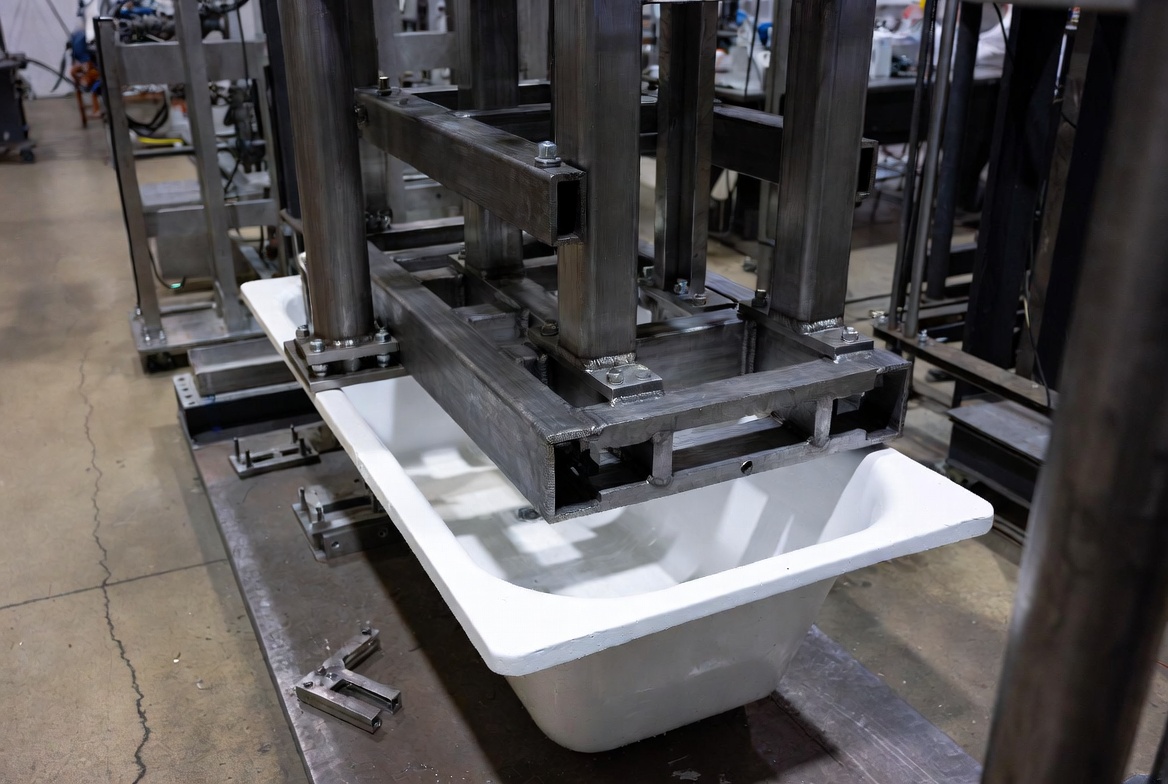
1. Request cross-section samples
Verify actual thickness—not just specifications.
2. Check weight-to-size ratio
A heavier tub often indicates better structural density.
3. Perform pressure tests
Observe flexing when force is applied.
4. Review reinforcement layers
Thickness must be supported by proper internal structure.
5. Ask for lifecycle testing data
Durability metrics are more meaningful than initial specs.
Achieving consistent 15mm–25mm thickness is not easy in mass production.
Miluo ensures this through:
- Precision mold engineering
- Automated layering processes
- Strict quality inspection protocols
- Batch consistency tracking
This is particularly important for OEM clients who require:
- Brand reliability
- Uniform product quality across shipments
- Reduced defect rates
While thicker bathtubs may have a higher upfront cost, the long-term value is significantly better.
Cost comparison perspective:
- Thin tubs: lower initial cost, higher replacement frequency
- 15mm–25mm tubs: moderate cost, extended lifespan
Total cost of ownership includes:
- Maintenance
- Replacement
- Customer satisfaction
- Brand reputation
For distributors and brands, investing in optimal thickness translates into stronger market positioning.
From both engineering and market perspectives, this range represents a balanced optimization:
- Not too thin to compromise durability
- Not too thick to waste resources
- Compatible with modern design aesthetics
- Suitable for both residential and commercial use
It is increasingly becoming the benchmark for premium bathtub manufacturing.
Miluo offers OEM/ODM flexibility within this optimal range.
Customization options include:
- Adjusting thickness based on regional standards
- Reinforcing specific areas (e.g., base, edges)
- Adapting to freestanding, built-in, or spa designs
This allows clients to:
- Align with target market expectations
- Optimize logistics and pricing strategies
- Differentiate product offerings
If you are sourcing high-quality bathtubs and want to ensure maximum structural integrity, durability, and market competitiveness, choosing the right thickness is critical.
Miluo provides custom-engineered bathtub solutions within the proven 15mm–25mm range, backed by manufacturing expertise and global project experience.
Contact our team today to discuss your OEM/ODM requirements and receive tailored product recommendations.
1. Why is 15mm–25mm thickness considered ideal for bathtubs?
It provides the best balance between strength, durability, weight, and cost efficiency, making it suitable for both residential and commercial use.
2. Is a thicker bathtub always better?
Not necessarily. Beyond 25mm, the benefits diminish while costs and weight increase significantly.
3. How can I verify bathtub thickness from a supplier?
Request cross-sectional samples, technical drawings, and physical testing data.
4. Does thickness affect heat retention?
Yes. Thicker bathtubs generally retain heat longer, improving user comfort.
5. What thickness is recommended for hotel projects?
Typically 15mm–25mm, with many luxury projects preferring the higher end of the range.
1. International Association of Plumbing and Mechanical Officials (IAPMO) – https://www.iapmo.org
2. American Society of Mechanical Engineers (ASME) standards on material strength – https://www.asme.org
3. Building Materials Research Journal – Composite Material Performance Studies – https://www.sciencedirect.com
4. Hospitality Design Guidelines for Bathroom Fixtures – https://www.hospitalitydesign.com
5. Acrylic Bathtub Manufacturing Insights – Plastics Industry Association – https://www.plasticsindustry.org


