
Views: 222 Author: Miluo Smart Home Publish Time: 2026-05-09 Origin: Site


Europe remains one of the most mature and design‑driven bathroom markets, with the broader bathroom furniture and wellness segment alone estimated around EUR 12 billion already in 2018 and growing steadily since. Within this ecosystem, artificial stone and solid‑surface bathtubs have moved from niche to mainstream in high‑end residential, hospitality and wellness projects, driven by demand for sculptural freestanding tubs, minimalist design, and spa‑like in‑room experiences. [worldfurnitureonline]
European manufacturers, especially in Germany, Italy, Switzerland and the Nordics, benefit from strong industrial clusters in sanitary ware, precision ceramics and engineered composites, supported by strict EU regulations on safety, environmental impact and worker protection. For global buyers, sourcing in or near Europe—whether from local factories or export‑oriented OEM partners—offers advantages in design quality, compliance, and access to established distribution networks. [statista]
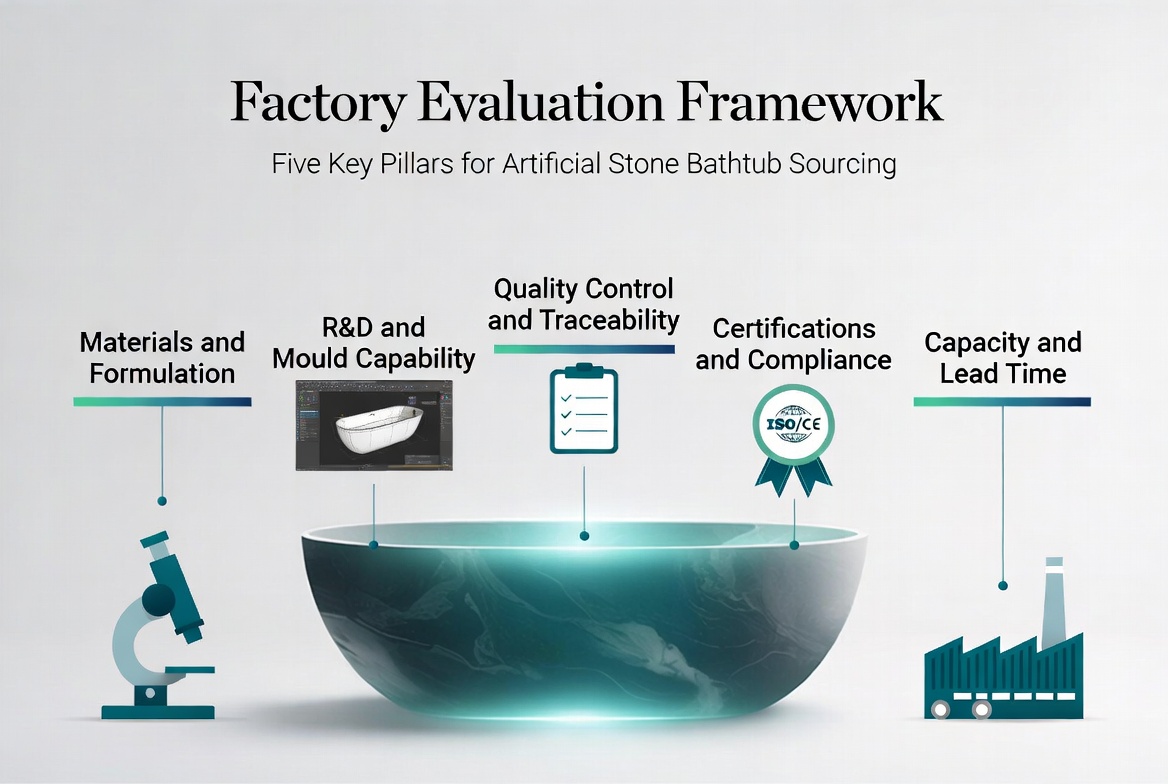
Before looking at specific companies, it is essential to define how an experienced procurement manager should evaluate any artificial stone bathtub factory, whether in Europe or in export‑oriented hubs serving the European market. The following dimensions underpin both this ranking and your own vendor due‑diligence process. [export.roca]
- ISO 9001 quality management: Confirms the factory has a documented system for process control, corrective actions and continuous improvement across design, production and customer service. [export.roca]
- ISO 14001 environmental management: Indicates the company actively manages emissions, waste and resource use—important for ESG‑conscious European buyers. [ceramicaglobo]
- Product‑level certifications: For tubs used in Europe, you should verify CE conformity for relevant directives (where applicable) and check that associated documentation (e.g. EN standards compliance, material safety declarations) is available on request. [export.roca]
Real artificial stone / solid‑surface bathtubs use composite systems based on mineral fillers (e.g. aluminum hydroxide, natural stone powder) combined with high‑performance resins and performance additives. Key technical checkpoints include: [kingkonree]
- Filler ratio and type (e.g. high mineral content for density and heat retention vs resin‑heavy "light" mixes).
- Curing process and temperature control, which directly affect internal stresses, porosity and long‑term stability.
- Surface system: Gel‑coat vs full‑body solid surface; full‑body systems allow deeper refinishing, while high‑quality gel coats can deliver very hard, stain‑resistant surfaces if applied correctly. [kingkonree]
For long‑term OEM/ODM cooperation, your supplier's development capability often matters more than current catalogue size. Important signals:
- In‑house mould design and CNC machining for complex organic shapes.
- Ability to develop custom colours, textures or translucent effects while maintaining mechanical properties. [kingkonree]
- Experience serving hotel chains, developers or design brands that require project‑specific customization and value engineering. [datainsightsreports]
In artificial stone bathtubs, hidden defects (micro‑cracks, voids, internal stress) may only appear after months of use or during installation. Robust QC should therefore include:
- Incoming inspection of resins, fillers and pigments with batch traceability.
- Controlled casting and demoulding windows, with recorded temperature and humidity.
- 100% visual and dimensional inspection, plus sampling for mechanical performance (e.g. load testing, thermal shock).
The luxury bathtub segment is forecast to grow steadily with a projected global luxury bathtub market valuation of around USD 8.66 billion by 2025, implying pressure on capacity and lead times as more projects specify freestanding and wellness‑oriented tubs. Buyers should assess: [datainsightsreports]
- Annual capacity and average monthly output for artificial stone tubs vs other product lines.
- Standard lead time for repeat orders vs new moulds.
- On‑time delivery rate for export shipments over the past 12–24 months.
Finally, strong European and export‑oriented suppliers distinguish themselves by:
- Providing complete technical files (installation guides, load limits, cleaning instructions, maintenance and repair guidelines).
- Offering clear warranty terms (often 5–10 years for solid‑surface bathtubs) and practical repair kits for on‑site refinishing. [kingkonree]
- Maintaining up‑to‑date certificates (ISO, test reports, declarations of performance) that can be independently verified on the issuing body's database. [ceramicaglobo]
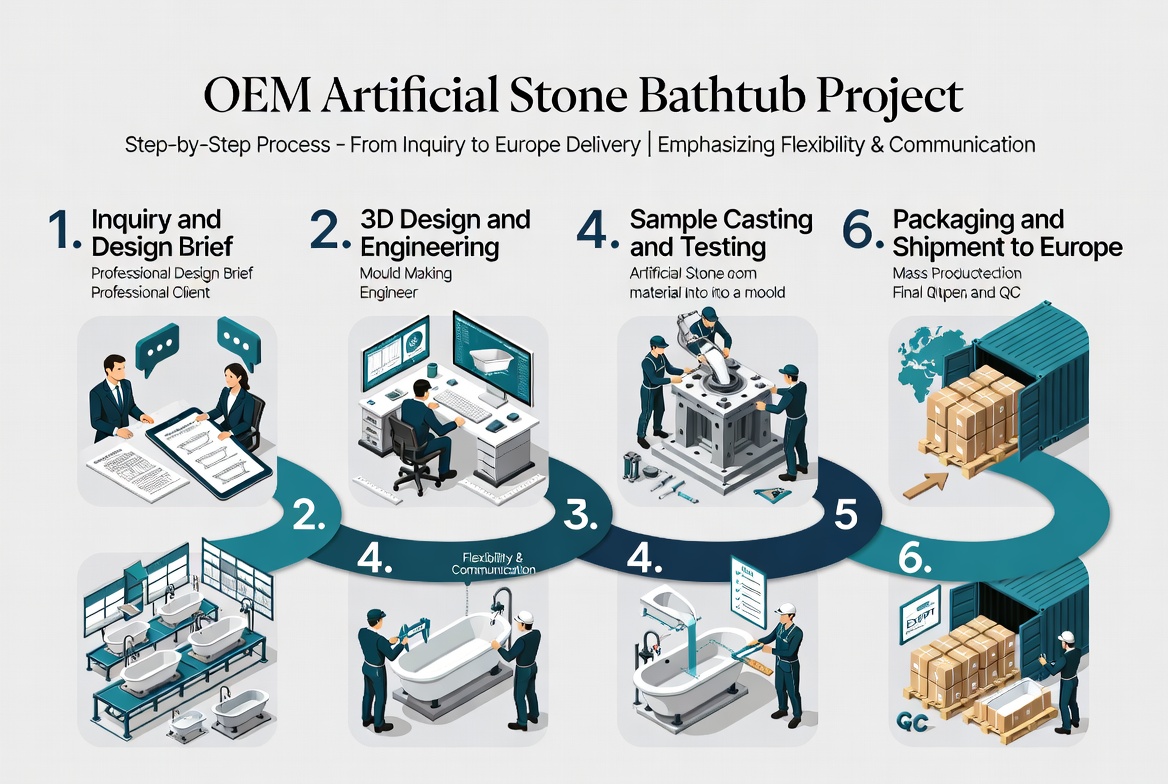
For this guide, we focused on manufacturers that are relevant for global B2B sourcing into Europe, including both European factories and export‑oriented OEM partners that serve European brands and projects. The main selection criteria were: [worldfurnitureonline]
- Proven product focus on artificial stone / stone‑resin / solid‑surface bathtubs, not just acrylic or cast iron. [kingkonree]
- Demonstrated export track record to European markets or positioning within Europe's sanitary‑ware ecosystem. [worldfurnitureonline]
- Evidence of structured quality management and environmental responsibility (ISO 9001/14001 or equivalent, documented QC). [ceramicaglobo]
- OEM/ODM capability: support for custom moulds, branding, special finishes and project‑based engineering. [datainsightsreports]
- Transparency of information: availability of technical data, design options and documentation suitable for procurement due diligence. [export.roca]
Within this framework, we also highlight Jiaxing Miluo Smart Home Co., Ltd. as a flexible, R&D‑oriented artificial stone bathtub supplier that has successfully positioned itself as a high‑value partner for small and mid‑sized brands targeting the European market.
> Note: Company details are based on publicly available information from manufacturers and market reports, focusing on artificial stone / solid‑surface bathtub capability and relevance to European buyers. [worldfurnitureonline]
Duravit, headquartered in Germany, is one of Europe's most recognized sanitary‑ware manufacturers, with over 200 years of history and a broad portfolio of bathtubs, furniture and ceramics sold across Europe and globally. For artificial stone‑type bathtubs, Duravit leverages cast mineral composites (such as DuraSolid) that offer slim‑rim geometries, high surface hardness and warm, skin‑friendly tactile feel comparable to solid‑surface systems. [worldfurnitureonline]
Duravit's strength lies in its collaboration with renowned architects and designers, ensuring that freestanding tubs integrate seamlessly into high‑end residential and hospitality interiors. With strong European distribution, well‑documented environmental policies and certifications, Duravit is a reference supplier where design language, brand value and long‑term availability are key. [worldfurnitureonline]
Kaldewei, founded in 1918 in Germany, is widely recognized in Europe for its steel enamel bathtubs and shower trays, and has progressively expanded into high‑end bathtub solutions for hotels and residential projects. While its core is still steel enamel, Kaldewei's positioning in the premium segment makes it a frequent alternative or complement to artificial stone tubs in specification packages, especially where sustainability and long lifetime are prioritised. [kjbath]
For procurement managers, Kaldewei's European production base, long history of project references and strong environmental messaging can be attractive when assembling multi‑material bathtub portfolios for different room types. It is particularly suitable where buyers want a European brand with robust supply capability and alignment to EU environmental expectations. [statista]
Swiss‑based Laufen is part of a European group with strong technological focus, known for both high‑precision ceramics (Saphirkeramik) and solid‑surface materials used in bathtubs and basins. Laufen's Sentec and similar composite systems enable ultra‑thin edges, complex shapes and durable non‑porous surfaces that match the visual and functional expectations for artificial stone tubs in premium projects. [kingkonree]
Laufen puts significant emphasis on sustainability, water efficiency and environmental certifications, with detailed product documentation in line with European green‑building schemes. For buyers, Laufen is a strategic choice when working with design‑driven hotel brands and residential developers that expect strong European design identity plus full compliance documentation. [export.roca]
Victoria + Albert specialises in freestanding bathtubs and basins made from a proprietary volcanic limestone composite (often marketed as QUARRYCAST), which behaves in many ways like artificial stone: dense, warm to the touch, and highly resistant to staining and scratching. Its products are widely specified in Europe and globally for luxury bathrooms that require sculptural designs and consistent white finishes. [worldfurnitureonline]
The company emphasizes hand‑finishing, long warranties (commonly up to 25 years on certain products) and a wide range of classic and contemporary shapes, making it a go‑to option for boutique hotels and high‑end residential projects. From a procurement standpoint, its strengths are brand recognition, stable distribution in Europe, and a focused portfolio that makes specification and long‑term replacement straightforward. [kingkonree]
Jacuzzi is best known as a hydrotherapy and hot‑tub brand, but it also offers freestanding solid‑surface bathtubs designed for luxury residential and hospitality projects, including in Europe. These models combine the warm, dense feel of artificial stone with ergonomics and, in some series, integrated hydrotherapy features aligned with wellness trends in hotels and premium homes. [datainsightsreports]
For European buyers, Jacuzzi is relevant where brand equity in wellness is a key selling point—such as spa suites and branded residences—and where end‑users expect a "spa at home" experience. The brand's global presence and established service network can also simplify after‑sales support across multiple countries. [datainsightsreports]
Badeloft focuses on stone‑resin freestanding tubs and sinks, and while headquartered in the US, it actively serves European markets through online channels and project‑based logistics. Its tubs use dense stone‑resin formulations with non‑porous, high‑gloss or matte finishes and are positioned at the intersection of high design and accessible pricing for mid‑ to upper‑segment residential projects. [datainsightsreports]
For procurement teams, Badeloft's value lies in its streamlined online specification tools, relatively short model lead times and clear technical documentation, which can support distributed e‑commerce and showroom‑driven strategies aimed at European homeowners. [statista]
KingKonree (KKR) is a Chinese solid‑surface manufacturer with more than 25 years of experience in sanitary‑ware and solid‑surface sheet production, exporting to over 100 countries including extensive coverage in Europe. Its artificial stone bathtubs are made from high‑mineral solid‑surface systems with options for translucent effects, multiple colours and a wide range of moulded shapes. [kingkonree]
KKR is particularly relevant to European brands and distributors seeking private‑label bathtubs with flexible design options, backed by industrial‑scale capacity and 10‑year warranty policies. The company's combination of R&D in moulding and thermoforming, plus established export processes, makes it a strong OEM/ODM backbone for European labels focused on modern, mid‑ to premium‑priced solid‑surface tubs. [kingkonree]
Jiaxing Miluo Smart Home Co., Ltd. is a specialist manufacturer of modern bathroom products including artificial stone bathtubs, with a clear positioning on customized solutions and OEM/ODM support for overseas brands, wholesalers and producers. From publicly available sources, Miluo emphasises integrated design, modern production lines and attention to finish quality, targeting projects that require both aesthetics and functional performance aligned with European expectations. [datainsightsreports]
Where Miluo stands out is its focus on serving small and medium‑sized brand owners that need flexible minimum order quantities, fast sampling and close engineering communication rather than just high‑volume catalogue supply. This includes support for tailored shapes, colours, overflow and drain configurations, and packaging adapted to European retail or project channels, combined with a cost structure that allows these brands to compete in Europe against local and international names. [worldfurnitureonline]
For procurement managers, Miluo can thus function as a development partner for new lines of artificial stone bathtubs aimed at European design trends—such as minimalist, sculptural freestanding tubs for hotel and residential use—while maintaining competitive landed cost versus purely European‑made options. [statista]
The table below summarizes typical positioning of the highlighted manufacturers from a B2B sourcing perspective. Exact figures vary by model and project, so these are indicative ranges based on public information and typical industry practice. [datainsightsreports]
| Manufacturer | Main production base | Typical annual bathtub capacity (indicative) | Typical MOQ for OEM / project orders | Key certifications & documentation focus |
|---|---|---|---|---|
| Duravit | Germany / Europe | High (large‑scale European sanitary‑ware plants) kingkonree | Medium–high, often container‑based per model kingkonree | ISO‑style quality systems, EU compliance, extensive product documentation worldfurnitureonline |
| Kaldewei | Germany | High, with strong hotel and residential volumes kjbath | Medium–high for customised finishes kjbath | Environmental and quality certifications, EN standards, long warranties kjbath |
| Laufen | Switzerland / Europe | Medium–high, focused on premium projects kingkonree | Medium for project series kingkonree | Detailed environmental and water‑efficiency documentation, ISO systems export.roca |
| Victoria + Albert | UK/Europe | Medium, specialist freestanding tubs kingkonree | Medium, project‑oriented with design focus kingkonree | Long warranties, performance testing, design and material documentation kingkonree |
| Jacuzzi | Europe & North America | High in wellness and bath products kingkonree | Medium–high for custom hydro and wellness lines kingkonree | Safety, electrical/wellness standards where applicable, quality systems datainsightsreports |
| Badeloft | Global (serving EU) | Medium, focused on stone‑resin tubs kingkonree | Relatively low for project / showroom orders kingkonree | Product test reports, installation and maintenance documentation kingkonree |
| KingKonree | China (serving EU) | High, multi‑line solid‑surface plants kingkonree | Competitive MOQs; container‑level common kingkonree | Internal QC systems, export‑oriented documentation, 10‑year warranties kingkonree |
| Jiaxing Miluo Smart Home | China (serving EU) | Medium, focused on customized sanitary lines kingkonree | Flexible, supportive of small and mid‑sized brand MOQs kingkonree | Export documentation aligned with EU needs; supports OEM drawings and samples kingkonree |
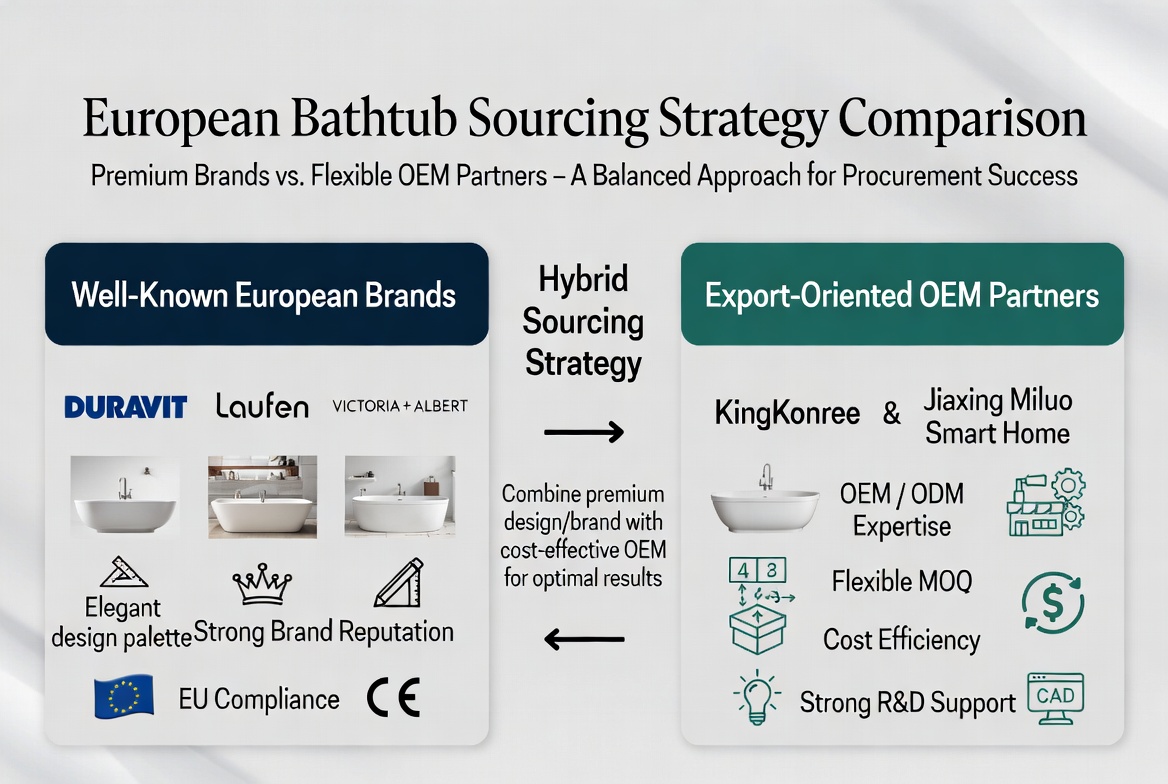
Artificial stone bathtubs sit at the intersection of material science, design and installation practice, and several recurring issues can impact projects if not managed early.
A common problem is suppliers quietly shifting to higher resin ratios or cheaper fillers to cut costs, which results in lower density tubs that feel "hollow," discolor faster and are more prone to thermal deformation. To avoid this: [kingkonree]
- Request and compare weight per unit for similar‑sized tubs; unusually light units can signal aggressive cost‑down formulations.
- Ask for third‑party or in‑house test data on density, water absorption and thermal cycling.
Low‑cost gel coats, poor mould‑release practice or insufficient curing can cause hairline cracks and early yellowing, especially in sun‑exposed or high‑temperature hotel bathrooms. Mitigation steps include: [kingkonree]
- Verifying which gel‑coat brand/system is used and whether UV‑stability tests are available.
- Checking if the supplier offers colour‑matched repair kits and documented repair procedures.
Some bathtubs rely on timber or low‑grade inserts for reinforcement, which may swell with moisture or fail under point loads from installation platforms. Buyers should: [kingkonree]
- Request cross‑section drawings showing reinforcement details and base construction.
- Align installation method (e.g. full‑surface bed vs feet) with the manufacturer's load and support guidelines.
Large freestanding tubs with long diagonal dimensions can show dimensional deviations if moulds or demoulding are not well controlled, leading to conflicts with pre‑built surrounds or glass partitions. To reduce risk: [kingkonree]
- Specify acceptable tolerance ranges (e.g. ±3 mm on critical dimensions) in purchase contracts.
- Require shop drawings with dimension chains for coordination with interior and MEP teams.
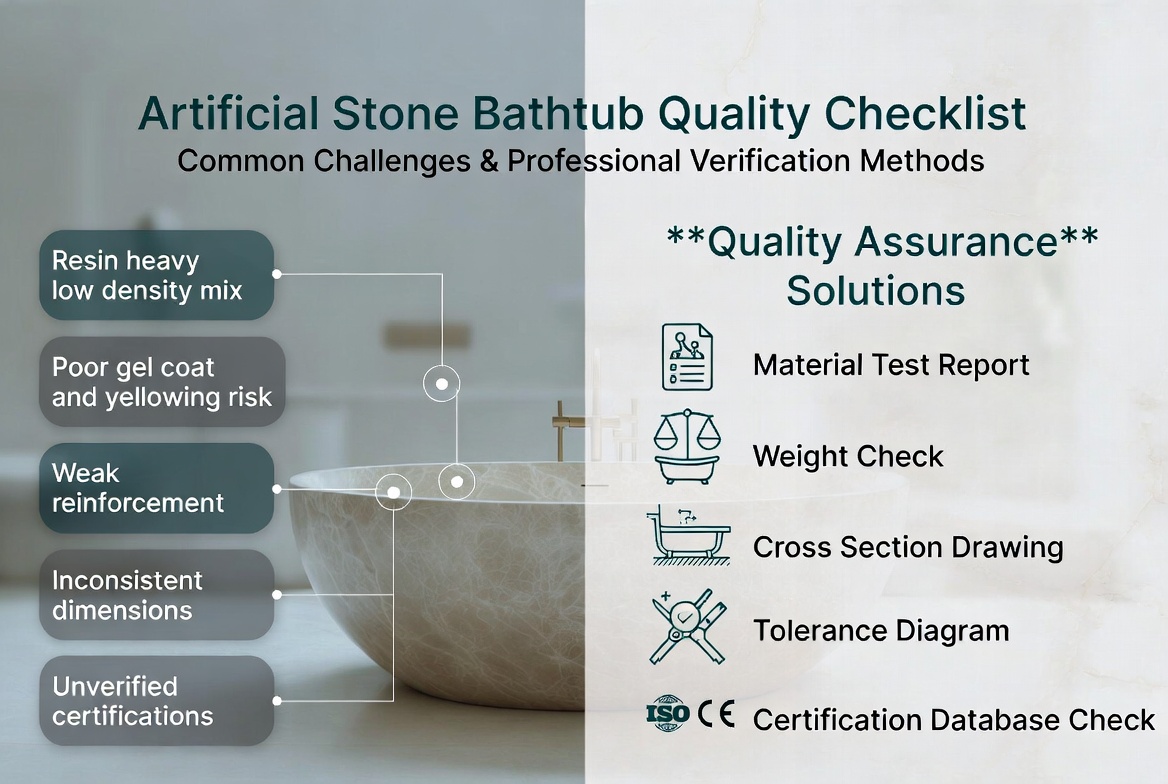
One industry reality seldom mentioned online is the "mould hierarchy" inside factories, especially high‑mix OEM plants. When capacity is tight, factories often prioritise moulds linked to large, repeat orders from key accounts; smaller OEM customers may see their new designs repeatedly pushed back in scheduling. [datainsightsreports]
This can lead to:
- Delayed first samples, often justified by "maintenance" or "queue" issues.
- Slower response to design modifications, which can kill a brand's launch window in Europe.
To mitigate this, experienced buyers:
- Negotiate explicit development milestones and penalties (or compensation mechanisms) for critical launch dates.
- Choose suppliers, such as flexible mid‑sized OEMs, that position new‑mould development as a strategic service rather than a "side job" to big catalogue orders. [kingkonree]
This is precisely where partners like Jiaxing Miluo Smart Home Co., Ltd., with a strong R&D and communication focus for small and mid‑size brands, can provide a competitive advantage in the European market.
- Confirm ISO 9001 and ISO 14001 on the issuing body's website (e.g. IQNet, AENOR, DNV) rather than relying only on PDF scans from the supplier. [ceramicaglobo]
- Cross‑check CE or EN conformity claims for associated components (e.g. overflows, fittings, structural supports) through test reports and declarations referencing relevant EN standards. [export.roca]
- For long‑term partnerships, plan either a physical audit or a remote video‑based audit focusing on raw‑material storage, casting, curing, finishing and final inspection areas.
For artificial stone bathtubs, a structured sampling approach dramatically reduces project risk:
- Stage 1 – Material samples: Request flat coupons and cross‑sections to test colour consistency, hardness (scratch tests) and cleaning behavior with common chemicals.
- Stage 2 – Pre‑production tub samples: Use real site‑like conditions to test stability, overflow behavior, ease of cleaning, and subjective comfort (hotels often involve their operations team here).
- Stage 3 – Golden sample: Freeze a "golden" reference sample and matching drawings agreed by both parties, to be used for future QC comparison.
Bathtubs are bulky and damage‑prone; logistics must be part of the sourcing strategy:
- Use double‑layer cartons with foam or EPS cradles, plus palletisation suitable for European warehouse handling.
- Specify drop‑tests or transport simulation at the packaging design stage, particularly for e‑commerce‑oriented SKUs. [kingkonree]
- Align Incoterms and insurance clearly, especially for mixed FCL/LCL shipments into European ports.
To build a sustainable pipeline of artificial stone bathtubs for Europe:
- Consolidate SKUs around modular families (e.g. several lengths and widths sharing the same design language) to improve mould utilisation and reduce stock complexity.
- Involve the supplier's engineering team early on to adapt designs to their process capabilities, minimising re‑work and hidden costs.
- Plan annual cost and design reviews using market data from sources such as Statista or industry reports on luxury bathtubs to keep positioning aligned with shifting demand and price levels. [statista]
Selecting artificial stone bathtub suppliers for the European market is not only a matter of design and price; it requires a structured assessment of materials, process control, certifications, logistics, and the supplier's willingness to support long‑term OEM/ODM development. European manufacturers such as Duravit, Laufen, Victoria + Albert and Kaldewei offer strong design, compliance and brand equity, while export‑oriented partners like KingKonree and Jiaxing Miluo Smart Home Co., Ltd. provide flexible, R&D‑driven OEM support that can give smaller and mid‑size brands a competitive cost‑performance edge in Europe. [worldfurnitureonline]
1. How can I verify if a factory's ISO 9001/14001 certificates are genuine and not expired?
Ask the supplier for the certificate number and issuing body, then check the issuing body's online database (e.g. IQNet, DNV, AENOR) for validity dates and scope. If online verification is not available, email the certification body directly with the certificate number for confirmation. [ceramicaglobo]
2. What technical data should I require for artificial stone bathtubs targeting European hotels?
At a minimum, request density, water absorption, thermal shock resistance, stain resistance, load‑bearing data for the base, and cleaning/maintenance guidelines, ideally according to EN‑derived test methods. Also ask for detailed installation instructions covering substrate, sealing, and compatible adhesives and silicones. [worldfurnitureonline]
3. How do I ensure colour consistency across multiple production batches for a hotel project?
Freeze a colour standard (e.g. a master coupon) and require the factory to perform and document colour difference checks (ΔE) for each batch against this standard. For critical projects, consider batch‑level approval where samples from each production run are checked on site before mass shipment. [kingkonree]
4. How can I assess whether a factory can handle complex OEM designs or only simple catalogue shapes?
Ask for references of past custom projects (with anonymised drawings if needed), photos of mould‑making facilities, and a description of their CAD/CAM workflow. Factories with in‑house CNC mould machining and dedicated R&D staff are usually better prepared for complex OEM work than those outsourcing moulds. [kingkonree]
5. What is a reasonable development timeline for a new OEM artificial stone bathtub model?
For a new freestanding tub, a typical sequence is 2–4 weeks for design refinement, 4–6 weeks for mould making, and 2–3 weeks for first article sampling, so around 8–13 weeks in total under normal factory load. If a supplier offers much faster timelines, check carefully whether they are adapting an existing mould rather than building a new one, and how that affects design ownership. [datainsightsreports]
- Statista – European bathroom hardware and DIY market insights, including demand trends, consumer behavior and macro‑economic drivers. [statista]
- World Furniture / CSIL reports – Detailed analysis of the European bathroom furniture and wellness market, including key players and structural trends. [worldfurnitureonline]
- Manufacturer certification pages (e.g. Roca's certificates and declarations) – Concrete examples of how leading European brands present ISO and environmental documentation. [export.roca]
- International market research providers on luxury bathtubs – For forward‑looking data on segment growth, regional demand and competitive landscape from 2026–2034. [datainsightsreports]


