
Views: 272 Author: Miluo Smart Home Publish Time: 2026-07-22 Origin: Site


Content Menu
● Ceramic and Porcelain: The Everyday Workhorses
>> Advantages of Ceramic and Porcelain
● Glass Basins: Sculptural and Light‑Reflecting
● Cast Stone, Solid Surface, and Composite Materials
● Natural Stone: Unique Character and Organic Texture
● Metal Sinks: Stainless Steel, Copper, and Beyond
● Newer and Eco‑Oriented Materials
● How to Choose the Right Bathroom Sink Material
>> User Profile and Traffic Level
>> Cleaning Habits and Water Quality
>> Design Direction and Brand Positioning
>> Lifecycle Expectations and Budget Planning
>> Installation Constraints and Technical Details
● Material Comparison at a Glance
● Current Trends in Bathroom Sink Materials and Colors
● Inside a Modern OEM / ODM Bathroom Sink Project
>> 1. Design Brief and Engineering Alignment
>> 2. Gypsum Sample and Shrinkage Management for Ceramic
>> 3. Sample Firing, Refinement, and Installation Testing
>> 4. Production Mold Creation and Mass Production
● Practical Guidelines for Specifiers and Buyers
>> 1. What is the most practical bathroom sink material for everyday family use?
>> 2. Are matte basins harder to keep clean than glossy ones?
>> 3. Is natural stone a good idea for a main family bathroom?
>> 4. How long does it usually take to develop a new custom ceramic basin?
>> 5. Why can an OEM or ODM sample look slightly different from the original drawing?
In contemporary bathrooms, sinks are made from a range of engineered and natural materials, each with a distinct feel, maintenance profile, and lifespan. Common choices include ceramic and porcelain, glass, cast stone and solid surface, natural stone, stainless steel, copper and other metals, as well as newer composite materials and eco‑oriented options such as recycled glass. Ceramic remains the most widely used because it balances durability, affordability, and everyday practicality, while alternative materials are increasingly specified where designers want unique aesthetics, tactile surfaces, or a stronger design statement.
When specifying or sourcing basins for international markets, it is helpful to think of the sink as a long‑term interface product between the user and water, rather than just a decorative bowl. The most suitable material will depend on who will use the sink, how often, how it will be cleaned, and how it needs to integrate with the countertop, the cabinet, and the overall bathroom concept.

Ceramic and porcelain have become the benchmark for everyday bathroom basins thanks to their combination of strength, stain resistance, and stable appearance over time. These materials are created from refined clays formed into shape, fired at high temperature, and coated with a vitreous glaze that seals the surface and makes it smooth, non‑porous, and easy to wipe clean. In most family bathrooms, hotels, and multi‑unit projects, a well‑glazed ceramic or porcelain sink still offers the best balance of performance and value.
Porcelain, technically a denser and finer form of ceramic, allows sharper lines and thinner profiles without sacrificing structural stability. This is why many ultra‑slim, modern basins with crisp edges are described as porcelain or fine fireclay. For users, the difference is felt in the details: a porcelain bowl can feel slightly more refined, with thinner rims and a "lighter" visual presence, yet still provides familiar ease of maintenance.
- Strong resistance to common bathroom stains from toothpaste, soap, cosmetics, and hair products.
- Non‑porous glazed surfaces that are easy to disinfect and keep bright with basic cleaners.
- Good longevity with minimal color change when exposed to light and typical tap water conditions.
- Wide range of configurations, from undermount and semi‑recessed to vessel and wall‑hung versions.
In practice, the performance gap between different ceramic basins often comes down to manufacturing quality rather than the material itself. Well‑controlled firing cycles and glazes reduce the risk of pinholes, warping, or micro‑cracking, and they help ensure that the sink fits perfectly into its cut‑out or wall mounting brackets.

Glass basins occupy a special niche where design and atmosphere matter as much as practicality. Tempered glass can be shaped into vessel bowls, troughs, or geometric forms that catch the light and introduce a sense of transparency or jewel‑like color into a bathroom. These pieces often appear in guest powder rooms, boutique hotels, and design‑led residential spaces where the sink serves as a centerpiece.
However, glass is less forgiving in high‑traffic environments. Water spots, fingerprints, and soap residue are more visible, especially under focused lighting. While tempered glass is stronger than ordinary household glass, it is still more vulnerable to impact from heavy objects or sharp blows than dense ceramic or porcelain. For households with children, or for spaces where users may not treat fixtures gently, glass is usually best reserved for accent areas.
Cast stone, solid surface, and engineered composites use mineral fillers and resins to create dense, non‑porous basins that can be shaped into seamless forms. These materials have become a favorite for integrated countertop‑and‑basin designs, where the bowl is molded as one piece with the surrounding surface. This approach reduces joints where dirt can accumulate and creates a calm, monolithic look.
One of the key benefits of solid‑surface and composite basins is their repairability. Minor scratches or dull spots can often be refinished on site with sanding and polishing techniques, extending the life of the product. These materials also lend themselves to modern matte finishes and soft, rounded geometries that feel warm to the touch compared with colder stone or metal. For designers, the ability to specify consistent color and texture across many units makes composities particularly attractive for large residential developments and commercial rollouts.
Natural stone basins, carved from marble, granite, travertine, basalt, and other stones, offer a one‑of‑a‑kind surface with unique veining and color variations. They immediately introduce a sense of craftsmanship and authenticity into a bathroom and align with broader design movements toward natural, tactile materials. Stone basins are often used in premium residential suites, spa‑inspired bathrooms, and boutique hospitality projects where distinctive character is a priority.
Because stone is naturally porous, it depends heavily on proper sealing and ongoing maintenance. Acids from some cleaning agents, skincare products, or hair dyes can etch or discolor the surface if not wiped away promptly. The material is also heavy, so cabinetry and wall structures must be designed to support the load safely. For all these reasons, stone basins work best in projects where users understand and accept the extra care they require and where installation is handled by experienced professionals.
Metal basins are increasingly visible in modern residential and commercial bathrooms, particularly where designers want an industrial, vintage, or hotel‑inspired aesthetic. Stainless steel is appreciated for its strength, corrosion resistance, and hygienic qualities, while copper and brass bring warmth and a "living" finish that develops a patina over time.
Stainless steel basins pair well with minimalist or loft‑style interiors and are particularly suitable for utility spaces or environments that demand high impact resistance. Copper and brass, meanwhile, appeal to users who appreciate surfaces that evolve visually with use, rather than remaining perfectly uniform. Because thin metal can sound hollow or rattle under water flow, higher‑end metal basins often incorporate thicker gauges and sound‑dampening treatments to deliver a more solid, reassuring feel during everyday use.
Beyond traditional materials, recent years have seen the growth of eco‑oriented basins made from recycled glass, concrete composites, or other sustainable formulations. These sinks support projects that prioritize responsible material choices and distinctive textures. Recycled glass basins, for example, combine fragments of glass embedded in a binder to create shimmering surfaces with a unique, handcrafted look.
Concrete and cement‑based composites are also gaining ground, especially in earth‑tone palettes that echo architectural and interior trends. Pigmented concrete basins can be produced in warm sands, terracottas, and muted greens, aligning with the move toward calm, nature‑inspired spaces. As with other composite solutions, consistent quality and long‑term stability depend on controlled production processes and careful sealing, making experienced manufacturing partners especially important.
Selecting the ideal sink material is a strategic decision that should reflect how the bathroom will be used every day. Instead of starting with color alone, it helps to work through a set of practical questions about the environment, maintenance expectations, and design goals.
Below are key factors to consider before committing to a specific basin material.
- For busy family bathrooms, prioritize hard‑wearing, non‑porous materials such as glazed ceramic or porcelain.
- In guest powder rooms or occasional‑use spaces, more delicate materials like glass or natural stone can be appropriate.
- In commercial or hospitality settings, evaluate not only durability but also how quickly cleaning staff can maintain a consistent appearance across many rooms.
Understanding who will use the sink—and how often—prevents over‑specifying fragile finishes for high‑impact environments.
- In hard‑water regions, matte black and very dark glossy finishes can show limescale more readily and may require more regular cleaning.
- Households that prefer gentle cleaners and quick wipe‑downs typically benefit from high‑quality glazed ceramic, which resists staining and can be refreshed easily.
- Where strong chemicals are common, it is important to check that the chosen material and finish are compatible and will not be etched or discolored over time.
Matching material choice to realistic cleaning practices means the sink will age more gracefully and remain pleasant to use for longer.
- Minimalist bathrooms with continuous countertops often benefit from integrated solid‑surface or cast‑stone basins.
- Spa‑like or biophilic spaces may favor natural stone or textured composites that echo the look of rock, clay, or earth.
- Industrial or contemporary hotel‑style concepts can make use of stainless steel, concrete, or deep‑colored porcelain.
The sink should support the wider design narrative, but not at the expense of comfort or usability for the intended users.
Some projects are planned around a three‑to‑five‑year refresh cycle, while others expect fixtures to remain in place for a decade or more. Denser, non‑porous materials with proven performance records are often the best investment for long‑term installations. For concept bathrooms or frequently updated showrooms, more experimental materials and colors can be justified as part of a higher‑turnover visual strategy.
Thinking explicitly about lifecycle before selecting a material helps align expectations between property owners, designers, and manufacturers.
- Wall‑hung and slim‑line vanities demand careful balancing of material thickness, weight, and fixing points.
- Retrofitting into existing furniture may limit basin width, depth, and bowl position.
- Undermount and semi‑recessed installations require precise cut‑outs, stable countertop substrates, and secure sealing to prevent water ingress.
Choosing a material is not only an aesthetic decision but also a technical one, and close coordination between designer, installer, and manufacturer typically leads to smoother on‑site work and fewer adjustments.
The table below summarizes how common basin materials generally perform in everyday use. Values are approximate and can vary by product quality and manufacturer, but they highlight key differences.
| Material | Durability (1–5) | Stain resistance (1–5) | Impact resistance (1–5) | Maintenance level | Typical applications | Visual character |
|---|---|---|---|---|---|---|
| Ceramic / vitreous china | 4 | 5 | 3 | Low | Family bathrooms, hotels, multi‑unit housing | Classic glossy, widely familiar |
| Porcelain | 4–5 | 5 | 3–4 | Low | Premium residential, boutique hospitality | Thin‑rim, crisp, modern |
| Glass | 3 | 3 | 2–3 | Medium | Powder rooms, design showpieces | Translucent, reflective, sculptural |
| Cast stone / solid surface | 4 | 4 | 3–4 | Medium | Integrated tops, design‑led projects | Matte, soft‑touch, seamless |
| Natural stone | 3 | 2–3 | 4 | Higher | Luxury homes, spa‑inspired and boutique spaces | Unique veining, organic texture |
| Stainless steel | 4 | 4 | 4–5 | Medium | Loft style, utility areas, some commercial | Industrial, sleek, reflective or brushed |
| Copper / metallic alloys | 3–4 | 3 | 3–4 | Medium | Character bathrooms, vintage or artisan looks | Warm tone, evolving patina |
| Recycled glass / composites | 3–4 | 3–4 | 3–4 | Medium | Eco‑focused and design‑driven projects | Textured, distinctive, often colorful |
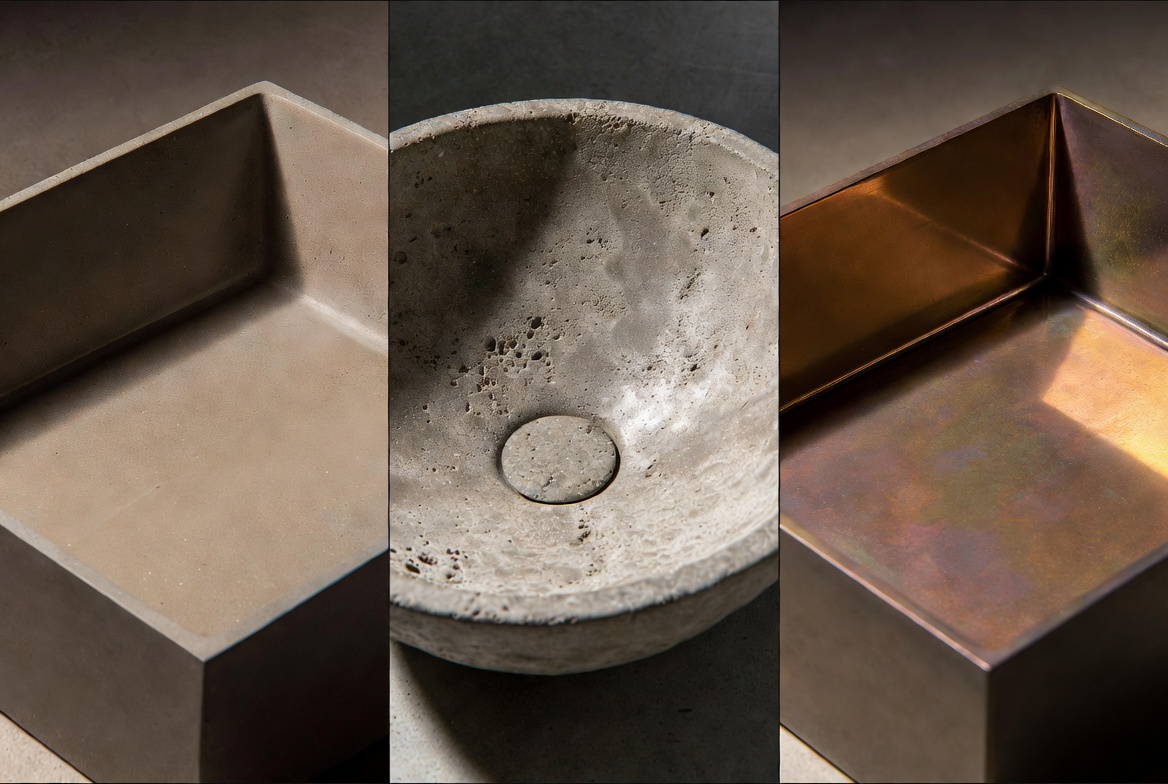
Recent years have brought a noticeable shift in both materials and finishes for bathroom basins. Neutral white ceramic still dominates in volume, but design‑driven projects increasingly explore texture, color, and integrated forms to create calm, coherent spaces.
Several trends stand out:
- A move toward matte and lightly textured surfaces that feel soft to the touch and diffuse light gently.
- Growing interest in earth‑tone materials such as concrete, basalt, and travertine, often in warm, nature‑inspired color families.
- Strong demand for darker, moodier basins in matte black, charcoal, and deep navy, particularly in modern and "quiet luxury" bathrooms.
- Renewed attention to metallic basins in copper and gunmetal, where the basin itself becomes a focal point with subtle, handcrafted character.
These shifts reflect a broader desire to transform bathrooms from purely functional rooms into calm retreats that still withstand daily use.
Behind every well‑designed basin is a structured development process that turns design intent into a stable, repeatable product. In modern factories, especially those that specialize in ceramic and composite basins, custom sink projects usually follow a staged journey from concept to mass production.
Understanding the main steps helps brands, wholesalers, and project clients set realistic timelines and quality expectations for new product launches.
The process starts with a detailed briefing phase where the brand or client clarifies what the basin must achieve, not only how it should look. At this stage, teams confirm mounting type (vessel, undermount, wall hung, integrated), overall dimensions, rim thickness, bowl depth, and drain and overflow configuration. Compatibility with cabinets, countertops, faucets, and accessories is checked in detail.
Engineering teams also evaluate draft angles, curvature, and wall thickness to make sure the piece can be formed, de‑molded, and fired successfully without warping or structural weaknesses. Early alignment here reduces costly changes later in the project.
For ceramic and porcelain basins, the first physical prototype is typically a gypsum sample—a master form used to create the working molds. Because ceramic materials shrink during firing, the gypsum sample is intentionally made larger than the target finished size. The exact level of oversizing depends on the clay body and firing profile.
By adjusting the gypsum form, engineers compensate for shrinkage so that the final fired basin achieves the right dimensions for furniture and countertop integration. This is why early samples may appear slightly oversized compared to digital drawings; those differences are deliberate and calculated.
Once the gypsum base is ready, the factory produces the first fired ceramic or composite samples. These samples are evaluated carefully for surface quality, glaze consistency, form accuracy, and water performance. Edges are refined, transitions are softened, and any minor pooling or drainage issues are resolved through careful adjustments to the mold and internal geometry.
Another crucial step is real‑world installation testing. The sample basin is installed on actual cabinets, countertops, and brackets to confirm that cut‑outs are accurate, clearances are sufficient, and the product sits securely without tension. Issues discovered in this phase are much easier to resolve at the mold stage than after mass production begins.
After samples meet both aesthetic expectations and technical requirements, the factory proceeds to build full production molds. In ceramic manufacturing, this stage often takes several weeks and represents a major investment, as mold quality directly affects consistency and yield over thousands of units.
Once production molds are in place, a controlled start‑up phase begins. Units are produced in increasing volumes while quality checks focus on dimensional stability, surface finish, and defect rates. Only when this data is stable does the project shift into full mass production. As a result, the complete journey from initial idea to reliable series production for a new basin commonly spans several months, especially for complex or highly customized shapes.
From the perspective of people who work daily with basins—designers, project managers, and manufacturers—a few practical guidelines consistently lead to better long‑term outcomes:
- Treat dimensional accuracy and installation compatibility as non‑negotiable basics for any new basin design.
- Match material selection to real cleaning habits and local water conditions, not just mood boards or showroom lighting.
- Balance eye‑catching designs with bowl depth, splash control, and user comfort, especially for households with children or older users.
- For large, multi‑unit or export projects, allow enough development time for samples, refinements, and on‑site installation tests before locking in production schedules.
When these principles are applied, the chosen basin material is more likely to deliver the combination of visual appeal, durability, and everyday ease of use that today's bathrooms require.
From classic white ceramic to textured stone and warm metal basins, today's bathrooms offer more material possibilities than ever before. The most successful projects are those where the chosen sink material reflects real‑world routines, local conditions, and installation requirements, not just an attractive photograph. By understanding the strengths and trade‑offs of each material and by collaborating closely with experienced manufacturers, designers and buyers can create bathroom spaces that look refined on day one and continue to feel comfortable, reliable, and inviting for many years.
High‑quality ceramic or porcelain is generally the most practical choice for family bathrooms. These materials resist staining, handle everyday impacts reasonably well, and are easy to clean with standard, non‑abrasive household products.
Matte finishes tend to hide fingerprints and minor smudges better than high‑gloss surfaces, but they may reveal mineral deposits more quickly in hard‑water areas. Regular, gentle cleaning helps keep both matte and glossy basins looking fresh, but it is worth considering local water conditions when choosing a finish.
Natural stone can look exceptional but usually requires more care and attention than ceramic or porcelain. It suits users who appreciate unique veining and are willing to maintain sealants, avoid aggressive chemicals, and wipe away staining agents promptly. For heavily used family bathrooms, stone is often better as an accent or feature rather than the default material.
Developing a new ceramic basin—from initial technical alignment through gypsum samples, fired prototypes, installation testing, and full production mold creation—typically takes at least several weeks and can extend over a couple of months for more complex designs. Timelines vary depending on design complexity, the number of sample iterations, and the manufacturer's production schedule.
In ceramic production, engineers build in allowances for material shrinkage and other manufacturing realities, so early prototypes may differ slightly in dimension or proportion from flat drawings or 3D visualizations. These adjustments are part of optimizing the design for stable production and reliable installation, and small refinements are common before the final version is approved for mass production.
1. Monblari – "Sink of Bathroom: Best Materials, Styles & Picks for 2026" https://monblari.com/blogs/guide/sink-of-bathroom-best-materials-styles-picks-for-2026
2. The Exeter Daily – "Top Bathroom Sink Trends for 2026: What's In and What's Out?" https://www.theexeterdaily.co.uk/news/homes-gardens/top-bathroom-sink-trends-2026-whats-and-whats-out
3. Pure Bath Bliss – "Bathroom Sink Color Trends 2026: Beyond Standard White" https://www.purebathbliss.com/articles/bathroom-sink-color-trends-2026
4. Porcelanosa – "Bathroom trends for 2026: everything you need to know" https://www.porcelanosa.com/trendbook/us/bathroom-trends-2026/
5. Accio – "Trending Bathroom Sinks 2026: Design & Materials" https://www.accio.com/business/trending-bathroom-sinks-2026
6. HanYu Ceramics – "OEM Bathroom Sinks: Custom from Sample to Mass Production" https://www.ceramicbasin.com/oem-bathroom-sinks-custom-development-process/
7. Marmorin Group – "Private label & ODM manufacturer of elegant washbasins" https://marmoringroup.com/washbasins/


