
Views: 224 Author: Miluo Smart Home Publish Time: 2026-09-26 Origin: Site


Content Menu
● What Is a One-piece Vanity Top and Basin?
>> Why the distinction matters to buyers
● One-piece Design Versus Separate Components
>> Appearance: continuity or contrast?
>> Cleaning: fewer edges, not zero upkeep
>> Installation and future replacement
● Which Material Delivers the Right Look?
>> Solid surface for a quiet transition
>> Ceramic and other formed surfaces
>> Finish is part of the decision
● A Practical Specification Test for OEM Buyers
>> 1. Does the drawing match the installation?
>> 2. Does the sample match the promise?
>> 3. Can the supplier repeat it?
● Where Each Design Works Best
>> Choose an integrated top when simplicity leads
>> Choose separate components when flexibility leads
>> Consider the buyer's after-sales plan
● Building a Cohesive Vanity Collection
>> Is a one-piece vanity top and basin completely seamless?
>> Is an integrated basin easier to clean?
>> Can a scratched one-piece vanity top be repaired?
>> Which is better for a small bathroom?
>> Are one-piece vanity tops available with two basins?
>> Does "one-piece" include the vanity cabinet?
A one-piece vanity top and basin creates a calm, uninterrupted look that suits a modern bathroom. But its appeal goes beyond appearance. Compared with a separate vanity top and basin, an integrated design can reduce exposed joints and simplify routine cleaning. The better choice, however, depends on the material, installation plan, repair strategy, and level of design flexibility a project needs.
For bathroom brands and wholesale buyers, that distinction matters. A product that looks seamless in a photograph must also fit its cabinet, connect correctly to the specified fittings, and arrive with a finish that can be repeated across an order. This guide compares both configurations from a design and procurement perspective.
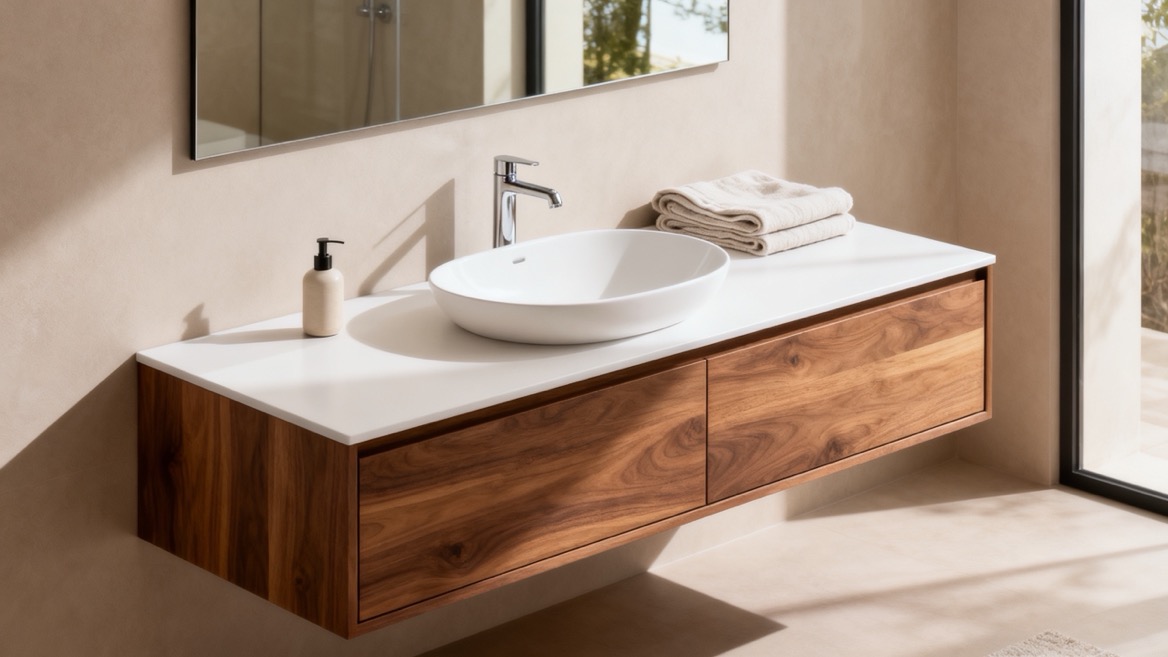
In a one-piece vanity top and basin, the washing area and surrounding counter form a unified assembly. Some products are molded as one piece. Others use a separately formed basin joined to the top to create a nearly continuous appearance. "One-piece" should therefore describe the verified construction, not merely the look.
A separate configuration uses a countertop and an independently made basin. That basin might sit above the counter, drop into a cutout, or mount beneath it. Each arrangement creates a different edge profile, cleaning routine, and installation requirement. A fully integrated top is not the same thing as a complete vanity unit: the cabinet, faucet, drain, and mirror may still be separate items.
Imagine two white vanity displays. From across the showroom, both appear to have a continuous counter and bowl. Up close, one has a molded transition, while the other has a joined basin with a carefully finished seam. Neither description alone establishes quality. Buyers should examine a production sample and ask how the basin connects to the top, where seams remain visible, and how the finished assembly is supported.
That simple check prevents a common specification problem: approving an image while leaving the construction method undefined.
The beauty of an integrated vanity is its visual restraint. Yet a vessel basin on a contrasting top can be equally compelling when the basin is meant to be the focal point. The choice is less about which design is universally better and more about where you want the eye to go—and how the product will be maintained. Duravit presents integrated and countertop basins as distinct design options, noting the easier-to-clean fit of integrated models and the visual emphasis a countertop basin can provide.
| Decision factor | One-piece vanity top and basin | Separate vanity top and basin |
|---|---|---|
| Visual effect | Continuous, quiet silhouette | Greater contrast and emphasis on the bowl |
| Exposed joint at the basin | Often reduced or absent, depending on construction | Usually present at the rim or mounting edge |
| Style flexibility | Top and basin are designed as a coordinated assembly | Basin and top can be selected independently |
| Cleaning | Fewer edges around the bowl to wipe | Rim, underside, or counter junction may need attention |
| Replacement | Damage to one area may affect the whole assembly | A basin or top may be replaceable on its own |
| Specification | Fewer visual mismatches, but dimensions remain critical | More component combinations to coordinate |
These are design and procurement tendencies, not guarantees. A poorly finished integrated top can be harder to live with than a well-installed separate basin. Similarly, replacement options depend on the actual product, cabinet, and availability of matching parts.
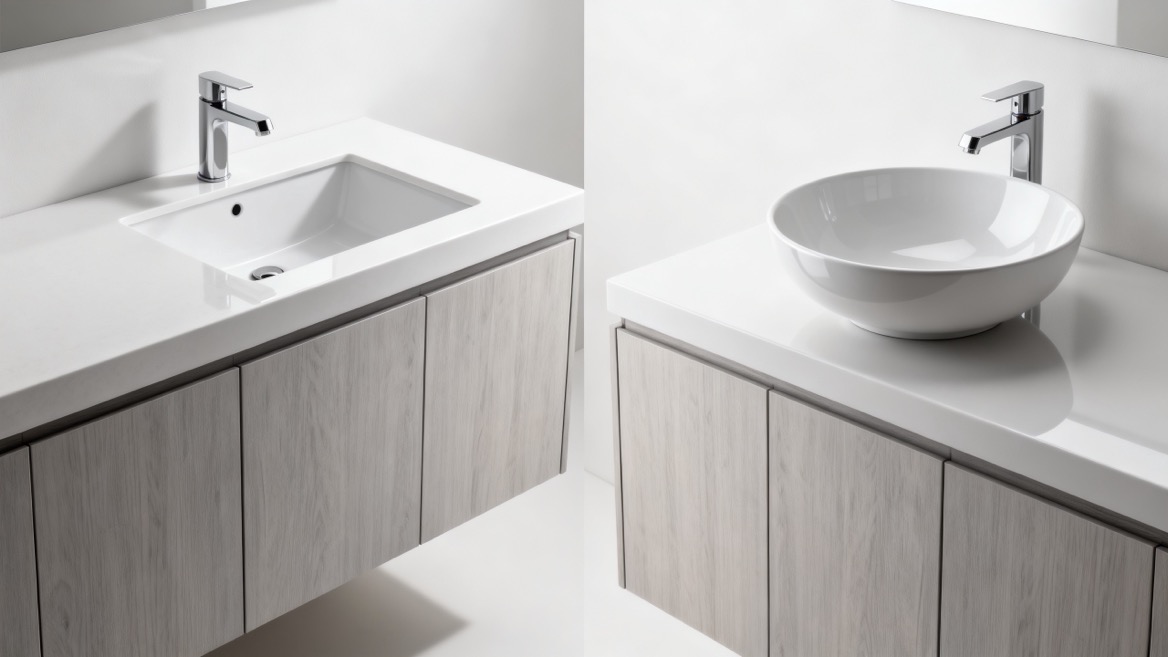
An integrated basin allows the counter to flow toward the bowl without a prominent raised rim. In a compact bathroom, that restrained outline can keep the vanity from looking busy. On a long double-basin top, it can give both washing positions a consistent visual rhythm.
A separate vessel basin makes a different statement. Its outline, color, and height can create a deliberate contrast with the counter. This may suit a collection built around a sculptural basin. An undermount basin offers a quieter alternative, although its construction and joint still need careful specification. Corian describes seamless undermounting as a way to remove rims that can trap dirt and water.
For a product range, the strongest approach may be to offer both: an integrated option for understated continuity and a separate basin for customers who want a more expressive combination.
The practical appeal of a one-piece vanity top and basin is easy to understand. Around a raised basin, water and residue can collect where the bowl meets the counter. A smooth transition reduces that particular cleaning task. It does not eliminate cleaning around the faucet, drain, overflow, or backsplash.
Material and finish also affect the experience. On some solid-surface products, standing water can leave a visible film, particularly in hard-water areas. Darker colors may show light scratches more readily than lighter ones. A buyer evaluating samples should inspect them after ordinary use and cleaning, not only when they are dry under showroom lighting.
An integrated assembly can reduce the need to align a separately purchased basin with a countertop cutout. It still requires a suitable cabinet or support, correctly placed plumbing, and careful handling. A separate configuration adds coordination between the basin, cutout, mounting method, and top—but may offer more flexibility if the design changes later.
Ask who supplies the dimensioned drawing. The drawing should identify the overall width and depth, bowl position, drain location, faucet-hole arrangement, rear edge, and cabinet interface. Do not assume that a top sold under a familiar nominal width will fit every cabinet of that description. Duravit likewise stresses matching vanity dimensions and accommodating plumbing connections when planning an installation.
The term "one-piece" identifies a configuration, not a material. Before judging durability or repairability, buyers need to know what the top and basin are made from—and whether both areas use the same construction.
Solid surface is well suited to designs that aim for a continuous top-and-basin appearance. Corian shows how the material can be used for integrated vanities and joined sinks, while the National Kitchen & Bath Association describes ready-formed solid-surface vanity tops with integrated basins. Those examples demonstrate design possibilities; they do not mean every solid-surface product has identical properties.
For an OEM or ODM brief, define the material system, color, finish, edge profile, and acceptable appearance of any join. Ask for care instructions for the proposed product rather than applying another brand's instructions to it. Some solid-surface finishes can be refinished after minor wear, but the appropriate method depends on the material and finish.
An integrated ceramic basin can deliver a clean, familiar sanitary-ware appearance. Ceramic is also used in designs where the basin is fitted closely to furniture, creating a coordinated visual unit. Visually continuous does not always mean physically molded as one piece, so construction should remain explicit in product copy and technical documents.
Other formed vanity-top materials may offer integrated bowls as well. Their care and repair requirements should be checked individually. Do not promise that a scratch can be sanded out, or that a finish is unaffected by a particular chemical, without product-specific evidence. The NKBA's material guide, for example, distinguishes the care considerations of cultured marble from those of solid surface.
A glossy white sample, a matte warm-white sample, and a dark stone-look sample can communicate very different positions within the same collection. Finish also influences what users notice after installation. On Corian solid surface, darker colors can require more attention and show light scratches more readily, while strong chemicals and direct heat exposure require care. Those are material-specific guidance points, not claims about every vanity top.
The useful question is not simply, "Which finish photographs best?" It is: Which finish will still suit the intended setting after everyday use?
This is where a design preference becomes a dependable product decision. Before approving a one-piece vanity top and basin for a collection, use the sample stage to answer three questions.
Check the top against the proposed cabinet and fitting layout. Confirm bowl placement, available counter space, faucet arrangement, drain position, wall clearance, and access to plumbing. If a splashback, side return, or wall-mounted faucet is involved, include it in the same review. Planning guidance from the NKBA treats fixture location, cabinetry, clearances, and systems coordination as connected design matters—not isolated selections.
A drawing approval should identify the revision being approved. Otherwise, a later change to bowl position can be mistaken for a cosmetic update when it actually affects the cabinet.
Inspect the transition between top and bowl at normal viewing distance and under direct light. Feel the edge and bowl surface. Look for finish variation, visible joins, and areas where water might remain. Then check the underside: an elegant top surface does not answer how the unit is supported or how its drain area interfaces with the cabinet.
For an original design, approve a physical pre-production sample against the agreed drawing and finish reference before treating photographs as the final standard. This is a proposed buyer workflow, not a claim that any particular supplier already performs every step.
A good sample is only the start of a successful collection. Ask how dimensions and finish will be checked during production, how units will be protected in transit, and what happens if an item arrives damaged. Record the acceptable appearance of edges and joins in the purchase specification.
For a wholesale range, repeatability may matter more than a dramatic prototype. The most beautiful vanity top is of limited value if later units cannot match the approved example.
A one-piece vanity top and basin is a strong candidate for modern collections built around clean lines and easy-to-understand coordination. It can also work well where a brand wants the basin and counter to read as one designed object. Fewer exposed edges at the bowl may make routine wiping more straightforward, provided the rest of the installation is properly detailed.
It is particularly worth evaluating for a collection with a matching cabinet, mirror, and finish palette. In that setting, the continuous surface supports the visual identity of the full vanity rather than competing with it.
A separate basin makes sense when the bowl itself is a signature design element, when buyers want to mix materials, or when one top must support several basin styles. It also allows more independent selection of the counter and basin.
That freedom creates more decisions. The basin height, mounting edge, cutout, faucet reach, and cabinet fit must work together. The result can be excellent, but component flexibility requires disciplined coordination. Duravit's range illustrates how countertop, recessed, and integrated arrangements serve different design intentions.
Before choosing either configuration, decide how a damaged item would be handled. Can a basin be replaced without changing the top? Can a mark on the selected material be repaired to an acceptable finish? Is the matching model likely to remain available for the intended sales period? These questions do not have one universal answer. They belong in the sourcing discussion before an order is placed.
For a bathroom brand, a one-piece top should not be specified in isolation. Its basin shape needs to suit the cabinet proportions. The faucet position should leave comfortable usable space. The mirror and storage should reinforce the same design language. A narrow rim, for instance, may look elegant but leave little room for the everyday items the intended customer keeps beside the basin.
Jiaxing Miluo Smart Home Co., Ltd. presents basins, vanities, and other bathroom products as part of its customized high-end bathroom offering. For overseas brands, wholesalers, and manufacturers exploring an OEM or ODM collection, that broader product scope makes it possible to discuss the vanity as a coordinated concept rather than a basin alone. Any proposed dimensions, materials, finish, and production requirements should still be confirmed for the specific project.
The most useful starting document is a short design brief: target market, reference images, preferred material and finish, cabinet dimensions, fitting requirements, expected order scope, and desired sample approval process. It gives both buyer and manufacturer a clearer basis for evaluating what is attractive *and* feasible.
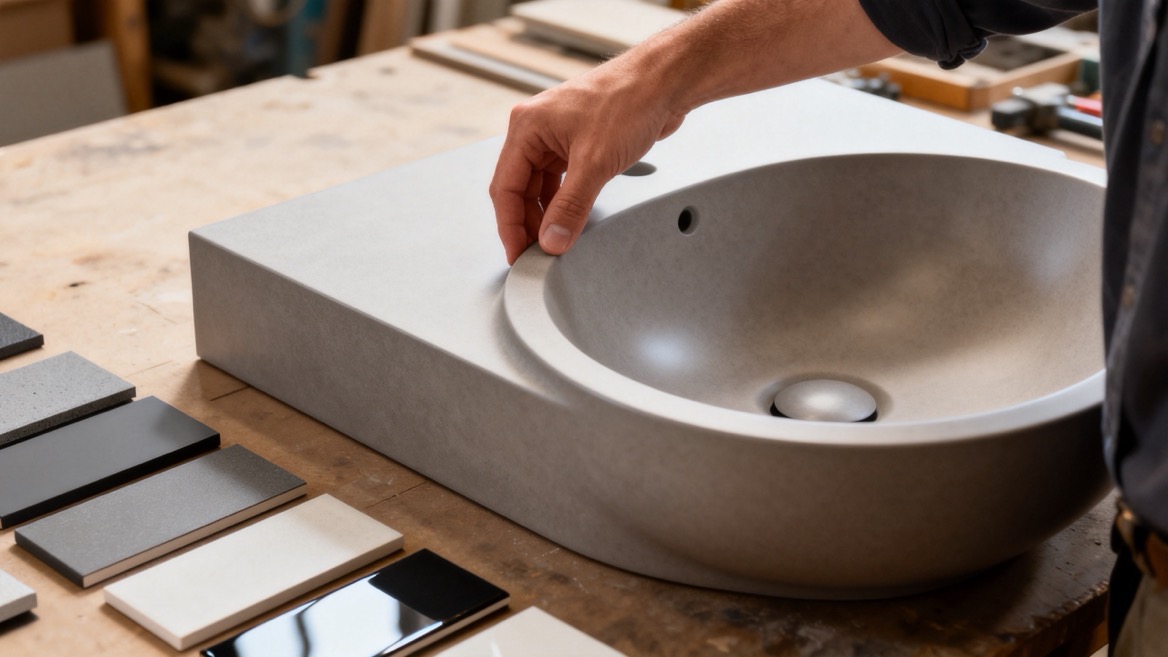
The beauty of a one-piece vanity top and basin lies in visual continuity with a practical purpose. It can make a bathroom feel composed while removing some of the edges that complicate cleaning. A separate top and basin remains the stronger option when contrast, modular choice, or independent replacement is central to the collection.
For your next bathroom range, send Jiaxing Miluo Smart Home Co., Ltd. your vanity dimensions, design references, preferred material and finish, and target market. Request a discussion of the integrated and separate-basin options, followed by drawings and a sample plan for the design you select.
Not necessarily. Some designs are molded as one piece; others join a separately made basin to the top for a near-seamless appearance. Ask for the construction method and inspect a sample before describing a product as fully seamless.
It often removes an exposed rim or joint around the bowl, which can simplify wiping. The faucet, drain, overflow, and other surrounding surfaces still need regular care. Cleaning requirements also depend on material and finish.
That depends on the material and the extent of the damage. Some solid-surface products allow minor scratches to be refinished; other finishes require different treatment. Follow the actual product manufacturer's instructions rather than assuming all integrated tops behave alike.
An integrated top can create a visually calm surface, but size and usability matter more than the label. Compare the overall depth, bowl position, usable counter space, and cabinet fit before choosing either design. Bathroom planning guidance emphasizes coordinating fixture placement and cabinetry.
Yes, double-basin vanity designs are available. The important checks are overall dimensions, basin spacing, counter space, cabinet support, and the planned plumbing arrangement.
Usually, the phrase refers to the top-and-basin assembly, not automatically to the cabinet. Confirm exactly what the quoted product includes: top, basin, cabinet, faucet, drain fittings, and any accessories should be listed separately where applicable.
- [Jiaxing Miluo Smart Home Co., Ltd. — Company Profile]. Company-reported product categories, customization focus, and contact details. [china-miluo]
- [Corian Design — Bathroom Sinks]. Integrated-surface design, joined basins, and cleaning considerations. [corian]
- [Corian Design — Use & Care]. Material-specific guidance on cleaning, scratches, heat, chemicals, and refinishing. [corian]
- [Duravit — Vanities]. Integrated and countertop basin configurations, design effects, and cleaning considerations. [duravit]
- [Duravit — Vanity Units]. Cabinet dimensions, plumbing accommodation, and installation planning. [duravit]
- [National Kitchen & Bath Association — Choosing a Bathroom Vanity Top]. Vanity-top materials and differing maintenance characteristics. [kb.nkba]
- [National Kitchen & Bath Association — Kitchen and Bath Planning Guidelines]. Planning topics covering fixture placement, cabinetry, clearances, and systems coordination. [nkba]


