
Views: 222 Author: Miluo Smart Home Publish Time: 2026-05-28 Origin: Site


When you stand in front of a beautiful stone-look bathtub, it can be hard to tell whether you are looking at engineered stone or a tub carved from a single stone block. As a bathroom product manufacturer and OEM/ODM partner, I am often asked which is better for real projects: stone-look bathtubs or real stone bathtubs. [thoughtshift.co]
From years of working with solid surface, resin stone, and natural marble bathtubs, my answer is simple: both have a place, but for most modern homes, hotels, and developers, a high-quality stone-look bathtub offers the best balance of design freedom, performance, and cost. [artemis]
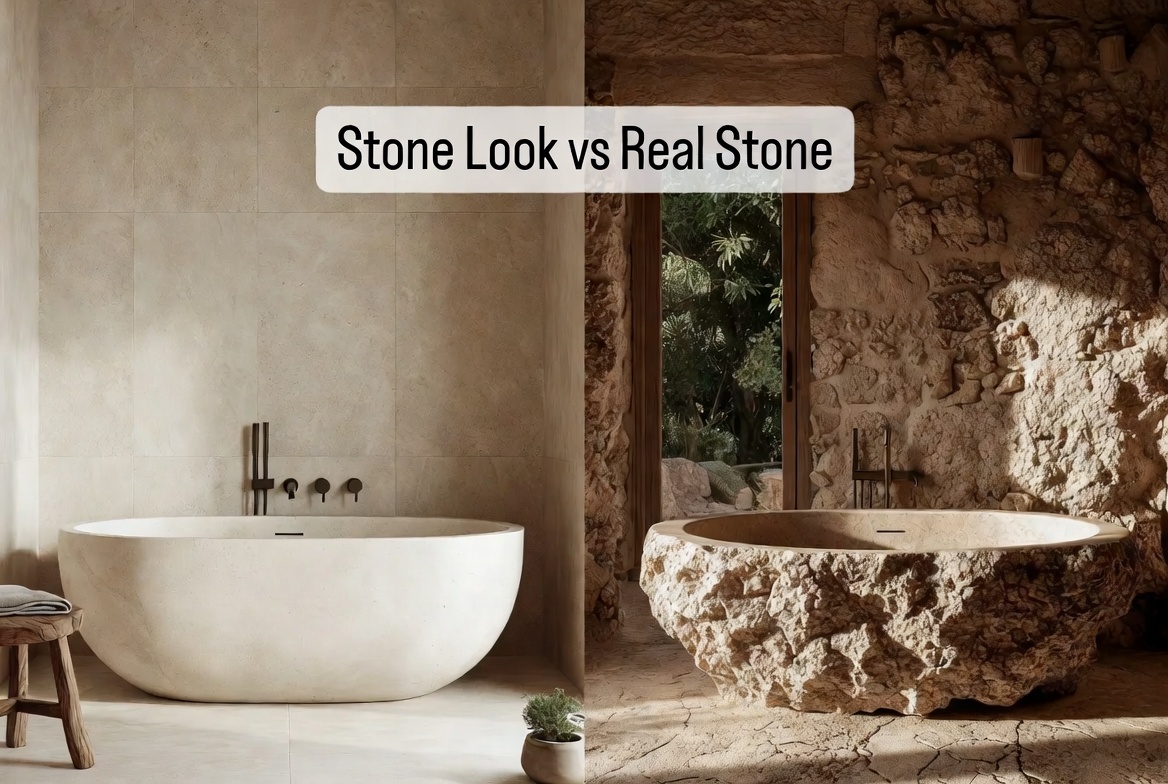
A stone-look bathtub is an engineered tub that reproduces the appearance and tactile feel of natural stone while using a controlled mix of minerals and resins. These tubs are usually freestanding and designed as the visual focal point of a bathroom. [artemis]
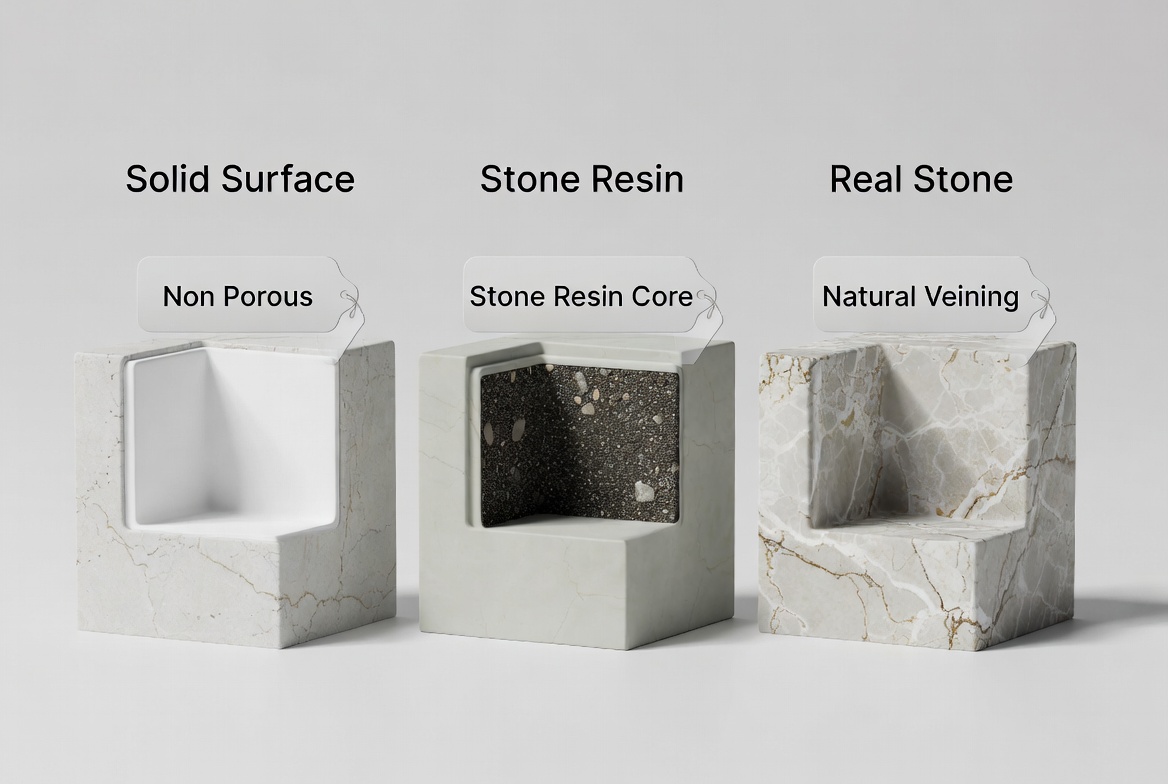
In practice, there are two main types we work with in OEM/ODM projects: [thoughtshift.co]
- Solid surface bathtubs
A composite of mineral fillers (often aluminum hydroxide) and acrylic or polyester resin, cast into precise molds and solid all the way through the cross-section. [artemis]
- Gel-coat stone resin bathtubs
A core made from crushed natural stone (about 75–80% by weight) mixed with resin, finished with a protective gel-coat surface layer. [artemis]
Both can closely mimic marble, granite, or limestone in color and texture, but they give manufacturers like us far more control over dimensions, tolerances, and finishes than real stone. [thoughtshift.co]
A real stone bathtub is carved directly from a block of natural stone such as marble, granite, or limestone. The stone itself forms over millions of years beneath the earth's surface, and each tub is shaped by stonemasons using heavy machinery and hand finishing. [artemis]
This brings several unique characteristics: [artemis]
- One-of-a-kind veining and color – no two marble or granite tubs are exactly the same.
- Very high density and weight – a typical real stone bathtub can weigh 500–800 kg, sometimes up to 1,000 kg, which directly impacts logistics and structural design. [artemis]
- Ultra-long lifespan – with proper sealing and care, real stone can easily last for decades or longer, which is why it is still specified for ultra-luxury residences and high-end hospitality projects. [artemis]
However, that same weight and craftsmanship significantly increase cost and installation complexity compared with engineered stone alternatives. [artemis]
- Stone-look (solid surface)
- Minerals + resin, poured into molds
- Solid throughout, same material from surface to core
- Typically around 1.6–1.8 g/cm³ in density [artemis]
- Stone-look (stone resin)
- Around 75–80% crushed natural stone plus resin, plus a gel-coat layer for protection [artemis]
- Density usually 1.8–2.2 g/cm³ [artemis]
- Real stone
- Pure marble, granite, or limestone
- Density typically 2.5–2.8 g/cm³ for marble and granite, and about 1.8–2.9 g/cm³ for limestone [artemis]
Because of these density differences, a bathtub of similar size in real stone can weigh 1.5–2 times more than a stone-look equivalent. For contractors, that difference can mean the gap between a straightforward bathroom upgrade and a structural reinforcement project. [artemis]
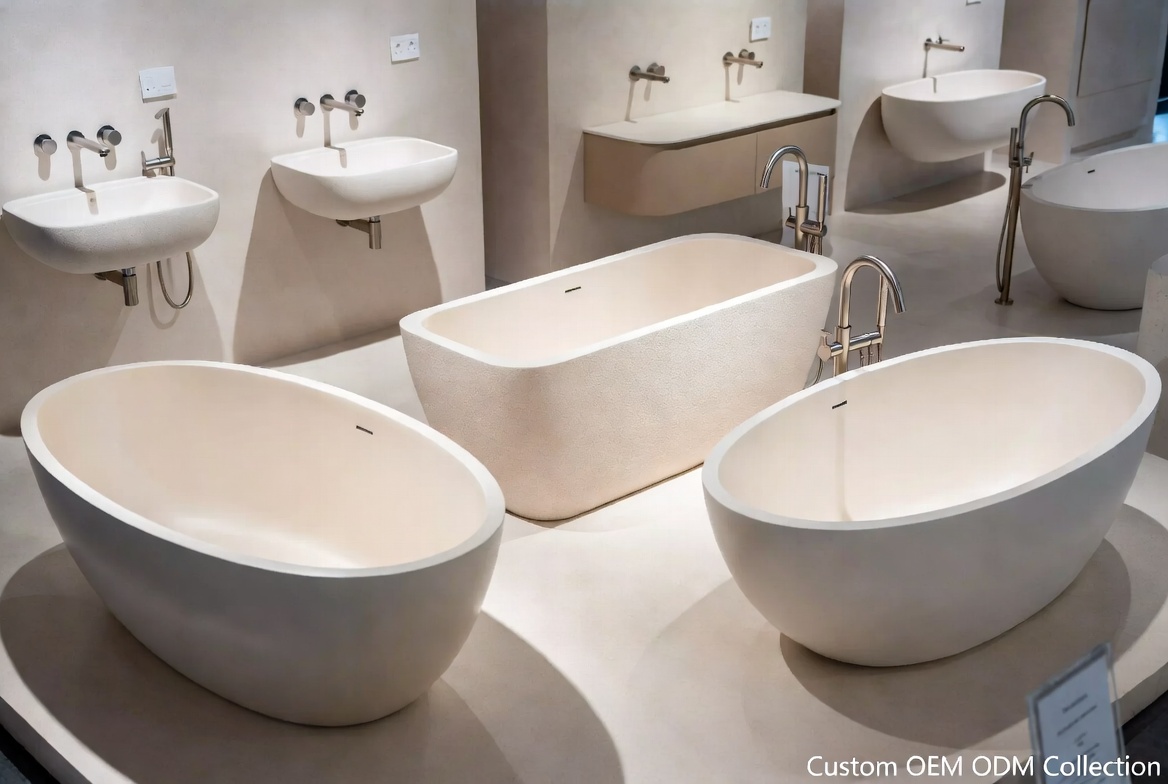
From a manufacturer's point of view, mold-based production is a game changer. With solid surface and stone resin bathtubs, we can offer: [thoughtshift.co]
- A wide range of shapes: oval, egg-shaped, rectangular, round, boat-shaped, Japanese soaking tubs, and more. [artemis]
- Precise dimensions with tight tolerances, often within ±1–3 mm, which is difficult and costly to achieve with carved stone. [artemis]
- Standard lengths from roughly 1500–1900 mm and widths from 700–900 mm, with custom sizing available for hotel chains and project-based OEM clients. [thoughtshift.co]
Real stone, by contrast, is limited by the raw block and the carving process. Deep curves, ultra-thin rims, or highly sculptural silhouettes are all more complex, more expensive, or simply not feasible. [artemis]
With stone-look bathtubs, we can control pigments, patterns, and surface finishes precisely: [thoughtshift.co]
- Smooth matte or glossy finishes
- Consistent white, warm off-white, or darker tones
- Subtle stone-like textures without the unpredictability of natural veining
Solid surface materials can also be sanded and buffed on-site to adjust sheen or correct minor surface issues, something impossible with real marble veining. [artemis]
Real stone delivers unmatched natural character—especially for high-variation marble—but that uniqueness also makes it harder to match with other surfaces and to maintain a consistent look across multiple units in a hotel or multi-unit project. [thoughtshift.co]
In real bathrooms, bathtubs face more than just water. They must handle: [artemis]
- Abrasive scrubbers
- Razors and metal accessories
- Nail polish removers and cosmetics
- Heavy soap dispensers or bottles
Stone-look bathtubs (especially solid surface) are engineered to handle typical household impacts and mild abrasions. They are designed for use with warm water and are compatible with mild, non-abrasive cleaners and pH-neutral creams. [artemis]
Real stone bathtubs are extremely strong but are more sensitive to chemicals. Certain cleaners, acids, or colored liquids can etch or stain marble or limestone if the surface is not properly sealed and maintained. [artemis]
One of the biggest practical differences is porosity: [artemis]
- Real stone typically has 0.1–1% porosity, which means it can absorb water and requires regular sealing to resist moisture and stains. [artemis]
- Stone-look bathtubs are non-porous by design. They do not need frequent sealing and are highly resistant to water absorption and mold formation, making them easier to keep clean and hygienic in high-humidity bathrooms. [artemis]
For families, hotels, and rental properties, that non-porous surface translates directly into lower maintenance costs and better hygiene over the life of the tub. [thoughtshift.co]
For stone-look tubs, the recommended cleaning routine is straightforward: [artemis]
1. Rinse with warm water after use.
2. Wipe dry with a soft cloth to avoid water marks.
3. Use pH-neutral or mild cream cleaners, avoiding bleach or ammonia.
Real stone requires a more cautious approach: stone-safe cleaners only, regular resealing, and careful handling of colored liquids or strong chemicals to avoid permanent marks. [artemis]
Both real stone and stone-look bathtubs offer excellent heat retention, significantly better than standard acrylic tubs. This is because both materials have relatively high density and specific heat capacity, which means they store heat well and release it slowly. [artemis]
When we look at the combined effect of density (ρ), specific heat capacity (Cp), thermal mass (ρ·Cp), and thermal conductivity (k), the picture is: [artemis]
- Real stone: highest density and thermal mass, good heat storage, but higher thermal conductivity that can initially feel cool to the touch. [artemis]
- Stone resin and solid surface: slightly lower density but better insulation, so the tub warms faster and maintains comfortable water temperature for a long soak. [artemis]
In real-world terms, a solid surface or stone resin tub will generally warm up faster and stay pleasantly warm, while natural stone may feel cooler initially but still holds heat for extended sessions once it reaches temperature. [artemis]
This is where real stone often becomes impractical for many modern projects. [artemis]
- Real stone bathtubs: commonly 500–800 kg empty, sometimes up to 1,000 kg, before water and user weight. [artemis]
- Stone-look bathtubs: often in the 150–200 kg range for solid surface, heavier than pure acrylic but well within normal structural capacity for typical residential and hotel construction. [artemis]
For upper-floor bathrooms or renovations where structural reinforcement is not desirable, stone-look bathtubs are usually the safer and more economical choice. [thoughtshift.co]
From an OEM/ODM perspective, cost is not just about the product price—it includes tooling, logistics, installation time, and lifetime service. [thoughtshift.co]
- Real stone
- Involves high-cost raw materials, hand craftsmanship, long production cycles, and special handling.
- A single real stone bathtub can cost USD 5,000–25,000 or more, depending on stone rarity and workmanship. [artemis]
- Stone-look
- Uses efficient mold-based production with stable raw material supply.
- Offers high-end aesthetics at a more accessible price point and is more scalable for projects with multiple identical units. [thoughtshift.co]
For most brands, distributors, and developers, stone-look bathtubs provide luxury-level design without needing ultra-luxury budgets or complex site preparation. [thoughtshift.co]
One of the most underrated advantages of solid surface bathtubs is their repairability. [artemis]
- Solid surface tubs
- Scratches, chips, and even some cracks can be filled, sanded, and buffed to a seamless finish. [artemis]
- For hospitality or multi-unit projects, this extends the service life and protects ROI.
- Gel-coat stone resin tubs
- Light scratches on the gel layer can often be polished out, but deeper damage may remain slightly visible if the gel coat must be rebuilt. [artemis]
- Real stone tubs
- Repairing chips or cracks is complex and expensive.
- Matching the exact color and veining pattern requires premium craftsmanship, and even then, repairs are often visible. [artemis]
In short, stone-look tubs are much more forgiving in real-world use, which is why they have captured a growing share of premium bathtub installations. [artemis]
To make the differences easier to see, here is a concise comparison:
| Aspect | Stone-Look Bathtubs (Solid Surface/Resin) | Real Stone Bathtubs |
|---|---|---|
| Design versatility | Very high – free-form, sculpted shapes artemis | Limited by stone block & carving artemis |
| Customization (color/size) | Highly customizable in OEM/ODM projects artemis | Mainly size and edge profiles |
| Weight | Medium (approx. 150–200 kg) artemis | Very heavy (500–800 kg+) artemis |
| Installation complexity | Standard installation in most buildings artemis | Often needs structural checks & reinforcement artemis |
| Maintenance & sealing | Low – non-porous, no sealing required artemis | High – must be sealed & protected artemis |
| Hygiene & mold resistance | Excellent – non-porous surface artemis | Good but depends on sealing artemis |
| Heat retention | Excellent, warms quickly and holds heat artemis | Excellent, high thermal mass artemis |
| Repairability | Very good, often seamless repairs artemis | Difficult, repairs usually visible artemis |
| Cost range | Premium but accessible artemis | Ultra-premium, highest price bracket artemis |
| Uniqueness of pattern | Controlled, repeatable aesthetics artemis | Truly unique veins & character artemis |
For most modern minimalist bathrooms, urban apartments, mid‑to‑high-end hotels, and residential developments, stone-look bathtubs deliver the ideal mix of luxury appearance, practicality, and scalability.
Based on working with global clients as an OEM/ODM manufacturer, here is a practical framework we use when advising brands, wholesalers, and project owners: [thoughtshift.co]
1. Clarify the project type
- Luxury villa, boutique hotel, large residential project, or retail brand line.
2. Check structural limits
- For upper floors or lightweight structures, stone-look is usually the safe default.
3. Define aesthetic priority
- If the client wants a sculptural centerpiece with precise dimensions and thin edges, choose solid surface.
- If they insist on natural stone character and budget allows, consider real stone.
4. Evaluate maintenance capability
- For rental properties or hotels with high turnover, prioritize non-porous, easy-to-repair solid surface or stone resin.
5. Align cost with lifecycle
- Compare not only purchase price but also installation, maintenance, and potential repair or replacement costs over 10–15 years.
Following this checklist helps ensure that the chosen bathtub is not just beautiful on day one but remains a profitable, low-risk choice throughout its lifecycle.
Manufacturers like Jiaxing Miluo Smart Home Co., Ltd. specialize in exactly this category: customized luxury bathtubs, basins, and vanities in solid surface and resin stone, developed for overseas brands, wholesalers, and project owners. With over 20 years of experience and a global export footprint, we can: [thoughtshift.co]
- Develop exclusive molds that reflect a client's brand identity.
- Match bathtub designs with coordinated basins, vanities, and shower bases to create cohesive bathroom collections. [thoughtshift.co]
- Support OEM and ODM cooperation from concept and 3D drawings to tooling, production, and quality control for markets like the US, UK, Europe, Australia, and the Middle East. [thoughtshift.co]
This is one reason why the world market share of stone-look bathtubs continues to grow—they offer the design freedom and brand differentiation that modern bathroom collections require, with a more manageable cost and risk profile than carved stone. [thoughtshift.co]
Real stone bathtubs remain the right choice when:
- The project is an ultra-luxury flagship residence or a statement suite where budget and structural capacity are not constraints.
- The client explicitly wants the natural, one-of-a-kind veining and is willing to accept more demanding maintenance. [artemis]
- The design concept is anchored around natural materials and the bathtub is treated as a long-term architectural element.
In those cases, we often suggest pairing real stone tubs with solid surface basins or vanities in complementary finishes to balance cost, weight, and maintenance across the full bathroom package. [thoughtshift.co]
Whether you are a homeowner, interior designer, or procurement manager, here is a simple decision path:
- Choose a stone-look solid surface bathtub if you need:
- Modern, minimalist or sculptural designs
- Reliable OEM/ODM supply and repeatable quality
- Easy cleaning, good repairability, and strong heat retention
- Moderate weight suitable for upper floors
- Consider a real stone bathtub if you:
- Are building an ultra-luxury space with no structural or budget constraints
- Want a bathtub that is literally a unique sculpture in the room
- Have a maintenance plan for stone care and sealing
If you are planning your next collection or project and want to integrate stone-look bathtubs with matching basins, vanities, and shower bases, partnering with a manufacturer like Miluo allows you to move from concept to final product with full support on design, engineering, and quality. [thoughtshift.co]
If you are a brand owner, wholesaler, or project contractor looking to add stone-look bathtubs to your portfolio, consider collaborating with an experienced OEM/ODM manufacturer. With decades of solid surface and resin stone expertise, Miluo can help you design custom bathtub collections that capture the look of real stone while delivering the practicality today's bathrooms demand. [thoughtshift.co]
You can explore our bathtub, basin, and vanity solutions and discuss your custom requirements with our team to build a product line that truly reflects your market positioning. [thoughtshift.co]
1. Are stone-look bathtubs as durable as real stone?
High-quality solid surface and stone resin bathtubs are extremely durable for residential and hospitality use, with strong resistance to everyday impacts and scratches when properly maintained. [artemis]
2. Do stone-look bathtubs turn yellow over time?
Manufacturers typically add UV stabilizers and pigments to reduce yellowing and maintain color stability, even in bathrooms with natural light. [artemis]
3. Are stone-look bathtubs difficult to install?
They are heavier than acrylic tubs but significantly lighter than real stone, so most installations can be handled by standard professional teams without structural reinforcement in typical buildings. [thoughtshift.co]
4. How often do real stone bathtubs need sealing?
The exact interval depends on stone type and usage, but because real stone has natural porosity, regular sealing is recommended to prevent stains and moisture penetration. [artemis]
5. Can solid surface bathtubs really be repaired seamlessly?
Yes, minor chips and scratches can be filled, sanded, and buffed so that repairs are often virtually invisible, which is a major advantage for hotels and high-traffic properties. [artemis]
1. KingKonree. "How Does a Stone-Look Bathtub Compare to Real Stone Bathtubs?" (accessed 2026). [https://www.kingkonree.com/blog/how-does-a-stone-look-bathtub-compare-to-real-stone-bathtubs.html] [artemis]
2. Jiaxing Miluo Smart Home Co., Ltd. Official Website. "Miluo Bath: Customized Bathtub, Wash Basin, Bathroom Vanity …" (accessed 2026). [https://www.china-miluo.com] [thoughtshift.co]
3. Jiaxing Miluo Smart Home Co., Ltd. Company Profile on Made-in-China (English). (accessed 2026). [jxmiluo.en.made-in-china]
4. QuickCreator. "On-Page SEO Best Practices for Sanitary Ware & Bathroom Fixtures." (accessed 2026). [quickcreator]
5. Peace Ajayi. "How to Fix Old Content to Meet Google's E-E-A-T Standards." LinkedIn article, 2025. [linkedin]


