
Views: 269 Author: Miluo Smart Home Publish Time: 2026-09-11 Origin: Site


Content Menu
● Why Freestanding Bathtubs Remain a Premium Bathroom Choice
● Freestanding Bathtub Types and Their Best Applications
>> Oval freestanding tubs: the most versatile category
>> Double-ended tubs for shared comfort
● How to Choose the Right Freestanding Bathtub Size
>> Measure the usable bathing zone
>> Do not overlook filled weight
● Acrylic vs. Solid Surface Freestanding Bathtubs
>> Acrylic freestanding bathtubs
>> Solid surface freestanding bathtubs
● The Installation Details That Prevent Expensive Problems
>> Drain alignment is not a small detail
● A Better Way to Specify a Custom Freestanding Bathtub
>> Step 1: Define the target customer
>> Step 2: Set functional specifications
>> Step 3: Review ergonomics before tooling
>> Step 4: Validate samples and packaging
● Design Trends Shaping Premium Bathtub Collections
>> Key directions for new collections
● How Jiaxing Miluo Supports OEM and ODM Bathtub Programs
● Build a Freestanding Bathtub Collection That Performs
>> What is the best material for a freestanding bathtub?
>> How much space is needed around a freestanding bathtub?
>> Can a freestanding bathtub be installed in a small bathroom?
>> Are solid surface bathtubs difficult to install?
>> Should a drain and overflow kit be included with the bathtub?
>> What is the best drain position for a freestanding soaking tub?
>> How can a bathroom brand create a custom bathtub collection?
A freestanding bathtub can become the visual and emotional center of a modern bathroom. For brand owners, wholesalers, project buyers, and bathroom manufacturers, however, selecting the right freestanding soaking tub is not simply about choosing an attractive silhouette. It requires a careful balance of comfort, material performance, installation planning, quality control, customization potential, and reliable supply.
At Jiaxing Miluo Smart Home Co., Ltd., we work with international bathroom brands, importers, wholesalers, and manufacturers seeking tailored bathtub solutions. From OEM bathtub production to ODM bathroom collections, we see one principle repeatedly: the most successful freestanding tub is the one that looks exceptional, fits the room correctly, feels comfortable in use, and is engineered for dependable installation.
This guide explains how to select, specify, customize, and install a freestanding bathtub for residential, hospitality, and premium development projects.

A freestanding bathtub stands independently rather than being built into a wall, deck, or alcove. Its exposed shape gives designers more freedom to create a spa-inspired room, especially in master bathrooms, boutique hotels, villas, and high-end apartments.
Unlike a traditional alcove bathtub, a freestanding model can become a sculptural product feature. Oval soaking tubs, double-ended tubs, egg-shaped tubs, slipper tubs, and soft-square designs each create a different visual effect.
The category continues to expand as buyers prioritize contemporary forms, customizable aesthetics, lightweight materials, and wellness-oriented bathroom experiences. Recent market reporting also points to growing demand for acrylic thermoformed tubs, contemporary silhouettes, and material options that make premium designs more accessible to a wider range of projects.
Across product reviews and buyer feedback, several expectations appear consistently:
- Comfortable back support for longer soaking sessions
- A deep bathing area without an excessively high step-in height
- Easy-clean, non-porous surfaces
- Reliable drainage and overflow performance
- A stable, level installation
- Clear installation instructions and included components
- A size that suits the user as well as the room
For example, customer feedback on freestanding soaking tubs frequently praises sturdy but lighter-weight construction, comfortable interiors, and easier entry and exit. Other reviews show that buyers become dissatisfied when actual water depth, drain kits, or included accessories do not match their expectations.
That feedback matters to every bathtub brand. A visually impressive tub can still create costly after-sales issues if its technical specifications are unclear.
The right tub style should reflect the target market, bathroom layout, price segment, and end-user preference.
| Freestanding tub type | Main characteristics | Best suited for |
|---|---|---|
| Oval soaking bathtub | Soft, balanced shape with broad market appeal | Hotels, apartments, family bathrooms, retail collections |
| Double-ended bathtub | Both ends are designed for reclining comfort | Couples, luxury homes, premium master suites |
| Slipper bathtub | One or two raised ends support the upper body | Traditional-luxury interiors and comfort-focused users |
| Egg-shaped bathtub | Rounded exterior with a contemporary profile | Modern homes, design-led brands, boutique hotels |
| Flat-bottom freestanding tub | Clean geometry and efficient internal space | Urban apartments and minimalist projects |
| Solid surface bathtub | Matte texture, substantial feel, sculptural appearance | Luxury residential, hospitality, design showrooms |
| Acrylic freestanding bathtub | Lightweight, versatile, cost-efficient | Volume retail, wholesalers, multi-unit developments |
The oval freestanding bathtub remains one of the most practical choices for international bathroom brands. It works with Scandinavian, minimalist, contemporary, transitional, and hotel-inspired interiors.
An oval silhouette also avoids sharp external corners, which can improve circulation around the tub in compact rooms. For suppliers developing a complete bathroom collection, this form pairs easily with freestanding tub faucets, wall-mounted fillers, floor-mounted accessories, and matching vanity products.
A double-ended freestanding bathtub usually places the drain near the center so that both ends can provide a comfortable reclining position. This is an important detail for couples and buyers who want a luxury soaking experience rather than a purely decorative product.
When developing a double-ended model, assess:
- Internal backrest angles
- Overflow position
- Center-drain configuration
- Useful water depth
- Shoulder and arm room
- Water capacity
- Faucet location and spout reach
A long tub is not automatically more comfortable. A well-designed interior contour can make a medium-sized tub feel more supportive than an oversized model with poor ergonomics.
A bathtub must fit three things: the bathroom, the user, and the installation system.
Freestanding tubs are often available in lengths ranging from roughly 55 to 72 inches, with widths commonly ranging from about 27 to 40 inches. Bathing depth varies widely by model, and deeper soaking tubs may offer approximately 16 to 24 inches of depth to the overflow.
These ranges are useful starting points, but project specifications should never rely on general dimensions alone.
Before selecting a bathtub, confirm the finished dimensions of the room rather than relying only on architectural drawings. Wall tile thickness, finished flooring, vanity projections, door swings, and plumbing access can all affect the usable space.
Use this planning sequence:
1. Mark the finished wall and floor lines.
2. Identify the final center point of the drain.
3. Confirm faucet location and required service access.
4. Check door movement and circulation around the bathtub.
5. Compare the tub's actual footprint, not only its stated nominal size.
6. Reserve enough space for cleaning, maintenance, and safe entry.
7. Verify that the floor can support the full filled weight of the bathtub.
Many installation guides recommend leaving clearance around the tub for cleaning and plumbing access. Depending on the product and room layout, recommendations can range from a few inches to approximately 4 to 6 inches around the bathtub, with additional access desirable near service connections.
A bathtub's installation weight includes:
Total filled weight=Tub weight+Water weight+Bather weight
Water weighs approximately 8.34 pounds per U.S. gallon. A 55-gallon bathtub therefore holds about 459 pounds of water before adding the tub itself or the person using it.
This calculation is particularly important when specifying solid surface bathtubs, cast materials, upper-floor installations, renovation projects, and hospitality developments. Project teams should verify structural requirements with a qualified professional before final installation.
Material selection affects cost, installation handling, finish, durability, thermal behavior, brand positioning, and logistics.
Acrylic tubs are widely used because they can provide a smooth gloss surface, lighter handling weight, flexible styling options, and competitive production costs.
A well-made acrylic freestanding bathtub can be an excellent fit for large-volume retail, export projects, and brand collections where design variety is essential.
Key advantages include:
- Lower weight than many mineral-based alternatives
- Smooth and non-porous surface
- Broad shape and size flexibility
- Easier handling during transportation and installation
- Suitable for gloss-white and selected color options
- Efficient for OEM bathtub programs
The most important quality factors are not simply "acrylic" as a label. Buyers should evaluate sheet thickness, reinforcement structure, base construction, thermal insulation, surface finish consistency, drainage compatibility, and packaging protection.
Solid surface bathtubs, often described as stone resin, mineral composite, engineered stone, or composite stone tubs, deliver a more substantial and design-oriented appearance. They are often chosen for premium residential and hospitality projects because of their matte surface, sculptural form, and tactile feel.
Current premium-market commentary shows an increased preference for stone-composite and solid-surface tub designs, particularly in matte neutral finishes and sculptural shapes.
Key advantages include:
- Premium matte appearance
- High-end visual weight and tactile quality
- Strong suitability for contemporary luxury interiors
- More potential for distinctive sculptural forms
- Good fit for boutique hotel and villa projects
- Opportunity for higher-value private-label collections
However, solid surface tubs are heavier and may require more careful freight planning, floor-load consideration, and installation handling.
| Decision factor | Acrylic bathtub | Solid surface bathtub |
|---|---|---|
| Product weight | Generally lighter | Generally heavier |
| Typical finish | Glossy, smooth | Matte, stone-like |
| Design positioning | Mid-market to premium | Premium to luxury |
| Shipping efficiency | Often more favorable | Requires stronger logistics planning |
| Shape flexibility | High | High, especially for sculptural forms |
| Installation handling | Easier for many projects | More labor-intensive due to weight |
| Ideal buyer | Retailers, wholesalers, project suppliers | Premium brands, designers, luxury developers |
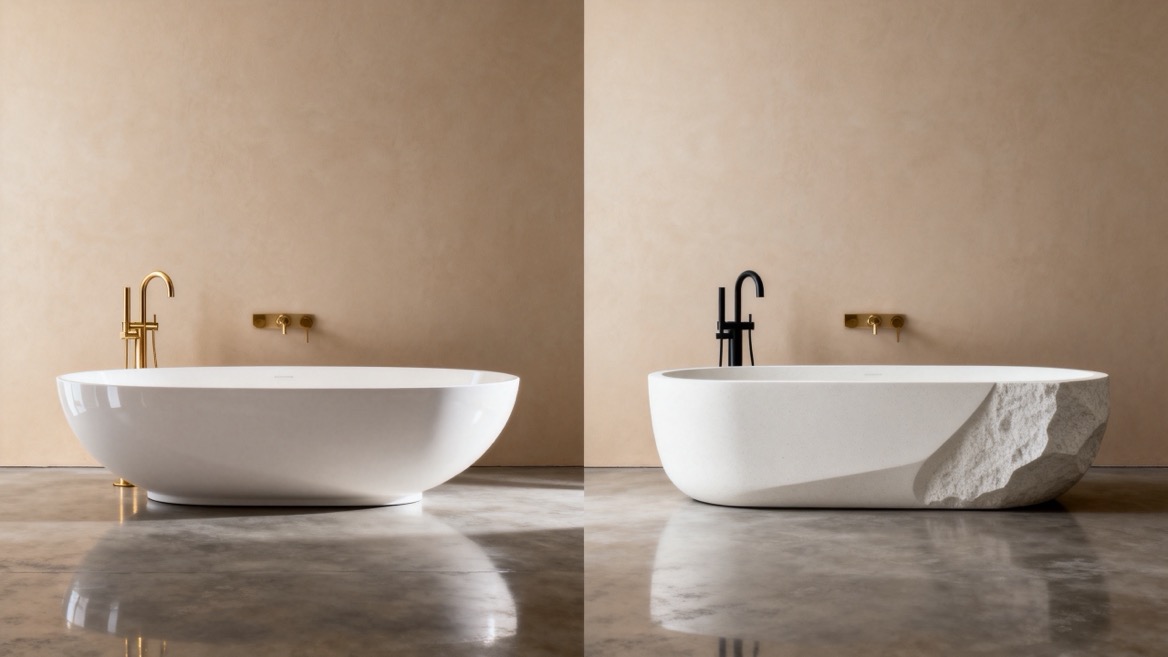
A freestanding bathtub installation should be planned before the finished floor is completed whenever possible. The most common problems come from incorrect drain alignment, inadequate access, uneven floors, missing parts, and unverified faucet placement.
Before the bathtub reaches the site, verify the following:
- Finished floor level is confirmed
- Drain rough-in matches the bathtub drain location
- Drain and overflow components are compatible
- Floor-mounted faucet rough-in is correctly positioned
- Tub filler spout has sufficient reach into the basin
- Water supply lines are pressure-tested
- The bathtub can pass through doors, elevators, and corridors
- The floor structure supports the anticipated filled weight
- The installer has the product drawing and installation manual
- The tub is inspected for damage before installation
A standard installation procedure commonly involves temporarily raising the bathtub to access the underside, aligning the drain connector, tightening watertight connections, testing the tub by filling and draining it, lowering it into final position, and sealing the perimeter as required.
The drain location should be treated as a critical product specification, especially for OEM and ODM programs. A center-drain tub, end-drain tub, and offset-drain tub each require different planning.
For brand owners, offering a technical drawing with these details can reduce installation claims:
- Overall length, width, and height
- Net and gross weight
- Internal bathing dimensions
- Drain center location
- Overflow location
- Water capacity
- Recommended faucet position
- Required floor opening or service zone
- Installation tolerance
- Included waste and overflow components
A customer may love the bathtub's appearance but still judge the entire purchase negatively if the drain kit is not included, the water depth is lower than expected, or the installer cannot access the connection properly. These concerns appear directly in retail review feedback.
For overseas brands, the strongest product development process begins before a mold is approved. A reliable supplier should help convert a design concept into a manufacturable, installable, and commercially viable product.
Start with the product's commercial role:
- Is it for a high-volume retail collection?
- Is it intended for luxury residential buyers?
- Will it be installed in hotels or serviced apartments?
- Is the buyer focused on low weight, deep soaking, or visual impact?
- Does the collection need matching basins, vanities, mirrors, or shower products?
A clear target prevents the common mistake of creating a visually appealing but commercially unclear bathtub.
A product brief should identify:
- Material and finish
- Overall size
- Internal soaking depth
- Water capacity
- Drain position
- Overflow style
- Color options
- Faucet configuration
- Load and packaging requirements
- Certification requirements for the destination market
- Logo, label, carton, and manual requirements
Before moving to mass production, assess the user's actual bathing posture. Consider backrest angle, shoulder room, arm placement, lumbar support, waterline level, and step-in height.
This is especially important for deep soaking tubs. A deeper bathtub can deliver a more immersive experience, but it should still allow a safe and comfortable entry and exit.
Sample approval should cover more than appearance. Check dimensional accuracy, gloss or matte consistency, edge finishing, drainage performance, overflow function, base stability, scratch resistance, and carton protection.
For export orders, packaging is a core part of the product experience. A premium tub can lose its value immediately if it arrives scratched, cracked, or missing components.
The current direction in premium bathroom design is toward calm, tactile, wellness-oriented spaces. Freestanding tubs are increasingly used as focal-point products rather than secondary sanitary fixtures.
- Soft organic forms: Oval, pebble, egg-shaped, and gently asymmetrical tubs create a relaxed visual feeling.
- Matte neutral finishes: Matte white remains a strong choice, while warm white, bone, soft gray, charcoal, and muted color options are gaining attention in upscale projects.
- Sculptural solid surface designs: Design-led projects increasingly use mineral composite or solid surface tubs for their substantial appearance.
- Compact luxury tubs: Smaller bathrooms still demand a spa-like experience, creating an opportunity for shorter but deeper freestanding soaking tubs.
- Coordinated bathroom collections: Bathtubs, basins, vanities, mirrors, faucets, and shower systems are increasingly developed as cohesive product families.
- Accessible comfort: Better step-in design, supportive backrests, and thoughtful internal geometry are becoming more important as bathroom spaces are designed for long-term use.
For suppliers and brand owners, the opportunity is not only to follow visual trends. It is to transform those trends into products that can be safely shipped, efficiently installed, comfortably used, and clearly specified.
Jiaxing Miluo Smart Home Co., Ltd. provides customized modern bathroom products and integrated solutions for overseas brands, wholesalers, manufacturers, and project buyers.
Our approach focuses on helping customers develop bathroom products that are commercially practical as well as visually distinctive.
Our OEM and ODM support can include:
- Freestanding bathtub shape and size development
- Acrylic and solid surface bathtub solutions
- Private-label branding and logo customization
- Color, finish, drain, and overflow customization
- Packaging and carton design for export distribution
- Product drawing and specification support
- Matching bathroom product development
- Quality-control coordination for international orders
- Custom solutions for retail, wholesale, hospitality, and project channels
A successful bathtub collection should feel consistent from first showroom impression to final installation. That is why product design, technical details, packaging, and after-sales documentation should be planned together rather than treated as separate tasks.
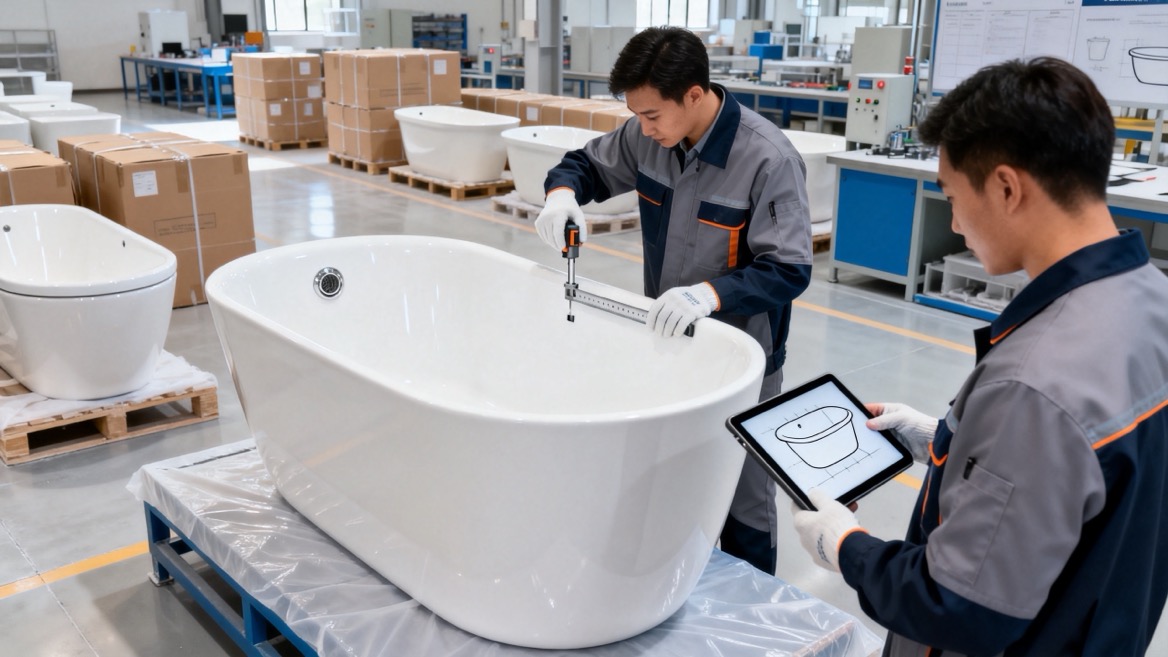
A premium freestanding bathtub should do more than photograph well. It should arrive safely, install predictably, drain reliably, support comfortable bathing, and strengthen your brand's position in a competitive bathroom market.
If you are developing a private-label bathtub range, sourcing customized freestanding tubs for wholesale distribution, or building an integrated bathroom collection, Jiaxing Miluo Smart Home Co., Ltd. can help turn your product concept into a tailored OEM or ODM solution.
Contact our team to discuss your custom freestanding bathtub design, target specifications, material options, packaging requirements, and project needs.
The best material depends on your market position and project requirements. Acrylic is often suitable for lightweight, cost-efficient, high-volume collections. Solid surface is often preferred for premium projects seeking a matte finish, sculptural appearance, and more substantial feel.
The required clearance depends on the specific bathtub, faucet location, room layout, and local building requirements. As a practical planning guide, leave enough room for cleaning, safe entry, and plumbing service. Many product guides suggest a few inches around the bathtub, while 4 to 6 inches can provide more convenient access in many installations.
Yes. Compact freestanding tubs are available for smaller bathrooms. The key is to select a tub with a suitable external footprint while maintaining adequate internal depth, walkway space, door clearance, and access to plumbing connections.
They are not inherently difficult, but they are generally heavier than acrylic tubs. Installers should confirm floor support, handling access, drainage alignment, and the manufacturer's installation instructions before placing the tub.
For a smoother buyer and installer experience, it is often beneficial to include compatible drain and overflow components or clearly state exactly what is and is not supplied. Missing or incompatible kits are a frequent source of dissatisfaction in product reviews.
A center drain is often preferred for double-ended tubs because it allows users to recline at either end. An end or offset drain may be better for one-person soaking tubs, depending on the backrest layout and faucet position.
Begin with a clear product brief covering target customer, material, dimensions, shape, finish, drain configuration, packaging, required documentation, and brand identity. Then review drawings and samples carefully before approving tooling or mass production.
1. [ResearchAndMarkets, "Bathtub Market Trends and Developments Worldwide, 2026–2030 & 2035"]
2. [Aquatica, "Soaking Tub Dimensions: Size, Depth and Fit Guide"]
3. [Aquatica, "Standard Bathtub Size: Dimensions, Types and Measuring Guide"]
4. [HOROW, "Installing Freestanding Tub: Step-by-Step Freestanding Tub Guide"]
5. [Mokleba, "Freestanding Tub Plumbing Requirements and Installation Guide"]
6. [Lowe's, "Typical Freestanding Bathtub Installation Procedure"]
7. [Wayfair, "Top 15 Bathtubs"]
8. [Home Depot, "Reviews for WOODBRIDGE 59 in. x 31.5 in. Soaking Bathtub"]
9. [Home Depot, "Reviews for Schon Logan 71 Inches Center Drain Freestanding Bathtub"]
10. [Giving Tree Home, "Freestanding Bathtub Installation Guide"]
11. [Designed | Curated, "Bathtub Design Trends 2026: A Designer's Guide"]


