
Views: 210 Author: Miluo Smart Home Publish Time: 2026-09-22 Origin: Site


Content Menu
● Quick Answer: Which Basin Chips Less?
● Resin Stone vs Ceramic Basins at a Glance
>> Ceramic Is Not Automatically Fragile
● Why Resin Stone Basins Often Chip Less
>> A Realistic Rental Scenario
● Not All Resin Stone Is Equal
● The Hidden Cost: Replacement vs Repair
● Scratch Resistance: Where Ceramic Has an Advantage
● Installation Can Decide the Result
>> Practical Installation Checklist
● Best Basin Choices by Rental Type
● How to Specify a Lower-Chip Basin Program
● Our Recommendation for Rental Projects
● Build a Basin Range for Real Rental Use
>> Do resin stone basins chip easily?
>> Are ceramic basins good for rental properties?
>> Can a chipped ceramic basin be repaired?
>> Can scratches be removed from a resin stone basin?
>> Which basin is better for a hotel bathroom?
>> Does basin thickness affect chip resistance?
>> What should buyers ask before ordering OEM basins?
For landlords, developers, hotel operators, and bathroom brands, the question is not simply whether a basin looks premium on handover day. The real question is: which basin material stays presentable after tenant turnover, accidental drops, rushed cleaning, and years of daily use?
In most rental-property scenarios, a well-made resin stone basin—particularly a solid-surface or through-body mineral-resin design—will usually chip less visibly than a traditional glazed ceramic basin. Ceramic remains an excellent, cost-effective and easy-care choice, but its hard glazed surface is more brittle under a sharp impact. Resin stone can better absorb minor impacts and, crucially, many superficial marks can be refinished instead of forcing a full replacement.
For overseas brands, wholesalers, project buyers, and OEM/ODM partners, however, "resin stone" is not one uniform material. Formula, wall thickness, pigmentation, moulding process, surface finish, installation method, and quality inspection all influence real-world chip resistance.

Resin stone basins generally chip less than ceramic basins in rental properties when the resin stone material is through-body, properly cured, and installed correctly.
That does not mean ceramic is a poor rental choice. A high-quality ceramic wash basin has strong scratch resistance, excellent stain resistance, reliable hygiene, and a familiar appearance that tenants understand immediately. Yet when a tenant drops a glass bottle, metal grooming tool, or heavy cosmetic container into the bowl, the material response is different.
- Ceramic: Very hard surface, but relatively brittle under concentrated impact.
- Resin stone: More forgiving under incidental impact and often easier to restore after surface damage.
- Rental-property winner for chip reduction: Resin stone, especially for premium apartments, serviced residences, hotels, and high-turnover projects.
- Rental-property winner for lowest initial purchase cost: Ceramic.
- Best long-term decision: Compare replacement risk, labor cost, downtime, and repairability—not only the basin's unit price.
A basin is rarely damaged because a tenant intends to damage it. Most failures occur during normal life: a bottle falls, a mirror is dropped during cleaning, a contractor leans on an improperly supported vanity, or a hard object strikes the rim during move-in and move-out.
| Factor | Resin Stone Basin | Ceramic Basin | Rental Property Implication |
|---|---|---|---|
| Chip resistance | Usually better against light-to-medium accidental impact | Can chip when a heavy or sharp object hits the glaze | Resin stone can reduce visible impact damage |
| Impact behavior | More forgiving; may dent, scratch, or mark rather than fracture immediately | Hard but brittle; may chip or crack at the impact point | Ceramic damage can be more sudden and permanent |
| Scratch resistance | Lower than ceramic in many formulations | Generally excellent due to the fired glaze | Ceramic may look better against abrasive daily contact |
| Repairability | Often sandable, polishable, or fillable depending on finish and formula | Small chips may be filled, but invisible repair is difficult | Resin stone can lower replacement frequency |
| Stain resistance | Strong when non-porous and properly finished | Strong glazed surface; easy to wipe clean | Both can perform well with appropriate cleaning |
| Heat tolerance | Depends on resin formulation; avoid extreme localized heat | Generally stronger under ordinary heat exposure | Ceramic suits tenants who may misuse hot tools |
| Design flexibility | High; supports integrated bowls, custom colours, thin profiles, and special shapes | More limited by moulding and firing constraints | Resin stone supports differentiated private-label collections |
| Initial purchase cost | Often higher | Often lower | Ceramic suits budget-led standard projects |
| Lifecycle value | Often favorable when repair and reduced replacement matter | Favorable where damage risk is low and replacement is easy | Evaluate by turnover and maintenance strategy |
The comparison should never be reduced to "soft versus hard." Rental-property performance depends on how a material fails, how visible the damage becomes, and how quickly the property team can return the room to rentable condition.
Ceramic basins are produced from refined clay-based materials and fired at high temperatures. The finished basin is typically coated with a hard glaze that creates the familiar smooth, glossy, non-porous surface.
This construction gives ceramic several genuine strengths:
- High surface hardness
- Good resistance to common bathroom stains
- Easy routine cleaning
- Excellent colour stability
- Broad market recognition
- Competitive cost at scale
However, high hardness can come with brittleness. If a hard, heavy, or sharp-edged object strikes a glazed ceramic basin, the surface may not flex enough to absorb the energy. Instead, the glaze or ceramic body can chip, crack, or fracture.
The rim is often the most vulnerable area. A metal toiletry case, glass fragrance bottle, hair tool, or maintenance tool can strike the rim at a concentrated point. A small chip may appear cosmetic at first, but it can be highly visible against a glossy white finish. It may also expose a different-coloured substrate beneath the glaze.
Industry testing recognizes that rim geometry, thickness, glaze fit, and material brittleness all influence chipping performance. ASTM C368, for example, is designed to evaluate impact breakage and rim chipping in ceramic ware; it specifically notes that rim contour and glaze/body characteristics affect the resulting damage.
It would be misleading to describe every ceramic basin as fragile. Quality ceramic basins can perform reliably for many years in apartments, hotels, student accommodation, and similar buildings.
The key distinction is this:
- Ceramic handles ordinary use very well.
- Ceramic is less forgiving when a concentrated impact occurs.
- Once chipped, repair is often visible or uneconomical.
For a low-turnover residential development where tenants use bathrooms carefully and the project needs a classic, low-cost product, ceramic remains a rational material choice. The risk becomes more important in furnished rentals, holiday apartments, student residences, hospitality projects, and rental units with frequent maintenance intervention.
The term "resin stone basin" may refer to several related engineered materials. In many premium bathroom applications, it means a composite made with mineral fillers and a resin binder. Some products have a gel-coated outer surface, while others use a more consistent solid-surface, through-body construction.
This distinction matters.
A through-body resin stone basin has colour and material consistency throughout much or all of its thickness. If a minor scratch or shallow mark occurs, the damaged area may be refinished without revealing a completely different material underneath. By contrast, a thin decorative coating can still be vulnerable if the coating is deeply chipped or damaged.
Resin stone's practical advantage comes from its ability to absorb or distribute some impact energy rather than responding as a highly brittle fired material. A dropped item may leave a scratch, scuff, shallow dent, or small surface mark—but not necessarily the sharp, permanent chip commonly associated with glazed ceramic.
That difference can matter greatly in rental maintenance.
Imagine a tenant drops a heavy glass skincare bottle into a countertop basin.
With ceramic, the impact may create:
- A visible glaze chip
- A rim fracture
- A hairline crack
- A replacement request before the next viewing
With a high-quality resin stone basin, the same event may result in:
- A superficial mark
- A fine scratch
- A small dent or scuff
- A localized area that can potentially be sanded and refinished
This is not a promise that resin stone cannot crack. Any basin can be damaged by severe impact, poor installation, excessive load, or misuse. The point is that resin stone is often more damage-tolerant and more recoverable after minor to moderate surface damage.
Project buyers should not specify "resin stone" without a technical definition. Two basins described using the same commercial term can perform very differently.
Ask a supplier these questions before approving a rental-property basin:
1. Is the basin through-body or surface-coated?
Through-body material normally offers better repair potential after shallow damage.
2. What mineral-to-resin ratio is used?
Formula affects density, stiffness, finish quality, thermal behavior, and impact response.
3. What is the wall thickness at the rim and bowl base?
Thin edges may look elegant, but inadequate thickness can increase vulnerability.
4. What impact and load tests are performed?
Ask for test procedures, test records, and sample inspection standards—not only a verbal assurance.
5. Can surface damage be repaired on site?
Request a practical repair guide, approved abrasive grades, polishing instructions, and colour-matched repair options.
6. What cleaning chemicals are approved?
Strong solvents, aggressive descalers, and abrasive powders can damage some resin-based finishes.
7. How is the basin packed for transport?
A low-chip material can still arrive damaged if packaging, palletization, or container loading is inadequate.
For European-oriented projects, EN 14688 covers functional characteristics and test methods for wash basins intended for domestic use, including hotels, student accommodation, hospitals, and similar buildings. Its scope includes items such as load resistance, drainage, thermal cycling, chemical resistance, surface durability, and cleanability.
A common sourcing mistake is to compare only the ex-factory price of a ceramic basin with a resin stone basin. Rental operators should compare the installed lifecycle cost.
A ceramic basin with a lower purchase price can become more expensive if a small visible chip triggers replacement. Replacement may involve more than a new basin:
- Maintenance scheduling
- Tenant access coordination
- Removal of silicone or countertop fittings
- Plumbing disconnection and reconnection
- Risk of damaging the vanity or countertop
- New sealant and finishing work
- Disposal of the damaged basin
- Room downtime or delayed move-in
A resin stone basin may cost more initially, but a repairable surface can reduce replacement events. Fine scratches on many solid-surface materials can be treated by cleaning, controlled sanding, and refinishing procedures. Corian's care guidance, for example, describes processes for addressing fine scratches with appropriate cleaning and abrasive materials, while noting that more severe damage may require professional repair.
For a rental portfolio, compare materials using this practical framework:
Annual basin cost=Purchase cost+installation cost+expected repair cost+expected replacement cost+downtime cost
The "expected replacement cost" is especially important in high-turnover properties. A slightly higher initial material cost may be justified if it lowers visible-damage claims and enables local repair.
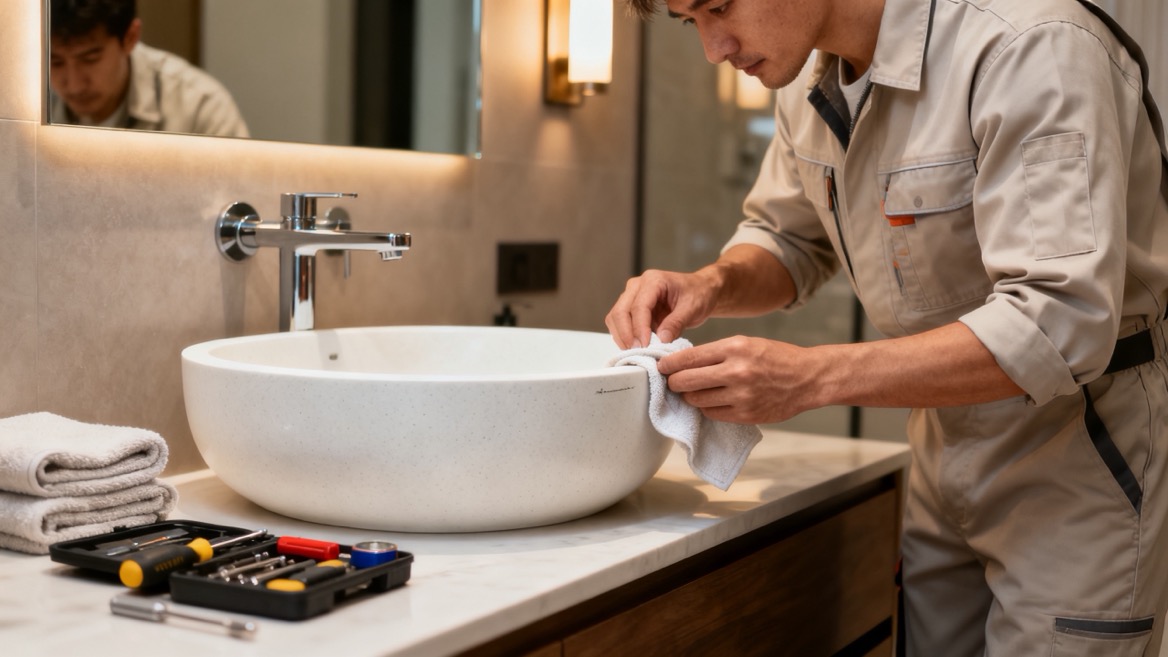
Rental buyers should avoid assuming that resin stone wins every category. Ceramic often has better resistance to everyday surface scratching because a fired glaze is extremely hard.
This means ceramic can handle routine contact with items such as:
- Toothbrush holders
- Rings and watches
- Small toiletry bottles
- Cosmetic containers
- Routine wiping and cleaning
Resin stone may scratch more easily, especially in matte finishes or lower-grade formulations. Abrasive scouring pads, rough cleaning powders, and sharp metal objects can leave marks.
The difference is what happens next.
- Ceramic scratch or chip: Often difficult to repair without visible evidence.
- Resin stone scratch: Often can be blended, sanded, polished, or professionally restored if the material is suitable.
For rental projects, this leads to a useful rule: choose ceramic when surface hardness and low initial cost are the main priorities; choose resin stone when impact forgiveness, modern design, and repairability matter more.
Material selection alone cannot prevent chips. In my experience reviewing basin specifications for private-label and project programs, poor installation is one of the most overlooked causes of apparent "material failure."
A basin can crack or chip because of:
- An uneven vanity or countertop cut-out
- Excessive stress around the waste opening
- Overtightened mounting hardware
- Missing support beneath a heavy basin
- A rigid adhesive joint that does not allow tolerance
- Incorrect silicone or sealant application
- Movement in a wall-hung vanity
- Shipping damage that was not detected before installation
For wall-hung applications, confirm the basin, brackets, wall structure, and fixing system as one assembly. EN 14688 includes load-related performance requirements for wall-hung wash basins.
Before handover, project teams should verify:
- The basin sits flat without rocking.
- The countertop cut-out matches the approved technical drawing.
- Waste fittings are tightened to the specified torque.
- The drain hole is aligned without forcing the basin.
- Silicone joints are continuous and clean.
- Wall-hung units have compatible brackets and substrate support.
- The basin surface is inspected under direct lighting.
- Packaging is removed only after the unit is ready for final installation.
A quick final inspection can prevent an avoidable dispute between installer, developer, distributor, and manufacturer.
| Rental Application | Better Material Choice | Why |
|---|---|---|
| Budget apartments | Ceramic | Lower initial cost, familiar appearance, easy everyday cleaning |
| Student accommodation | Resin stone or robust ceramic | Consider higher impact risk and frequent turnover |
| Serviced apartments | Resin stone | Repairability and premium visual consistency can reduce turnover pressure |
| Boutique hotels | Resin stone | Supports custom shapes, integrated designs, and a high-end look |
| Long-stay executive rentals | Resin stone | Better fit for premium interiors and lifecycle-oriented maintenance |
| Standard residential developments | Ceramic or resin stone | Choose based on budget, positioning, and local service capacity |
| Luxury branded residences | Resin stone | Greater customization, modern styling, and easier refinishing potential |
For a brand owner, the right product range may include both materials. Ceramic can serve entry and mid-market programs, while resin stone supports higher-margin collections with customized dimensions, colours, overflow configurations, integrated backsplashes, and matching vanity systems.
A strong OEM or ODM basin program should translate operational risks into measurable product requirements.
Specify:
- Through-body or defined surface-layer construction
- Approved mineral-resin formula
- Minimum wall thickness by basin zone
- Edge-radius requirements for exposed rims
- Matte, satin, or gloss finish level
- Colour tolerance standard
- Repair-kit compatibility
- Chemical-cleaning guidance
- Drop, impact, and load test protocol
- Export packaging and pallet requirements
Specify:
- Body and glaze quality requirements
- Uniform glaze coverage around the rim and overflow
- Rim geometry designed to reduce sharp-edge vulnerability
- Flatness and dimensional tolerances
- Thermal and load performance requirements
- Visual inspection standard for pinholes, glaze defects, cracks, and colour variation
- Protective packaging for container transport
- Spare-unit policy for project after-sales needs
A reliable supplier should be able to discuss these points with engineering detail. Product photographs alone do not reveal structural design, formula quality, curing discipline, or inspection consistency.
If your main concern is which material chips less, choose a high-quality resin stone basin with proven through-body construction and a documented repair process. It is generally the more forgiving option when tenants drop objects or when maintenance teams need to restore a basin quickly between occupancies.
Choose ceramic when the project needs:
- A lower initial procurement cost
- A classic glossy sanitaryware look
- Excellent scratch resistance
- Simple, widely understood cleaning routines
- Easy replacement access in the local market
Choose resin stone when the project needs:
- Better resistance to visible chipping from accidental impact
- A modern, premium appearance
- Custom shapes, colours, and integrated basin designs
- Restoration options for cosmetic damage
- A lower risk of full-basin replacement after minor surface incidents
For Jiaxing Miluo Smart Home Co., Ltd., the most effective product strategy is not to position resin stone as a universal replacement for ceramic. Instead, offer buyers a clear, application-led selection: dependable ceramic for value-driven projects, and engineered resin stone solutions for premium rentals, hospitality, branded residences, and customized bathroom collections.
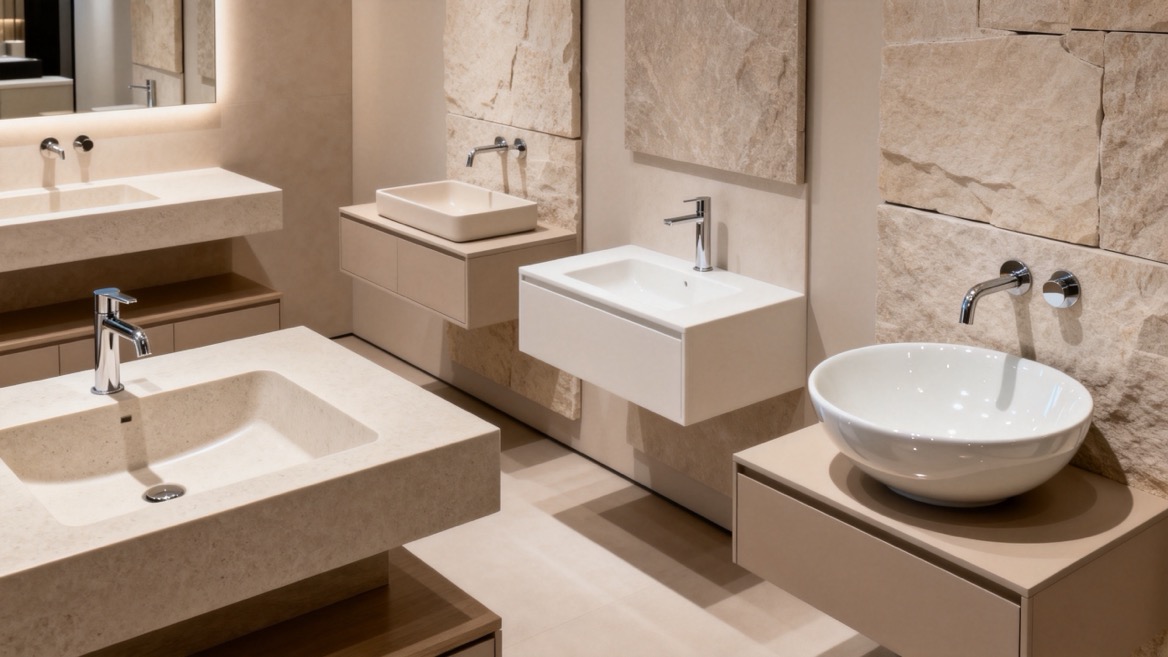
A rental basin should do more than photograph well. It should withstand daily use, reduce maintenance disruption, and support the visual standard your brand promises at every tenant turnover.
Jiaxing Miluo Smart Home Co., Ltd. provides customized modern bathroom products and integrated solutions for international brands, wholesalers, and manufacturers. Whether you are developing a value-focused ceramic basin collection or a premium resin stone vanity program, our OEM and ODM team can support custom dimensions, finishes, colours, packaging, technical documentation, and project-oriented product development.
Contact Miluo Smart Home to discuss your rental-property basin specification, request material samples, and build a bathroom collection designed for long-term commercial performance.
High-quality resin stone basins are generally more resistant to visible chipping from everyday accidental impacts than glazed ceramic basins. They can still be damaged by severe impact, poor installation, or misuse, but minor marks are often more repairable.
Yes. Ceramic basins are widely used in rental properties because they are cost-effective, hygienic, easy to clean, and highly scratch resistant. They are best suited to projects where replacement access is easy and impact-related chips are expected to be infrequent.
Small ceramic chips can often be filled with repair compounds, but an invisible repair is difficult to guarantee. The final appearance depends on the chip depth, glaze colour, location, lighting, and quality of the repair work.
Many superficial scratches on solid-surface resin stone basins can be reduced or removed through controlled sanding and refinishing. Always use the basin manufacturer's approved repair procedure, because the correct method depends on the material and surface finish.
For premium hotels and serviced apartments, resin stone is often preferred because it supports custom design, integrated styling, and repairable surfaces. For cost-sensitive hotel projects, high-quality ceramic remains a strong and proven option.
Yes. Thickness, rim geometry, material formula, curing or firing quality, and installation support all affect durability. A thin visual profile does not automatically mean poor quality, but it must be engineered and tested carefully.
Ask for technical drawings, material specifications, samples, quality-control standards, test reports, colour tolerances, repair guidance, packaging details, lead time, and after-sales support. For rental projects, request spare-unit planning and a clear damage-repair policy.
1. [ASTM C368-88(2020): Standard Test Method for Impact Resistance of Ceramic Ware]
2. [DIN EN 14688:2018 — Sanitary Appliances: Wash Basins, Functional Requirements and Test Methods]
3. [EN 14688:2015+A1:2018 Overview and Test Requirements]
4. [DuPont Corian Solid Surface Care and Maintenance Guide]
5. [Heat & Plumb: Resin vs Ceramic Basins for Bathroom Vanity]
6. [The Qualis Collection: Comprehensive Guide to Stone Resin Basins]
7. [Signature Hardware: How to Clean and Remove Scratches From Solid Surface]


